When your system depends on how waves behave—say, for vibration isolation, sound problems, NDT, or signal timing—basic formulas only get you so far. You’re going to want real numbers for displacement, velocity, acceleration, phase, and the actual energy moving through the system, right at specific points and times. This Harmonic Wave Equation Calculator lets you punch in amplitude, wave number, angular frequency, position, and time to get concrete answers that apply directly to mechanical, acoustic, or electromagnetic wave scenarios. Throughout this page, you'll find not just the core equations, but also a worked-through steel piano wire example, a practical explanation of interference and dispersion, and a FAQ aimed squarely at common engineering headaches.
What is the harmonic wave equation?
If you need to know how a sine wave moves through a physical medium, this is the go-to formula. It gives you the exact displacement anywhere along the wave at any instant, grounded in amplitude, frequency, and wave speed. Most wave modeling boils down to this relationship.
Simple Explanation
Think about flicking a rope and watching the bump travel along. The harmonic wave equation just gives you the math for what’s happening at any single spot—how far up or down the rope is, at any moment you care about. Amplitude is simply the highest point reached, frequency tells you how often the peaks recur, and wave speed is how quickly that pattern marches along the rope. This formula links those together in a way you can actually use.
📐 Browse all 1000+ Interactive Calculators
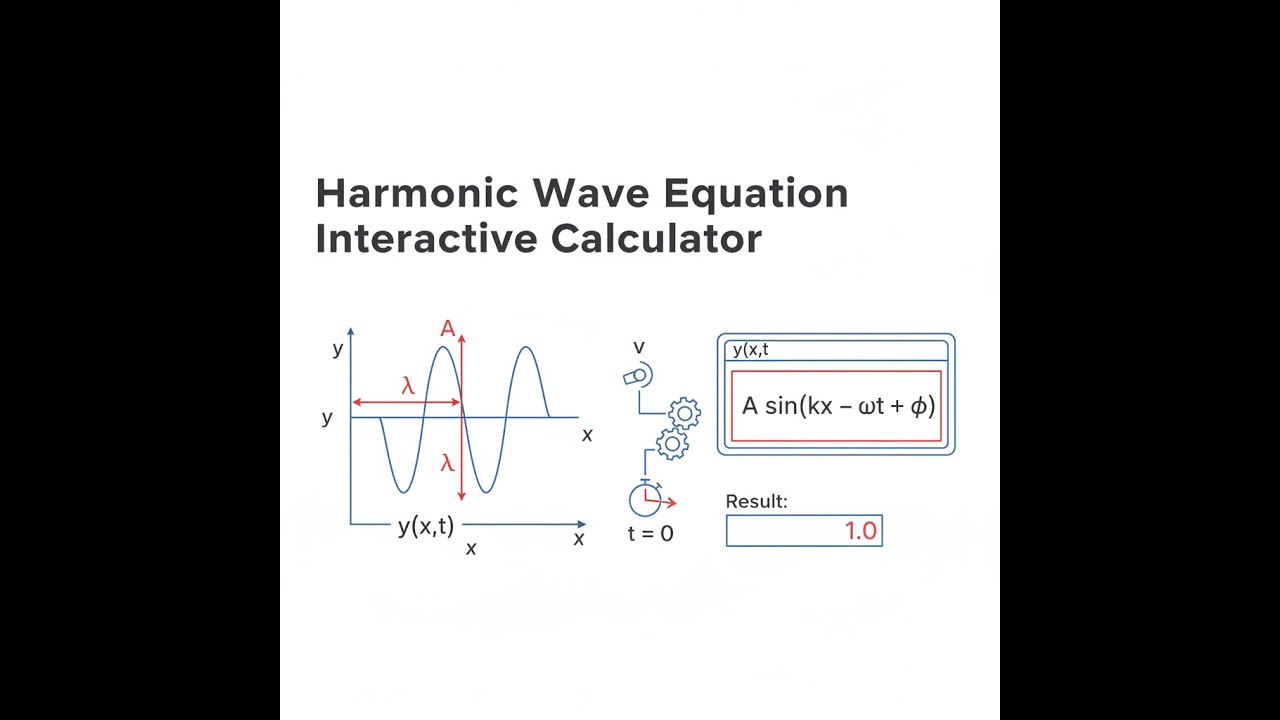
Wave Propagation Diagram

How to Use This Calculator
- Pick what you want to find: displacement, velocity, acceleration, wave speed, energy, or phase.
- Enter values for amplitude, wave number, angular frequency, position, time, and phase constant, as needed for the calculation.
- For wave speed calculations, you'll only need wavelength and frequency. For energy, you’ll use linear density, wave speed, angular frequency, and amplitude.
- Click Calculate to get your result.
Interactive Harmonic Wave Calculator
This calculator is intended for education, concept evaluation, and preliminary design. Results are based on the equations and assumptions described on this page, but cannot account for every real-world load case, tolerance, material property, environmental condition, installation detail, safety factor, code, or regulatory requirement. Verify all inputs, assumptions, units, and results independently before selecting components or using the result in a real application. Safety-critical, structural, medical, lifting, transportation, or regulated applications must be reviewed by a qualified engineer.
Questions about this calculator or found an error? Message our engineering team.
Harmonic Wave Equation Interactive Visualizer
Use this animation to see, in real time, how displacement, particle velocity, and phase relationships actually shift as you change amplitude, frequency, or wave speed. Small changes here let you directly observe how energy moves with the wave so there are no surprises in the physical setup.
DISPLACEMENT
0.00 m
PARTICLE VEL
0.00 m/s
WAVE SPEED
5.33 m/s
FIRGELLI Automations — Interactive Engineering Calculators
Harmonic Wave Equations
Here's the straightforward formula for finding displacement at any given spot and time.
General Wave Function
y(x, t) = A sin(kx - ωt + φ)
Where:
- y(x, t) = displacement at position x and time t (m)
- A = amplitude, maximum displacement from equilibrium (m)
- k = wave number = 2π/λ (rad/m)
- ω = angular frequency = 2πf (rad/s)
- φ = phase constant, determines initial conditions (rad)
- λ = wavelength (m)
- f = frequency (Hz)
To get wave speed from wavelength and frequency, use this:
Wave Speed Relation
v = λf = ω/k
Where:
- v = wave speed (m/s)
- T = period = 1/f (s)
If you need particle velocity or acceleration, go to the derivatives of the wave:
Particle Velocity and Acceleration
vparticle = ∂y/∂t = -Aω cos(kx - ωt + φ)
aparticle = ∂²y/∂²t = -Aω² sin(kx - ωt + φ) = -ω²y
Maximum Values:
- vmax = Aω (at y = 0)
- amax = Aω² (at y = ±A)
For energy density and transmitted power, here's the direct route:
Energy and Power
Energy Density: u = ½μω²A²
Power: P = ½μω²A²v
Where:
- u = energy per unit length (J/m)
- μ = linear mass density (kg/m)
- P = average power transmitted (W)
Simple Example
A wave with amplitude A = 0.05 m, wave number k = 2.0 rad/m, angular frequency ω = 10.0 rad/s, and phase constant φ = 0. At position x = 1.5 m, time t = 0.3 s:
Plug into the phase: Phase = kx − ωt + φ = (2.0 × 1.5) − (10.0 × 0.3) + 0 = 3.0 − 3.0 = 0 rad
Displacement y = A sin(0) = 0.05 × 0 = 0 m (crossing equilibrium at that instant).
Maximum particle velocity = Aω = 0.05 × 10.0 = 0.5 m/s.
Theory & Practical Applications
Physical Foundation of Harmonic Waves
The harmonic wave equation describes how sinusoidal disturbances move through a medium. It’s a direct solution to the one-dimensional wave equation you get from Newton’s laws when you model a stretched string or an elastic medium. The sign in (kx - ωt) tells you which way the wave moves (right if negative, left if positive). Wave number k sets the spatial spacing between peaks. Angular frequency ω tells you how quickly these oscillate in time. The speed v = ω/k isn’t based on the wave you impose but on the medium itself.
Don’t mix up particle velocity (vparticle) with wave speed (v). Particle velocity is about how fast a material point moves back and forth—this peaks at Aω right as displacement passes through zero. Wave speed, however, is set by things like tension and density (v = √(T/μ) for a string) and tells you how fast a pattern moves. People regularly get this confused when taking readings with vibration sensors. At high frequencies, particle velocity can be significant even if actual displacement is tiny. That matters in settings like earthquake monitoring, where particle velocity ties to loading, while wave speed affects how quickly waves hit different parts of a structure.
Phase Relationships and Interference
The phase constant φ fixes where the wave starts in time and space. φ = 0 means the wave is crossing equilibrium and heading positive when t = 0 and x = 0. φ = π/2, and you start at maximum positive displacement. When two waves line up but have different phase, add them and you get ytotal = A₁sin(kx - ωt + φ₁) + A₂sin(kx - ωt + φ₂). You can repackage that as a single wave with amplitude Aresultant = √(A₁² + A₂² + 2A₁A₂cos(Δφ)), where Δφ is the difference in phase constants. If the phases match (Δφ = 0, 2π, …), you get full constructive interference. At Δφ = π (or an odd multiple), it’s full destructive (you get |A₁ - A₂|).
Standing waves are just the combination of two equal-amplitude, opposite-direction waves. Mathematically, y = Asin(kx - ωt) + Asin(kx + ωt) = 2Asin(kx)cos(ωt), so you get nodes wherever sin(kx) = 0 (x = nλ/2), and antinodes midway between. This explains why only certain frequencies survive on a string or pipe of fixed length. You can see the same effect in microwave ovens, musical instruments, and even in how building acoustics cause some parts of a room to sound much louder than others.
Energy Transport and Dispersion
With harmonic waves, energy density goes up as the square of both frequency and amplitude (u = ½μω²A²). Double the frequency or amplitude, and you pump four times the energy through the medium. For strings and sound waves, the density μ (or, in three dimensions, ρ) controls the inertia. Transmitted power follows P = ½μω²A²v, so changing wave speed has a direct effect on energy transfer. That’s why steel cables shift vibration energy more efficiently than rubber ones—higher wave speed, greater transmitted power, even with similar amplitude.
Few real materials are perfectly non-dispersive. In dispersive systems, wave speed depends on frequency, which means different parts of a complex signal arrive at different times. You see this in ocean waves (where long waves outrun short ones), in optical fibers (where short and long wavelengths drift apart over distance), and even in vibration isolators. If you’re designing anything where timing of wave arrival matters, or where pulse stretching will hurt detection, you’ll need to consider real-world dispersion.
Industrial Applications
In ultrasonic non-destructive testing (NDT), harmonic waves in the 1-10 MHz range are a standard way to spot weld cracks or voids in metal or composite structures. You’re dealing with waves reflecting at interfaces where the acoustic impedance Z changes. Reflection strength depends on the ratio (Z₂ - Z₁)/(Z₂ + Z₁). Some features disappear completely if their thickness matches quarter-wavelength multiples due to destructive interference, so it’s routine practice to sweep frequencies during inspection. The phase of echoes also gives clues: reflections from air gaps (low Z) flip phase, while those from hard inclusions maintain phase. That helps differentiate defect types in a scan.
For machinery vibration, you must watch for resonance—a sharp amplitude spike when excitation frequency matches system natural frequency. If your rotor’s critical speed approaches input frequency, energy piles up fast unless you add sufficient damping. Counterweight positioning matters as much as mass in reducing vibrations, because if they're not phased right, you might make things worse. Active vibration suppression and anti-noise headphones both rely on adding a wave with exactly the right amplitude but 180° out of phase to cancel out the original. The basic principle works in large structures, audio, and precision instruments alike.
Worked Engineering Example: String Vibration Analysis
Problem: A steel piano wire (μ = 0.0078 kg/m, L = 1.24 m) is tensioned to 847 N. The second harmonic rings out with amplitude A = 2.3 mm at the antinode. Calculate: (a) fundamental and second harmonic frequency, (b) wave speed, (c) peak particle velocity at antinode, (d) peak particle acceleration, (e) average transmitted power, (f) phase difference between points 15.5 cm apart.
Solution:
(a) Frequencies: Wave speed: v = √(T/μ) = √(847 N / 0.0078 kg/m) ≈ 329.5 m/s
First harmonic: f₁ = v/(2L) = 329.5 / (2 × 1.24) ≈ 132.9 Hz
Second harmonic: f₂ = 2 × 132.9 = 265.8 Hz (middle C on the piano is close to this)
(b) Wave speed: Already found: v = 329.5 m/s. Doesn’t depend on frequency or amplitude, only on tension and density.
(c) Maximum particle velocity: ω = 2πf₂ = 2π × 265.8 ≈ 1,670.1 rad/s
Amplitude: A = 2.3 mm = 0.0023 m
Maximum vparticle: 0.0023 × 1,670.1 = 3.841 m/s
Notice how particle velocity (3.84 m/s) and wave speed (329.5 m/s) aren’t even close—one’s local, one’s how fast the pattern travels.
(d) Maximum acceleration: amax = 0.0023 × (1,670.1)² = 6,415.2 m/s² (about 654g). This helps explain why piano strings fatigue even when you barely see them move.
(e) Average power: Take just one travel direction: P = ½μω²A²v
P = 0.5 × 0.0078 × (1,670.1)² × (0.0023)² × 329.5 ≈ 18.93 W per direction
Total — just under 38 W in the string, which matches up with how fast the sound decays once you mute the sustain pedal.
(f) Phase difference: λ = v/f₂ = 329.5 / 265.8 ≈ 1.24 m
k = 2π/λ ≈ 5.067 rad/m
Δx = 0.155 m
Δφ = kΔx = 5.067 × 0.155 = 0.785 rad ≈ 45° difference
With a 45° phase gap, two identical waves would have a resultant amplitude multiplier of about 1.85 if superimposed (cos(45°) = 0.707). This all goes to show how changes to system setup ripple through every parameter, from wave speed to phase.
Frequently Asked Questions
Free Engineering Calculators
Explore our complete library of free engineering and physics calculators.
Browse All Calculators →🔗 Explore More Free Engineering Calculators
About the Author
Robbie Dickson — Chief Engineer & Founder, FIRGELLI Automations
Robbie Dickson brings over two decades of engineering expertise to FIRGELLI Automations. With a distinguished career at Rolls-Royce, BMW, and Ford, he has deep expertise in mechanical systems, actuator technology, and precision engineering.
Video Walkthrough - How to Use This Calculator
Need to implement these calculations?
Explore the precision-engineered motion control solutions used by top engineers.


