If you choose the wrong eyepiece, your telescope can give you blurry or dim images. If you push magnification beyond what the optics can handle (the diffraction limit), you only make a bigger blur. This Telescope Magnification Calculator helps you work out magnification, exit pupil, the useful magnification range, and theoretical resolving power based on the focal lengths, aperture, and wavelength you use. Getting these numbers right is important—otherwise you can end up with wasted aperture or reduced image contrast, whether you're looking at the sky, distant wildlife, or inspecting precision optics. Below, I cover the formulas, a step-by-step example using different setups, some plain-English background, and a detailed FAQ.
What is telescope magnification?
Telescope magnification is the ratio of how large an object appears through the telescope compared to how it looks with the naked eye. A magnification of 100× means the object appears 100 times larger in angular size than it does without any optics.
Simple Explanation
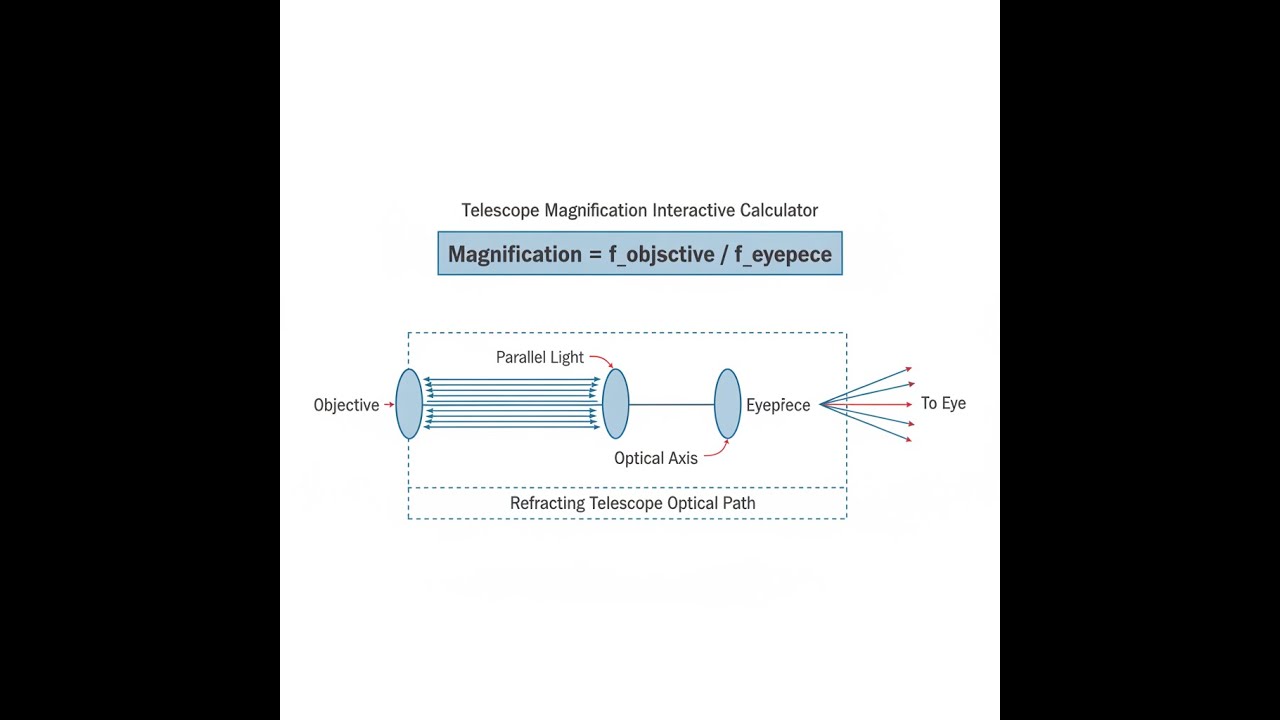
Think of a telescope as a two-step zoom system. The objective lens (or mirror) at the front gathers light and creates a small, sharp image inside the tube — like a projector shrinking a scene onto a screen. The eyepiece then acts like a magnifying glass, enlarging that internal image so your eye can see it big. The longer the objective's focal length relative to the eyepiece's focal length, the more it zooms in.
📐 Browse all 1000+ Interactive Calculators
Optical Diagram

How to Use This Calculator
- Select your calculation mode from the dropdown — magnification, objective focal length, eyepiece focal length, exit pupil, optimal magnification range, or resolving power.
- Enter the required input values for your chosen mode — objective focal length, eyepiece focal length, aperture diameter, wavelength, and/or eye pupil diameter as prompted.
- Review the visible input fields to confirm you have entered all required values in the correct units (mm or nm as labeled).
- Click Calculate to see your result.
Interactive Telescope Magnification Calculator
This calculator is intended for education, concept evaluation, and preliminary design. Results are based on the equations and assumptions described on this page, but cannot account for every real-world load case, tolerance, material property, environmental condition, installation detail, safety factor, code, or regulatory requirement. Verify all inputs, assumptions, units, and results independently before selecting components or using the result in a real application. Safety-critical, structural, medical, lifting, transportation, or regulated applications must be reviewed by a qualified engineer.
Questions about this calculator or found an error? Message our engineering team.
Telescope Magnification Interactive Calculator
Visualize how objective focal length and eyepiece focal length determine magnification, exit pupil diameter, and optical performance. Adjust parameters to see real-time calculations for optimal astronomical observation setup.
MAGNIFICATION
50×
EXIT PUPIL
3.0 mm
F-RATIO
f/6.7
FIRGELLI Automations — Interactive Engineering Calculators
Governing Equations
Use the formula below to calculate telescope magnification.
Basic Magnification
M = fobj / feye
M = Angular magnification (dimensionless)
fobj = Objective focal length (mm)
feye = Eyepiece focal length (mm)
Exit Pupil Diameter
dexit = D / M = (D × feye) / fobj
dexit = Exit pupil diameter (mm)
D = Objective aperture diameter (mm)
M = Magnification
Rayleigh Resolution Criterion
θ = 1.22 λ / D
θ = Minimum resolvable angle (radians)
λ = Wavelength of light (meters)
D = Objective aperture diameter (meters)
For λ = 550 nm (green light): θ(arcsec) ≈ 138 / D(mm)
F-ratio and Optimal Magnification Range
f/# = fobj / D
Mmin = D / dpupil Mmax ≈ 2.5D
f/# = F-ratio (focal ratio)
dpupil = Observer's dark-adapted pupil diameter (typically 5-7 mm)
Mmax = Practical maximum magnification (per mm of aperture)
Simple Example
Objective focal length: 1000 mm. Eyepiece focal length: 10 mm.
M = 1000 / 10 = 100×
With a 100 mm aperture: exit pupil = 100 / 100 = 1.0 mm
Optimal minimum magnification (7 mm pupil): 100 / 7 = 14×
Theory and Practical Applications of Telescope Magnification
Telescope magnification represents the angular enlargement of celestial or terrestrial objects as viewed through the optical system. Unlike simple lens magnifiers, telescopes form real images at infinity focus, making the fundamental relationship M = fobj / feye applicable across all astronomical telescope designs—refractors, reflectors, and catadioptrics. This ratio determines not only image scale but also constrains field of view, brightness per unit solid angle, and the effective resolution observable under real-world atmospheric conditions.
Optical Principles and Keplerian Configuration
The Keplerian telescope, consisting of two converging lenses separated by the sum of their focal lengths, produces an inverted image with angular magnification given by the focal length ratio. Parallel rays from a distant object converge at the objective's focal plane, where the real image serves as the object for the eyepiece positioned one focal length away. The eyepiece re-collimates these rays, creating virtual images at infinity that the relaxed eye can view comfortably.
The critical non-obvious consequence: magnification alone says nothing about light-gathering power, which depends exclusively on objective aperture area. A 50× magnification through a 50mm aperture delivers far dimmer extended-object images than 50× through a 200mm aperture, despite identical angular enlargement. Atmospheric extinction and light pollution further complicate the relationship between magnification and practical visibility.
Exit Pupil Matching and Light Transmission Efficiency
The exit pupil diameter dexit = D/M must match the observer's physiological pupil diameter to maximize light transmission efficiency. A dark-adapted human pupil dilates to approximately 7mm at age 20, declining to 5-6mm by age 50, and further to 4-5mm beyond age 60. When dexit exceeds pupil diameter, peripheral light fails to enter the eye—wasted aperture. Conversely, when dexit falls below 0.5mm, diffraction at the exit pupil itself begins to degrade resolution, and brightness per unit area drops precipitously.
The optimal minimum magnification Mmin = D/dpupil ensures full utilization of collected light. For a 150mm telescope and 6mm pupil, Mmin = 25×. Operating significantly below this wastes aperture; operating vastly above encounters the maximum useful magnification limit imposed by diffraction and seeing.
Dawes Limit, Rayleigh Criterion, and Maximum Useful Magnification
Diffraction fundamentally limits angular resolution according to the Rayleigh criterion: θ = 1.22λ/D. For λ = 550nm (peak photopic sensitivity), a 100mm aperture achieves θ = 1.38 arcseconds. The empirically-derived Dawes limit for binary star separation is slightly tighter: 116/D(mm) arcseconds. However, atmospheric turbulence typically dominates ground-based resolution, with median seeing conditions ranging from 1-3 arcseconds at good sites to 5+ arcseconds in urban environments.
Magnifying beyond the point where diffraction disk diameter becomes resolvable to the human eye (approximately 1 arcminute resolution threshold) produces "empty magnification"—larger but no sharper images. The practical maximum Mmax ≈ 2.5D (in mm) represents the magnification where the Airy disk angular size reaches ~1 arcminute, assuming perfect optics and average seeing. For a 200mm telescope, Mmax = 500×, though 300-400× is more realistic for sustained planetary observation.
Field of View Relationships and Apparent Field
True field of view (TFOV) decreases inversely with magnification: TFOV = AFOV / M, where AFOV is the eyepiece's apparent field of view (typically 45-65° for Plössl designs, 68-82° for wide-field designs, and up to 100-110° for premium ultra-wide eyepieces). A 20mm eyepiece with 60° AFOV on a 1200mm focal length telescope (M = 60×) yields TFOV = 1°, sufficient to frame the full Moon. At 240× (5mm eyepiece), TFOV shrinks to 0.25°, isolating lunar craters but excluding context.
Survey and comet-hunting applications demand low magnification and wide fields; planetary detail extraction requires high magnification and narrow fields. The physical stop diameter of eyepiece field lenses sets the maximum AFOV before vignetting occurs, creating engineering tradeoffs between field width, eye relief, and optical aberration correction.
Industrial and Scientific Applications Beyond Astronomy
Terrestrial spotting scopes employ the same magnification principles but typically incorporate erecting prism systems (Porro, roof, or Abbe-König configurations) to correct image inversion. Surveying theodolites and alidades use fixed magnifications (20-30×) optimized for angular measurement precision over wide magnification ranges. Rifle scopes balance magnification (3-9× typical for hunting, 10-50× for long-range precision shooting) against exit pupil requirements under varying light conditions—dawn/dusk hunting demands larger exit pupils (4-5mm) necessitating lower magnifications.
Microscope magnification follows similar M = fobjective / feyepiece relationships but with tube length corrections and finite conjugate imagery. Automated inspection systems in semiconductor manufacturing use telecentric objectives with fixed magnifications and extremely high numerical apertures to ensure orthographic projection across the entire depth of field, critical for defect detection on patterned wafers.
Chromatic and Spherical Aberration Impacts
High magnifications amplify residual optical aberrations. Achromatic doublets (crown + flint glass) correct primary chromatic aberration (red and blue wavelengths converge at common focus) but leave secondary spectrum—visible as purple halos around high-contrast objects like lunar limbs and Jupiter at magnifications above 150×. Apochromatic triplets using ED (extra-low dispersion) or fluorite elements push correction limits, enabling magnifications to 300× before false color becomes objectionable.
Spherical aberration from Newtonian primaries below f/6 becomes apparent at planetary magnifications, necessitating coma correctors. Cassegrain and Schmidt-Cassegrain designs fold the optical path, achieving long focal lengths (f/10-f/15) in compact tubes, inherently supporting higher magnifications with better aberration control. Adaptive optics systems on large research telescopes compensate for atmospheric wavefront distortion in real-time, allowing diffraction-limited performance at magnifications impossible for amateur instruments.
Fully Worked Example: Multi-Configuration Telescope System
Consider a commercial Schmidt-Cassegrain telescope with the following specifications:
- Objective aperture diameter D = 203mm (8 inches)
- Objective focal length fobj = 2032mm (f/10 system)
- Available eyepieces: 40mm (AFOV 68°), 25mm (AFOV 52°), 10mm (AFOV 52°), 5mm (AFOV 40°)
- 2× Barlow lens available for focal length doubling
- Observer age 45 (dark-adapted pupil ≈ 6mm)
- Observing site median seeing: 2.3 arcseconds
Part A: Calculate magnification and exit pupil for each eyepiece without Barlow
For 40mm eyepiece:
M = fobj / feye = 2032mm / 40mm = 50.8×
dexit = D / M = 203mm / 50.8 = 4.0mm
TFOV = AFOV / M = 68° / 50.8 = 1.34°
For 25mm eyepiece:
M = 2032 / 25 = 81.3×
dexit = 203 / 81.3 = 2.5mm
TFOV = 52° / 81.3 = 0.64°
For 10mm eyepiece:
M = 2032 / 10 = 203×
dexit = 203 / 203 = 1.0mm
TFOV = 52° / 203 = 0.26°
For 5mm eyepiece:
M = 2032 / 5 = 406×
dexit = 203 / 406 = 0.5mm
TFOV = 40° / 406 = 0.10°
Part B: Determine optimal magnification range for this telescope
Minimum useful magnification (exit pupil = observer's pupil):
Mmin = D / dpupil = 203mm / 6mm = 33.8×
The 40mm eyepiece at 50.8× exceeds Mmin, but an ideal low-power eyepiece would be approximately 60mm focal length (M = 33.9×, exit pupil = 6.0mm).
Maximum useful magnification (empirical limit):
Mmax = 2.5 × D = 2.5 × 203 = 507×
The 5mm eyepiece at 406× approaches this limit. With 2× Barlow, effective focal length becomes 2.5mm, yielding M = 813×—well into empty magnification territory where atmospheric seeing (2.3 arcsec) vastly exceeds diffraction limit.
Part C: Calculate Rayleigh resolution and compare to magnified seeing disk
Rayleigh criterion at λ = 550nm:
θRayleigh = 1.22λ / D = (1.22 × 550 × 10-9m) / 0.203m
θRayleigh = 3.31 × 10⁻⁶ radians = 3.31 × 10-6 × (180/π) × 3600 arcsec/degree
θRayleigh = 0.68 arcseconds
Atmospheric seeing limits resolution to 2.3 arcsec. At M = 203×, the seeing disk subtends:
Angular size = 2.3 arcsec × 203 = 467 arcseconds = 0.13°
This exceeds the 1 arcminute (60 arcsec) resolution threshold of the human eye. At M = 138×, the seeing disk would subtend 60 arcsec—the threshold where additional magnification yields empty magnification. For this telescope under median local seeing, optimal planetary magnification is approximately 140-180×, corresponding to eyepieces in the 11-15mm range.
Part D: Configuration recommendations for specific targets
Deep-sky nebulae and open clusters (maximize exit pupil):
Use 40mm eyepiece (M = 51×, exit pupil = 4mm, TFOV = 1.34°). The large true field frames extended objects like M42 Orion Nebula (1° extent) while maintaining sufficient exit pupil for faint detail visibility.
Lunar observation (balance detail and context):
Use 25mm eyepiece (M = 81×). Exit pupil of 2.5mm remains comfortable, TFOV of 0.64° allows viewing entire lunar disk (0.52° average apparent diameter) with margin, and magnification reveals craters down to ~4km diameter.
Planetary detail (Jupiter's Great Red Spot, Saturn's Cassini Division):
Use 10mm eyepiece (M = 203×). Exit pupil of 1mm borders on uncomfortable but remains practical for short observing sessions. Magnification reveals detail at the atmospheric seeing limit. On nights of exceptional seeing (below 1.5 arcsec), the 5mm + 2× Barlow combination (M = 813×) would show no additional detail—purely empty magnification.
This comprehensive example demonstrates how magnification selection depends on target type, aperture, seeing conditions, and observer physiology—not a single "best" magnification value.
Barlow Lenses and Focal Reducers
Barlow lenses are negative achromatic doublets inserted between objective and eyepiece, effectively multiplying the objective's focal length by the Barlow's power factor (typically 2×, 2.5×, or 3×). A 2× Barlow converts a 1200mm telescope to effective 2400mm focal length, doubling all magnifications without changing eyepieces. However, Barlows increase optical path length, potentially introducing aberrations in fast systems (below f/6) and incompatibility with some eyepiece designs due to insufficient back focus.
Conversely, focal reducers (0.63× or 0.5× multipliers) decrease effective focal length, lowering magnifications and widening fields—valuable for deep-sky astrophotography where fast focal ratios (f/3-f/5) reduce exposure times. Telecentric focal reducers maintain collimation and minimize field curvature across large imaging sensors, critical for professional survey instruments.
Frequently Asked Questions
Free Engineering Calculators
Explore our complete library of free engineering and physics calculators.
Browse All Calculators →🔗 Explore More Free Engineering Calculators
About the Author
Robbie Dickson — Chief Engineer & Founder, FIRGELLI Automations
Robbie Dickson brings over two decades of engineering expertise to FIRGELLI Automations. With a distinguished career at Rolls-Royce, BMW, and Ford, he has deep expertise in mechanical systems, actuator technology, and precision engineering.
Video Walkthrough - How to Use This Calculator
Need to implement these calculations?
Explore the precision-engineered motion control solutions used by top engineers.


