Understanding Emergency Ventilator Needs During Crisis Situations
The COVID-19 pandemic exposed a critical vulnerability in global healthcare infrastructure: the severe shortage of mechanical ventilators. During peak outbreak periods, hospitals worldwide faced impossible decisions as ventilator availability fell far short of patient needs. Professional medical ventilators cost between $25,000 and $50,000 per unit, with manufacturing lead times measured in months, not days. This reality forced engineers, makers, and medical professionals to explore alternative solutions for emergency respiratory support.
🎥 Video — Homemade Ventilator
The concept of a homemade ventilator may seem radical, but history shows it's not without precedent. In one remarkable case documented in Chinese media, a father kept his son alive for five years using a self-built ventilator when commercial options were unavailable. While such stories are exceptional, they demonstrate that fundamental respiratory assistance can be provided through simplified mechanical means when conventional medical equipment is inaccessible.
Legal Disclaimer: The information provided here is for educational purposes only. FIRGELLI Automations does not accept any responsibility for devices built using this information. Any homemade medical device should only be considered in extreme circumstances where professional medical equipment is completely unavailable. This content is published as a reference for emergency situations, not as a replacement for professional medical equipment or care.

How Mechanical Ventilators Work: Core Principles
A mechanical ventilator performs a deceptively simple function: it moves air into and out of a patient's lungs in a controlled, rhythmic pattern that mimics natural breathing. When a patient suffers from respiratory failure due to conditions like severe pneumonia, acute respiratory distress syndrome (ARDS), or other pulmonary complications, their respiratory muscles cannot generate sufficient pressure to inflate the lungs adequately. The ventilator takes over this mechanical work.
Professional medical ventilators are sophisticated devices with multiple operational modes, pressure sensors, volume monitoring, oxygen concentration control, and alarm systems. However, at the most fundamental level, they accomplish their primary function through positive pressure ventilation: pushing air into the lungs during inspiration, then allowing the lungs' natural elasticity to expel air during expiration.
Bag Valve Mask (BVM) Fundamentals
The bag valve mask, also known as an Ambu bag, represents the simplest form of mechanical ventilation. Used routinely in emergency medicine, these devices consist of a self-expanding bag, one-way valves, and a face mask or endotracheal tube adapter. When the bag is compressed manually, air flows through a one-way valve into the patient's airway. When released, the bag re-expands by drawing in ambient air (or supplemental oxygen if connected), while exhaled air exits through a separate one-way valve.
A trained medical professional can manually operate a BVM for extended periods, but maintaining consistent tidal volumes, respiratory rates, and pressure limits becomes increasingly difficult over time. Hand fatigue sets in within 15-20 minutes, and maintaining the precise 12-20 breaths per minute required for adult patients becomes challenging. This is where automation becomes valuable.
Using Linear Actuators for Automated BVM Compression
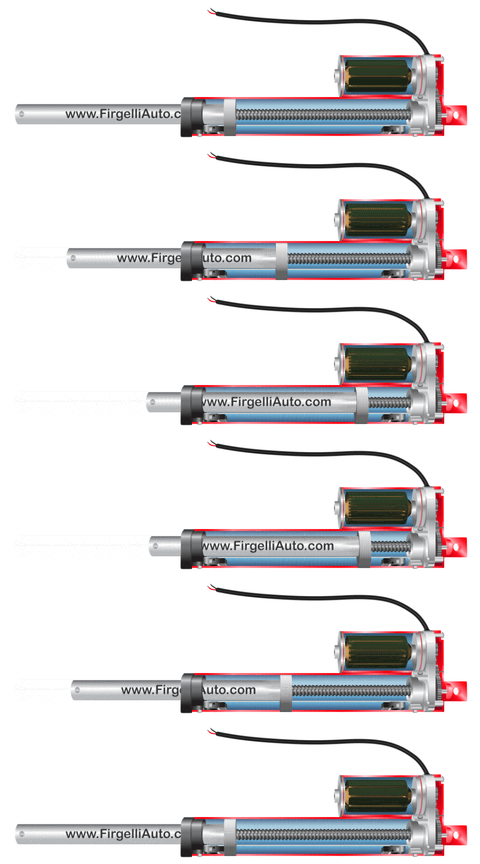
The fundamental concept behind an actuator-driven ventilator is straightforward: replace the human hand with an electric linear actuator that compresses the BVM bag with consistent force, timing, and frequency. A linear actuator converts rotary motion from an electric motor into linear pushing or pulling force, making it ideal for this repetitive compression application.
Selecting the Right Linear Actuator
For BVM compression, the actuator must meet several specific requirements. A 4-inch stroke length provides adequate travel distance to fully compress a standard adult BVM bag. The actuator should deliver between 50-150 pounds of force, sufficient to achieve the necessary bag compression without excessive mechanical stress on the system. Most importantly, the actuator must be rated for continuous duty cycle operation, as ventilator support may be required for hours or days without interruption.
FIRGELLI's Premium linear actuators are engineered for 100% duty cycle operation, meaning they can run continuously without overheating or mechanical failure. This distinguishes them from lower-cost actuators designed for intermittent use in applications like TV lifts or cabinet doors. The actuators operate on 12V DC power, which can be supplied by standard power supplies or backup battery systems.
Building the Mechanical Framework
The physical setup requires a rigid enclosure that holds both the BVM bag and the linear actuator in precise alignment. The enclosure should be constructed from plywood, MDF, or metal with the following considerations:
- The BVM bag must be securely positioned so it cannot shift during compression cycles
- The actuator mounting point must be rigid enough to prevent flexing under load
- A compression plate attached to the actuator rod should distribute force evenly across the bag surface
- The enclosure must allow access to the bag's oxygen input port and patient connection port
- Adequate spacing must ensure the bag can fully re-expand during the extension stroke
Proper mounting brackets are essential for securing the actuator to the enclosure frame. The alignment between the actuator's travel path and the center of the BVM bag determines compression efficiency and prevents uneven wear on the bag material.
Electronic Control System Design
The electronic control system governs the actuator's movement patterns, determining respiratory rate, inspiration-to-expiration ratio, and compression depth. While simple timer circuits could provide basic on-off control, a microcontroller-based system offers far greater flexibility and the potential for feedback-based adjustments.
Arduino-Based Control Implementation
An Arduino microcontroller board provides an accessible platform for controlling the actuator's motor driver circuit. The Arduino can be programmed to generate pulse-width modulation (PWM) signals that control actuator speed, direction, and position. For basic ventilator operation, the control algorithm must:
- Drive the actuator forward at a controlled speed to compress the bag over 1-2 seconds (inspiration phase)
- Hold briefly at full compression to ensure complete lung inflation
- Retract the actuator to allow bag re-expansion and passive exhalation over 2-3 seconds
- Pause briefly before the next cycle begins
- Repeat this cycle 12-20 times per minute for adult patients
The Arduino code must calculate appropriate timing based on desired respiratory rate and inspiration-to-expiration (I:E) ratio, typically 1:2 or 1:3 for most patients. For example, at 15 breaths per minute with a 1:2 I:E ratio, each complete cycle takes 4 seconds: 1.33 seconds for inspiration and 2.67 seconds for expiration.
Motor Driver Circuit Requirements
The Arduino cannot directly power a 12V linear actuator; it requires a motor driver circuit capable of handling the actuator's current draw. An H-bridge motor driver module rated for at least 5 amps continuous current provides bidirectional control. The driver receives PWM signals from the Arduino's digital output pins and translates them into the higher current needed to drive the actuator motor.
Proper wiring includes flyback diodes to protect against voltage spikes during motor direction changes, adequate gauge wire to handle current without voltage drop, and fuses for overcurrent protection. The entire system should be powered by a regulated power supply capable of delivering at least 3-5 amps at 12V DC.
Implementing Pressure Feedback Systems
Professional ventilators continuously monitor airway pressure to ensure safe and effective ventilation. Excessive pressure can cause barotrauma (pressure-induced lung injury), while insufficient pressure results in inadequate ventilation. Adding pressure monitoring elevates a basic automated BVM system toward more sophisticated functionality.

Pressure Sensor Selection and Integration
Medical-grade pressure sensors designed for respiratory applications provide analog output proportional to measured airway pressure. These sensors typically measure pressure in the range of 0-100 cm H₂O, which covers normal ventilation pressures. The sensor mounts inline between the BVM bag and the patient interface, measuring pressure in real-time throughout the respiratory cycle.
The sensor's analog output connects to the Arduino's analog input pin, where it's converted to a digital value representing pressure. By monitoring this pressure throughout the compression and release cycle, the controller can detect several important conditions:
- Peak inspiratory pressure (PIP) during maximum compression
- Plateau pressure after the initial compression phase
- Positive end-expiratory pressure (PEEP) at the end of exhalation
- Pressure-volume curves that indicate lung compliance
Adaptive Control Based on Pressure Feedback
With pressure sensing implemented, the control system can operate in pressure-controlled mode rather than simple volume-controlled mode. In this configuration, the Arduino adjusts actuator compression depth and speed to achieve target pressure values rather than simply moving through a fixed stroke length.
For example, if the target peak pressure is 20 cm H₂O but the sensor reads 25 cm H₂O, the controller can reduce the compression depth on subsequent breaths until the target is achieved. This adaptive behavior provides a significant safety improvement over fixed-stroke operation, though it increases system complexity.
Implementing such feedback control requires feedback actuators that include internal position sensors, allowing the Arduino to know the precise actuator position at all times. This position data, combined with pressure measurements, enables closed-loop control algorithms that continuously optimize ventilation parameters.
Required Components and Assembly Guide
Building an actuator-driven BVM compression system requires the following core components:
Essential Component List
- Bag Valve Mask: Adult-size BVM with oxygen reservoir and standard patient connection port. These are readily available from medical supply vendors for $30-50.
- Linear Actuator: 4-inch stroke, 12V DC, 100 lbs force minimum, rated for continuous duty. A premium linear actuator designed for extended operation is essential.
- Arduino Board: Arduino Uno or similar microcontroller with sufficient I/O pins for motor control and sensor inputs.
- Motor Driver: H-bridge driver module rated for 5A continuous current, compatible with Arduino logic levels.
- Power Supply: 12V DC power supply rated for at least 5A output capacity.
- Mounting Hardware: Appropriate mounting brackets, bolts, and rigid compression plate.
- Enclosure Materials: Plywood, MDF, or aluminum framing to create rigid mounting structure.
Optional Advanced Components
- Pressure Sensor: Medical-grade respiratory pressure transducer with analog output.
- Display Module: LCD or OLED display to show current settings and pressure readings.
- Control Interface: Potentiometers or rotary encoders to adjust respiratory rate and pressure limits.
- Alarm System: Audio buzzer and LED indicators for pressure limit violations or system faults.
- Battery Backup: Sealed lead-acid or lithium battery system for power failure protection.
Step-by-Step Assembly Process
Begin by constructing the rigid enclosure that will house the BVM bag. The enclosure should secure the bag firmly while allowing the actuator to compress it along its central axis. Mount the linear actuator to one end of the enclosure using appropriate brackets, ensuring the mounting points are rigid enough to prevent flexing under load.
Attach a compression plate to the actuator's extending rod. This plate should be slightly smaller than the BVM bag's compressible area and constructed from rigid material like polycarbonate or aluminum. The plate distributes compression force evenly and prevents point loading on the bag material.
Wire the motor driver to the Arduino following the specific driver's pinout diagram. Typically, this involves connecting direction and PWM speed control pins from Arduino digital outputs to the driver inputs, along with common ground connections. Connect the actuator's motor leads to the driver's output terminals, observing polarity for proper extension/retraction direction.
If implementing pressure sensing, mount the pressure sensor inline between the BVM bag and patient connection port. Run the sensor's signal wire to an Arduino analog input pin and provide the sensor with its required supply voltage, usually 5V from the Arduino's regulated output.
Programming and Operational Considerations
The Arduino code must implement precise timing control to achieve appropriate respiratory rates and breathing patterns. A basic control program should include adjustable parameters for respiratory rate (breaths per minute), inspiration time, and expiration time. These parameters can be hardcoded initially and later made adjustable through physical controls or serial interface.
Critical Safety Considerations
Any device that interfaces directly with a patient's airway carries inherent risks. Professional medical ventilators include multiple redundant safety systems that are extremely difficult to replicate in a DIY system. Critical safety concerns include:
- Excessive Pressure: Over-pressurization can cause pneumothorax (collapsed lung) or other barotrauma. Maximum pressure should be limited to 30-40 cm H₂O.
- Inadequate Ventilation: Insufficient tidal volume leads to hypoxemia (low blood oxygen) and hypercapnia (CO₂ retention).
- Mechanical Failure: Any component failure could immediately endanger the patient. Backup systems and alarms are essential.
- Infection Risk: All components contacting the airway must be sterile or designed for single-use.
- Power Failure: Ventilation must continue during power outages, requiring battery backup systems.
For these reasons, any homemade ventilator system should only be considered as an absolute last resort when professional medical equipment is completely unavailable and the alternative is no respiratory support whatsoever.
Comparing DIY Systems to Professional Medical Ventilators
Understanding the gap between a DIY automated BVM system and a professional medical ventilator is crucial. Professional ventilators include sophisticated features that are challenging or impossible to replicate without specialized components and engineering expertise:
Features of Professional Medical Ventilators
Modern medical ventilators provide multiple ventilation modes including assist-control ventilation, synchronized intermittent mandatory ventilation (SIMV), pressure support ventilation, and adaptive modes that respond to patient effort. They continuously monitor flow, volume, and pressure with medical-grade sensors accurate to within 1-2%. Alarm systems detect dozens of potential fault conditions, from disconnection to circuit occlusion to apnea.
Oxygen blenders precisely control FiO₂ (fraction of inspired oxygen) from 21% (room air) to 100% pure oxygen. Humidification systems prevent airway drying during prolonged ventilation. Professional devices undergo rigorous testing and certification under medical device regulations, including FDA approval in the United States and CE marking in Europe.
Limitations of DIY Automated BVM Systems
A DIY system based on actuator-driven BVM compression cannot match this sophistication. It provides fixed-volume, time-cycled ventilation without adaptation to patient effort. Pressure monitoring, if implemented, relies on non-certified sensors without medical-grade accuracy. The system lacks comprehensive alarm functions, oxygen blending, and humidification. Most critically, it has not undergone safety testing or regulatory approval.
These limitations mean a DIY system should only ever be considered when the alternative is complete absence of ventilatory support—a situation that should drive every effort toward accessing professional medical care instead.
Frequently Asked Questions
Is it legal to build and use a homemade ventilator?
The legality varies by jurisdiction, but in most regions, building such a device is not explicitly illegal. However, using it on another person could raise significant legal and medical liability issues. Medical devices are heavily regulated, and homemade devices have not undergone safety testing or regulatory approval. This information is provided for educational purposes and extreme emergency scenarios only, not as a recommendation to build or use such equipment.
Why use a linear actuator instead of other mechanical systems?
Linear actuators offer several advantages for automated BVM compression: precise control over speed and position, ability to operate continuously without fatigue, compatibility with microcontroller-based control systems, and availability of feedback actuators that report position. Alternative systems like pneumatic cylinders require compressed air sources, while motor-driven cam systems are more complex to build and calibrate. The actuator's linear motion directly matches the compression movement needed for BVM operation.
How much would it cost to build this system?
A basic system using readily available components would cost approximately $200-400, including the BVM bag ($30-50), linear actuator ($100-200), Arduino board ($20-30), motor driver ($15-25), power supply ($20-30), and construction materials ($20-50). Adding pressure sensing, displays, and alarm systems would increase costs to $400-600. This is significantly less than the $25,000-50,000 cost of professional medical ventilators, but the DIY system lacks their safety features, reliability, and clinical capabilities.
What respiratory rate and settings should be used for ventilation?
Normal adult respiratory rates range from 12-20 breaths per minute. Tidal volume (the amount of air per breath) should be approximately 6-8 mL per kilogram of body weight, or roughly 400-600 mL for an average adult. The inspiration-to-expiration ratio is typically 1:2 or 1:3, meaning expiration takes 2-3 times longer than inspiration. Peak airway pressures should generally not exceed 30-40 cm H₂O to avoid lung injury. However, appropriate ventilator settings vary significantly based on the patient's specific condition and should only be determined by qualified medical professionals.
Can a linear actuator-based system run continuously for extended periods?
High-quality linear actuators designed for industrial applications can operate at 100% duty cycle, meaning they can run continuously without overheating or mechanical failure. However, other components also require consideration: the BVM bag may degrade after extended compression cycles, the motor driver must be adequately heat-sinked, and the power supply must be rated for continuous operation. A backup power system using batteries is essential to maintain operation during power failures, as interruption of ventilation can be immediately life-threatening.
What maintenance would this system require?
Regular inspection of all mechanical connections, actuator mounting points, and electrical connections is essential. The BVM bag should be examined for wear, tears, or valve degradation and replaced as needed. Actuator operation should be verified for smooth movement without binding or unusual noise. If pressure sensing is implemented, sensor calibration should be checked regularly. All patient-contact components must be cleaned and sterilized according to medical standards. Battery backup systems require periodic testing and eventual battery replacement. Given the critical nature of ventilation, redundant backup systems should be available immediately.
What alternatives exist to building a homemade ventilator?
Before considering any DIY respiratory support system, all conventional options should be exhausted. This includes coordinating with hospitals and emergency services to access professional ventilators, exploring medical equipment rental services, contacting medical device manufacturers about emergency availability, and investigating transport to facilities with available equipment. Some regions established temporary field hospitals during the pandemic specifically to expand ventilator capacity. Non-invasive ventilation methods like BiPAP or CPAP machines may be appropriate for some patients and are more readily available. A DIY system should only be contemplated as an absolute last resort when no other option exists.


