What Is Duty Cycle in a Linear Actuator?
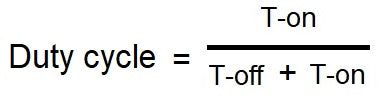
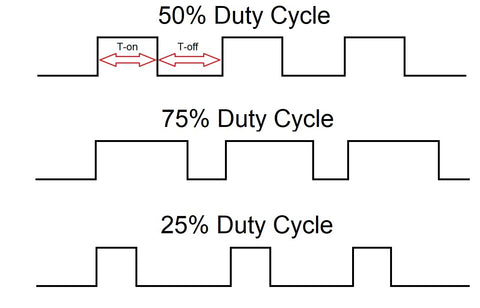
The duty cycle of a linear actuator is the ratio of running time to total cycle time, expressed as a percentage. Put simply, it is the ratio of Time "On" to Time "Off".
Duty cycle is a thermal limit. Every electric motor generates heat when it runs. If the motor generates heat faster than it can dissipate it, the internal components overheat and fail. The duty cycle is the manufacturer's specification for how long the unit can operate continuously before it must rest and cool down.
For example: a linear actuator with a 75% duty cycle would operate for 45 seconds and then require 15 seconds of rest. The unit spends 75% of its time running and 25% resting. A 25% duty cycle means 1 minute of operation followed by 3 minutes of rest.
Duty cycles for linear actuators typically range from 10% to 75% and are heavily dependent on the load applied to the actuator. The higher the load, the more current the motor draws, the more heat it generates, and the lower the duty cycle must be.
How to Calculate Duty Cycle
The formula for duty cycle (D) is the on-time divided by the total cycle time (on-time plus off-time):
Using the 75% example:
- Ton (Running Time): 45 seconds
- Toff (Rest Time): 15 seconds
To reverse the calculation and find run time from a known duty cycle, multiply the duty cycle percentage by the total cycle period. For a 25% duty cycle over a 5-minute (300-second) window: 0.25 × 300 = 75 seconds of run time, with 225 seconds of rest.
Why Duty Cycle Matters: The Physics of Motor Failure
Duty cycle is not a suggestion — it is a physical limit determined by the motor's ability to dissipate heat. When electricity passes through the DC motor of a linear actuator, it encounters electrical resistance in the copper windings. This resistance converts electrical energy into heat, known as I²R losses (heat is proportional to the square of the current multiplied by the resistance).
If the actuator runs continuously without rest, this heat builds up inside the sealed housing. When the internal temperature exceeds the rating of the winding insulation (typically Class F at 155°C or Class H at 180°C), the insulation breaks down, causing a short circuit and permanent motor failure.
The three standard failure modes from exceeding duty cycle are:
- Insulation Breakdown: The varnish coating on the copper wires melts, causing adjacent windings to short-circuit. This is the most common failure mode and is irreversible.
- Brush Failure: The carbon brushes that conduct electricity to the spinning commutator overheat, losing structural integrity and contact. The motor loses power or stops entirely.
- Magnet Demagnetization: Excessive heat permanently weakens the permanent magnets inside the motor, reducing torque output even after the motor cools down. The actuator becomes progressively weaker.
The "5-Minute Rule"
Duty cycle is always calculated over a specific time period. For FIRGELLI actuators, we use an assumed 5-minute continuous cycle as the reference window.
This is an important distinction. A 25% duty cycle does not mean you can run the actuator for 2 hours and then rest for 6 hours. It means that within any 5-minute window, the actuator can run for 1.25 minutes (75 seconds) and must rest for the remaining 3.75 minutes (225 seconds).
| Duty Cycle | Run Time (per 5 min) | Rest Time (per 5 min) | Run Time (per 1 min) |
|---|---|---|---|
| 10% | 30 seconds | 4 min 30 sec | 6 seconds |
| 25% | 1 min 15 sec | 3 min 45 sec | 15 seconds |
| 50% | 2 min 30 sec | 2 min 30 sec | 30 seconds |
| 75% | 3 min 45 sec | 1 min 15 sec | 45 seconds |
| 100% | 5 min (continuous) | None required | 60 seconds |
Practical note: if you are moving your actuator for less than 1 minute total, you likely do not need to worry about duty cycle. The motor will not accumulate enough heat in that time to cause damage.
Factors That Affect Duty Cycle
Duty cycle is not a fixed number. It changes based on operating conditions. The three biggest factors are load, ambient temperature, and dead driving.
1. Load (The Biggest Factor)
There is a direct and non-linear relationship between load and heat. Higher loads require more current (Amps) to move. Since heat generation is proportional to the square of the current (I²R), a small increase in load causes a disproportionately large increase in heat.
- At low load: The motor draws less current, runs cooler, and can handle a higher duty cycle — sometimes up to 100% continuous operation.
- At maximum rated load: The motor draws maximum current, heats up rapidly, and requires a lower duty cycle with longer rest periods.
It is possible to run a linear actuator at 100% duty cycle if the load is considerably lower than the actuator's maximum rated capacity and the ambient temperature is cool. This is why oversizing your actuator is one of the most effective ways to extend duty cycle (see below).
2. Ambient Temperature
The colder the air surrounding the actuator, the faster it can dissipate heat. If you are using an actuator in a hot environment — inside an engine bay, near an oven, in direct sun on a rooftop — the effective duty cycle decreases because the surrounding air cannot absorb heat from the motor housing as efficiently. Conversely, in cold or sub-zero environments, the actuator may be able to run longer than its rated duty cycle.
3. Mounting and Enclosure
An actuator mounted in a sealed, insulated box will overheat much faster than one mounted in open air with natural convection. If your application requires an enclosed actuator, consider adding ventilation holes or a small cooling fan to the enclosure to help dissipate heat.
Duty Cycle Reference Table
This table shows how duty cycle, load, and actuator life interact. The general principle: the further below maximum capacity you operate, the longer the actuator lasts.
| Operating Condition | Approx. Duty Cycle | Motor Temperature | Expected Lifespan |
|---|---|---|---|
| 10–25% of rated load | Up to 100% | Cool to warm | Maximum — full rated life |
| 25–50% of rated load | 50–75% | Warm | Long — moderate thermal stress |
| 50–75% of rated load | 25–50% | Hot | Reduced — significant thermal cycling |
| 75–100% of rated load | 10–25% | Very hot | Shortest — operate with caution |
| Dead driving (stall) | 0% — do not operate | Critical | Seconds to failure |
Dead Driving: The Actuator Killer
The fastest way to burn out an actuator is dead driving — pushing the actuator rod into an obstruction that will not move. In this state, the motor draws stall current (the maximum possible current the motor can pull) but performs zero mechanical work. 100% of the electrical energy is converted directly into heat. A motor can burn out in seconds under these conditions.
Dead driving commonly occurs when an actuator hits a hard stop before its built-in limit switch triggers, when a load jams or binds during travel, or when the actuator is undersized for the application and cannot move the load.
To prevent dead driving damage, we recommend the FA-POCT Overcurrent Protection Unit. This module monitors current draw in real time and automatically cuts power if the current spikes above a programmable threshold, protecting the motor before it overheats.
How to Extend Duty Cycle (Extend Actuator Life)
If your actuator is overheating or failing prematurely, you have two primary options:
1. Oversize the Actuator
This is the single most effective strategy. If your application requires 50 lbs of force, do not buy a 50 lb actuator — it will run at 100% capacity and heat up fast. Instead, choose a 150–200 lb force actuator. It performs the same job using only 25–33% of its capacity, keeping the motor cool and allowing a much higher effective duty cycle — potentially 100% continuous operation.
The cost of a slightly larger actuator is almost always less than the cost of repeatedly replacing burned-out undersized units.
2. Improve Ventilation
Ensure airflow around the motor housing. If the actuator is enclosed in a tight box or sealed compartment, install a small cooling fan or cut ventilation holes to allow heat to escape. Even passive airflow from convection vents can significantly improve thermal performance.
3. Use Overcurrent Protection
Install the FA-POCT Overcurrent Protection Unit to automatically cut power during stall conditions. This prevents the most catastrophic form of overheating (dead driving) and can save the actuator from instant failure.
How to Control Duty Cycle
The best way to manage duty cycle is to control exactly when the actuator moves using a microcontroller. By programming specific on-times and off-times, you can ensure the system never exceeds its thermal limits, even in automated or unattended applications.
Arduino microcontrollers are the most common tool for this. They are affordable, easy to program, and can automate the timing perfectly. A simple Arduino sketch can enforce a 25% duty cycle by running the motor for 75 seconds and then holding it off for 225 seconds, repeating indefinitely.
For simpler setups that do not require programming, FIRGELLI offers control boxes and remotes with built-in timing options. View our Tutorials for wiring diagrams and setup guides.
Tech Note: While FIRGELLI does not write custom PLC or Arduino code, we do provide wiring diagrams, tutorials, and technical guidance to help you develop your own control solutions. Contact our Tech Department for assistance.
Related Guides and Calculators
- Linear Actuator Engineering Guide — complete reference for force, stroke, duty cycle, and sizing
- Inside a Linear Actuator — detailed technical breakdown of internal components
- IP Ratings Explained — choosing the right environmental protection
- 5 Steps Before Buying an Actuator — avoid common purchasing mistakes
- Actuator Replacement Guide — step-by-step replacement instructions
- Wiring Diagram Generator — custom wiring diagrams for any actuator setup
- Remote Control Guide — wireless control setup
- Lid and Hatch Calculator — force and stroke sizing for hinged applications
- Linear Motion Calculator — push/pull/slide sizing tool
- Full Calculator Suite — all FIRGELLI engineering tools in one place
Frequently Asked Questions About Duty Cycle
What is duty cycle in a linear actuator?
Duty cycle is the ratio of running time to total cycle time, expressed as a percentage. It represents the thermal limit of the motor — how long the actuator can run before it must rest to cool down. A 25% duty cycle means the actuator can run for 1 minute and must rest for 3 minutes within a 5-minute window.
How do you calculate duty cycle?
Duty cycle (D) equals on-time divided by total cycle time: D = Ton ÷ (Ton + Toff). For example, 45 seconds on and 15 seconds off gives 45 ÷ 60 = 0.75, or 75% duty cycle.
Can I run a linear actuator at 100% duty cycle?
Yes, but only if the load is considerably lower than the actuator's maximum rated capacity and the ambient temperature is cool. At low loads the motor draws less current, generates less heat, and can run continuously. At or near maximum load, 100% duty cycle will cause overheating and motor failure.
What happens if I exceed the duty cycle?
The motor overheats. This causes insulation breakdown (varnish on copper wires melts, causing short circuits), brush failure (brushes lose structural integrity), and magnet demagnetization (permanent magnets weaken, reducing torque). In extreme cases the motor can burn out in seconds.
What is dead driving and why is it dangerous?
Dead driving occurs when the actuator pushes against an immovable obstruction. The motor draws maximum stall current but performs no mechanical work, so 100% of electrical energy converts to heat. This is the fastest way to burn out an actuator motor — failure can occur in seconds. Use the FA-POCT overcurrent protection module to prevent this.
How do I extend the duty cycle of my actuator?
Oversize the actuator so it operates well below its maximum capacity. If you need 50 lbs of force, use a 150–200 lb actuator. The motor runs cooler at partial load, allowing longer run times. You can also improve ventilation around the motor housing to help dissipate heat faster.
What does the 5-minute rule mean for duty cycle?
For FIRGELLI actuators, duty cycle is calculated over a 5-minute continuous cycle. A 25% duty cycle means the actuator can run for 1.25 minutes (75 seconds) within any 5-minute window and must rest for the remaining 3.75 minutes. It does not mean 2 hours on and 6 hours off.
How does load affect duty cycle?
Load is the biggest factor. Heat generation is proportional to the square of the current (I²R losses), so a small increase in load causes a large increase in heat. At low load the motor runs cool and can handle higher duty cycles. At maximum load it heats up fast and requires longer rest periods.


