Replacing a failed or underperforming linear actuator can seem daunting, especially when you're facing a malfunctioning system that needs immediate attention. Whether you're maintaining industrial equipment, repairing a custom automation project, or troubleshooting a TV lift or standing desk, finding the correct replacement actuator requires more than simply ordering "another actuator." The specifications must match your application's requirements precisely, or you risk poor performance, premature failure, or incompatibility with your existing mounting configuration.
🎥 Video — How to find a Replacement Actuator
This comprehensive guide will walk you through the systematic process of identifying, specifying, and selecting a replacement linear actuator. We'll cover the critical parameters that define actuator performance—from stroke length and force ratings to electrical specifications and environmental protection ratings. By following this methodical approach, you'll be equipped to find a suitable replacement that integrates seamlessly into your application, whether you're working with standard commercial units or specialized industrial actuators.
Understanding these specifications isn't just about finding a part that fits—it's about ensuring your system operates reliably and efficiently for years to come. Let's begin with the most fundamental specification: stroke length.
Understanding Stroke Length Requirements
The stroke length is the single most defining characteristic of any linear actuator and represents the total distance the actuator's rod can extend and retract. This specification is non-negotiable—you cannot use an actuator with insufficient stroke for your application, as it simply won't reach the required positions. Conversely, selecting an actuator with excessive stroke may introduce unnecessary cost, weight, and installation complexity.
To determine the required stroke length, start by examining the label on your existing actuator. Most manufacturers, including FIRGELLI Automations, clearly mark the stroke length on the product label, typically expressed in inches or millimeters. Common stroke lengths range from 1 inch (25mm) for micro linear actuators up to 48 inches (1200mm) or more for industrial applications.
If the label is missing, worn, or illegible, you can measure the stroke length directly. Fully extend the actuator to its maximum length and measure from a fixed reference point (such as the motor housing) to a point on the moving rod. Then fully retract the actuator and measure again. The difference between these two measurements is your stroke length. Be sure to account for any mechanical stops or limits that might prevent full extension in your current installation.
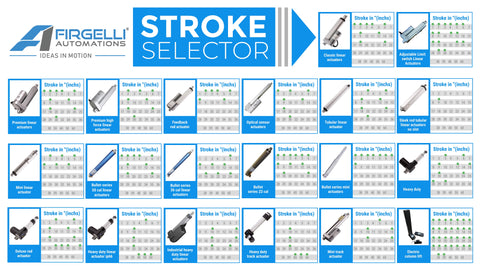
When selecting a replacement, it's generally advisable to match the stroke length exactly. However, in some applications, you may have flexibility to go slightly longer if your mounting configuration and available space permit. Remember that stroke length directly affects the actuator's retracted and extended dimensions, which impacts installation distance—a critical factor we'll discuss shortly.
Evaluating Force Rating Capacity
Force rating defines the maximum load an actuator can push or pull reliably throughout its operational life. This specification is typically expressed in pounds (lbs), kilograms (kg), or Newtons (N), with common conversions being: 1 lb ≈ 4.45 N, and 1 kg ≈ 9.81 N. Selecting an actuator with insufficient force capacity will result in slow operation, premature motor failure, or complete inability to move your load.
The force rating should be clearly indicated on your existing actuator's label. Standard force ratings for electric linear actuators typically range from 10 lbs (45 N) for light-duty applications up to 2,200 lbs (10,000 N) or higher for heavy industrial equipment. When examining the label, note whether the specification refers to dynamic load (moving) or static load (holding), as some actuators have different ratings for each condition.
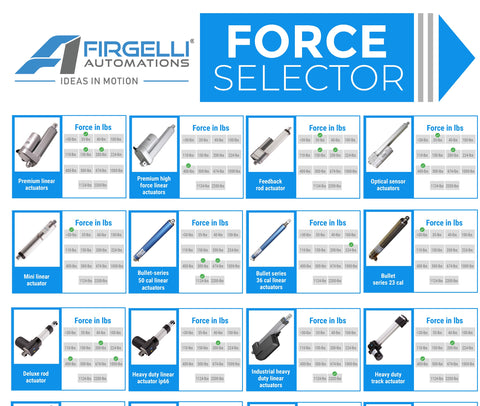
If the force rating isn't visible on the label, search for the model number online along with terms like "force rating" or "specifications." Manufacturer datasheets will provide this information. If you cannot locate documentation, you'll need to estimate the required force based on your application. For vertical lifting applications, the minimum force required equals the weight being lifted plus a safety factor. For horizontal pushing applications, consider friction forces and any resistance in the system.
As a best practice, select a replacement actuator with a force rating 20-30% higher than your calculated requirement. This safety margin accounts for friction, binding, wear over time, and ensures the actuator operates within its optimal performance range rather than at maximum capacity. Operating an actuator near its rated capacity continuously will significantly shorten its lifespan. The bullet actuator series, for example, offers force ratings from 150 lbs to 400 lbs, making it suitable for medium-duty applications with appropriate safety margins built in.
Determining Installation Dimensions
Installation distance, also called mounting distance or hole-to-hole distance, represents the center-to-center measurement between the actuator's two mounting points when fully retracted. This dimension is critical because it determines whether a replacement actuator will physically fit in your existing mounting configuration. Unlike stroke and force, which must meet minimum requirements, installation distance must match your application's mounting points precisely—or require modification to your mounting structure.
To measure installation distance, locate the mounting holes at both ends of the actuator—typically one at the clevis or rod end and one at the motor housing or rear mounting bracket. With the actuator fully retracted, measure the center-to-center distance between these holes. This measurement is crucial because it represents the minimum space required between your mounting points.
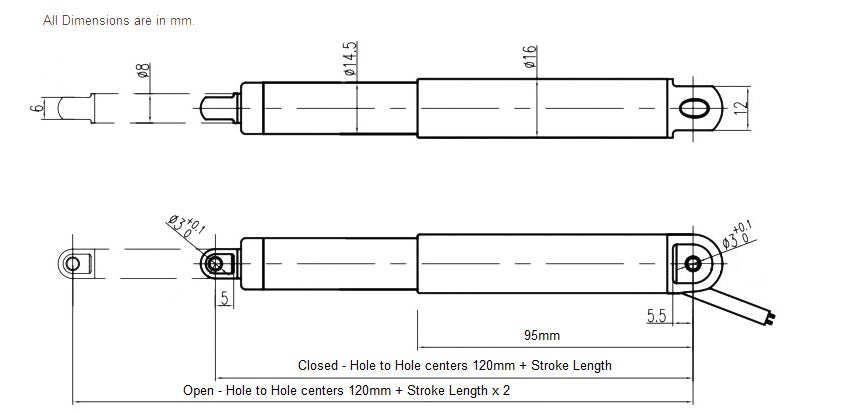
Finding a direct replacement with identical installation dimensions can be challenging because most manufacturers use proprietary designs with varying body lengths, motor housing dimensions, and mounting configurations. Even actuators with the same stroke and force ratings may have different installation distances due to differences in gearbox design, motor size, or housing configuration.
If you cannot find an exact match for installation distance, you have several options. First, consider using adjustable mounting brackets that can compensate for slight dimensional differences—typically up to 1-2 inches of adjustment. Second, you may need to modify your application's mounting points by drilling new holes or welding new mounting tabs. Third, consider whether repositioning one end of the actuator's mounting point is feasible in your design.
When reviewing replacement options, carefully examine dimensional drawings in the product datasheets. At FIRGELLI Automations, every actuator listing includes detailed dimensional drawings showing installation distance, extended length, retracted length, and mounting hole specifications. Pay attention to mounting style as well—some actuators use clevis mounts, others use bracket mounts or threaded rod ends, and these mounting styles may not be interchangeable without adapters.
Confirming Electrical Specifications
Electrical compatibility is straightforward but absolutely critical—connecting an actuator to the wrong voltage can result in immediate motor failure, fire hazard, or void warranties. Most electric linear actuators operate on DC (direct current) power, with 12VDC and 24VDC being the most common voltages for standard applications. Some specialized industrial actuators may operate on 48VDC or even AC (alternating current) power, typically 110VAC or 220VAC.
To determine your required voltage, examine your existing power supply. The voltage output should be clearly labeled on the power adapter, battery, or electrical system powering the actuator. If you're replacing an actuator in an existing system, the voltage requirement is determined by your power supply—you cannot simply use a different voltage actuator without also replacing your power infrastructure.
Beyond voltage, consider the current draw (measured in amperes or amps). Higher force actuators or faster speed actuators draw more current, which affects your power supply requirements and wire gauge selection. If you're upgrading to a higher force or faster actuator, verify that your existing power supply can deliver sufficient current. An undersized power supply will cause voltage drop under load, resulting in slow operation, overheating, or intermittent failures.
Most linear actuators use DC motors that reverse direction by reversing polarity. This means they can be controlled with simple DPDT (double pole, double throw) switches, relays, or motor controllers. If your original actuator used a control box or remote control, ensure your replacement actuator is compatible with the same control system, or plan to upgrade your controls along with the actuator.
Assessing Environmental Protection Ratings
The Ingress Protection (IP) rating defines an actuator's resistance to solid particles (dust) and liquids (water). This two-digit rating is critical for determining whether an actuator will survive in your operating environment. The first digit (0-6) indicates protection against solids, while the second digit (0-8) indicates protection against liquids. For example, an IP65-rated actuator is dust-tight and protected against water jets from any direction.
For indoor applications in clean, dry environments—such as home automation, office furniture like standing desks, or interior TV lifts—a lower IP rating (IP20 to IP54) is typically sufficient. These actuators are less expensive and may offer better performance characteristics because they don't require the additional sealing and robust construction necessary for harsh environments.
Outdoor applications, marine environments, food processing equipment, medical devices, or industrial settings exposed to dust, moisture, or washdown requirements demand higher IP ratings. An IP65 rating provides dust-tight protection and resistance to water jets, making it suitable for most outdoor installations. IP66 offers protection against powerful water jets, while IP67 actuators can withstand temporary immersion in water up to 1 meter depth. For permanent underwater installations, IP68-rated actuators are necessary.
When replacing an actuator, match or exceed the IP rating of your original unit. If your previous actuator failed due to environmental factors (water ingress, dust accumulation, corrosion), consider upgrading to a higher IP rating. Keep in mind that higher IP ratings typically come with increased cost and may involve trade-offs such as reduced speed or increased friction due to additional sealing components.
Considering Speed and Noise Characteristics
Actuator speed, typically measured in inches per second (in/s) or millimeters per second (mm/s), determines how quickly the actuator extends and retracts. Standard linear actuators operate at speeds ranging from 0.5 in/s (slow) to 2.0 in/s (fast), with some high-speed units exceeding 4 in/s. Speed is inversely related to force—for a given motor size and gearbox, faster actuators produce less force, while slower actuators generate higher force.
If speed specifications aren't available for your existing actuator, you can measure it directly. Fully retract the actuator, then time how long it takes to fully extend while measuring the stroke length. Divide stroke length by extension time to calculate speed. For example, a 10-inch stroke that extends in 5 seconds operates at 2 inches per second.
Speed becomes particularly important in applications where cycle time matters—such as automated equipment, packaging machinery, or any system where the actuator's motion time affects overall productivity. For consumer applications like adjustable furniture or home automation, speed is often a user experience consideration rather than a functional requirement, but it still matters for perceived quality and convenience.
Noise level is closely related to speed and gearbox design. Faster actuators with higher gear ratios tend to produce more noise. Most electric linear actuators operate in the 45-60 decibel range, roughly equivalent to normal conversation or background office noise. For applications in quiet environments—bedrooms, offices, libraries, or medical facilities—noise becomes a selection criterion. Some manufacturers offer "quiet" actuator models with specialized gearboxes, lower speeds, or enhanced dampening.
If noise is critical in your application and specifications aren't available, operate the existing actuator and use a smartphone sound meter app to measure decibel level during operation. When selecting a replacement, look for actuators with similar or lower noise ratings, recognizing that slower speeds generally correlate with quieter operation.
Checking for Feedback Sensors
Feedback sensors enable position control and synchronization capabilities that are essential for advanced applications. The two most common feedback sensor types in linear actuators are potentiometers and Hall effect sensors. These sensors provide real-time position information to a controller, allowing for precise positioning, synchronized multi-actuator systems, or programmable motion profiles.
To determine if your existing actuator has feedback sensors, examine the output cable. A standard actuator without feedback will have only two wires (positive and negative) for motor power. If you see three or more wires, the actuator likely contains internal feedback sensors. Potentiometer feedback typically uses three wires (power, ground, and signal), while Hall effect sensors may use four or more wires depending on the specific sensor configuration.
If your application currently uses feedback actuators for position control, synchronization, or integration with programmable controllers like Arduino or PLC systems, you must replace with an actuator that has compatible feedback. Conversely, if your current setup uses simple open-loop control (switches or relays controlling extend/retract without position feedback), you don't need to pay extra for feedback capabilities unless you're planning to upgrade your control system.
Potentiometer feedback provides analog voltage output that varies proportionally with actuator position—typically 0-5VDC or 0-10VDC across the full stroke range. This analog signal is easy to interface with most controllers and provides smooth, continuous position information. Hall effect sensors provide digital pulses that can be counted to determine position with very high resolution, making them ideal for precision positioning applications but requiring more sophisticated controllers to process the pulse data.
When replacing a feedback actuator, ensure the replacement has compatible feedback type and signal characteristics. Mixing feedback types (replacing a potentiometer actuator with a Hall effect model, for example) will require reprogramming or reconfiguring your control system to interpret the different signal format.
Utilizing Selection Tools and Resources
Modern actuator selection has been greatly simplified through online selector tools and comprehensive technical resources. Rather than manually comparing dozens of specifications across hundreds of products, you can use interactive tools to filter options based on your specific requirements.
The FIRGELLI Automations website features an advanced selector tool that allows you to filter linear actuators by force rating, stroke length, speed, feedback type, and IP rating. Start by selecting your required force range and stroke length—these two parameters will narrow down options significantly. Then apply additional filters for voltage, speed, and environmental protection as needed.
Each actuator listing includes comprehensive technical datasheets with complete specifications, dimensional drawings, wiring diagrams, and performance curves. These datasheets are essential resources when comparing potential replacements. Pay particular attention to the dimensional drawings, which show exact measurements for installation distance, mounting hole sizes and locations, body dimensions, and extended/retracted lengths.
Performance curves—graphs showing the relationship between force, speed, and duty cycle—provide valuable insights into how an actuator will perform in your specific application. These curves reveal that actuator force typically decreases as speed increases due to motor characteristics and electrical losses. Understanding these trade-offs helps you select an actuator that balances force, speed, and longevity for your particular duty cycle.
For specialized applications requiring track actuators, rotary actuators, or column lifts, additional selection criteria may apply. These products often serve specific use cases with unique mounting configurations, control requirements, or environmental considerations that don't apply to standard rod-style linear actuators.
Making the Final Selection
After gathering all necessary specifications and identifying potential replacement options, conduct a final verification before ordering. Create a checklist comparing your requirements against the candidate actuator's specifications: stroke length (exact match), force rating (meets or exceeds requirement with appropriate safety margin), installation distance (compatible with existing mounting or modification plan), electrical specifications (matches your power supply), IP rating (appropriate for environment), speed (acceptable for your application), and feedback capabilities (matches your control system requirements).
If multiple actuators meet all your requirements, additional factors may guide your final selection. Consider duty cycle requirements—how frequently and for how long the actuator will operate. Actuators designed for continuous duty with 100% duty cycle ratings can operate non-stop, while others are rated for intermittent duty with specifications like 20% or 50% duty cycle. Exceeding duty cycle ratings leads to overheating and premature failure.
Mounting style compatibility is another consideration. Standard mounting options include clevis mounts (allowing pivoting in one plane), double clevis mounts (allowing pivoting in two planes), bracket mounts (fixed mounting), and threaded rod ends (for custom mounting solutions). Ensure your replacement actuator's mounting style is compatible with your application or that you have appropriate mounting brackets available.
Weight and physical dimensions beyond installation distance may matter in weight-sensitive or space-constrained applications. Heavier-duty actuators with higher force ratings are inherently larger and heavier due to bigger motors, stronger gearboxes, and more robust housing. If you're upgrading force capacity, verify that the larger actuator will fit in your available space and won't create structural or balance issues.
Finally, consider lead time and availability. Critical applications requiring immediate replacement may require choosing an in-stock alternative rather than the theoretically optimal unit with extended delivery time. FIRGELLI Automations maintains substantial inventory of popular actuator models to minimize downtime in replacement situations.
Conclusion
Successfully replacing a linear actuator requires systematic evaluation of multiple technical specifications to ensure compatibility with your application. By methodically confirming stroke length, force rating, installation dimensions, electrical specifications, environmental protection requirements, speed characteristics, and feedback capabilities, you can identify suitable replacement options with confidence.
The process becomes significantly easier when you leverage available resources—product labels, online datasheets, selection tools, and technical support from experienced engineers. While finding an exact dimensional match can be challenging due to varying manufacturer designs, understanding which specifications are non-negotiable versus which allow flexibility enables you to make informed trade-offs when necessary.
Remember that replacing an actuator is also an opportunity to improve performance. If your original actuator was marginal for the application or failed due to environmental factors, this is the perfect time to upgrade to a higher force rating, better IP protection, or enhanced feedback capabilities. The modest incremental cost of upgrading specifications is far less than the cost of repeated failures and downtime.
Frequently Asked Questions
Can I use an actuator with a different stroke length than my original?
You can use an actuator with a longer stroke length if your mounting configuration and available space permit, as long as the increased extended length doesn't cause interference with other components. However, you cannot use an actuator with shorter stroke length if it won't achieve the full range of motion required by your application. When considering a longer stroke actuator, remember that it will also have a longer retracted length, which affects installation distance and may require mounting modifications. The safest approach is to match the stroke length exactly unless you've specifically designed your system to accommodate variations.
What happens if I select a replacement actuator with a much higher force rating than needed?
Using an actuator with significantly higher force rating than required has both advantages and disadvantages. On the positive side, it provides excellent safety margin, reduces stress on components, and typically extends service life because the actuator operates well below its maximum capacity. The downsides include higher initial cost, increased physical size and weight, potentially slower speed (since force and speed are inversely related in most actuator designs), and greater current draw requiring more robust power supplies. A force rating 20-50% above your requirement is ideal—enough safety margin without excessive oversizing. Extremely oversized actuators may also lack the mechanical sensitivity needed for precise positioning in low-load applications.
Can I power a 24VDC actuator with a 12VDC power supply or vice versa?
No, you should never operate an actuator at a different voltage than its rating. Running a 24VDC actuator on 12VDC will result in severely reduced force output and very slow speed—the actuator may not move at all under load or may stall. Conversely, running a 12VDC actuator on 24VDC will cause the motor to spin at double its rated speed, drawing excessive current, generating heat, and likely failing immediately or within a very short time due to motor burnout or gearbox damage. The voltage rating is a critical specification that must be matched exactly. If you need to change voltage, you must replace both the actuator and the power supply as a system.
How do I know what IP rating I need for outdoor use?
For outdoor applications, IP65 is generally the minimum acceptable rating for most environments. IP65 provides complete dust protection and resistance to water jets, making it suitable for outdoor installations that may be exposed to rain, snow, or washing. If your installation faces direct, powerful water spray (such as boat wash-down areas or agricultural equipment subject to pressure washing), consider IP66 or higher. For applications where the actuator may be temporarily submerged—such as marine equipment, pool covers, or flood-prone areas—IP67 or IP68 ratings are necessary. Also consider that outdoor environments often involve temperature extremes, UV exposure, and corrosion from moisture or salt air, so look for actuators with corrosion-resistant materials and appropriate temperature ratings in addition to adequate IP protection.
What should I do if I can't find any specifications for my old actuator?
If your actuator has no visible markings and you cannot locate documentation, you'll need to measure and estimate the critical specifications. Measure stroke length by extending and retracting the unit fully and calculating the difference. For force requirements, analyze your application—what weight is being lifted or what resistance is being overcome? Use a force gauge or scale to measure the actual load if possible. Measure installation distance between mounting holes when fully retracted. Check your power supply voltage to determine electrical requirements. Estimate speed by timing full extension and dividing stroke by time. For IP rating, assess the environment—if it's indoors and dry, lower ratings suffice; if outdoors or exposed to moisture, assume you need IP65 or higher. If you're still uncertain about specifications or can't determine required force, contact FIRGELLI Automations with photos and description of your application—our technical team can help recommend appropriate specifications based on your use case.


