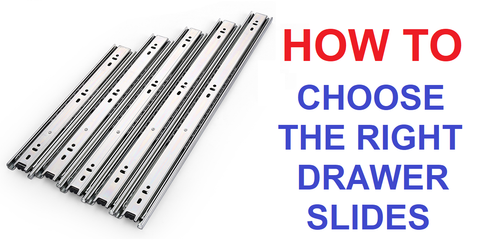
A drawer slide is a linear-motion hardware assembly — typically two or three nested steel sections riding on ball bearings or rollers — that supports a drawer's weight while allowing it to extend smoothly out of a cabinet and retract back into it. Selecting the right drawer slides is more critical than most people realize. The difference between a drawer that glides smoothly under heavy load for years and one that binds, sags, or fails prematurely often comes down to choosing slides with the proper specifications for your application. Whether you're building custom cabinetry, retrofitting existing furniture, or designing specialized storage systems for industrial equipment, understanding the engineering principles behind drawer slide selection will save you time, money, and frustration.
The market is flooded with drawer slide options ranging from basic roller-bearing slides found in budget furniture to heavy-duty telescopic systems capable of supporting hundreds of pounds. Many DIYers and even experienced builders make critical mistakes in this selection process—underestimating weight requirements, misjudging extension needs, or failing to account for how load capacity changes when slides are fully extended. This guide will walk you through the technical considerations and practical factors that separate adequate drawer slides from exceptional ones.
At FIRGELLI Automations, our expertise in linear motion systems—from linear actuators to precision slide rails—gives us unique insight into what makes drawer slides perform reliably under real-world conditions. We'll help you navigate the specifications that matter and avoid the common pitfalls that lead to premature failure.
Measure the hard part of travel, not the easy middle. A drawer slide's true capacity is its capacity at full extension — the position where leverage is greatest and bearing overlap is smallest.
"A drawer slide's rated capacity only matters if it holds at full extension, because that's exactly when you're loading the drawer. A slide rated at the closed position is rating itself in the easy condition — not the one that actually matters." — Robbie Dickson, Founder and Chief Engineer of FIRGELLI Automations
What are the three critical factors in drawer slide selection?
Before diving into specific product types, you need to establish three fundamental requirements that will drive your entire selection process. Getting these wrong means everything that follows will be compromised, regardless of how carefully you choose other features.
Extension Length and Travel
Extension length refers to how far the drawer needs to travel from its fully closed to fully open position. This isn't just about convenience—it's about accessibility and functionality. A drawer that only opens 75% of its depth leaves the back 25% of contents difficult or impossible to reach, particularly in deeper cabinets.

Drawer slides typically offer three extension categories:
- Three-quarter extension: Opens to approximately 75% of the slide length—adequate for shallow drawers but limiting for deeper applications
- Full extension: Opens to 100% of the slide length—the minimum recommended for most applications where you need complete access to drawer contents
- Over-travel extension: Extends slightly beyond 100%—useful in specialized applications where you need to completely clear the cabinet frame
The extension requirement directly impacts which mounting style and mechanism type will work for your application. Telescopic slides, which we'll discuss in detail later, are essential for achieving full extension in applications where the closed length must equal the extension length.
Weight Capacity: Understanding Dynamic vs. Static Ratings
Here's where many builders encounter their biggest disappointment: weight capacity ratings can be misleading if you don't understand how they're tested and reported. The load-bearing capacity of a drawer slide changes dramatically based on its extension position.
Most consumer-grade slides from big box stores rate their weight capacity in the closed or partially extended position. This is a critical distinction. When those same slides reach full extension, their effective weight capacity typically drops by 50% or more due to increased leverage and reduced support surface. A slide rated at 100 lbs might only safely handle 50 lbs when fully extended—precisely when you're most likely to be loading or unloading the drawer.
All FIRGELLI drawer slides specify their weight capacity at full extension, giving you an honest assessment of real-world performance. Our slides start at 400 lbs capacity and extend to 500 lbs for heavy-duty applications, with ratings that remain consistent throughout the entire range of travel. This engineering approach mirrors the standards we apply to our industrial actuators, where precision and reliability under load are non-negotiable.
When calculating your weight requirement, consider not just the contents but also the drawer box itself. A solid hardwood drawer box can easily add 20-30 lbs before you put anything in it. Always spec slides with at least 25% capacity headroom beyond your calculated maximum load to ensure longevity and smooth operation.
Mounting Location and Configuration
The mounting location is often predetermined by your cabinet design, but understanding the implications of each mounting style helps you make informed decisions about construction or modification options. The three primary mounting configurations each have distinct advantages and limitations:
Side mounting is the most common and mechanically sound approach, distributing load across two slides mounted to the drawer sides. This configuration provides the best weight capacity and requires clearance between the drawer box and cabinet sides—typically 1/2 inch per side to accommodate the slide width.
Center mounting places a single slide underneath the drawer center, keeping the hardware completely hidden even when open. However, this orientation significantly reduces weight capacity—often by 70-80%—because the slide operates in a less mechanically advantageous position. This approach works well for lightweight drawers where aesthetics are the priority.
Undermounting attaches slides to the bottom edges of the drawer sides, offering a cleaner look than side mounting while maintaining better weight capacity than center mounting. These typically require specialized mounting brackets and more precise installation but deliver excellent results for furniture-grade applications.

How do you measure for drawer slide length?
Accurate measurement is the foundation of successful drawer slide installation. Incorrect measurements lead to slides that don't fit, drawers that can't fully open, or hardware that protrudes beyond the cabinet face. Follow these steps to get it right the first time.
Measuring Drawer Depth
Start by measuring the internal depth of your drawer box from the inside face of the drawer front to the inside face of the drawer back. This gives you the drawer depth—the primary dimension that determines your minimum slide length for full extension applications.
For side-mount or undermount configurations, you also need to measure the cabinet depth from the inside face of the cabinet back to the front edge of the cabinet frame where the drawer front will sit when closed. This cabinet depth measurement determines the maximum slide length that will fit without protruding.
Subtract approximately 1 inch from the cabinet depth measurement to determine your maximum usable slide length. This allowance accounts for the drawer front thickness and provides clearance for the slide mounting hardware. For example, if your cabinet measures 22 inches from back to front, your maximum slide length would be approximately 21 inches.
Accounting for Closed Length
The closed length of a slide—its physical dimension when fully retracted—must fit within your cabinet depth. This is where telescopic slides become essential for many applications. A three-section telescopic slide can achieve 100% extension, meaning a 20-inch slide extends 20 inches while measuring only 20 inches when closed. This 1:1 ratio of closed length to extension is impossible with two-section slides, which typically max out at 75% extension.

Two-section slides work acceptably for shallow drawers where the reduced extension isn't a functional problem, but they sacrifice weight capacity due to reduced overlap when extended. The mechanical advantage decreases as the two sections separate, which is why these slides are typically rated for lighter loads—usually 50-75 lbs maximum.
Special Considerations for Center-Mount Slides
Center-mount slides require a different measurement approach. Because the slide mounts under the drawer center, the slide length should equal the drawer depth measurement. However, you must verify that the cabinet depth accommodates the closed slide length plus the drawer front thickness.
The critical limitation with center mounting is weight capacity reduction. Taking a slide designed for side mounting and reorienting it horizontally underneath a drawer changes the load dynamics substantially. The same slide that handles 400 lbs in side-mount configuration might only support 80-100 lbs in center-mount orientation due to reduced moment arm and increased deflection potential.
How do telescopic drawer slides work?
Telescopic slides represent the most versatile and capable category of drawer slide technology. Understanding their construction and operation helps you appreciate why they outperform simpler alternatives in demanding applications.
Three-Section Telescopic Design
A telescopic slide consists of three nested sections that extend sequentially. The outermost section mounts to the cabinet, the innermost section mounts to the drawer, and the middle section acts as an intermediate carrier that enables the extended travel. This three-piece construction allows the slide to collapse to approximately one-third of its extended length.
The engineering advantage of this design is substantial. As you pull the drawer open, the sections extend in sequence, maintaining overlap between each section throughout the entire range of motion. This continuous overlap preserves the mechanical strength and load-bearing capacity of the slide even at full extension.
Ball bearings between each section provide smooth, low-friction movement while distributing loads across the contact surfaces. Quality telescopic slides use precision-ground bearing races and hardened steel balls, similar to the bearing systems in precision slide rails and linear bearings. This attention to bearing quality is what separates professional-grade slides from consumer alternatives.
Load Distribution and Capacity
The telescopic design maintains relatively consistent load capacity throughout the extension range because the overlapping sections distribute forces across multiple bearing contact points. While some capacity reduction occurs at full extension due to increased leverage, well-engineered telescopic slides maintain 80-90% of their rated capacity throughout their travel.
This contrasts sharply with two-section slides, which may drop to 50% or less of their nominal capacity at maximum extension. The additional section in a telescopic slide isn't just about achieving greater extension—it's fundamentally about maintaining structural integrity and load-bearing performance.
FIRGELLI heavy-duty telescopic slides are engineered to maintain their full rated capacity of 400-500 lbs throughout their entire extension range, from 10 inches up to 60 inches. This consistency comes from robust section design, precision bearing placement, and careful attention to material selection and heat treatment.
How should you interpret drawer slide weight capacity specifications?
Understanding weight capacity ratings requires looking beyond the single number printed on the package. The engineering reality of how slides bear loads is more complex than a simple maximum weight figure suggests.
Static vs. Dynamic Load Ratings
Static load capacity refers to the weight a slide can support when stationary and fully extended. This is the rating most manufacturers advertise because it produces the most impressive numbers. Dynamic load capacity accounts for the forces experienced during movement—accelerating the drawer open, decelerating it closed, and handling the impact loads from items settling during motion.
Dynamic loads are substantially higher than static loads due to inertia effects. Pulling a 100-lb drawer open quickly might generate momentary forces of 150 lbs or more at the slide attachment points. Quality slides engineer significant safety margins to handle these dynamic conditions without permanent deformation or bearing damage.
How Extension Affects Capacity
The mechanical principle at work is leverage. When a drawer is closed, the load sits near the cabinet back where the slide mounting provides rigid support. As the drawer extends, the center of gravity moves forward, increasing the moment arm and the bending stress on the slide members.
Imagine holding a weight close to your body versus at arm's length—the same weight feels much heavier when extended because you're fighting greater leverage. Drawer slides experience this same effect. The further the load moves from the fixed mounting point, the greater the bending moment and the higher the stress on the slide components.
Premium slides compensate with thicker section walls, larger diameter bearings, and optimized geometry that minimizes deflection under load. The goal is to maintain functional capacity throughout the useful travel range, not just achieve impressive numbers in ideal conditions.
Safety Margins and Real-World Loading
Professional installation practice calls for specifying slides with at least 25% capacity margin above your calculated maximum load. This safety factor accounts for:
- Dynamic forces during operation
- Uneven load distribution within the drawer
- Material property variation in manufacturing
- Degradation of bearing lubrication over time
- Potential impact loads from closing drawers forcefully
A 100-lb load should use slides rated for 125 lbs minimum at full extension. This approach ensures smooth operation, extends component life, and provides reliability margin for unexpected conditions. It's the same engineering philosophy we apply to sizing linear actuators for motion control applications—conservative specification prevents field failures.
What are the differences between drawer slide mounting types?
Each mounting configuration offers distinct advantages and imposes specific requirements. Understanding these differences helps you select the approach that best matches your priorities for capacity, aesthetics, installation complexity, and cost.
| Mounting Type | Typical Capacity (relative) | Side Clearance Required | Visibility | Installation Complexity | Best For |
|---|---|---|---|---|---|
| Side-Mount | 100% (baseline, up to 400–500 lb) | 1/4"–1/2" per side | Visible when open | Moderate | Tool storage, heavy loads |
| Center-Mount | 20–30% of side-mount | 1/2"–3/4" below drawer | Fully hidden | Moderate | Silverware, light utensils |
| Undermount | 50–75% of side-mount | 3/16"–1/4" per side | Mostly hidden | High | Furniture-grade cabinetry |
Side-Mount Drawer Slides
Side mounting represents the most mechanically sound configuration for drawer slides. By placing slides on both sides of the drawer, you create a balanced, symmetrical load distribution that maximizes weight capacity and minimizes racking forces that can cause binding or premature wear.

Side-mount slides come in two primary mechanism types: roller bearing and ball bearing. Roller bearing slides use cylindrical rollers running in stamped metal channels—simple, economical, and adequate for light-duty applications up to 50 lbs. These are the slides you'll find in most budget furniture and basic kitchen cabinets.
Ball bearing side-mount slides use precision ball bearings running in machined or formed races, providing smoother operation, higher load capacity, and substantially longer service life. The quality difference between economy ball bearing slides and precision telescopic ball bearing slides is significant—precision slides use hardened races, tighter tolerances, and better bearing retention systems.
Installation requires measuring and marking slide positions on both the drawer sides and cabinet sides, ensuring alignment so the drawer travels smoothly without binding. While this demands careful measurement, the process is straightforward with basic tools: a tape measure, square, drill, and screwdriver.
Clearance requirements for side mounting typically range from 1/4 inch to 1/2 inch per side depending on slide width. Measure your cabinet opening and drawer box width to verify adequate clearance before purchasing slides.
Center-Mount Drawer Slides
Center mounting appeals to furniture makers and cabinetry applications where visual aesthetics matter more than maximum weight capacity. With the slide completely hidden beneath the drawer, the installation maintains clean lines and traditional appearance even with the drawer open.
The engineering trade-off is substantial capacity reduction. A slide designed for 400-lb capacity in side-mount orientation might only support 80-100 lbs in center-mount configuration. This reduction occurs because the slide operates on its side with the load applied perpendicular to its design orientation, increasing deflection and stress concentration at mounting points.
Center mounting works well for silverware drawers, utensil organizers, and other applications where loads remain modest. It's inappropriate for tool storage, file drawers, or any application where significant weight is anticipated.
Installation differs from side mounting because you're working with a single slide centered under the drawer. Precise alignment becomes even more critical—any offset will cause the drawer to bind or track at an angle. The clearance requirement depends on slide thickness rather than width, typically 1/2 inch to 3/4 inch from the cabinet bottom to allow for the slide plus mounting hardware.
Undermount Drawer Slides
Undermount slides offer a middle ground between side-mount functionality and center-mount aesthetics. Ball-bearing mechanisms mount to the lower edges of drawer sides, connecting to brackets attached underneath the drawer box. This configuration conceals the slides from normal viewing angles while maintaining better weight capacity than true center mounting.

The installation complexity increases with undermount slides because you must precisely position both the slide mounting to the cabinet and the drawer-mounted brackets. Misalignment causes binding and poor operation. Many undermount systems include adjustment mechanisms to correct minor alignment errors, but getting the initial installation accurate saves time and frustration.
Clearance requirements are modest—typically 3/16 inch to 1/4 inch per side—because the slides mount in a more compact configuration than full side-mount slides. This makes undermounting attractive when drawer openings are tight and you need to maximize drawer box width.
Weight capacity with undermount slides typically falls between side mounting and center mounting for the same slide model. The orientation provides better mechanical advantage than center mounting but doesn't match the balanced load distribution of true side mounting. Expect capacity ratings around 75-100 lbs for standard undermount slides, though heavy-duty versions can handle more.
When do you need heavy-duty or long-stroke drawer slides?
While standard kitchen drawer slides serve basic needs adequately, specialized applications demand slides engineered for extreme conditions. Tool storage, industrial equipment access, RV and marine installations, and commercial kitchen applications all require capabilities beyond consumer-grade hardware.
Industrial and Commercial Requirements
Heavy-duty drawer slides must withstand punishing conditions: frequent cycling, heavy loads, exposure to dust and debris, temperature extremes, and sometimes corrosive environments. These factors demand robust construction with generous safety margins.
FIRGELLI heavy-duty drawer slides address these requirements with features like:
- Hardened steel construction with corrosion-resistant finishes
- Oversized ball bearings for increased load distribution and extended service life
- Thicker section walls that resist deflection under heavy loads
- Sealed bearing races that exclude contaminants
- Ratings from 400 lbs up to 500 lbs at full extension
- Extension lengths from standard sizes up to 60 inches for deep cabinet applications
These specifications aren't marketing hype—they reflect engineering decisions based on decades of experience in linear motion systems. The same design philosophy that produces reliable industrial actuators and precision slide rails informs our drawer slide engineering.
Extra-Long Stroke Requirements
Applications like truck bed toolboxes, server rack access, industrial workstations, and specialized storage systems often require extension lengths exceeding 40 inches. Standard consumer slides rarely exceed 28-32 inches, leaving these applications underserved.
Long-stroke slides face increased engineering challenges. Longer slides amplify deflection under load, require more robust mounting to prevent sagging, and demand tighter manufacturing tolerances to prevent binding across the extended travel range. The telescopic section design must maintain adequate overlap at full extension to preserve structural integrity.
FIRGELLI offers drawer slides with extensions up to 60 inches while maintaining 500-lb weight capacity. These slides incorporate reinforced sections, additional ball bearing sets, and optimized geometry that manages deflection across the extended length. This capability serves applications from mobile workshops to industrial machinery access panels where both reach and load capacity are essential.
Comparing Consumer vs. Professional-Grade Slides
The price difference between big box store slides and professional heavy-duty slides reflects fundamental engineering and manufacturing differences:
Consumer slides use thinner steel, fewer bearings, less precise manufacturing tolerances, and minimal corrosion protection. They're adequate for light-duty residential use with modest loads and infrequent cycling. Weight capacities typically max out at 100 lbs, and that rating often applies to closed or partially extended positions rather than full extension.
Professional slides incorporate heavier gauge steel, precision-ground bearing races, hardened components, and protective finishes. They're engineered for sustained heavy use, maintaining rated capacity throughout their service life. The higher initial cost delivers lower total cost of ownership through extended service life and reduced failure rates.
For hobbyists and DIY builders working on projects like custom tool storage, mobile workshops, or specialized cabinetry, professional-grade slides represent an investment in functionality and reliability. They're not overkill—they're appropriate specification for applications where failure means lost productivity or safety concerns.
What are the best practices for installing drawer slides?
Proper installation is as important as choosing the right slides. Even the best-engineered drawer slides will perform poorly if mounted incorrectly. Follow these practices to ensure smooth operation and long service life.
Measurement and Marking
Start by measuring and marking slide positions on both drawer and cabinet before drilling any holes. For side-mount installations, mark a horizontal line on each cabinet side at the appropriate height for drawer positioning. Ensure these lines are level and at identical heights on both sides—even small misalignments cause binding.
Mark corresponding positions on the drawer sides, measuring from the drawer bottom or using the centerline depending on your slide design. Again, symmetry is critical. The drawer should sit square in the opening with equal clearance on all sides.
Use a square to verify that your lines are perpendicular to the cabinet front. Slides mounted at angles will cause the drawer to track poorly and may prevent full extension or closure.
Mounting Hardware and Techniques
Use appropriate screws for your material and application. Wood screws work for cabinet and furniture applications, while machine screws with nuts or threaded inserts serve better for metal cabinets or composite materials. Don't substitute longer or shorter screws than specified—incorrect length can split wood, strip threads, or fail to engage sufficient material depth.
Pre-drill pilot holes to prevent splitting wood and ensure accurate screw placement. Pilot hole diameter should be slightly smaller than the screw shank diameter. This provides adequate material engagement while preventing splitting stress.
Tighten mounting screws firmly but avoid overtightening, which can strip threads or deform thin mounting flanges on the slides. If mounting to thin material, consider using backing plates or larger washers to distribute clamping force over a greater area.
Testing and Adjustment
After installation, test drawer operation before loading it with contents. The drawer should slide smoothly throughout the entire travel range without binding, catching, or requiring excessive force. Test both opening and closing motion—sometimes issues appear in only one direction.
If binding occurs, check for:
- Misalignment between left and right slides
- Drawer box out of square
- Insufficient clearance between drawer and cabinet sides
- Foreign material or debris in the slide mechanism
- Loose mounting screws allowing shift during operation
Many slides include limited adjustment capability in the mounting holes—slotted holes that allow minor repositioning. Use this adjustment to correct small alignment errors, but don't rely on it to compensate for poor initial measurement.
Once operation is smooth and consistent, load the drawer progressively while testing at each stage. Start with 25% of anticipated load, then 50%, 75%, and finally full load. This progressive testing reveals any capacity or mechanical issues before you fully commit to the installation.
How do you maintain drawer slides for long service life?
Quality drawer slides require minimal maintenance but benefit from periodic attention that extends service life and maintains smooth operation.
Cleaning and Lubrication
Periodically clean slides to remove accumulated dust, debris, and old lubricant that has collected contaminants. Use a clean cloth or soft brush to wipe accessible surfaces, paying particular attention to bearing races where debris can cause pitting and accelerated wear.
Most quality ball bearing slides come pre-lubricated and don't require additional lubrication under normal conditions. If slides begin feeling rough or sticky, apply a small amount of lithium-based grease or light machine oil to the bearing races. Avoid over-lubricating, which attracts dust and debris that causes more harm than the lubrication helps.
Never use penetrating oils like WD-40 as a long-term lubricant—these products are designed to displace moisture and free stuck parts, not provide lasting lubrication. They evaporate quickly and leave slides under-lubricated.
Inspection and Preventive Replacement
Inspect slides periodically for signs of wear, damage, or loosening hardware. Look for:
- Loose mounting screws that need retightening
- Cracks or deformation in slide members
- Excessive play or wobble indicating worn bearings
- Corrosion or rust, especially in humid environments
- Bent or damaged sections from impact or overload
Address issues promptly before they cause complete failure or damage to the drawer or cabinet. A loose screw is easily tightened; a slide that has pulled loose and dropped the drawer requires more extensive repair.
In demanding applications with frequent cycling, consider preventive replacement before failure occurs. Track the number of cycles if possible, and replace slides proactively when they approach their rated cycle life. This prevents unexpected failures and the associated downtime.
What usually goes wrong with drawer slides?
Most drawer slide failures trace back to a small set of recurring issues. Recognizing them up front prevents the majority of warranty calls and rebuilds:
- Capacity miscalculation. Using a slide rated in the closed position for a load that exists at full extension — the most common cause of sag and premature bearing wear.
- Binding from misalignment. Left and right slides mounted at slightly different heights, or out-of-square drawer boxes, force the bearings to fight the geometry instead of carry the load.
- Bearing wear and pitting. Contamination from dust and debris, accelerated when penetrating oils like WD-40 are used as a long-term lubricant instead of a proper lithium-based grease or machine oil.
- Mounting screw pullout. Thin cabinet sides or particleboard without backing plates can't hold the clamping force, especially under dynamic loading.
- Side-mount slide repurposed as center-mount. Reorienting a side-mount slide horizontally beneath a drawer loses 70–80% of its rated capacity because the load is applied perpendicular to the design orientation.
- Corrosion. Humid or marine environments attack unprotected finishes; specify hardened steel with corrosion-resistant coatings when the install location warrants it.
How do you select the right FIRGELLI drawer slide for your application?
FIRGELLI Automations brings decades of linear motion expertise to drawer slide engineering. Our slides are designed with the same attention to performance and reliability that defines our broader product line of linear actuators, TV lifts, and motion control systems.
Product Range Overview
Our drawer slide lineup covers applications from standard cabinetry to extreme heavy-duty requirements:
Standard Heavy-Duty Range: 10-inch to 50-inch stroke lengths with 400-lb capacity at full extension. These slides serve workshop storage, tool cabinets, industrial workstations, and any application requiring reliable performance under substantial loads. Three-section telescopic design provides full extension with closed length equal to stroke length.
Extended Heavy-Duty Range: 40-inch to 60-inch stroke lengths with 500-lb capacity at full extension. These slides address specialized applications like truck bed toolboxes, server rack access panels, large industrial equipment, and custom mobile storage solutions. Extended lengths don't compromise capacity—these slides maintain full rating across their entire travel.
Technical Support and Application Assistance
Selecting components for custom applications sometimes requires guidance beyond catalog specifications. Our technical team brings engineering expertise from automotive, aerospace, and industrial automation backgrounds—we understand the challenges of specifying motion control components for demanding applications.
If your application involves unusual mounting constraints, extreme environmental conditions, or specialized integration requirements, contact our team. We can provide application-specific recommendations, help you calculate actual loads and forces, and suggest solutions that deliver the performance you need.
This same technical support extends across our entire product line, from micro linear actuators to industrial actuators, ensuring you have the expertise to successfully implement your project.
Conclusion
Choosing the right drawer slides comes down to accurately assessing your requirements for extension length, weight capacity, and mounting configuration, then selecting slides engineered to meet those demands with appropriate safety margins. The difference between adequate and excellent drawer performance lies in understanding how extension affects capacity, why telescopic design matters for demanding applications, and how mounting configuration impacts both function and aesthetics.
Consumer-grade slides serve basic needs adequately, but specialized applications—heavy tool storage, industrial equipment, long-reach access, or high-cycle-count environments—demand engineering that goes beyond economy hardware. Professional-grade slides deliver measurably better performance through robust construction, precision manufacturing, and honest specification of capacities under real-world conditions.
Whether you're building custom cabinetry, outfitting a mobile workshop, or designing specialized storage systems, taking time to properly specify drawer slides pays dividends in functionality, reliability, and longevity. The right slides transform a drawer from basic storage into a precision tool that performs flawlessly for years.
Frequently Asked Questions
How do I calculate the weight capacity I need for my drawer slides?
Add up the weight of the drawer box itself plus the maximum anticipated contents, then specify slides with at least 25% capacity headroom above that total — at full extension, not in the closed position. A solid hardwood drawer box can add 20–30 lbs before any contents go in. For a 100-lb total load, choose slides rated for at least 125 lbs at full extension. The safety margin covers dynamic forces during operation, uneven load distribution, manufacturing variation, lubrication degradation, and impact loads from forceful closing.
Why does drawer slide capacity drop when fully extended?
It's leverage. When a drawer is closed, the load sits near the cabinet back where the slide mounting provides rigid support. As the drawer extends, the center of gravity moves forward, increasing the moment arm and the bending stress on the slide members. Most consumer-grade slides rate capacity in the closed or partially extended position; at full extension their effective capacity typically drops by 50% or more. FIRGELLI drawer slides specify capacity at full extension so the rating reflects real-world loading.
What's the difference between telescopic and two-section drawer slides?
A telescopic slide has three nested sections — outer (cabinet), middle (intermediate carrier), and inner (drawer) — that extend sequentially. This allows 100% extension with a closed length equal to the stroke length, and maintains overlap between sections throughout the travel so capacity stays at 80–90% of rated even at full extension. Two-section slides typically max out at about 75% extension and lose capacity rapidly at full extension because section overlap shrinks; they're usually rated for lighter loads (50–75 lbs).
How do I choose between side-mount, undermount, and center-mount slides?
Side-mount is the most mechanically sound and offers the highest capacity (up to 400–500 lbs on heavy-duty models) but is visible when the drawer is open and requires 1/4"–1/2" clearance per side. Undermount slides hide most of the hardware while maintaining 50–75% of side-mount capacity, with modest 3/16"–1/4" clearance per side and higher installation precision. Center-mount slides hide completely beneath the drawer but lose 70–80% of capacity because the slide operates perpendicular to its design orientation — best reserved for silverware drawers and other light loads.
How much safety margin should I build into my drawer slide selection?
At least 25% above your calculated maximum load at full extension. That margin covers dynamic forces (a 100-lb drawer pulled open quickly can generate momentary forces of 150 lbs or more at the slide attachment points), uneven load distribution within the drawer, material property variation in manufacturing, bearing lubrication degradation over time, and impact loads from drawers closing forcefully. Conservative specification prevents field failures and extends component life.


