This comparison organizes actuators by motion and power source, then explains the practical tradeoffs between linear, rotary, electric, hydraulic, pneumatic, mechanical, and piezoelectric designs.
Use What Is an Actuator? for the broad definition and categories, What Is a Linear Actuator? for the electric linear mechanism, and Linear Actuators to compare available products.
When designing automation systems, selecting the right actuator can make the difference between a reliable, efficient installation and one plagued by maintenance issues or performance limitations. While the term "actuator" broadly describes any device that creates motion in a system, understanding the specific types—and more importantly, their practical applications and limitations—is essential for engineers, designers, and DIY enthusiasts alike.
The actuator landscape has evolved significantly over the past two decades. What once required complex hydraulic systems and dedicated maintenance crews can now often be accomplished with clean, programmable electric actuators. At FIRGELLI Automations, we've witnessed this transition firsthand since our founding in 2002, as industries ranging from marine automation to medical equipment have increasingly adopted electric linear motion solutions. This comprehensive guide explores the different types of actuators available today, with particular emphasis on linear actuators—the workhorses of modern automation that most people interact with daily without even realizing it.
Whether you're automating a boat hatch, designing an adjustable workstation, or engineering a precision positioning system, understanding the capabilities and trade-offs of each actuator type will help you make informed decisions that save time, money, and future headaches.
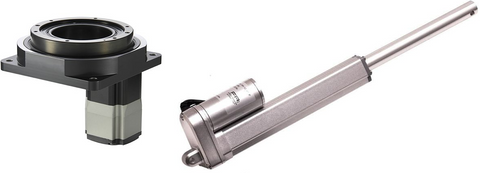
Fundamental Actuator Categories: Rotary vs. Linear
At the highest level, actuators fall into two fundamental categories based on their output motion: rotary actuators and linear actuators. Rotary actuators produce spinning or angular motion—think of electric motors, servo motors, or the actuators that open ball valves in industrial piping. These are essential for applications requiring continuous rotation or precise angular positioning.
Linear actuators, by contrast, produce straight-line motion along a single axis. This "push-pull" or "extend-retract" motion is what you experience when adjusting a power seat in your vehicle, when a TV lift raises a display from a cabinet, or when automated window openers ventilate a greenhouse. Linear motion is fundamental to countless automation tasks: opening and closing, lifting and lowering, pushing and pulling.
Within the linear actuator category, there are several distinct technologies, each with unique operating principles: mechanical, hydraulic, pneumatic, piezoelectric, and electric. The choice between these technologies depends on factors including force requirements, speed, precision, environmental conditions, and total cost of ownership.
Mechanical Linear Actuators
Mechanical linear actuators convert rotary motion into linear motion through simple mechanical advantage—using components like screws, wheels and axles, cams, or chain drives. The classic example is a manual car jack: you rotate a handle (rotary input), and a threaded screw mechanism converts this into vertical linear motion to lift your vehicle.

In their purely mechanical form (no motor), these actuators are manually operated. They're commonly found in laser positioning systems, optical adjustment mechanisms, and precision machinery where manual fine-tuning is acceptable or even preferred. Some mechanical designs are inherently directional—for example, a chain drive actuator can only pull, while a screw mechanism can both push and pull depending on the rotation direction.
The advantages of mechanical actuators include simplicity, reliability, and the ability to hold position without power (due to the self-locking nature of many screw designs). The primary limitation is that manual versions require human operation, though many mechanical actuators can be motorized to create electric linear actuators—a category we'll explore in detail later.
Hydraulic Linear Actuators
Hydraulic actuators use pressurized fluid—typically hydraulic oil—to generate linear motion through a piston and cylinder arrangement. When fluid is pumped into one side of the cylinder, it forces the piston to extend; reversing the flow retracts the piston. This technology has been in use for over a century and remains prevalent in applications requiring extremely high force output.

Hydraulic systems excel in heavy-duty applications: construction equipment, marine steering systems, aircraft landing gear, and industrial presses all rely on hydraulic actuators because they can generate forces measured in tens or even hundreds of thousands of pounds. The hydraulic jack you might use to lift your car is a simple, manually-operated hydraulic actuator; industrial versions use electric or combustion-engine-driven pumps to generate the required pressure.
However, hydraulic systems come with significant operational complexity. A complete hydraulic system requires not just the actuator itself, but also a fluid reservoir, high-pressure pump, control valves, filters, and often a cooling system to manage heat generated during operation. Hydraulic fluid leaks are a persistent maintenance concern, creating both environmental hazards and system performance degradation. The systems also generate substantial noise and heat during operation.
For marine applications—particularly larger vessels—hydraulics have traditionally dominated steering systems and stabilizer control. However, many boat builders are now transitioning to electric actuators for hatch openers, adjustable seating, and smaller automation tasks where the complexity and maintenance demands of hydraulics aren't justified by force requirements.
Pneumatic Linear Actuators
Pneumatic actuators operate on the same basic principle as hydraulics, but use compressed air instead of pressurized fluid. An air compressor feeds pressurized air into a cylinder, driving a piston that creates linear motion. Like hydraulics, pneumatics can generate bidirectional force, pushing and pulling depending on which side of the piston receives the pressurized air.

Pneumatic actuators are valued for their exceptional speed—they can achieve stroke speeds of 30 inches per second or more, far exceeding what most electric actuators can accomplish. They're also relatively simple and provide clean operation since air (rather than oil) is the working medium. This makes them popular in food processing, pharmaceutical manufacturing, and other environments where fluid contamination is unacceptable.
The automotive industry uses pneumatic actuators extensively—automatic door closers, quick-release mechanisms, and sensor triggers all frequently employ pneumatic technology. Manufacturing facilities often maintain plant-wide compressed air systems, making pneumatic actuators a logical choice for assembly line automation tasks.
The drawbacks are notable, however. Pneumatic systems require an air compressor, which consumes significant electrical power and creates noise. The compressor must run continuously or cycle frequently to maintain pressure. Additionally, pneumatic actuators offer poor energy efficiency—compressed air systems typically waste 70-80% of input energy as heat. Precise position control is also challenging with pneumatics due to the compressibility of air. Once installed, the fixed piping makes pneumatic systems difficult to reconfigure.
Piezoelectric Linear Actuators
Piezoelectric actuators exploit the piezoelectric effect: certain crystalline materials, particularly specialized ceramics, physically expand when subjected to an electric field. By applying high voltage across a piezoelectric element, engineers can achieve extremely precise dimensional changes—measured in microns or even nanometers.

The defining characteristics of piezoelectric actuators are extreme precision and high force density. A piezo stack actuator might move only 0.1mm when fully extended, but it can generate this motion while carrying loads of several tons. This unique combination makes piezoelectric actuators indispensable in applications like scanning tunneling microscopes, semiconductor manufacturing alignment systems, precision optics, and aerospace systems requiring micro-positioning.
However, these capabilities come with significant constraints. Piezoelectric actuators require high voltages—often hundreds or even thousands of volts—to achieve their full stroke. The stroke length itself is inherently limited; extensions beyond a few millimeters are impractical. And while the technology offers remarkable precision, it's expensive and requires specialized drive electronics. For these reasons, piezoelectric actuators remain confined to scientific instrumentation and high-precision industrial applications rather than general automation tasks.
Electric Linear Actuators: The Modern Standard
Electric linear actuators represent what is arguably the most versatile and practical solution for the vast majority of linear motion applications. These devices use an electric motor (AC or DC) to drive a lead screw or ball screw mechanism, converting rotary motor shaft motion into linear actuator rod motion. This elegant integration of motor, gearbox, and screw drive into a single sealed unit has revolutionized automation across industries.
The advantages of electric linear actuators are compelling. Unlike hydraulic and pneumatic systems, they require no external fluid systems, compressors, pumps, or control valves—just an appropriate power supply and, for automated systems, a control box or programmable logic controller. There are no fluid leaks, no compressed air to maintain, and no environmental contamination concerns. Maintenance requirements are minimal—typically just occasional inspection and rare lubrication in harsh environments.
Electric actuators offer excellent controllability. By varying voltage or using pulse-width modulation, you can precisely control extension speed. By incorporating feedback actuators with position sensors, you can achieve closed-loop control for exact positioning repeatability—essential for applications like adjustable workstations, automated doors with obstacle detection, or synchronized multi-actuator systems.
The force capabilities of modern electric actuators have expanded dramatically. While compact 12V DC models might generate 100-200 lbs of force, heavy-duty industrial actuators can deliver over 2,000 lbs. Stroke lengths range from compact 2-inch units up to 60 inches or more for specialized applications. Speed varies with force—a typical relationship sees higher-force actuators operating slower, though this can be tuned through gearbox selection.
Electric actuators integrate seamlessly with modern control systems. They can be operated via simple switches and relays, controlled through Arduino or Raspberry Pi for DIY projects, or incorporated into sophisticated industrial automation systems using PLCs and industrial protocols. This flexibility makes them equally at home in a hobbyist's workshop and a automated manufacturing facility.
Voltage Options: DC vs. AC Motors
Electric linear actuators are available with different motor voltages to match application requirements and available power sources. DC voltage actuators are most common for mobile, marine, and residential applications:
- 12V DC actuators are the most popular choice, compatible with automotive electrical systems, marine electronics, RV power systems, and solar battery banks. They typically offer forces from 50 lbs to 500 lbs.
- 24V DC actuators are used when higher force or faster speeds are needed while maintaining DC power compatibility. Common in commercial vehicles, industrial machinery, and automation systems requiring 500-1,000+ lbs of force.
- 36V and 48V DC actuators serve specialized applications requiring very high forces or operating from specific battery systems.
AC voltage actuators are primarily specified for stationary industrial applications with reliable mains power:
- 110-120V AC single-phase actuators work from standard North American outlets
- 220-240V AC single-phase actuators are common in European installations and for higher-power applications
- 220-415V AC three-phase actuators are reserved for industrial installations requiring maximum force and power efficiency
The choice between DC and AC typically comes down to available power and mobility requirements. DC actuators dominate mobile and marine applications, while AC actuators are preferred for stationary industrial installations where their slightly higher efficiency and unlimited duty cycle matter most.
Specialized Electric Actuator Types
Within the electric actuator category, several specialized designs address specific application requirements. Understanding these variants helps match actuator capabilities to project needs.
Feedback Actuators
Feedback actuators incorporate position sensors that provide real-time information about actuator extension. This enables closed-loop control—the control system knows exactly where the actuator is positioned and can make automatic corrections to reach and maintain desired positions.

Three sensor technologies are commonly used:
- Potentiometric feedback uses a resistive potentiometer mechanically linked to the actuator drive system. As the actuator extends or retracts, the potentiometer resistance changes proportionally, producing a voltage signal that indicates position. These are cost-effective and provide continuous analog position data.
- Optical feedback employs an LED and photodetector pair with a slotted disc attached to the gear train. As the motor rotates, the disc interrupts the light beam, generating pulses that the controller counts to determine position. Optical feedback offers excellent accuracy and isn't subject to the drift that can affect potentiometers over time.
- Hall effect feedback uses magnetic field sensors to detect rotating magnetic poles in the gear assembly. Like optical sensors, these generate pulses for position calculation. Hall sensors are robust, immune to contamination, and work reliably in harsh environments.
Feedback actuators are essential for applications requiring synchronized multi-actuator motion (like four-corner adjustable tables or platforms), programmable position presets (adjustable desks with memory settings), or obstacle detection and safety systems.
Track Actuators
Track actuators integrate the actuator mechanism within a rigid aluminum or steel track that guides the moving element. Rather than having an exposed rod that extends into open space, the entire stroke occurs within the protective track profile.

This design offers several advantages. The track provides superior lateral load resistance—track actuators can handle much higher side loads than rod-style actuators of similar size, since the track itself acts as a linear bearing. The enclosed design protects internal components from dust, debris, and moisture, making track actuators reliable in harsh environments. They're also more compact when retracted since there's no separate motor housing projecting beyond the track.
Track actuators excel in slide rail applications: sliding doors, extendable panels, adjustable shelving, and retractable screens. They're popular in marine automation for sliding hatches and in RVs for slideout rooms. However, they're limited to linear paths defined by the track orientation and typically handle lower forces than equivalent rod-style actuators.
Column Lifts and Multi-Stage Actuators
When applications require long stroke lengths in a compact retracted package, column lifts (also called telescoping actuators) provide the solution. These actuators consist of multiple nested tubular stages that extend sequentially, achieving strokes of 24-40 inches while maintaining a retracted height often 50-60% shorter than a rod-style actuator would require.

Column actuators are specifically engineered for vertical lifting applications. The nested tube design provides inherent lateral stability—they incorporate internal guide systems that resist side loads without requiring external linear guides. This makes them ideal for applications where the actuator itself must support and stabilize the load, such as adjustable-height tables, TV lifts, pop-up displays, and ergonomic workstations.
Installation is simplified since column actuators don't require external guide rails or support structures—they're self-contained vertical motion systems. They mount via a base plate at the bottom and a top plate that attaches to the lifted object. This integrated approach reduces both installation time and component count compared to rod-style actuators, which typically need mounting brackets and often linear guides for vertical applications.
The trade-off is that column actuators are optimized for vertical orientation and aren't suitable for horizontal or angled installations where side loads would be significant. They also typically offer lower maximum force ratings than heavy-duty rod-style actuators.
Micro Linear Actuators
Micro linear actuators bring electric linear motion to space-constrained applications where standard actuators simply won't fit. These miniature units can be as small as 50mm long in their retracted state, with strokes ranging from 10mm to 100mm depending on the model.

Despite their diminutive size, micro actuators can generate forces from 5 lbs up to around 35 lbs—sufficient for light-duty automation tasks. They're quiet, efficient, and often feature low current draw, making them perfect for battery-powered applications. The compact form factor enables automation in previously impractical scenarios: hobbyist robotics, animatronics, camera positioning systems, small model animation, RC vehicles, multi-copter drones, artistic installations, and medical devices.
The limitations are predictable—force capacity is inherently limited by the small motor size, and stroke lengths remain relatively short. However, for applications where size trumps power, micro actuators open up creative possibilities that simply wouldn't exist with full-size units.
Bullet Actuators for Harsh Environments
Bullet actuators feature a fully sealed, cylindrical design that offers maximum protection against environmental contamination. The "bullet" designation comes from their rounded, streamlined appearance—there are no external gaps, joints, or openings where water, dust, or corrosive substances can penetrate.
These actuators typically achieve IP66 or IP67 ingress protection ratings, meaning they can withstand high-pressure water jets and temporary immersion. This makes them the preferred choice for marine environments (boat hatches, stabilizer control, fishing equipment), outdoor automation exposed to weather, agricultural equipment, and industrial settings with washdown requirements or airborne contamination.
The sealed construction does require careful installation attention to mounting brackets and cable entry points—these must be properly sealed to maintain the overall system integrity. However, when properly installed, bullet actuators deliver exceptional reliability in conditions that would rapidly degrade standard actuators.
How to Select the Right Actuator for Your Application
Choosing the optimal actuator requires methodically evaluating your application requirements against actuator capabilities. This process can be distilled into four essential steps:
Step 1: Determine Force Requirements
Force is arguably the most critical specification. Insufficient force means your actuator won't move the load; excessive force means you're paying for capability you don't need. Calculate the actual force required by considering:

- Load weight: How much does the object weigh that you're moving?
- Orientation: Lifting vertically requires force equal to the load weight plus friction. Pushing horizontally on wheels or slides requires much less force—typically just overcoming friction and inertia.
- Mechanical advantage or disadvantage: If the actuator attaches at a distance from the pivot point, leverage affects required force. An actuator mounted close to a hinge point needs more force than one mounted at the far end of a panel.
- Friction and binding: Sticky hinges, misaligned guides, or dragging seals all increase force requirements. A safety margin of 20-50% above calculated force is prudent to ensure reliable operation under real-world conditions.
For complex applications involving angles and leverage, FIRGELLI provides a free online calculator that helps determine actual force requirements based on your specific mounting geometry.

Step 2: Define Required Stroke Length
Stroke length determines how far the actuator can extend. Measure the total distance your load needs to travel from fully closed/retracted to fully open/extended position. Common mistakes include:
- Assuming the stroke equals the travel distance when mechanical advantage is involved—with levers and linkages, actuator stroke may be quite different from final load travel
- Not accounting for mounting point geometry—the actuator stroke must accommodate the arc path created by rotational motion around a hinge
- Forgetting clearances—ensure the fully extended actuator doesn't interfere with other structures
Stroke lengths are fixed at manufacture. Standard options typically range from 2" to 36" for rod-style actuators, with specialty units available up to 60". Column lifts offer strokes up to 40"+. If you're between standard sizes, round up—you can electrically limit travel but can't extend beyond the physical stroke.
Step 3: Establish Speed Requirements
Actuator speed is typically specified in inches per second or millimeters per second at no load. Real-world speed under load will be slightly slower. Consider whether your application is time-sensitive. A hatch that takes 30 seconds to open may be perfectly acceptable; an emergency safety system likely isn't.
Remember the inverse relationship between force and speed: higher-force actuators operate slower due to gear reduction ratios. A 200 lb actuator might move at 1.5"/sec, while a 1,000 lb version moves at 0.3"/sec. This is a fundamental design trade-off, not a quality issue. If you need both high force and high speed, expect to pay significantly more for specialized gearing and more powerful motors.
Step 4: Select the Appropriate Actuator Style
With force, stroke, and speed defined, choose the actuator style that best fits your installation requirements:
- Rod-style actuators (standard linear actuators) offer maximum force capability and work in any orientation. Best for general-purpose applications.
- Track actuators excel where space is limited, lateral loads are high, or environmental protection is needed. Ideal for sliding applications.
- Column lifts are optimal for vertical lifting where long stroke is needed in a compact retracted height with integrated stability.
- Micro actuators fit where nothing else will, for light-duty applications where size is paramount.
- Bullet actuators withstand harsh environments—marine, outdoor, and washdown applications.
- Feedback actuators enable position control, synchronization, and programmable operation.
Don't forget supporting components: appropriate power supplies, mounting brackets suited to your installation, and control systems whether simple switches or sophisticated automation controllers.
Why Electric Actuators Have Become the Dominant Choice
The migration from hydraulic and pneumatic systems to electric actuators represents one of the most significant trends in automation over the past two decades. This transition isn't driven by marketing or fashion—it's based on compelling practical advantages that matter to end users.
Total cost of ownership strongly favors electric actuators. While the actuator itself may cost more than a basic hydraulic cylinder, you eliminate pumps, reservoirs, valves, filters, compressors, and extensive plumbing. Installation labor drops dramatically. Maintenance requirements—and their associated downtime and costs—are minimal. Energy efficiency is substantially better, particularly compared to pneumatic systems.
Environmental and safety benefits are significant. There are no hydraulic fluid leaks contaminating the environment or creating slip hazards. No compressed air escaping creates noise pollution. Electric actuators run quietly and cleanly, suitable for noise-sensitive environments like hospitals, offices, and residential installations.
Control and integration capabilities match modern expectations. Electric actuators interface naturally with programmable controllers, IoT systems, and smart home platforms. You can achieve sophisticated control strategies—synchronized motion, programmable position memory, soft start/stop profiles, obstacle detection—that would require complex and expensive valve systems with hydraulic or pneumatic actuators.
Space efficiency and flexibility make electric actuators adaptable. The self-contained design mounts easily with minimal additional equipment. Reconfiguration is straightforward—move the actuator, change the wiring, done. Try reconfiguring a hydraulic or pneumatic system's fixed piping.
The result: electric actuators now dominate applications from marine automation to medical beds, from adjustable workstations to industrial processing equipment. The exceptions remain: ultra-high-force applications (heavy construction equipment), extremely high-speed requirements (some manufacturing processes), and specific legacy installations where existing infrastructure makes replacement impractical.
Conclusion: Matching Actuator Technology to Application Needs
The diversity of actuator technologies—mechanical, hydraulic, pneumatic, piezoelectric, and electric—exists because different applications demand different capabilities. Understanding these technologies and their practical trade-offs enables informed decision-making that balances performance, cost, maintenance, and longevity.
For the vast majority of modern automation projects, electric linear actuators offer the optimal combination of capability, controllability, reliability, and cost-effectiveness. Within the electric category, specialized designs like track actuators, column lifts, micro actuators, and feedback-enabled models address specific requirements while maintaining the fundamental advantages of electric actuation.
The key to successful actuator selection is systematic evaluation: define your force requirements accurately, determine necessary stroke and speed, consider environmental factors, and select the actuator style that best matches your installation constraints. When in doubt, FIRGELLI's technical support team and online selection tools can help navigate the options to find the ideal solution for your specific application.
Frequently Asked Questions
What's the difference between linear and rotary actuators?
Linear actuators produce straight-line (push/pull) motion along a single axis, while rotary actuators produce spinning or angular motion. Linear actuators are used for applications like opening doors, adjusting heights, or moving objects in a straight line. Rotary actuators are used for applications requiring continuous rotation (like motors driving wheels) or precise angular positioning (like valve actuators). Most applications requiring motion control use one or both types depending on the specific motion needed.
When should I use electric actuators instead of hydraulic actuators?
Electric actuators are the better choice for most applications requiring less than 2,000 lbs of force, where clean operation is important, where minimal maintenance is desired, and where integration with electronic control systems is needed. Hydraulic actuators remain preferable when extremely high forces (over 2,000-3,000 lbs) are required, when existing hydraulic infrastructure already exists, or in some mobile heavy equipment applications. For marine, RV, home automation, and industrial automation applications, electric actuators typically offer superior total cost of ownership, easier installation, and better controllability.
What IP rating do I need for outdoor or marine actuator applications?
For outdoor applications exposed to rain and weather, look


