Creating Motion in Art: How Silent Linear Actuators Enable Revolutionary Lenticular Animation
The intersection of art and engineering rarely produces results as mesmerizing as Heather Lowe's "Silent FIRGELLI" — a lenticular artwork that literally moves to create its optical illusions. For most gallery visitors, lenticular art represents a static experience: you walk past the piece, and the ribbed lens creates an animated effect through parallax. But what happens when you reverse that equation and move the artwork itself while the viewer stands still?
🎥 Video — The Art of Illusion: How Heather Lowe Crafted Motion Magic with the Silent FIRGELLI Actuator
This question drove visual artist Heather Lowe down a path of technical innovation that would ultimately demonstrate how precision micro linear actuators can transform artistic vision into physical reality. Her journey wasn't straightforward — it involved oversized motors, noisy mechanisms, jittery motion, and multiple design iterations. But the final result showcases what's possible when artists gain access to industrial-grade motion control technology designed for silence, precision, and compact integration.
This case study explores the technical and creative challenges of motorizing lenticular art, the specific requirements for motion control in gallery environments, and how the right actuator selection transformed a noisy experiment into an acclaimed interactive installation.

Understanding Lenticular Art and the Physics of Motion-Enhanced Viewing
Before examining the technical solution, it's essential to understand the optical principles at work. Lenticular printing creates depth and animation through a deceptively simple mechanism: multiple images are interlaced and printed on a substrate, then laminated to the back of a plastic sheet embossed with parallel lenticules (cylindrical lenses). Each lenticule acts as a magnifying lens, directing different interlaced images to each eye based on viewing angle.
In traditional lenticular art, the viewer moves past the stationary piece. The changing angle of observation causes the lenticules to reveal different interlaced images in sequence, creating the illusion of motion, depth, or transformation. This technique has been used commercially in everything from novelty postcards to museum installations, but it relies entirely on viewer movement.
Heather Lowe's critical observation was that the animated effect intensified dramatically when the print itself moved freely across the lens rather than being permanently laminated to it. This discovery suggested a radical alternative: instead of requiring the viewer to walk past the artwork, the artwork could perform its own motion, creating a more controlled, repeatable, and visually striking animation. The technical challenge was implementing controlled linear motion in a way that enhanced rather than detracted from the art viewing experience.
Initial Experiments: The Challenges of Oversized Actuators and Uncontrolled Motion
Heather's first attempt at motorizing her lenticular piece followed a logical but ultimately flawed approach. She mounted a wood block to the back of the print and attached a standard linear actuator. While this proved the concept was viable, several problems immediately became apparent.
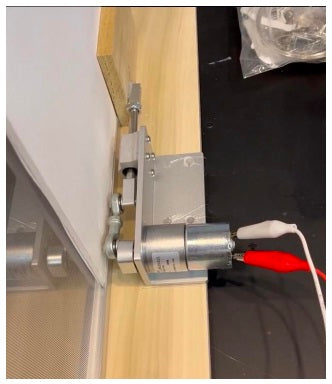
The actuator was physically too large for the frame dimensions. Gallery artwork requires a certain aesthetic proportion — mechanical elements protruding beyond the frame or creating an ungainly depth profile undermine the piece's visual impact. Beyond size concerns, the mechanism lacked the smooth, controlled motion necessary for the optical effect. Lenticular animation depends on consistent speed and positioning; any variance in motion translates directly to visual artifacts in the perceived animation.
Collaborating on Design Refinement
Working with Martin Van Diest, Heather began a series of design iterations aimed at miniaturization and motion control. They developed a custom wooden drawer system with channels that would guide the print's movement smoothly back and forth across the lenticular lens. This represented a significant mechanical improvement — rather than simply pushing the print with an actuator, they created a slide rail system that would maintain perfect alignment throughout the stroke.
To control the actuator's movement programmatically, they integrated an Arduino microcontroller. This allowed them to define precise motion profiles: speed, stroke length, dwell time at each end of travel, and cycling patterns. In theory, this setup should have solved their problems. In practice, two critical issues remained.
The Problems of Jittery Motion and Acoustic Noise
First, the motion wasn't smooth. The actuator exhibited jerkiness during direction changes and inconsistent speed throughout its stroke. For an optical effect dependent on steady motion, these irregularities were unacceptable. The lenticular animation would stutter and break, destroying the illusion.
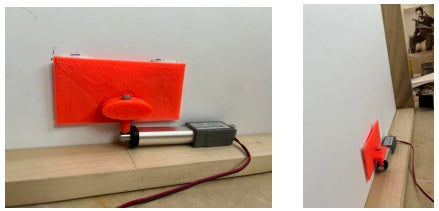
Second, and perhaps more problematically, the actuator was loud. Gallery spaces demand near-silence. Viewers expect to contemplate artwork in a quiet environment, and mechanical noise is particularly jarring in that context. The motor whine and gear noise from their compact actuator made the piece unsuitable for exhibition. The irony was clear: they had succeeded in creating motion-enhanced lenticular art but had simultaneously made it impossible to display in the very galleries where it belonged.
The Silent Actuator Breakthrough: Engineering Requirements for Gallery Installation
Heather's research into alternative actuation solutions led her to FIRGELLI's silent micro actuator line. These actuators are specifically engineered for applications where noise is unacceptable but precision and reliability remain essential. The technical specifications aligned precisely with her requirements.
Why Noise Reduction Matters in Actuator Design
Understanding what makes an actuator silent requires examining the noise sources in typical designs. Standard linear actuators use DC motors coupled to lead screws or ball screws through gear reduction systems. The primary noise sources are:
- Motor commutation noise: Brushed DC motors produce electromagnetic and mechanical noise as the commutator switches current between armature coils
- Gear noise: Metal gears under load generate audible vibration, particularly in compact actuators using plastic gears
- Lead screw friction: The nut traveling along the screw creates friction noise, especially in non-lubricated designs
- Vibration transmission: Actuator housing can act as a resonator, amplifying internal noise
FIRGELLI's silent actuators address these sources through precision manufacturing tolerances, optimized gear geometry, enhanced lubrication, and vibration-damping housing materials. The result is operational noise levels below 45 dB — quieter than a typical library and effectively inaudible in most gallery environments.
Technical Specifications for Art Applications
Beyond silence, the actuator needed to meet several other specifications for successful integration into Heather's artwork. The stroke length had to precisely match the lenticular effect's optimal animation window — too short and the effect wouldn't complete, too long and the print would move beyond the lens area. The force output had to overcome friction in the slide mechanism while maintaining smooth starts and stops. Speed control needed to be variable and precise, allowing the Arduino to create the exact motion profile that produced the best optical effect.
The compact form factor was equally critical. The finished artwork measures 26" × 12" × 3", and the actuator had to fit entirely within that depth envelope while leaving room for the slide mechanism, print mounting, and wiring. FIRGELLI's micro actuators are specifically designed for space-constrained applications, with stroke lengths available from 10mm to 100mm and cross-sectional dimensions as small as 10mm × 20mm.
Integration and Control System: Arduino Motion Programming and Sensor Integration
With the silent actuator selected, Martin Van Diest designed an enhanced control system that transformed the artwork from a repetitive mechanical demonstration into an interactive installation. The key innovation was integrating a motion sensor at the top of the frame.
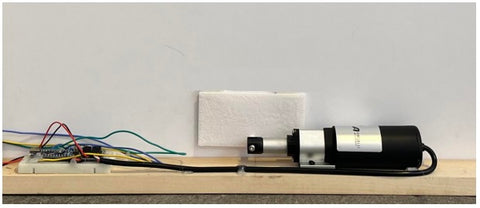
Arduino Programming for Smooth Motion Control
The Arduino microcontroller serves as the intelligence layer between the sensor input and actuator output. When the motion sensor detects a gallery visitor, the Arduino initiates a programmed motion sequence. This isn't simply a matter of extending and retracting the actuator — the motion profile is carefully crafted to optimize the lenticular effect.
The program likely implements pulse-width modulation (PWM) to control actuator speed, starting slowly to avoid jarring the mechanism, accelerating to the optimal viewing speed, then decelerating smoothly before reversing direction. Dwell times at each end of travel prevent abrupt direction changes. The FIRGELLI website provided code examples and wiring schematics that formed the foundation for this control system, though Martin customized the implementation for the specific artistic requirements.
Power Supply Considerations for Gallery Installation
Gallery installations require reliable, continuous operation over extended periods. The power supply selection had to account for the actuator's voltage and current requirements while providing stable output that wouldn't introduce electrical noise into the control system. The compact design also necessitated clean cable management to maintain the artwork's professional appearance from all viewing angles.
The Final Masterpiece: "Silent FIRGELLI" Performance and Exhibition Success
After multiple design iterations, technical setbacks, and collaborative problem-solving, Heather Lowe's vision materialized as "Silent FIRGELLI" — a 26" × 12" × 3" lenticular installation that represents a genuine innovation in kinetic art. The piece operates exactly as intended: silent, smooth, and mesmerizing.
Gallery visitors approach the apparently static piece, triggering the motion sensor. The lenticular print begins its programmed movement across the lens array, creating an animated sequence that couldn't be achieved through viewer movement alone. The effect is controlled, repeatable, and optimized in ways that passive lenticular art cannot match. Most importantly, the mechanism is completely silent — visitors experience only the visual magic, without any mechanical distraction.
Technical Achievement and Artistic Innovation
The piece demonstrates several important principles that extend beyond this specific installation. It proves that precision motion control technology, traditionally reserved for industrial applications, can be successfully adapted for artistic purposes when the specifications align properly. It shows that artist-engineer collaborations can solve problems neither party could address alone. And it validates the concept that interactive elements, when implemented thoughtfully, enhance rather than diminish fine art experiences.
The journey from noisy, oversized actuators to silent, integrated motion control also illustrates the importance of component selection. The wrong actuator — regardless of how it's programmed or mounted — would have made this project impossible. The right actuator became invisible, allowing the art itself to take center stage.
Applications for Artists and Designers: Beyond Lenticular Art
While "Silent FIRGELLI" focuses on lenticular animation, the underlying technology enables countless other creative applications. Artists and designers working in kinetic sculpture, interactive installations, theatrical sets, and museum exhibitions face similar challenges: they need reliable, controllable motion without noise, bulk, or visual intrusion.
Kinetic Sculpture Applications
Sculptors creating pieces with moving elements can use linear actuators to produce controlled, repeatable motion. Unlike motors with visible rotating shafts or hydraulic cylinders requiring pumps and reservoirs, electric actuators provide linear motion in a self-contained package. Silent operation becomes critical when the sculpture's movement is meant to be contemplative rather than mechanical.
Interactive Museum Installations
Museums increasingly incorporate interactive elements that respond to visitor presence or input. Motion control allows exhibits to reveal hidden information, transform configurations, or demonstrate mechanical principles. The combination of sensor input and programmed actuator response creates experiences that educate through participation. Silent operation is non-negotiable in these environments, where multiple exhibits operating simultaneously cannot create acoustic chaos.
Theatrical and Stage Automation
Theater productions use automated scenery, props, and effects that must operate reliably during live performance. While some effects benefit from dramatic mechanical sounds, many require silent operation to avoid breaking audience immersion. Compact actuators can be hidden within set pieces, enabling transformations that appear magical because the mechanism remains invisible and inaudible.
Selecting the Right Actuator for Creative Projects: Engineering Considerations
Heather Lowe's experience offers valuable lessons for anyone considering actuators for creative applications. The selection process should begin with clearly defined requirements across multiple dimensions.
Force and Stroke Requirements
Calculate the actual force needed to move your mechanism. For sliding applications like Heather's lenticular print, measure the friction force by pulling the element manually with a force gauge. Add a safety margin of 50-100% to account for variations and ensure smooth operation throughout the actuator's lifetime. Similarly, measure the required stroke length precisely — ordering an actuator with excess stroke complicates mounting and adds unnecessary size.
Speed and Control Requirements
Determine whether your application requires variable speed or simple on/off control. Feedback actuators provide position information that enables closed-loop control, allowing microcontrollers to position the actuator at specific points along its stroke or synchronize multiple actuators. Standard actuators without feedback are simpler and less expensive but only support full extension and retraction.
Mounting and Integration
Consider how the actuator will physically attach to your project. Most actuators provide mounting holes or mounting brackets at each end, but custom fabrication may be necessary for unusual configurations. The actuator's body also needs support — in Heather's case, the wooden drawer mechanism provided a stable mounting structure.
Noise Specifications for Public Spaces
If your project will operate in galleries, museums, residences, or other noise-sensitive environments, prioritize actuators specifically designed for quiet operation. Standard industrial actuators may produce 60+ dB of noise, which is unacceptable in these contexts. Silent actuators achieve sub-45 dB operation, making them effectively inaudible except in completely silent rooms.
Resources for Implementation: From Concept to Working Installation
One factor that enabled Heather's success was access to technical documentation and example code. FIRGELLI provides comprehensive resources for integrating actuators with Arduino and other microcontroller platforms, including wiring diagrams, sample code, and troubleshooting guides.
Control Electronics Options
Projects can implement actuator control at various complexity levels. The simplest approach uses a basic control box with manual switches for extend/retract. More sophisticated applications use microcontrollers programmed with custom logic, as Heather's installation demonstrates. For projects requiring wireless operation, remote control systems are available that integrate with various actuator models.
Prototyping and Testing Recommendations
Before committing to a final design, build a functional prototype that tests the complete motion sequence. This reveals issues with speed, force, noise, and control logic before they become permanent problems. Heather's experience — progressing through multiple actuator choices before finding the optimal solution — underscores the value of prototyping. The cost of testing different components is minimal compared to rebuilding a completed installation.
Conclusion: When Engineering Enables Art
"Silent FIRGELLI" stands as proof that technical challenges need not limit artistic vision — with the right components and collaborative problem-solving, artists can realize concepts that bridge mechanical engineering and fine art. Heather Lowe's journey from noisy, oversized actuators to silent, integrated motion control demonstrates the transformation that occurs when industrial-grade technology is adapted thoughtfully for creative applications.
The piece succeeds because every technical decision served the artistic intent. The silent operation preserves the contemplative gallery environment. The precise motion control optimizes the lenticular effect. The compact integration maintains aesthetic proportions. And the interactive sensor activation creates engagement without requiring instruction. These aren't compromises between art and engineering — they're examples of engineering in service of art.
For artists, designers, and makers considering motion control for their own projects, the lessons are clear: define your requirements precisely, prioritize the right specifications for your application, prototype thoroughly, and don't settle for components that work "well enough" when better solutions exist. The difference between Heather's early experiments and her final masterpiece wasn't artistic vision — that remained constant. The difference was finding actuator technology that could execute that vision without compromise.
Frequently Asked Questions
What is lenticular art and how does it create animation?
Lenticular art uses a plastic sheet with parallel cylindrical lenses (lenticules) laminated over an interlaced print of multiple images. As your viewing angle changes — either by walking past the piece or by the artwork moving — different interlaced images become visible through each lenticule, creating the illusion of animation, depth transformation, or 3D effects. Traditional lenticular art relies on viewer movement, but motion-enhanced lenticular art like Heather Lowe's "Silent FIRGELLI" reverses this by moving the print across the lens while the viewer remains stationary, creating a more controlled and dramatic animated effect.
Why is a silent actuator important for gallery artwork?
Gallery and museum environments require near-silence to allow visitors to contemplate artwork without distraction. Mechanical noise from motors or actuators is particularly jarring in these spaces, breaking the immersive experience that galleries strive to create. Standard actuators can produce 60+ dB of operational noise — roughly equivalent to normal conversation — which would make them unsuitable for public art installations. Silent actuators designed for noise-sensitive applications operate below 45 dB, making them effectively inaudible in typical gallery environments and allowing the art itself to remain the focus of attention.
How do you control a linear actuator with Arduino?
Controlling a linear actuator with Arduino requires connecting the microcontroller to a motor driver or relay that can handle the actuator's voltage and current requirements. The Arduino sends control signals that determine direction (extend or retract) and can use pulse-width modulation (PWM) to control speed. For basic on/off control, the Arduino activates relays that reverse polarity to change direction. More sophisticated control uses feedback actuators that report position back to the Arduino, enabling precise positioning anywhere along the stroke and programmed motion profiles with controlled acceleration and deceleration. FIRGELLI provides wiring diagrams and sample code that serve as starting points for custom programming.
What force rating do I need for a micro actuator in art installations?
The required force depends on what you're moving and the friction in your mechanism. For sliding applications like moving a lenticular print across a lens, measure the actual friction force by pulling the element manually with a force gauge or scale. Add a 50-100% safety margin to ensure smooth operation and account for variations over time. Heather Lowe's lenticular piece likely required only a few pounds of force given the small print size and low-friction slide mechanism. Micro actuators are available with force ratings from 5 lbs to over 100 lbs, so matching your specific requirements is straightforward. Oversizing force capacity by excessive amounts wastes power and can make the mechanism harder to control smoothly.
How do you make artwork interactive with motion sensors?
Interactive artwork uses sensors to detect viewer presence or actions, triggering programmed responses. For motion-activated installations like "Silent FIRGELLI," a passive infrared (PIR) sensor mounted on or near the artwork detects body heat from approaching visitors. The sensor output connects to a microcontroller (like Arduino) which monitors for triggers and initiates the programmed motion sequence when detected. The programming can include features like minimum time between activations (to prevent constant triggering), variable motion sequences, or timeout periods. This creates an engaging experience where the artwork responds to viewers without requiring buttons, instructions, or explicit interaction — visitors naturally trigger the effect simply by approaching to look at the piece.
What are the power requirements for a permanent art installation?
Permanent installations require reliable power supplies matched to the actuator's voltage and current specifications. Most micro actuators operate on 12V DC, though some use 6V or 24V. Calculate current requirements by checking the actuator's specifications under load — typically 1-3 amps for small actuators. The power supply should provide at least 20% more current capacity than the actuator's maximum draw to prevent overheating and ensure stable operation. For gallery installations, choose power supplies with proper certifications (UL, CE) and consider using enclosed power supplies that minimize electrical noise. Wire sizing should be appropriate for the current and cable length to prevent voltage drop, and all connections should be secure and properly insulated for safety and reliability over extended operating periods.


