Electric linear actuators have become indispensable components in modern automation, from adjusting solar panels and operating RV slide-outs to powering standing desks and TV lifts. Despite their widespread use, many engineers, hobbyists, and DIYers don't fully understand the elegant mechanical principles that allow these devices to convert rotary motion into precise linear movement. Whether you're selecting an actuator for your first automation project or optimizing a production line, understanding how these devices work internally will help you make better decisions about force requirements, speed considerations, and application suitability.
At FIRGELLI Automations, we've been engineering electric linear actuators since 2002, and one question consistently emerges from customers: how does a simple DC motor produce the powerful linear force needed to lift hundreds of pounds? The answer lies in a sophisticated interplay of gears, lead screws, and drive nuts—a system refined over decades of industrial engineering. In this comprehensive guide, we'll take you inside a linear actuator to reveal exactly how these components work together, why the force-speed trade-off is fundamental to actuator design, and what you need to know when selecting the right actuator for your application.
The Fundamental Principle: Rotary-to-Linear Conversion
Every electric linear actuator begins with rotational movement. At the heart of the system is a DC motor, typically operating on 12V or 24V power, which produces continuous rotary motion. The engineering challenge—and the core innovation of linear actuators—is converting this spinning motion into controlled linear movement that can push, pull, lift, or lower a load.

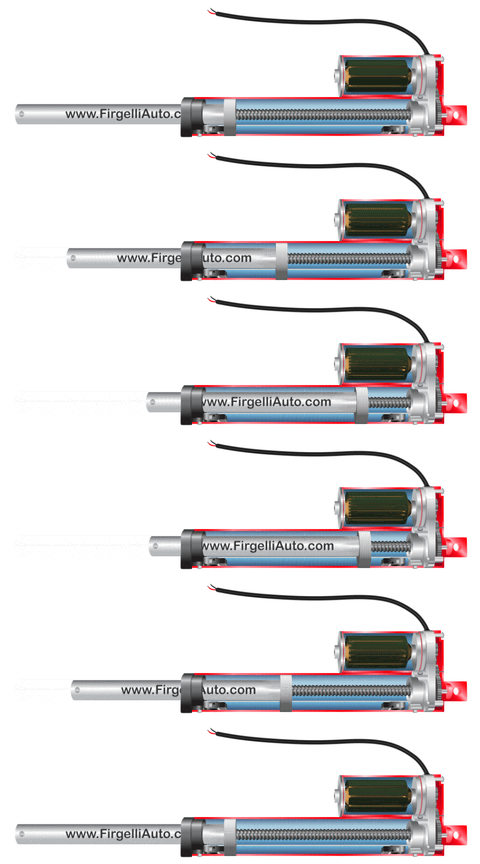
This conversion happens through a lead screw mechanism—a threaded rod that acts as the critical interface between rotary and linear motion. When the motor spins, it rotates the lead screw through a gearbox. A drive nut, which is prevented from rotating by the actuator housing, rides along the lead screw's threads. As the lead screw spins, the drive nut is forced to move linearly along the screw's length, either extending or retracting the actuator shaft depending on the direction of motor rotation.
The beauty of this system lies in its mechanical advantage. The helical threads of the lead screw effectively "unwind" the rotational force, translating high-speed, low-torque motor rotation into slow-speed, high-force linear movement. This is why a small DC motor consuming just a few amps can generate hundreds or even thousands of pounds of linear force—the lead screw geometry provides substantial mechanical advantage.
Core Components Inside an Actuator
Understanding what's inside a linear actuator helps explain not just how it works, but also why certain specifications and limitations exist. Let's examine each major component and its function within the system.
The DC Motor
The DC motor is the power source for the entire actuator assembly. Most linear actuators use permanent magnet DC motors rated for 12V or 24V operation. These motors are selected for their reliability, controllability, and compatibility with common power systems used in automotive, marine, and industrial applications. The motor's speed is relatively constant at a given voltage, typically ranging from 3,000 to 5,000 RPM unloaded. This high rotational speed must be dramatically reduced to produce the slow, powerful linear motion required for most applications.
Gearbox Assembly
The gearbox is where the fundamental force-speed trade-off occurs. A multi-stage gear reduction system—typically using spur gears, planetary gears, or a combination—reduces the motor's high-speed rotation to a much slower speed while proportionally increasing the available torque. A typical gear ratio might range from 50:1 for high-speed applications to 500:1 or higher for industrial actuators requiring maximum force.
The gear ratio directly determines the actuator's performance characteristics. A higher gear ratio means more force but slower speed, while a lower ratio provides faster movement with less force. This is why FIRGELLI offers multiple models with different force and speed ratings—we're essentially changing the internal gear ratios to meet different application requirements. For instance, a micro linear actuator designed for light-duty applications might use a 100:1 ratio, while a heavy-duty industrial actuator might employ a 400:1 ratio for maximum lifting capacity.
Lead Screw and Drive Nut
The lead screw is a precision-threaded rod, typically made from steel or stainless steel for durability and corrosion resistance. Most actuators use ACME thread profiles, which offer an excellent balance of efficiency, strength, and self-locking properties. The thread pitch—the distance the nut travels per revolution—determines how much linear movement occurs for each rotation of the screw.
The drive nut (often called an ACME nut) engages with the lead screw threads and is constrained within the actuator housing so it cannot rotate. When the lead screw spins, the nut is forced to travel along its length. In most designs, the drive nut is made from bronze, brass, or engineered plastic, materials chosen for their low friction and wear resistance when paired with a steel lead screw. This drive nut also serves a secondary function: it engages the limit switches at the end of each stroke to stop the actuator's movement.

Extension Tube and Shaft
The outer tube provides structural support and houses all the internal components. The inner shaft or rod extends through this tube and attaches to the drive nut assembly. As the drive nut moves along the lead screw, it carries the shaft with it, creating the visible linear extension. The stroke length of an actuator—the total distance it can extend—is determined by the length of the lead screw and the physical constraints of the housing design.
FIRGELLI actuators use different shaft and lead screw lengths to create products with strokes ranging from just 1 inch in compact micro actuators to 60 inches or more in specialized industrial models. The shaft is typically chrome-plated steel or stainless steel for corrosion resistance and smooth operation.
Limit Switches: Critical Protection System
One of the most important yet often overlooked components in a linear actuator is the built-in limit switch system. Approximately 90% of quality linear actuators include these safety devices, and understanding how they work is crucial for reliable operation.

Why Limit Switches Matter
Without limit switches, an actuator would attempt to continue moving even after reaching the physical end of its stroke. The consequences would be severe: the drive nut would slam into the mechanical stop, the motor would stall while drawing maximum current, internal components could strip or break, and the motor would eventually overheat and fail. Limit switches prevent this catastrophic scenario by cutting power to the motor when the actuator reaches either its fully extended or fully retracted position.
How Limit Switches Operate with Diodes
The clever design of limit switch circuits incorporates diodes to allow bidirectional operation even when a limit is triggered. Each limit switch contains a diode—a semiconductor component that allows electrical current to flow in only one direction, functioning like a one-way valve for electricity.

Here's how the system works: When the actuator reaches full extension, the drive nut physically triggers the extend limit switch, opening the circuit and stopping the motor. However, the diode in the circuit allows current to flow when the polarity is reversed. This means you can immediately reverse the motor direction to retract the actuator, even though the extend limit switch is still being triggered. Once the drive nut moves away from the limit switch position, normal bidirectional operation resumes.
The same principle applies to the retract limit switch at the opposite end of the stroke. This elegant design ensures that the actuator can always reverse direction from either limit position without requiring any reset procedure or manual intervention—a critical feature for automated systems and remote-controlled applications like TV lifts or adjustable furniture.
The Force-Speed Trade-Off Explained
Understanding the inverse relationship between force and speed is fundamental to selecting the right actuator for your application. This trade-off isn't a design limitation—it's a consequence of basic physics and mechanical engineering principles.
The Physics Behind the Trade-Off
The DC motor in an actuator delivers relatively constant power at a given voltage. Power is the product of force and speed, which means if you increase force, speed must decrease proportionally, and vice versa. The gearbox and lead screw system control where on this force-speed curve your actuator operates.
A high gear ratio (like 400:1) dramatically reduces the motor's speed but increases torque by the same ratio. When this increased torque is applied to the lead screw, it translates to high linear force. Conversely, a low gear ratio (like 50:1) maintains higher speed but provides less torque and therefore less linear force. This is why a bullet actuator designed for speed might move at 2 inches per second but only generate 50 lbs of force, while a heavy-duty actuator might move at just 0.2 inches per second but deliver 2,000 lbs of force.
Practical Implications for Selection
When selecting an actuator, you must decide which is more important for your application: speed or force. For a TV lift mechanism, moderate speed with sufficient force to lift the television smoothly is ideal—typically 0.5 to 1.0 inches per second with 200-400 lbs of force. For a standing desk, you need enough force to lift a desktop with equipment (often 200-500 lbs total) but speed is less critical since the adjustment happens infrequently.

Industrial applications might require maximum force even if that means very slow movement. Solar panel tracking systems, for example, need substantial force to overcome wind loads but can move quite slowly since they're only adjusting position gradually throughout the day. In contrast, automotive applications like tonneau cover lifts might prioritize speed for user convenience while still providing adequate force.
Voltage and Speed Considerations
Because the DC motor speed is relatively constant at a given voltage, you can increase actuator speed by increasing the operating voltage. A 12V actuator will move approximately twice as fast when operated at 24V. However, this comes with important caveats: higher voltage operation increases wear on internal components, generates more heat, and can reduce the actuator's duty cycle and overall lifespan. For continuous or high-frequency operation, it's better to select an actuator with the appropriate gear ratio for your speed requirements rather than over-volting a slower unit.
Stroke Length and Customization Options
The stroke length—the total distance an actuator can extend—is another critical specification determined by the internal design. FIRGELLI achieves different stroke lengths by changing the length of the lead screw and the corresponding inner shaft. A 6-inch stroke actuator has a 6-inch lead screw, while a 24-inch stroke model has a 24-inch lead screw.
The stroke length you need depends entirely on your application. For drawer slides, the stroke should match the depth of the drawer. For TV lifts, the stroke must be sufficient to raise the television from its hidden position to viewing height. For hatch or door operators, the stroke determines how far the opening can travel.
It's important to note that longer strokes don't affect the actuator's force or speed specifications—those are determined by the motor and gearbox combination. However, very long strokes may introduce concerns about column strength and buckling under high loads, particularly in compression applications. For specialized requirements, track actuators provide excellent side-load resistance and stability over longer strokes.
Advanced Actuator Features and Options
Modern linear actuators have evolved beyond the basic motor-gearbox-leadscrew configuration to include features that enhance functionality and control precision.
Position Feedback Systems
Feedback actuators incorporate potentiometers or Hall effect sensors that provide real-time position information. This allows you to know exactly where the actuator is at any moment and to command it to specific positions rather than just fully extended or fully retracted. Feedback is essential for synchronized multi-actuator systems, precise positioning applications, and integration with Arduino or other microcontroller-based control systems.
Control Systems and Automation
While basic actuator operation requires only reversing polarity to change direction, many applications benefit from dedicated control boxes and remote controls. These systems can provide features like soft-start/soft-stop to reduce mechanical shock, position memory, synchronization of multiple actuators, and integration with home automation systems. Pairing your actuators with appropriate power supplies ensures stable operation and protects against overcurrent conditions.
Mounting Hardware and Installation
Proper mounting is crucial for actuator longevity and performance. Mounting brackets allow the actuator to pivot at both ends, ensuring that force is applied purely along the actuator's axis. Side-loading—force applied perpendicular to the actuator shaft—dramatically increases wear and can cause premature failure. The clevis and tang mounting styles used on most actuators accommodate the angular movement that occurs as the actuator extends or retracts in a hinged mechanism.
Maintenance and Longevity Considerations
Electric linear actuators are designed for long service life with minimal maintenance, but understanding what affects longevity helps you maximize your investment.
The duty cycle—the ratio of operating time to rest time—is a critical factor. Most actuators are rated for a 20% or 25% duty cycle, meaning they can operate for 2 minutes out of every 10 minutes. Exceeding the rated duty cycle causes excessive heat buildup in the motor and gearbox, accelerating wear and potentially causing failure. For applications requiring continuous or near-continuous operation, industrial actuators with higher duty cycle ratings are available.
Environmental protection is another consideration. The IP (Ingress Protection) rating indicates how well the actuator is sealed against dust and moisture. Indoor applications like TV lifts or standing desks typically require only IP54 protection, while outdoor or marine applications need IP66 or higher to prevent corrosion and contamination.
Proper lubrication of the lead screw and drive nut is essential for smooth operation and long life. Quality actuators come with appropriate lubrication from the factory, but for very high-cycle applications, periodic re-lubrication may extend service life. The gearbox is typically sealed and requires no maintenance over the actuator's operational life.
Conclusion
Understanding the inner workings of a linear actuator—from the DC motor and gearbox through the lead screw mechanism to the limit switch protection system—empowers you to make informed decisions about actuator selection and application design. The fundamental principles of rotary-to-linear conversion, the unavoidable force-speed trade-off, and the protective role of limit switches with diodes form the foundation of actuator operation.
Whether you're building a custom automation project, specifying components for industrial equipment, or simply trying to understand how your TV lift or standing desk works, this knowledge helps you appreciate the elegant engineering that converts simple electrical power into precise, powerful linear motion. At FIRGELLI Automations, we've refined these principles over two decades of actuator design and manufacturing, creating reliable solutions for applications ranging from micro actuators for compact projects to heavy-duty industrial actuators for demanding environments.
Frequently Asked Questions
Why can't a linear actuator have both high force and high speed?
The force-speed trade-off is determined by the constant power output of the DC motor. Since power equals force multiplied by speed, increasing one necessarily decreases the other. The gearbox gear ratio controls this balance—high ratios multiply torque (creating more linear force) but reduce speed, while low ratios maintain speed but provide less force. This is a fundamental mechanical principle, not a design limitation. If your application truly requires both high force and speed, you would need a larger motor with higher power output, which increases size, cost, and power consumption.
Are limit switches necessary, or can I control an actuator without them?
While technically possible to operate an actuator without limit switches using external control logic, built-in limit switches provide essential protection against mechanical damage and motor burnout. Without them, if the actuator reaches the end of its stroke and continues to receive power, the motor will stall while drawing maximum current, quickly overheating and failing. The internal components may also be damaged by the extreme mechanical stress. Approximately 90% of quality actuators include limit switches for this reason. For applications requiring more sophisticated control, feedback actuators with position sensors are a better solution than eliminating limit switches.
Can I increase actuator speed by running it at higher voltage?
Yes, you can increase speed by operating a 12V actuator at 24V, roughly doubling the speed. However, this comes with significant trade-offs. Higher voltage operation increases current draw, generates more heat, accelerates wear on the motor brushes and gearbox, and reduces the actuator's duty cycle and overall lifespan. For occasional or short-duration use, modest over-voltage operation may be acceptable, but for regular operation or high-frequency cycling, it's better to select an actuator with the appropriate gear ratio for your required speed. Over-volting should be considered a temporary solution, not a long-term operating strategy.
What causes an actuator to stop moving under load even though the motor is running?
If the motor continues running but the actuator shaft doesn't move, the most common cause is a stripped gear or a damaged lead screw/drive nut interface. This typically happens when the actuator has been overloaded beyond its rated capacity or operated with excessive side-loading that should have been absorbed by proper mounting brackets. It can also occur if the actuator has reached the end of its service life in high-cycle applications. Another possibility is mechanical binding due to contamination in the lead screw mechanism or misalignment in the installation. Always ensure your actuator is rated for at least 1.5-2 times your maximum expected load to provide an adequate safety margin.
How do I determine what stroke length I need for my application?
The required stroke length depends on the geometry of your mechanism and how much linear travel you need. For a simple push-pull application, measure the distance between the fully closed and fully open positions—that's your minimum stroke length. For hinged mechanisms like hatches or lift systems, the calculation is more complex because the effective linear distance changes as the angle changes. A good rule of thumb is to sketch your mechanism in both extreme positions and measure the distance between the mounting points at each extreme. The difference is your required stroke. It's often wise to add 10-20% to this calculated stroke to provide installation tolerance and ensure the actuator isn't operating at its absolute limits, which can trigger the limit switches prematurely due to mounting variations.
What is duty cycle and why does it matter?
Duty cycle is the ratio of operating time to total time, typically expressed as a percentage. A 20% duty cycle means the actuator can operate for 2 minutes and then must rest for 8 minutes to dissipate heat. During operation, the motor and gearbox generate heat from electrical resistance and mechanical friction. If operated continuously beyond the rated duty cycle, this heat accumulates faster than it can dissipate, eventually causing motor damage, gear wear, or lubricant breakdown. For applications requiring frequent or continuous operation—such as standing desks in commercial settings or industrial automation—select actuators rated for higher duty cycles (50% or 100%) or industrial actuators specifically designed for continuous use.
How can I synchronize multiple actuators to move together?
Synchronizing multiple actuators requires position feedback to ensure they maintain the same position throughout travel. Standard actuators without feedback will naturally vary slightly due to manufacturing tolerances, load differences, and friction variations. Feedback actuators with built-in potentiometers or Hall effect sensors provide position data that a control box can use to command all actuators to the same position simultaneously. For simpler applications, mechanical linkages can ensure synchronization, though this adds complexity to the installation. When synchronization is critical—such as in TV lift systems where uneven lifting would damage the mechanism—investing in feedback actuators and appropriate control electronics is essential.


