When it comes to selecting linear actuators for outdoor applications, marine environments, or industrial settings exposed to the elements, one question stands above all others: will water damage destroy my investment? From automated boat hatches and outdoor enclosures to agricultural equipment and industrial machinery, understanding water protection is critical for ensuring longevity, reliability, and safety. The answer to whether linear actuators are waterproof isn't a simple yes or no—it depends entirely on the actuator's design, construction, and most importantly, its IP rating.
🎥 Video — Are Linear Actuators Waterproof?
At FIRGELLI Automations, we've spent over two decades engineering motion control solutions for environments ranging from pristine indoor installations to harsh marine conditions. Our experience has taught us that proper water protection isn't just about sealing an enclosure—it's about understanding the specific demands of your application and selecting an actuator with the appropriate ingress protection rating. Whether you're designing an automated boat cover system, an outdoor solar tracker, or simply need an actuator that can withstand occasional rain exposure, this comprehensive guide will help you navigate the complexities of waterproofing and make an informed decision.
In this article, we'll demystify IP ratings, explain the critical difference between waterproof and water-resistant actuators, and provide practical guidance for selecting the right level of protection for your specific application. We'll also address common misconceptions and help you understand what protection ratings mean in real-world conditions.
Understanding Waterproof vs. Water-Resistant: Critical Distinctions
The terms "waterproof" and "water-resistant" are frequently used interchangeably in marketing materials, but they represent fundamentally different levels of protection. Understanding this distinction is essential when selecting linear actuators for applications involving moisture exposure.
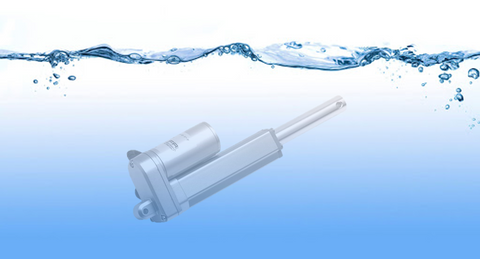
Water-resistant actuators are designed to resist water penetration under specific conditions and for limited durations. Think of them as having defensive barriers that work effectively against splashes, rain, and temporary exposure to moisture. A water-resistant actuator can handle getting wet, but it has limitations—prolonged submersion or exposure to high-pressure water jets will eventually compromise the internal components. Most consumer electronics, including smartphones marketed as "waterproof," are actually water-resistant with defined operational limits.
Waterproof actuators, by contrast, are engineered to prevent water ingress entirely, even under continuous submersion at significant depths. These actuators feature advanced sealing technologies, specialized gaskets, and materials specifically chosen for their impermeability. True waterproof actuators can operate underwater indefinitely without any degradation to their electrical or mechanical systems. This level of protection is essential for marine applications, underwater robotics, and any scenario where the actuator will be continuously submerged.
The practical difference becomes clear in real-world applications. A water-resistant industrial actuator with an IP65 rating works perfectly for an outdoor gate system that sees occasional rain and wind-driven moisture. However, that same actuator would fail quickly if used to control a submerged boat rudder or an underwater camera platform—applications that demand truly waterproof actuators rated IP68.
Decoding the IP Rating System for Linear Actuators
The Ingress Protection (IP) rating system, established by the International Electrotechnical Commission (IEC 60529), provides a standardized method for classifying the degree of protection an enclosure offers against intrusion by solid objects and liquids. For engineers and designers, IP ratings eliminate guesswork and provide precise specifications for environmental protection capabilities.
How IP Ratings Are Structured
An IP rating appears as "IP" followed by two digits (e.g., IP65, IP68). Each digit conveys specific information about protection levels:
First Digit: Protection Against Solids
- 0: No protection against solid objects or dust
- 1: Protected against solid objects larger than 50mm (large body parts like hands)
- 2: Protected against solid objects larger than 12.5mm (fingers and similar objects)
- 3: Protected against solid objects larger than 2.5mm (tools, thick wires)
- 4: Protected against solid objects larger than 1mm (most wires, small tools)
- 5: Dust protected (limited ingress permitted, but no harmful deposits)
- 6: Dust-tight (complete protection against dust ingress)
Second Digit: Protection Against Liquids
- 0: No protection against liquids
- 1: Protected against vertically falling water droplets
- 2: Protected against water droplets falling at angles up to 15°
- 3: Protected against water spray at angles up to 60°
- 4: Protected against water splashes from all directions
- 5: Protected against low-pressure water jets from any direction
- 6: Protected against powerful water jets and heavy seas (marine applications)
- 7: Protected against temporary immersion (15cm to 1m depth for 30 minutes)
- 8: Protected against continuous immersion under pressure (true waterproof)

Interpreting IP Ratings for Your Application
Understanding what these numbers mean in practical terms helps you select the appropriate actuator for your specific environment:
IP54: Suitable for indoor applications with occasional dust and splash exposure. Common in factory automation where equipment may encounter cleaning operations but not direct water jets or submersion.
IP65: The most common rating for outdoor linear actuators. Completely dust-tight and protected against low-pressure water jets from any direction. Ideal for exposed outdoor installations, agricultural equipment, and automated systems that experience rain, snow, and wind-driven moisture. Most FIRGELLI outdoor-rated actuators carry this specification.
IP66: Similar to IP65 but with enhanced protection against powerful water jets and heavy seas. Recommended for marine deck applications, car wash equipment, and industrial settings with high-pressure washdown procedures.
IP67: Dust-tight with protection against temporary immersion up to 1 meter for 30 minutes. Suitable for applications where accidental submersion might occur, such as actuators mounted low on marine vessels or equipment used near water bodies.
IP68: The highest practical rating for industrial actuators. Completely dust-tight and protected against continuous immersion under manufacturer-specified pressure. Essential for underwater robotics, submersible platforms, boat trim tab systems, and any application requiring sustained underwater operation. The specific depth and duration ratings vary by manufacturer and should be confirmed for your exact requirements.
Selecting the Right IP Rating for Your Application
Choosing the appropriate IP rating involves carefully analyzing your application's environmental conditions, exposure patterns, and reliability requirements. Over-specifying protection adds unnecessary cost, while under-specifying risks premature failure and costly replacements.
Outdoor and Exposed Applications
For most outdoor automation projects—including TV lifts in covered outdoor entertainment areas, automated gates, solar trackers, and agricultural equipment—an IP65 rating provides excellent protection at a reasonable cost. This rating ensures complete dust protection and handles rain, snow, and wind-driven moisture effectively. The actuator can withstand pressure washing at moderate distances and temporary exposure to water jets during cleaning operations.
However, if your application involves direct exposure to high-pressure water (such as equipment near irrigation systems, waterfront installations subject to wave splash, or machinery that requires frequent high-pressure cleaning), consider IP66-rated actuators. The enhanced protection against powerful water jets significantly extends service life in these demanding conditions.
Marine and Boating Applications
Marine environments present unique challenges that go beyond simple water exposure. Saltwater is highly corrosive, and the combination of moisture, salt spray, and constant motion creates one of the harshest operating conditions for electrical equipment. For marine applications such as automated boat hatches, anchor systems, or deck equipment, IP66 is the minimum recommended rating, with IP67 or IP68 preferred for components regularly exposed to waves and saltwater spray.
For applications involving submersion—including underwater camera systems, submerged lighting platforms, boat trim tabs, or any actuator that operates below the waterline—IP68 rating is mandatory. When selecting IP68-rated bullet actuators or other underwater-capable models, always verify the manufacturer's specified maximum depth and continuous operation duration. These specifications vary significantly between products and directly impact reliability and warranty coverage.
Additionally, consider that marine-rated actuators should feature corrosion-resistant materials such as stainless steel shafts and marine-grade aluminum housings. The IP rating addresses water ingress, but material selection determines resistance to the corrosive effects of saltwater exposure over time.
Industrial and Washdown Environments
Food processing facilities, pharmaceutical manufacturing, and chemical processing plants often require regular high-pressure washdown to maintain sanitary conditions. Equipment in these environments must withstand not only water exposure but also cleaning chemicals and sanitizers. IP66 or IP67 ratings are standard for washdown-compatible industrial actuators, depending on the intensity and frequency of cleaning operations.
In environments where actuators might be temporarily submerged during flooding or cleaning procedures, IP67 provides essential protection. The 30-minute submersion resistance at depths up to 1 meter offers a critical safety margin for industrial equipment that must maintain operational integrity during facility cleaning cycles.
Protected Outdoor and Covered Locations
Some outdoor applications enjoy partial environmental protection—covered patios, carports, overhangs, and semi-enclosed structures shield equipment from direct precipitation while still exposing it to humidity, condensation, and occasional moisture. For these scenarios, IP54 or IP55 ratings often suffice, offering splash protection and dust resistance at a lower cost than fully weatherproof alternatives.
However, remember that wind-driven rain can reach equipment under overhangs, and condensation forms on equipment exposed to temperature fluctuations even under cover. When budget permits, specifying IP65 for covered outdoor applications provides additional reliability margin and extends service intervals.
Beyond IP Ratings: Complete System Protection
A common misconception is that selecting an actuator with an appropriate IP rating guarantees a waterproof installation. In reality, the IP rating applies only to the actuator's enclosure itself—not to the electrical connections, mounting brackets, control boxes, or wiring that complete the system.
Protecting Electrical Connections and Wiring
The electrical connections to your linear actuator represent the most vulnerable point in any weatherproof installation. Bare wire terminals, screw connections, and standard connectors will corrode rapidly when exposed to moisture, even if the actuator body maintains perfect integrity. To achieve system-level protection:
- Use marine-grade heat-shrink tubing with adhesive lining to seal all wire splices completely
- Apply dielectric grease to all electrical connections before assembly to displace moisture and prevent corrosion
- Select waterproof connectors rated for your application environment (IP67 or IP68 connectors are available for marine and submersible applications)
- Route wiring away from direct water exposure wherever possible, using drip loops to prevent water migration along wire runs
- Protect connection points inside enclosures rated equal to or higher than your actuator's IP rating
- Consider potted connections (encapsulation in waterproof epoxy) for permanent installations in harsh environments
Control System and Power Supply Considerations
Your power supply and control electronics require equal attention to environmental protection. A NEMA-rated electrical enclosure matching or exceeding your actuator's IP rating protects controllers, relays, and power supplies from moisture damage. For outdoor installations, NEMA 4X enclosures (roughly equivalent to IP66) provide excellent protection against rain, snow, corrosion, and windblown dust.
Position control enclosures where they avoid direct water exposure and ensure proper drainage. Even weatherproof enclosures can collect water if mounted in positions where water pools around seals or penetrations. Mounting enclosures with a slight forward tilt allows any water that enters to drain away rather than accumulating inside.
Mounting and Installation Best Practices
How you mount and install your track actuators or other linear actuators significantly impacts long-term water resistance. Even IP68-rated actuators can fail prematurely if installed improperly:
- Mounting orientation: Whenever possible, mount actuators with the motor end higher than the stroke end, allowing any condensation that forms to drain away from electrical components
- Cable entry points: Use downward-facing cable entries or install cable glands that prevent water from running down wires into the actuator housing
- Mounting bracket drainage: Ensure mounting brackets don't create water collection points where moisture can pool against actuator seals
- Regular inspection schedule: Even the best seals degrade over time. Establish a maintenance schedule to inspect seals, gaskets, and connections periodically
Common Misconceptions About Waterproof Linear Actuators
Several persistent myths about waterproofing lead to poor product selection and installation failures. Understanding these misconceptions helps you make better decisions:
Myth: Higher IP ratings are always better. While IP68 actuators offer maximum protection, they're also more expensive and may be over-engineered for applications requiring only splash resistance. An IP65 actuator typically costs less, offers easier maintenance access, and performs perfectly in most outdoor applications where submersion isn't a risk.
Myth: IP ratings cover all environmental factors. IP ratings specifically address solid particle and liquid ingress. They don't account for chemical exposure, UV degradation, temperature extremes, or corrosive atmospheres. Marine environments require additional consideration of material corrosion resistance beyond the IP rating alone.
Myth: Waterproof actuators never require maintenance. All mechanical systems require periodic inspection and maintenance, regardless of IP rating. Seals degrade over time, particularly in applications involving frequent movement, temperature cycling, or UV exposure. Regular inspection and seal replacement according to manufacturer recommendations ensure continued protection.
Myth: Any IP67 or IP68 actuator works underwater indefinitely. Even IP68-rated actuators have specified depth and duration limits that vary by manufacturer. Always verify these specifications match your application requirements. Some IP68 actuators are rated for shallow submersion only, while others can operate at significant depths.
FIRGELLI Waterproof and Weather-Resistant Actuator Solutions
At FIRGELLI Automations, we engineer linear actuators for a wide range of environmental conditions, from climate-controlled indoor installations to harsh marine environments. Our product line includes various IP-rated options designed to meet specific application demands:
Our standard industrial actuators carry IP65 ratings, making them ideal for outdoor automation projects, agricultural equipment, and industrial applications where dust protection and water jet resistance are essential. These actuators feature completely sealed motor compartments with specialized gaskets preventing moisture ingress during rain exposure, pressure washing, and dust-laden environments.
For marine and submersible applications, we offer IP66 and IP67-rated models engineered with marine-grade materials including corrosion-resistant coatings, stainless steel shafts, and enhanced sealing systems. These actuators withstand saltwater spray, temporary immersion, and the corrosive conditions present in boating environments.
Our feedback actuators with environmental protection provide position sensing capabilities in outdoor applications, enabling precise automated control in systems exposed to weather while maintaining the same ingress protection as our standard models.
When selecting any FIRGELLI actuator for wet or outdoor environments, our technical team can provide specific guidance on IP ratings, material compatibility, and installation best practices for your particular application. We understand that proper specification goes beyond catalog ratings—it requires understanding the complete operational environment and designing systems that perform reliably over years of service.
Testing and Certification Standards
IP ratings aren't simply marketing claims—they're the result of standardized testing procedures performed according to IEC 60529 protocols. Understanding how these tests work provides confidence in the ratings and helps interpret what they mean for your application.
For solid ingress protection (first digit), testing involves attempting to introduce test probes or dust of specific sizes into the enclosure. A dust-tight IP6X rating requires eight hours of exposure to talcum powder circulated under negative pressure—if no dust penetrates to the electrical components, the enclosure passes.
Liquid ingress testing (second digit) follows progressively more severe procedures. IPX4 testing involves spraying water from all directions at 10 liters per minute for five minutes. IPX5 testing uses water jets at 12.5 liters per minute at increasing pressures. IPX7 testing requires complete submersion at specified depths for 30 minutes, with the unit inspected afterward for any water penetration that could impair operation.
For IP68 certification, manufacturers specify the exact test conditions—depth, duration, and water type—under which the enclosure maintains protection. This is why you'll see variations in IP68 specifications between different actuators; one might be rated for 2 meters continuous submersion, while another is certified for 10 meters.
When evaluating actuators from different manufacturers, look for certification documentation from recognized testing laboratories. Independent third-party certification provides assurance that ratings are legitimate and testing was performed correctly.
Making the Right Choice for Your Application
Selecting between waterproof and water-resistant linear actuators ultimately depends on carefully analyzing your application's environmental demands, installation location, exposure patterns, and reliability requirements. While IP ratings provide a standardized framework for understanding protection levels, successful implementation requires considering the complete system—electrical connections, control equipment, mounting methods, and maintenance procedures.
For most outdoor automation projects not involving submersion, IP65-rated linear actuators deliver excellent protection at reasonable cost. Marine applications and equipment subject to wave splash benefit from IP66 or IP67 ratings, while truly submerged applications demand IP68 certification with verified depth and duration specifications matching your operational parameters.
Remember that the IP rating applies to the actuator enclosure itself. Achieving system-level water resistance requires equal attention to protecting electrical connections, control systems, and all components of your installation. Proper wire sealing, waterproof connectors, appropriate enclosures, and correct mounting orientation all contribute to long-term reliability in wet environments.
Frequently Asked Questions
Is IP65 good enough for outdoor use of linear actuators?
Yes, IP65-rated linear actuators are generally excellent for outdoor applications that don't involve submersion. An IP65 rating provides complete dust protection and protection against water jets from any direction, which effectively handles rain, snow, wind-driven moisture, and even moderate pressure washing. This rating is standard for outdoor gates, agricultural equipment, solar trackers, and similar applications. However, if your installation involves direct exposure to high-pressure water jets, wave splash in marine environments, or any possibility of temporary submersion, consider upgrading to IP66 or IP67 for additional protection margin.
Can I use an IP54 linear actuator outside if it's under a cover?
While an IP54 actuator can work in covered outdoor locations with limited moisture exposure, this represents minimal protection that leaves little margin for error. IP54 protects against dust and water splashes, but wind-driven rain can easily reach equipment under overhangs, and condensation forms on equipment exposed to temperature fluctuations even under cover. If your budget allows, specifying IP65 for covered outdoor applications provides significantly better long-term reliability and extends maintenance intervals. The modest additional cost of IP65 protection typically proves worthwhile through reduced maintenance and longer service life.
What IP rating do I need for a submersible linear actuator?
For any application involving continuous submersion, you need an IP68-rated linear actuator specifically certified for underwater use. However, IP68 ratings vary significantly between manufacturers, with different depth and duration specifications. Always verify the exact submersion depth and continuous operation duration that the manufacturer certifies. Some IP68 actuators are rated only for shallow submersion (up to 1 meter), while others can operate at depths of 10 meters or more. Additionally, for marine submersion involving saltwater, confirm that the actuator features corrosion-resistant materials such as stainless steel shafts and marine-grade coatings, as the IP rating addresses water ingress but not corrosion resistance.
Do IP ratings cover the electrical connections on linear actuators?
No, IP ratings apply only to the actuator's sealed enclosure, not to the electrical connections, wiring, or terminals. This is one of the most common misconceptions about waterproof actuators. Even if you purchase an IP68-rated actuator, the bare wire connections will corrode rapidly if exposed to moisture unless you take additional protective measures. To achieve system-level protection, you must use marine-grade heat-shrink tubing with adhesive lining, apply dielectric grease to all connections, select waterproof connectors rated for your environment, and protect connection points inside appropriately rated enclosures. Many actuator failures in outdoor applications result from neglecting electrical connection protection rather than actuator seal failure.
Can I pressure wash an IP65 linear actuator?
Yes, IP65-rated actuators are designed to withstand low-pressure water jets from any direction, which includes most standard pressure washing operations at reasonable distances. However, maintain appropriate standoff distances and avoid concentrating high-pressure streams directly on seals, cable entries, or mounting points for extended periods. If your application requires frequent high-pressure washdown at close range—common in food processing and pharmaceutical manufacturing—consider IP66-rated actuators specifically designed for powerful water jet resistance. Always follow the manufacturer's guidelines regarding pressure washing, and establish appropriate standoff distances and pressure limits to maximize seal life and maintain warranty coverage.
Do waterproof linear actuators require any special maintenance?
Yes, even waterproof linear actuators require periodic inspection and maintenance to ensure continued protection over time. Seals and gaskets degrade gradually due to UV exposure, temperature cycling, mechanical wear, and normal aging. Establish a regular inspection schedule—annually for most outdoor applications, more frequently for marine environments—to examine seals for cracking, hardening, or damage. Check that cable glands and connector seals remain tight and intact. Inspect electrical connections for any signs of corrosion, even in sealed enclosures. Clean exterior surfaces to prevent debris accumulation around seals. Following the manufacturer's recommended maintenance schedule and replacing seals proactively according to service life specifications prevents premature failures and extends overall actuator life significantly.


