Whether you’re working out antenna size, picking a fiber optic wavelength, or figuring out a photon's energy, you always come back to the same group of variables: speed, frequency, and wavelength. This calculator lets you solve for whichever parameter you’re missing—wavelength, frequency, wave speed, or photon energy—using the data you’ve got. You can use it for jobs ranging from radio to optics to acoustics, and it’s handy for quantum calculations too. You’ll find all the basic formulas, a real dipole antenna design example, explanations relevant to each application, and a thorough FAQ.
What is wavelength?
Wavelength is simply the distance between two identical points on a repeating wave—usually crest to crest. If you increase the frequency, the wavelength gets shorter; lower the frequency and it gets longer. They’re tied together by the speed at which the wave travels.
Simple Explanation
If you drop a stone in water, the ripples spread out in waves. The spacing from one peak to the next is the wavelength. Every wave—sound, light, radio—has a wavelength set by its speed and frequency. Take the speed and divide by the frequency; that's your wavelength. With faster waves, but the same frequency, the wavelength is longer. Keeping speed constant, increasing frequency shortens wavelength.
📐 Browse all 1000+ Interactive Calculators
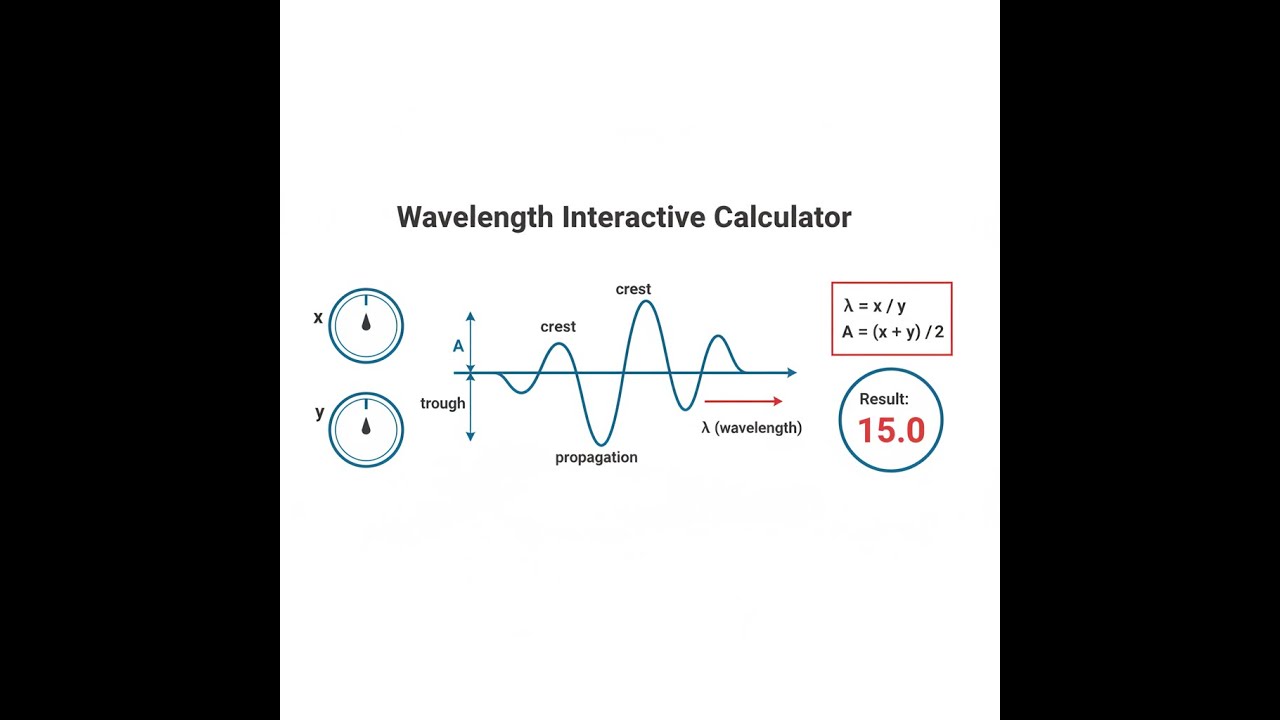
Wave Diagram

How to Use This Calculator
- Choose what you want to solve for from the dropdown: wavelength, frequency, wave speed, or photon energy.
- Enter the values you know—frequency in Hz, wavelength in meters, etc. The wave speed defaults to the speed of light; you’ll want to change that for sound or other mechanical waves.
- If you’re working with photon energy, pick the correct unit (Joules or electron volts).
- Click Calculate to get your answer.
Interactive Wavelength Calculator
This calculator is intended for education, concept evaluation, and preliminary design. Results are based on the equations and assumptions described on this page, but cannot account for every real-world load case, tolerance, material property, environmental condition, installation detail, safety factor, code, or regulatory requirement. Verify all inputs, assumptions, units, and results independently before selecting components or using the result in a real application. Safety-critical, structural, medical, lifting, transportation, or regulated applications must be reviewed by a qualified engineer.
Questions about this calculator or found an error? Message our engineering team.
Wavelength Interactive Visualizer
See how adjusting frequency or wave speed affects wavelength and photon energy across real cases in optics and RF. Tweak the sliders and watch how this changes the wave—in real working ranges, not textbook extremes.
WAVELENGTH
600 nm
PHOTON ENERGY
2.07 eV
SPECTRUM
Visible
FIRGELLI Automations — Interactive Engineering Calculators
Fundamental Equations
Here are the basic equations to swap between wavelength, frequency, and wave speed.
Wave Equation
v = f λ
λ = v / f
f = v / λ
Photon energy is tied to wavelength using Planck’s equation:
Photon Energy (Planck-Einstein Relation)
E = h f = h c / λ
λ = h c / E
You’ll also run into these derived quantities:
Derived Wave Parameters
T = 1 / f (period)
k = 2π / λ (wave number)
ω = 2π f (angular frequency)
Variable Definitions:
- λ (lambda) = Wavelength (m)
- f = Frequency (Hz or s-1)
- v = Wave propagation speed (m/s)
- c = Speed of light in vacuum = 299,792,458 m/s
- E = Photon energy (J or eV)
- h = Planck's constant = 6.626 × 10⁻³⁴ J·s
- T = Period (s)
- k = Wave number (m-1 or rad/m)
- ω (omega) = Angular frequency (rad/s)
Simple Example
If your green light source emits at 5 × 10¹⁴ Hz, and light moves at 3 × 10⁸ m/s, plug those in:
λ = v / f = 3 × 10⁸ / 5 × 1014 = 6 × 10⁻⁷ m = 600 nm
That lands you at 600 nm, which is a typical green laser or LED.
Theory & Practical Applications
Physical Basis of Wavelength
Wavelength is the spatial repeat distance for a wave—pick any point in the wave, move forward one wavelength, and you’re at the same phase. This applies to everything from radio to water waves. For electromagnetic waves (in vacuum), the relationship between frequency and wavelength is strictly set by the speed of light. In most mechanical systems, wave speed is set by the medium—like tension and mass in a string, or bulk modulus and density for sound. You’ll use v = f λ for both, but remember: the constants behind “v” vary. If you’re looking at how fast information or energy moves (group velocity), not just the shape of the wave (phase velocity), you need to know if your medium is dispersive. Optical fiber, for example, has different speeds for different colors (wavelengths), which is why bit rates in communication are limited by dispersion, not just loss.
If you only look at v = f λ, you get the phase velocity. If you care about how a pulse of light (or an information-carrying bit) travels, look up group velocity vg = dω/dk. Communications fiber design usually revolves around group velocity since it limits data transmission. For standard telecom glass, low-loss does not always line up with zero dispersion—engineers use compensation tricks to get both long reach and minimal pulse spreading.
Electromagnetic Spectrum Engineering
The engineering around electromagnetic waves changes a lot depending on the wavelength. Radio people stick to frequency—they have to for tuning, regulations, and circuit design. Long wavelengths bend around buildings and obstacles, making lower frequency bands (like UHF/VHF) practical for mobile or broadcast signals. Wi-Fi at 2.4 GHz is a compromise: short enough to make antennas small and still long enough to get through a wall. The basic physics works everywhere, but every band runs into different practical issues—from antenna size to atmospheric absorption and interference.
For infrared, the earth’s atmosphere determines what’s possible: thermal imaging and telecoms both take advantage of transparency “windows.” This is why 1550 nm (just outside visible) is the big workhorse for fiber optics: lowest loss, mature amplifier tech, and decent dispersion control, even though it’s not the natural “zero-dispersion” point. Sometimes you work harder on compensation, but the net result—longer reach or more data—wins.
Visible light is a sliver of the spectrum and has quirks of its own. Sunlight’s peak roughly lines up with where chlorophyll works and where human vision is most sensitive—evolution did the optimization for us. Solar cell engineers know silicon is good enough but not perfect; the bandgap cuts off collection above a certain wavelength, and any excess photon energy just creates heat. UV gets you into a whole different engineering world; you’ll see it in chipmaking when feature sizes push down below 200 nm.
Quantum Mechanics and Photon Energy
Unlike acoustics or radio, quantum engineering needs you to think in terms of energy as well as frequency or wavelength. If you want to knock electrons loose (as in the photoelectric effect), break chemical bonds, or ionize a gas, the photon energy E = hf = hc/λ must be enough. X-rays, with tiny wavelengths, bring energies high enough to slam into atomic core electrons—useful for imaging or probing crystal structure. For LEDs or lasers, the energy gap (Eg) in the semiconductor tells you what color you can actually generate, and tuning the chemistry or structure tweaks the emission wavelength. Shorter wavelength LEDs are less efficient and harder to manufacture; you can’t just scale designs indefinitely, since new material defects or non-radiative losses pile on at very short or very long wavelengths.
Acoustic Wavelength Applications
In acoustics, wavelength determines what you can actually hear, resolve, or direct. Sound at 1 kHz in air is about 34 cm long—room-sized. Subwoofers radiate almost equally in every direction because for 40 Hz, with an 8.6 m wavelength, the room is tiny in comparison. High frequencies “beam” and low ones spread. Ultrasound is a game of tradeoffs: smaller wavelengths give you better detail, but don’t travel far in real materials. In non-destructive testing or medicine, picking the right frequency is about finding a limit that gives enough penetration without blurring out small but important features. The numbers matter here—twice the frequency can mean one-fourth the penetration in a test piece.
Worked Example: Multi-Band Antenna Design
Here’s a practical example. Say you need a GPS dipole that handles both L1 (1575.42 MHz) and L5 (1176.45 MHz). Start with the free-space wavelength: λ = c/f. For L1, you get 19.03 cm; for L5, 25.48 cm. Real antennas aren’t in free space (end-effects, etc.), so include a “velocity factor” (usually around 0.95 for air-insulated). For half-wave dipoles, that means L1 arm length is about 9.04 cm, L5 about 12.10 cm.
But L1 and L5 aren’t harmonically related, so you can’t just use traps or the same element with a clever tap. Double-check the electrical length at the “wrong” frequency; you’ll see one band shows up reactive at the other—requiring matching or isolation. Also, antennas can interact if the elements are close (mutual coupling), but at standard PCB distances, interference is usually below a few ohms—often manageable. The physical bandwidth you get is limited by conductor thickness; thin wires mean narrow usable bandwidth, so if your fractional bandwidth matches the GPS spec, you’re right up against the practical size limit for the metal used. These sorts of hard numbers quickly drive your engineering toward multi-feed or networked solutions when multi-band operation is required. No magic, just tradeoffs.
Dispersion and Wavelength-Dependent Propagation
When your signal spans more than one wavelength or color, the material’s refractive index may change with wavelength (dispersion). That creates problems over distance: the different parts of your signal spread out. In a fiber, this is enough to limit data rates or require compensation. Sometimes the refractive index change looks small (less than 1%), but after a few kilometers, dispersion can stretch things out by hundreds of picoseconds or more—enough to scramble even moderate-speed digital signals. Strategies like shifting the zero-dispersion point, or compensating with specialty fiber, are routine in telecom engineering, especially for long-haul or submarine cables where repeaters are expensive and reliability is crucial.
Dispersion doesn’t just affect fiber—atmospheric dispersion can blur astronomical images and force you to use correction optics. The way scattering scales with wavelength (λ-4) also explains why longer wavelength lasers (like 850 nm) are less affected by haze than visible ones, even if the detectors cost more. A good design checks usable atmospheric windows and detector availability early, rather than assuming all wavelengths are equal.
Frequently Asked Questions
Free Engineering Calculators
Explore our complete library of free engineering and physics calculators.
Browse All Calculators →🔗 Explore More Free Engineering Calculators
About the Author
Robbie Dickson — Chief Engineer & Founder, FIRGELLI Automations
Robbie Dickson brings over two decades of engineering expertise to FIRGELLI Automations. With a distinguished career at Rolls-Royce, BMW, and Ford, he has deep expertise in mechanical systems, actuator technology, and precision engineering.
Video Walkthrough - How to Use This Calculator
Need to implement these calculations?
Explore the precision-engineered motion control solutions used by top engineers.


