Engineers and technicians working with sound often run into the same issue—sound waves don't act the same way in every material, and wavelength changes with both frequency and the medium. If you get the wavelength wrong, you might find problems late—like duct noise or poor room acoustics—when it's far harder or more expensive to fix. This calculator lets you work out wavelength, frequency, speed, or period, depending on what values you start with. You’ll find equations, a step-by-step concert hall example, definitions, and answers for real-world problems like temperature effects, media changes, and the limitations of ultrasonic testing.
What is Sound Wavelength?
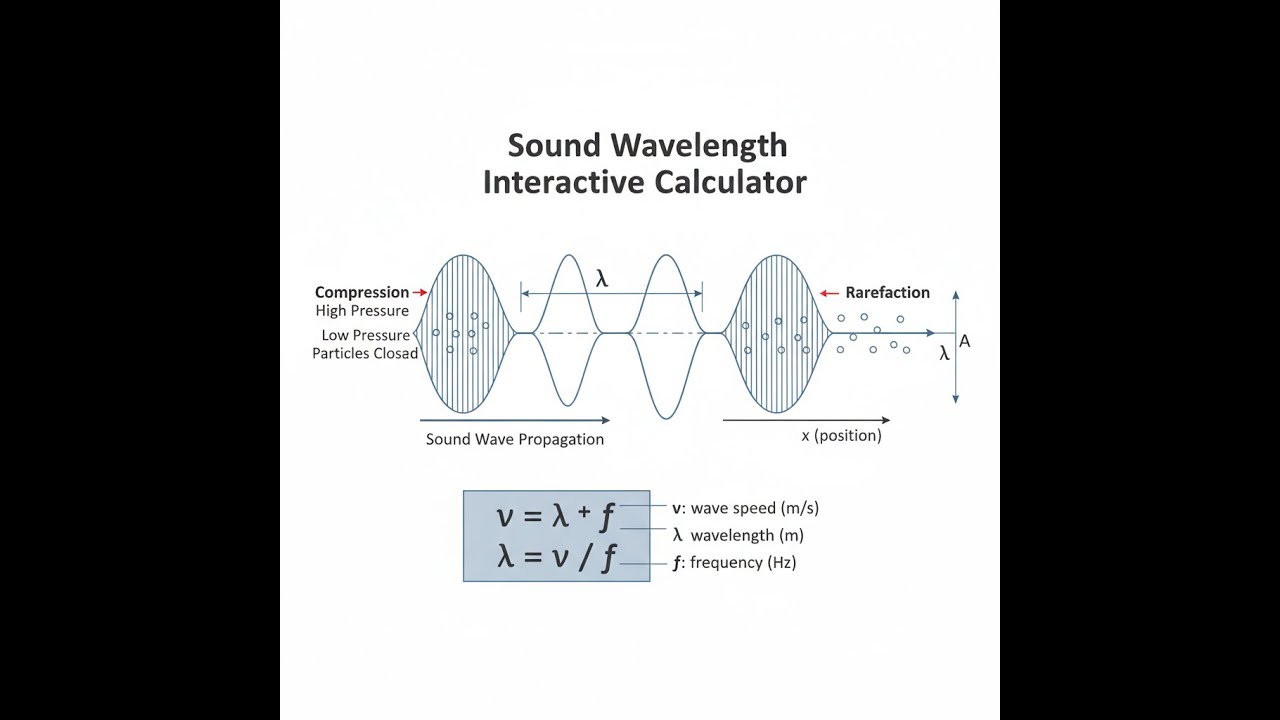
Sound wavelength is the distance between two consecutive pressure peaks in a moving sound wave. It depends on the speed of sound in your material and the frequency of the source. The faster the sound or the lower the frequency, the longer the wavelength gets.
Simple Explanation
Imagine dropping a rock in water—the rings that spread out are like sound waves, and the space between rings is the wavelength. A low-pitch drum makes wide rings; a whistle creates rings that are close together. The type of material only affects how quickly these rings move, and that changes how much space you get between each peak.
📐 Browse all 1000+ Interactive Calculators
Sound Wave Diagram

Interactive Calculator
How to Use This Calculator
This calculator is intended for education, concept evaluation, and preliminary design. Results are based on the equations and assumptions described on this page, but cannot account for every real-world load case, tolerance, material property, environmental condition, installation detail, safety factor, code, or regulatory requirement. Verify all inputs, assumptions, units, and results independently before selecting components or using the result in a real application. Safety-critical, structural, medical, lifting, transportation, or regulated applications must be reviewed by a qualified engineer.
Questions about this calculator or found an error? Message our engineering team.
- Choose your Calculation Mode — select what you want to solve for (wavelength, frequency, wave speed, or period).
- Fill in the data you know — use frequency (Hz), wave speed (m/s), wavelength (m), or period (s) as your starting points, depending on mode.
- Double-check the units — the default for speed is 343 m/s (air at 20°C). Change this if your case involves something like water, steel, or another medium.
- Click Calculate. The result should appear under Results.
Sound Wavelength Interactive Visualizer
Watch how frequency and wave speed control wavelength in real-time. Adjust the controls to see sound waves stretch and compress as they travel through different media.
WAVELENGTH
0.78 m
PERIOD
2.27 ms
MEDIUM
Air
FIRGELLI Automations — Interactive Engineering Calculators
Fundamental Equations
If you need to find sound wavelength, frequency, speed, or period, these are the formulas you’ll actually use.
v = λ × f
Wave speed (m/s) = Wavelength (m) × Frequency (Hz)
λ = v / f
Wavelength (m) = Wave speed (m/s) / Frequency (Hz)
f = v / λ
Frequency (Hz) = Wave speed (m/s) / Wavelength (m)
T = 1 / f
Period (s) = 1 / Frequency (Hz)
λ = v × T
Wavelength (m) = Wave speed (m/s) × Period (s)
Variable Definitions:
- v — Wave speed through the medium (m/s)
- λ (lambda) — Wavelength, the spatial period of the wave (m)
- f — Frequency, number of oscillations per second (Hz)
- T — Period, time for one complete oscillation (s)
Simple Example
A concert A note plays at 440 Hz through air at room temperature (343 m/s).
- Mode: Calculate Wavelength
- Frequency: 440 Hz
- Wave Speed: 343 m/s
- Result: λ = 343 / 440 = 0.780 m
Theory & Practical Applications
Sound wavelength is just the physical gap between each compression or rarefaction in the wave. Unlike electromagnetic waves, sound needs a material—no medium, no sound. The formula v = λf is basic and direct, but the details matter: the speed of sound (v) changes a lot depending on both the density and stiffness of the medium. In real applications, you’ll find v = √(K/ρ) for longitudinal sound where K is bulk modulus and ρ is density.
Wave Propagation Mechanisms in Different Media
In gases, sound gets passed between molecules by collisions. The speed in an ideal gas uses v = √(γRT/M). Here, γ is usually 1.4 for air, R is the gas constant, T is in kelvin, and M is molar mass. Faster (warmer) air means higher speed, and that stretches out the wavelength for a fixed frequency. In practice, a 1000 Hz wave in air shrinks from 0.343 m at 20°C to 0.331 m at 0°C. If your calculations involve things like HVAC or performance halls, this temperature effect isn’t trivial.
In liquids and solids, molecules are packed closer so sound travels faster—up to 4× in water and much more in steel. For water, v = 1480 m/s, so a 1 kHz signal has a wavelength of 1.48 m—quite a difference from air. In steel, at 5960 m/s, the same frequency stretches wavelength to 5.96 m. This has consequences: for ultrasonic testing or vibration in structures, frequency and material properties directly control what size features (or flaws) you can find.
Acoustic Resonance and Standing Waves
Resonance appears when sound reflects and overlaps, forming standing waves. For a closed pipe, key frequencies show up at fₙ = nv/(4L), where n is odd and L is length. That means the fundamental resonance wavelength is λ₁ = 4L. A half-meter closed tube in air will resonate first at 171.5 Hz with a 2.0 m wavelength. Change your pipe length a bit and the resonance shifts—about 3.4 Hz per cm. This matters when tuning things like organ pipes, especially as both temperature and expansion can shift pitch unpredictably.
In room acoustics, look at how wavelength lines up with room dimensions—modes kick in when they're similar. For a 5×4×3 m room, axial modes appear at about 34-57 Hz (length, width, height). These room "bass" modes lead to boomy sound and uneven response. Foam panels work on higher frequencies, but at low frequencies you need thicker materials or totally different solutions—a 5 cm foam panel simply can't absorb a 3 m wavelength.
Ultrasonic Applications and Near-Field Effects
Ultrasound at 40 kHz in air generates an 8.6 mm wavelength, which makes it practical for short-range object detection with resolution at a few millimeters. Go higher in frequency and you gain spatial detail, but lose range, since attenuation goes up quickly (with f²). As a result, most air-coupled ultrasonic sensors won't work reliably past about 5–8 meters.
For metal inspection, wavelength needs to match the defect size to spot it clearly. Say you want to see a 1 mm crack in steel—your wavelength must be similar or less, so you end up needing around 6 MHz. But the higher the frequency, the less depth you get, due to strong attenuation. The usual approach is to use a frequency where the wavelength is 2–3× the defect size if possible, trading off resolution for penetration and reliability.
If you're working near the transmitter (inside the so-called Fresnel or near-field distance), coverage is uneven and measurements are unreliable. Fresnel distance depends on the transducer diameter, frequency, and speed of sound. For a typical 25 mm, 2.25 MHz transducer in steel, the near field is about 59 mm long. You want to position your sensors beyond this, if possible, to avoid false readings.
Doppler Effect and Moving Sources
With a moving source or observer, both the frequency and the wavelength you measure will shift. The equations are straightforward (e.g., f' = f(v/(v-vₛ))) for source approaching at speed vₛ, but in practice, expect 1 kHz to shift upward if a siren approaches—by about 100 Hz if the vehicle travels 30 m/s. The wavelength in front of the vehicle shrinks, and behind, it stretches. This effect is common in radar, medical diagnostics, and even astrophysics.
Worked Example: Concert Hall Acoustic Design
Problem: You’ve got a concert hall: 42 m long, 28 m wide, and 16 m high at 22°C. You need the first three resonant frequencies and wavelengths for the length, estimate how thick acoustic absorbers must be, work out the wavelength of a 440 Hz note, and calculate how much the note's frequency shifts if temperature rises to 26°C during a concert.
Solution:
(a) Axial mode analysis:
First, calculate sound speed at 22°C: v ≈ 331.3 + 0.606×22 = 344.6 m/s. Axial mode frequencies along the 42 m length: f₁ = 344.6/(2×42) = 4.10 Hz, f₂ = 8.20 Hz, and f₃ = 12.30 Hz. The wavelengths: 84.0 m, 42.0 m, 28.0 m. These are below hearing range but still matter for pressure variation. The fundamental mode's wavelength is twice the room length.
(b) Absorber thickness requirement:
For 80% absorption, you need material thicker than λ/4 at the working frequency. At 4.10 Hz, this is 21.0 m. Clearly, this isn't realistic, so you can't control those modes using absorbers. That's why room shape and ratios matter much more for low-frequency control in large spaces.
(c) Musical note wavelength:
For A4 (440 Hz): λ = 344.6/440 = 0.783 m. This is about the width of a seated person, which means the sound bends—or diffracts—around people and produces noticeable "shadow" effects in the hall.
(d) Temperature-induced frequency shift:
At 26°C: v = 331.3 + 0.606×26 = 347.1 m/s. Since the length of the organ pipe doesn’t change, frequency rises with v, so Δf/f = Δv/v = (347.1-344.6)/344.6 = 0.00725. For 440 Hz, the shift is 3.19 Hz. The pitch noticeably rises. This is why musicians tune after the room warms up, and why fixed pipes and wind instruments struggle with variable temperatures.
More examples and advanced calculators—covering effects like interference and Doppler—can be found at the FIRGELLI Engineering Calculator Hub.
Frequently Asked Questions
Free Engineering Calculators
Explore our complete library of free engineering and physics calculators.
Browse All Calculators →🔗 Explore More Free Engineering Calculators
About the Author
Robbie Dickson — Chief Engineer & Founder, FIRGELLI Automations
Robbie Dickson brings over two decades of engineering expertise to FIRGELLI Automations. With a distinguished career at Rolls-Royce, BMW, and Ford, he has deep expertise in mechanical systems, actuator technology, and precision engineering.
Video Walkthrough - How to Use This Calculator
Need to implement these calculations?
Explore the precision-engineered motion control solutions used by top engineers.


