Impedance mismatch is one of the most common causes of wasted power and damaged transmitters in RF systems — and it often goes undetected without the right numbers in front of you. Use this VSWR calculator to calculate reflection coefficient, return loss, mismatch loss, and reflected power percentage using VSWR, impedance values, or return loss as inputs. Getting these figures right matters in antenna design, high-power broadcast systems, and cellular base station installations where even a few percent of reflected power causes real problems. This page includes the governing formulas, a full worked example, theory on standing waves and impedance matching, and an FAQ covering common field scenarios.
What is VSWR?
VSWR — Voltage Standing Wave Ratio — is a number that tells you how well a transmission line is matched to its load. A VSWR of 1:1 means perfect match and zero reflected power. Higher numbers mean more power is bouncing back toward the source instead of reaching the antenna or load.
Simple Explanation
Think of a garden hose connected to a nozzle that's the wrong size — water backs up instead of flowing through cleanly. In an RF system, mismatched impedances do the same thing to electrical energy: some of it reflects back down the cable instead of radiating from the antenna. VSWR measures how bad that mismatch is — the closer to 1, the better the match and the more power gets delivered where you need it.
📐 Browse all 1000+ Interactive Calculators
How to Use This Calculator
- Select a Calculation Mode from the dropdown — choose based on what value you already know (VSWR, reflection coefficient, return loss, or impedances).
- Enter your known value into the corresponding input field — VSWR, Γ, return loss in dB, load impedance, or forward power depending on the mode selected.
- If using impedance mode, enter both load impedance ZL and line impedance Z0 in ohms.
- Click Calculate to see your result.
System Diagram

Interactive VSWR Calculator
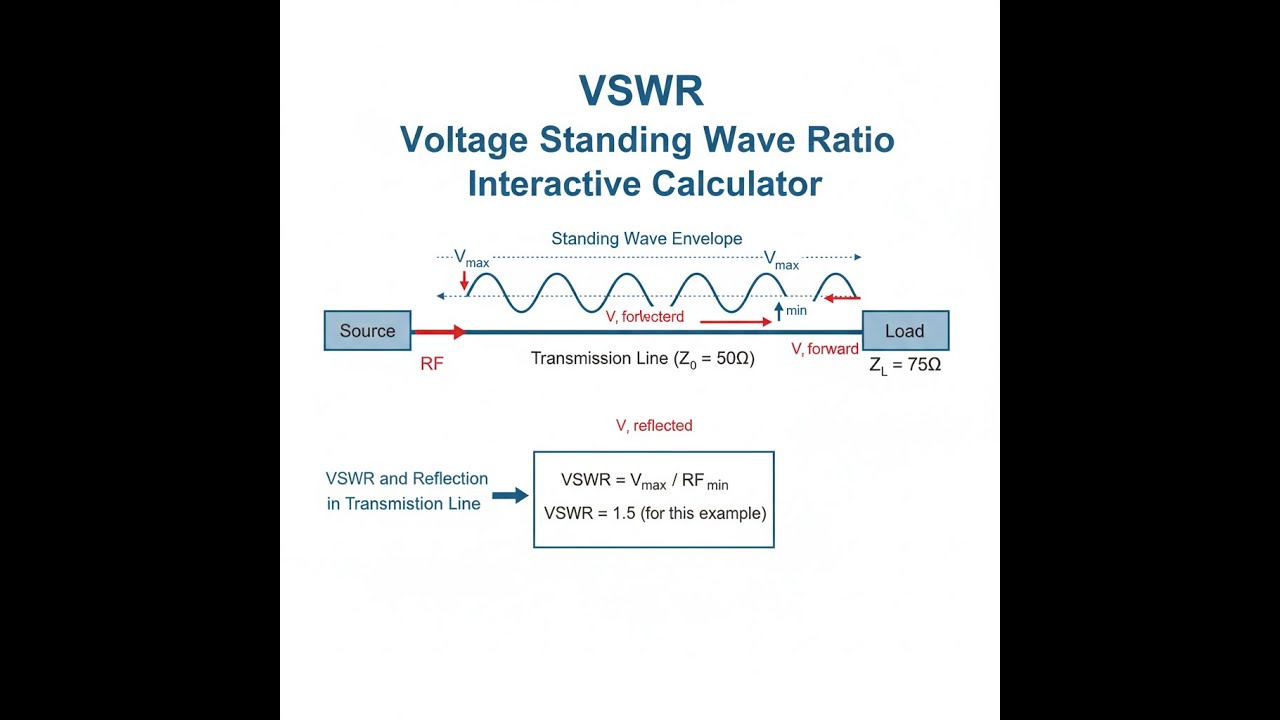
VSWR interactive visualizer
Watch how impedance mismatch creates standing waves and reflected power in real-time. Adjust VSWR to see voltage patterns, reflection coefficients, and power loss instantly.
REFLECTION
0.20
RETURN LOSS
14.0 dB
REFLECTED
4.0%
DELIVERED
96.0%
FIRGELLI Automations — Interactive Engineering Calculators
Governing Equations
VSWR from Reflection Coefficient
Use the formula below to calculate VSWR from the reflection coefficient.
VSWR = (1 + |Γ|) / (1 - |Γ|)
Where:
- VSWR = Voltage Standing Wave Ratio (dimensionless, ≥ 1)
- Γ = Reflection coefficient (dimensionless, 0 to 1)
Reflection Coefficient from Impedances
Use the formula below to calculate the reflection coefficient from load and line impedances.
Γ = (ZL - Z0) / (ZL + Z0)
Where:
- ZL = Load impedance (Ω)
- Z0 = Characteristic impedance of transmission line (Ω)
Return Loss
Use the formula below to calculate return loss from the reflection coefficient.
RL = -20 log10(|Γ|)
Where:
- RL = Return loss (dB, positive value)
Mismatch Loss
Use the formula below to calculate mismatch loss from the reflection coefficient.
ML = -10 log10(1 - |Γ|2)
Where:
- ML = Mismatch loss (dB)
Reflected and Transmitted Power
Use the formula below to calculate reflected and transmitted power from forward power and reflection coefficient.
Preflected = Pforward × |Γ|2
Ptransmitted = Pforward × (1 - |Γ|2)
Where:
- Pforward = Forward power from source (W)
- Preflected = Power reflected back to source (W)
- Ptransmitted = Power delivered to load (W)
Simple Example
A 75Ω load connected to a 50Ω transmission line:
- Γ = (75 - 50) / (75 + 50) = 0.200
- VSWR = (1 + 0.200) / (1 - 0.200) = 1.500
- Return Loss = -20 × log₁₀(0.200) = 13.98 dB
- Reflected Power = 0.200² × 100 = 4.0%
Theory & Practical Applications of VSWR
Physical Origin of Standing Waves in Transmission Lines
When a transmission line terminates in an impedance that differs from its characteristic impedance Z0, a portion of the forward-traveling electromagnetic wave reflects back toward the source. The superposition of forward and reflected waves creates a standing wave pattern with spatially fixed maxima and minima. The voltage standing wave ratio quantifies the amplitude variation of this pattern, defined as the ratio of maximum to minimum voltage magnitude along the line. For a perfectly matched load (ZL = Z0), no reflection occurs and VSWR equals unity. As impedance mismatch increases, VSWR grows without bound—a VSWR of 10:1 indicates severe mismatch with 81% of incident power reflected.
The reflection coefficient Γ represents the complex ratio of reflected to incident voltage wave amplitude. Its magnitude determines both VSWR and the fraction of power reflected. In lossless transmission lines, the relationship VSWR = (1 + |Γ|) / (1 - |Γ|) follows directly from phasor addition of forward and reflected waves at voltage maxima (waves in-phase) and minima (waves 180° out-of-phase). This fundamental relationship enables bidirectional conversion between VSWR measurements and impedance mismatch calculations essential for RF system design.
Return Loss and Its Engineering Significance
Return loss quantifies reflected power in decibel notation, expressing the logarithmic ratio between incident and reflected power. While VSWR provides intuitive visualization of mismatch severity, return loss offers direct power-based interpretation. A return loss of 20 dB indicates that reflected power is 1% of forward power—acceptable for most communications systems but inadequate for high-power transmitters where even small reflected power causes thermal stress on output stages. Broadcast transmitters typically require return loss exceeding 30 dB (VSWR ≤ 1.065) to prevent damage to solid-state amplifiers operating at kilowatt power levels.
The non-linear relationship between return loss and VSWR creates practical measurement challenges. At high VSWR values (poor matches), small changes in return loss produce large VSWR variations, while at low VSWR (good matches), substantial return loss changes cause minimal VSWR movement. This logarithmic sensitivity explains why precision vector network analyzers report return loss with 0.01 dB resolution while VSWR measurements often suffice with 0.1 precision. In antenna tuner design, achieving the last 3 dB of return loss improvement (from 25 to 28 dB) requires the same effort as the initial 20 dB improvement from no tuning.
Mismatch Loss and System Efficiency
Mismatch loss represents the decibel reduction in power delivered to a load relative to the maximum available power under perfect matching conditions. Unlike return loss which quantifies reflected power at the interface, mismatch loss accounts for system-level efficiency including multiple reflections in lossy transmission lines. For a reflection coefficient Γ, mismatch loss equals -10 log₁₀(1 - |Γ|²), which differs from return loss by the squared magnitude term. A VSWR of 2:1 produces 11.1% reflected power (return loss = 9.54 dB) but only 0.51 dB mismatch loss, since 88.9% of incident power still reaches the load.
In cascaded RF systems, cumulative mismatch loss degrades link budget more severely than individual component VSWRs suggest. Consider a cellular base station with antenna VSWR = 1.5 (return loss 13.98 dB, mismatch loss 0.18 dB) connected through a duplexer with VSWR = 1.3 (return loss 17.69 dB, mismatch loss 0.07 dB). The combined system mismatch loss exceeds simple addition of individual losses due to re-reflection phenomena where the reflected wave from the antenna partially re-reflects at the duplexer interface, creating an infinite series of diminishing reflections that constructively or destructively interfere depending on electrical line length between components.
Impedance Matching in Antenna Systems
Antenna impedance rarely equals the standard 50Ω or 75Ω characteristic impedance of coaxial feedlines, necessitating impedance transformation networks to minimize VSWR. A resonant half-wave dipole exhibits approximately 73Ω impedance at its center feedpoint—seemingly close to 50Ω but producing VSWR = 1.46 and 1.8% reflected power. This mismatch becomes more problematic at the band edges where dipole impedance transitions from capacitive to inductive reactance, raising VSWR to 3:1 or higher. Broadband antennas employ matching networks using quarter-wave transformers, L-C networks, or tapered baluns to maintain VSWR below 2:1 across entire operating bandwidths.
In phased array radar systems, mutual coupling between adjacent antenna elements modifies individual element impedances as a function of scan angle. An element perfectly matched at broadside (VSWR = 1.0) may exhibit VSWR = 2.5 when the array beam steers to 60° off-axis. Active impedance tuning networks at each element dynamically adjust matching as the beam scans, maintaining low VSWR and preventing amplifier damage from excessive reflected power. This technique, termed "active impedance synthesis," allows wide-angle scanning without the gain loss and pattern distortion caused by impedance mismatch variation across the array aperture.
VSWR Measurement Techniques and Instrumentation
Directional couplers and slotted line resonance detectors historically dominated VSWR measurement, but modern vector network analyzers (VNAs) provide comprehensive impedance characterization including magnitude and phase of the reflection coefficient. A calibrated VNA measures S₁₁ parameter (input return loss) by comparing reflected to incident wave amplitudes with phase information, enabling Smith chart visualization of impedance vs. frequency. The 12-term error correction models in VNAs compensate for systematic errors including directivity, source match, and reflection tracking—achieving return loss measurement accuracy within ±0.05 dB at frequencies to 67 GHz and beyond.
Handheld antenna analyzers used in field installations measure VSWR without full VNA capability, employing bridge circuits that null at perfect match. These instruments indicate VSWR magnitude and reactance sign (capacitive/inductive) but lack phase information for complex impedance determination. A critical limitation of field measurements involves feedline loss masking true antenna VSWR—a lossy coaxial cable attenuates both forward and reflected waves, reducing measured VSWR below the actual antenna interface value. For a 100-foot run of RG-8X coaxial cable with 1 dB loss at 146 MHz, an antenna with true VSWR = 3.0 appears as only 2.1 measured at the transmitter end, potentially concealing tuning problems until the cable is replaced with lower-loss hardline.
High-Power Transmitter Protection and VSWR Interlock Systems
Solid-state RF power amplifiers tolerate minimal VSWR before entering thermal runaway conditions where reflected power heats output transistors faster than heat sinking can dissipate. A 1 kW FM broadcast transmitter with 3:1 VSWR experiences 250W reflected power plus dissipation of up to 750W in the lossy transmission line, potentially raising output transistor junction temperatures above 200°C where silicon bandgap narrows and thermal runaway initiates. Modern transmitters incorporate VSWR protection circuits that reduce output power or shut down entirely when reflected power exceeds safe thresholds.
Interlock systems monitor forward and reflected power using directional couplers with logarithmic detector circuits that generate DC voltages proportional to RF power levels. Microcontroller-based protection algorithms calculate VSWR in real-time: VSWR = (1 + √(P_reflected/P_forward)) / (1 - √(P_reflected/P_forward)). When VSWR exceeds programmed limits (typically 2.0 for solid-state transmitters, 3.0 for tube transmitters), the interlock first reduces drive power by 6 dB attempting to maintain operation under reduced VSWR stress. If VSWR persists above limits for more than 50 milliseconds—indicating sustained antenna system fault rather than transient interference—the transmitter executes emergency shutdown and latches off pending manual reset after repairs.
Worked Example: Cellular Base Station Link Budget Analysis
A cellular base station transmits 43 dBm (20W) through a system consisting of a duplexer, 50 meters of 7/8" coaxial feedline, and a panel antenna. Characterize system losses and delivered power under measured VSWR conditions.
Given:
- Transmitter output power: Ptx = 20W = 43.01 dBm
- Duplexer insertion loss: Lduplexer = 0.6 dB, VSWR = 1.25
- Feedline loss specification: 0.85 dB/100m at 1850 MHz for 7/8" line
- Antenna VSWR measured at antenna terminals: VSWRant = 1.42
- Frequency: 1850 MHz (PCS band)
Step 1: Calculate feedline loss
For 50 meters of cable: Lfeedline = 0.85 dB/100m × 50m = 0.425 dB
Step 2: Calculate duplexer reflection coefficient and mismatch loss
From VSWR = 1.25:
Γduplexer = (VSWR - 1)/(VSWR + 1) = (1.25 - 1)/(1.25 + 1) = 0.111
Mismatch loss: MLduplexer = -10 log₁₀(1 - Γ²) = -10 log₁₀(1 - 0.111²) = 0.054 dB
Return loss: RLduplexer = -20 log₁₀(0.111) = 19.09 dB
Step 3: Calculate antenna reflection coefficient and mismatch loss
From VSWR = 1.42:
Γant = (1.42 - 1)/(1.42 + 1) = 0.173
Mismatch loss: MLant = -10 log₁₀(1 - 0.173²) = 0.130 dB
Return loss: RLant = -20 log₁₀(0.173) = 15.24 dB
Reflected power percentage: (0.173)² × 100% = 2.99%
Step 4: Calculate total system loss
Total loss = Lduplexer + Lfeedline + MLduplexer + MLant
Total loss = 0.6 + 0.425 + 0.054 + 0.130 = 1.209 dB
Step 5: Calculate delivered power to antenna
Pdelivered = Ptx - Total loss = 43.01 dBm - 1.209 dB = 41.80 dBm
Converting to watts: Pdelivered = 10^((41.80 - 30)/10) = 15.14W
Step 6: Calculate radiated power accounting for antenna reflection
Pradiated = Pdelivered × (1 - Γant²) = 15.14W × (1 - 0.173²) = 14.69W
Reflected power: Preflected = 15.14W × 0.173² = 0.45W
Results interpretation: Of the original 20W transmitter output, 1.025 dB (21%) is lost to component insertion loss and feedline attenuation, while an additional 0.184 dB (4.3%) is lost to impedance mismatch effects. The antenna radiates 14.69W (73.5% efficiency), with 0.45W reflected back toward the transmitter. This reflected power partially dissipates in the lossy feedline and partially re-reflects at impedance discontinuities, creating measurement uncertainty in field VSWR tests. The relatively low antenna VSWR of 1.42 proves adequate for cellular systems where link budget margin exceeds 10 dB, but tighter matching would benefit systems operating near coverage boundaries.
VSWR in Non-50Ω Systems and Impedance Standards
While most RF engineering standardizes on 50Ω characteristic impedance (a compromise between power handling of 30Ω and loss minimization of 77Ω in air-dielectric coaxial cables), video and cable television systems use 75Ω impedance for optimized signal-to-noise ratio in high-impedance receiver inputs. VSWR calculations remain identical regardless of reference impedance, but mixing impedance standards within a single system creates unavoidable mismatch. Connecting a 50Ω transmitter to a 75Ω antenna through 75Ω coaxial cable yields VSWR = 1.5 at the transmitter output even with a perfectly matched antenna, since the 50Ω source sees the 75Ω line as a mismatched load.
Laboratory test equipment and RF components maintain impedance consistency through careful specification. A spectrum analyzer input specified for 50Ω displays VSWR = 1.3 maximum, corresponding to |Γ| = 0.13 or 17.7 dB return loss. High-quality attenuators and filters achieve VSWR below 1.2 (20.8 dB return loss) to minimize measurement uncertainty in cascaded systems. When unavoidable impedance transitions occur, quarter-wave transformers provide broadband matching: for a 50-to-75Ω transition at 1 GHz, a 61.2Ω (√(50×75)) quarter-wavelength section 37.5mm long in PTFE dielectric (velocity factor 0.66) reduces VSWR below 1.1 over a 30% bandwidth.
Frequently Asked Questions
Free Engineering Calculators
Explore our complete library of free engineering and physics calculators.
Browse All Calculators →🔗 Explore More Free Engineering Calculators
- LED Resistor Calculator — Current Limiting
- Capacitor Charge Discharge Calculator — RC Circuit
- Low-Pass RC Filter Calculator — Cutoff Frequency
- RLC Circuit Calculator — Resonance Impedance
- Capacitive Transformerless Power Supply Calculator
- Insertion Loss Calculator
- Transistor Biasing Calculator
- Voltage Divider Calculator — Output Voltage from Two Resistors
- Transformer Turns Ratio Calculator
- Ohm's Law Calculator — V I R P
About the Author
Robbie Dickson — Chief Engineer & Founder, FIRGELLI Automations
Robbie Dickson brings over two decades of engineering expertise to FIRGELLI Automations. With a distinguished career at Rolls-Royce, BMW, and Ford, he has deep expertise in mechanical systems, actuator technology, and precision engineering.
Need to implement these calculations?
Explore the precision-engineered motion control solutions used by top engineers.


