When light moves through a slit or past an object roughly the size of its wavelength, it doesn’t behave the way ray diagrams suggest. Instead, it spreads out, producing a pattern of bright and dark bands you won’t see in ray optics. These patterns let you measure the physical limits of lenses, apertures, and other optical hardware. The calculator here finds where these minima and maxima show up, using your chosen values for wavelength, slit width, slit spacing, grating density, or aperture size—across single-slit, double-slit, and grating setups. This matters in practical terms: diffraction sets the smallest detail a microscope can resolve, the sharpness of a telescope, and the limits of resolution in spectrometers and fiber optic links. You’ll find key formulas, a full step-by-step calculation for a spectrometer, some plain explanation of the physics, and a FAQ below.
What is diffraction?
Diffraction is what happens when a wave — like light or radio — bends around the edges of an obstacle or spreads out after passing through a narrow gap. The result is a pattern of alternating bright and dark bands called a diffraction pattern.
Simple Explanation
Think of water waves passing through a gap in a harbor wall — instead of continuing in a straight line, they fan out on the other side. Light does exactly the same thing when it squeezes through a tiny slit or around a sharp edge. The bright and dark bands you see are caused by the light waves from different parts of the slit either reinforcing or canceling each other out as they overlap.
📐 Browse all 1000+ Interactive Calculators
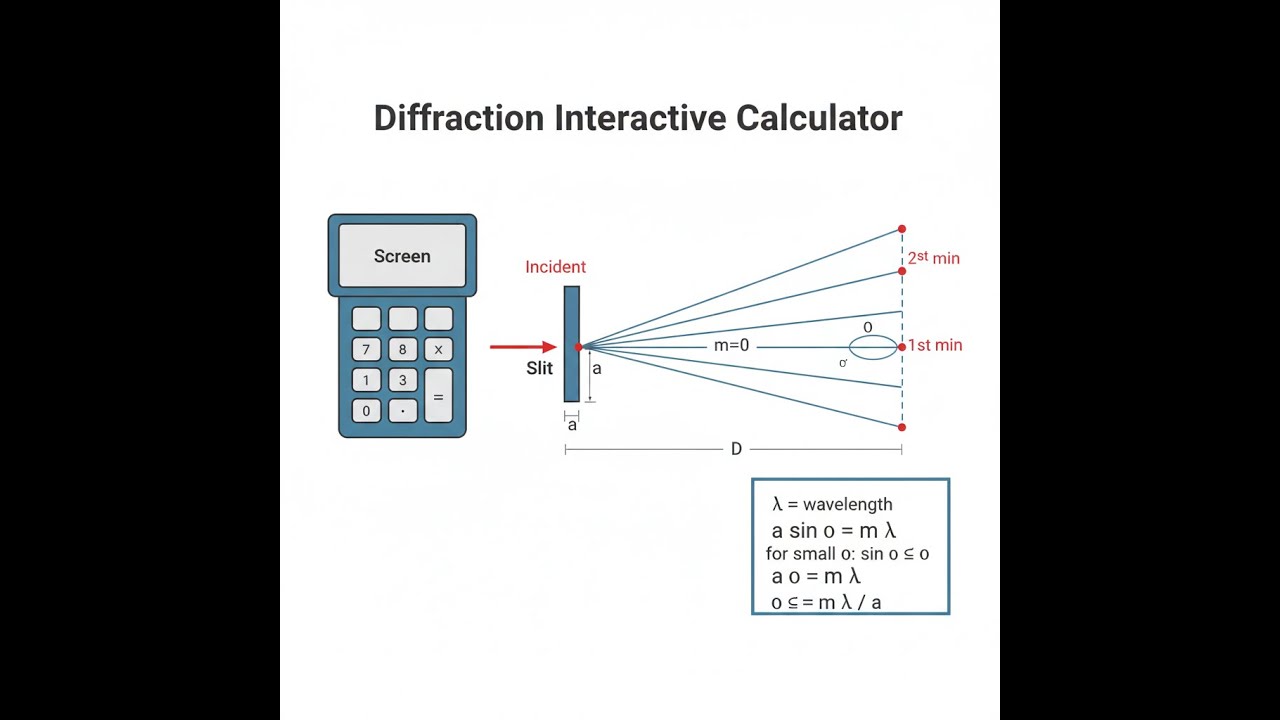
Diffraction Pattern Diagram

How to Use This Calculator
- Select your calculation mode from the dropdown — choose from single-slit, double-slit, diffraction grating, or Rayleigh criterion.
- Enter the wavelength of your light source in nanometers, then fill in the remaining visible input fields (slit width, slit separation, grating line density, aperture diameter, or order number as required by the selected mode).
- Use the Try Example button to load a pre-filled set of values if you want to see a sample calculation first.
- Click Calculate to see your result.
Diffraction Calculator
This calculator is intended for education, concept evaluation, and preliminary design. Results are based on the equations and assumptions described on this page, but cannot account for every real-world load case, tolerance, material property, environmental condition, installation detail, safety factor, code, or regulatory requirement. Verify all inputs, assumptions, units, and results independently before selecting components or using the result in a real application. Safety-critical, structural, medical, lifting, transportation, or regulated applications must be reviewed by a qualified engineer.
Questions about this calculator or found an error? Message our engineering team.
Diffraction Interactive Visualizer
Visualize how light bends through apertures and around obstacles, creating interference patterns of bright and dark fringes. Watch real-time diffraction patterns as you adjust wavelength, slit width, and observation angle.
DIFFRACTION ANGLE
1.26°
FRINGE SPACING
22.0 mm
RESOLUTION
0.55 μrad
FIRGELLI Automations — Interactive Engineering Calculators
Governing Equations
Use the formula below to calculate the angular position of diffraction minima and maxima for each configuration.
Single-Slit Diffraction (Minima)
a sin(θ) = mλ
Where:
- a = slit width (m)
- θ = angular position of the mth minimum measured from central axis (radians or degrees)
- m = order number (m = 1, 2, 3, ...) — integers only for minima
- λ = wavelength of incident light (m)
Double-Slit Interference (Maxima)
d sin(θ) = mλ
Where:
- d = center-to-center slit separation (m)
- θ = angular position of the mth bright fringe (radians or degrees)
- m = order number (m = 0, ±1, ±2, ±3, ...) — m = 0 is the central maximum
- λ = wavelength (m)
Diffraction Grating
d sin(θ) = mλ
Where:
- d = grating spacing = 1/(lines per unit length) (m)
- θ = diffraction angle for order m (radians or degrees)
- m = diffraction order (integer)
- λ = wavelength (m)
Maximum observable order: mmax = floor(d/λ), where sin(θ) ≤ 1
Rayleigh Criterion for Circular Apertures
θmin = 1.22 λ / D
Where:
- θmin = minimum resolvable angular separation (radians)
- λ = wavelength of light (m)
- D = aperture diameter (m)
- 1.22 = numerical factor arising from the first zero of the Bessel function J1(x) for circular apertures
Simple Example
Single-slit, 1st order minimum: wavelength = 550 nm, slit width = 50 μm, order m = 1.
sin(θ) = (1 × 550 nm) / 50,000 nm = 0.011
θ = arcsin(0.011) = 0.630°
The 1st dark fringe appears 0.630° from the central bright axis — at a screen 1 m away, that's 11 mm from center.
Theory & Practical Applications
Physical Origins of Diffraction
Diffraction represents the departure of wave propagation from the straight-line predictions of geometric optics. When wavefronts encounter an aperture, edge, or obstacle with dimensions comparable to the wavelength, Huygens' principle dictates that every point on the unobstructed portion of the wavefront acts as a source of secondary spherical wavelets. The superposition of these wavelets produces the observed diffraction pattern — an interference effect arising from the coherent addition of waves traveling different path lengths to any observation point.
For single-slit diffraction, the key insight is that light from different portions of the slit arrives at off-axis observation points with varying phase relationships. When the slit width a and observation angle θ satisfy a sin(θ) = mλ (where m is an integer), light from the top half of the slit interferes destructively with light from the bottom half, producing a minimum. The central maximum spans from m = -1 to m = +1 and contains approximately 95% of the total diffracted energy. This intensity concentration explains why single-slit patterns appear much brighter at center than at the fringes — a critical consideration in optical power budgeting for laser beam delivery systems.
The transition from Fraunhofer (far-field) to Fresnel (near-field) diffraction occurs when the Fresnel number F = a²/(λL) approaches unity, where L is the observation distance. Fraunhofer conditions (F much less than 1) are assumed in most engineering calculations because they simplify to angular analysis, but precision optical systems operating at short working distances must account for Fresnel effects where the phase contributions from different aperture zones no longer reduce to simple angular relationships.
Resolution Limits in Optical Instruments
The Rayleigh criterion defines the fundamental diffraction-limited resolution of imaging systems. For a circular aperture of diameter D observing at wavelength λ, the angular radius of the Airy disk (the central diffraction spot) is θ = 1.22λ/D radians. Two point sources are considered "just resolved" when the central maximum of one Airy pattern coincides with the first minimum of the other. This is not a hard physical boundary — the Sparrow criterion and other definitions exist — but the Rayleigh criterion provides a conservative, widely-adopted standard.
For visible light (λ ≈ 550 nm) and the human eye's 7 mm dark-adapted pupil, the diffraction limit is approximately 1 arcminute (0.29 mrad). In practice, atmospheric turbulence and ocular aberrations degrade resolution to roughly 1 arcminute under good conditions, making the eye nearly diffraction-limited for photopic vision. This explains why astronomical observations benefit enormously from large-aperture telescopes: doubling the aperture halves the Airy disk radius, quadrupling the resolving power.
The Hubble Space Telescope's 2.4 m primary mirror achieves 0.05 arcsecond resolution at 500 nm wavelength — approximately 100 times better than ground-based instruments fighting atmospheric seeing.
Microscope resolution follows the same physics but inverts the geometry. The Abbe diffraction limit for a microscope objective with numerical aperture NA = n sin(α), where n is the refractive index of the medium and α is the half-angle of the acceptance cone, gives lateral resolution d = 0.61λ/NA. High-NA oil-immersion objectives (NA ≈ 1.4) achieve d ≈ 200 nm for green light, defining the "diffraction barrier" that limited optical microscopy for over a century. Super-resolution techniques (STED, PALM, STORM) circumvent this limit through clever manipulation of fluorophore emission states, but the underlying diffraction physics remains unchanged.
Diffraction Gratings in Spectroscopy
Diffraction gratings disperse polychromatic light by wavelength through constructive interference at discrete angles satisfying d sin(θ) = mλ. Unlike prisms, which disperse via wavelength-dependent refractive index, gratings achieve angular separation proportional to wavelength: dθ/dλ = m/(d cos θ). This linear dispersion, combined with the ability to manufacture gratings with thousands of lines per millimeter, makes them indispensable in high-resolution spectroscopy.
The resolving power of a grating — its ability to distinguish two closely-spaced spectral lines — is R = λ/Δλ = mN, where N is the total number of illuminated grooves. A 100 mm wide grating with 1200 lines/mm has N = 120,000 grooves. At second order (m = 2), this yields R = 240,000, sufficient to resolve spectral features separated by Δλ = 550 nm / 240,000 ≈ 2.3 picometers at visible wavelengths. This capability enables precise measurement of Doppler shifts in stellar spectra (velocities of order 1 km/s produce shifts of ~2 pm at 550 nm), isotope identification, and hyperfine structure analysis.
Grating efficiency — the fraction of incident light diffracted into a particular order — depends critically on groove profile. Blazed gratings with asymmetric sawtooth profiles concentrate up to 80% of the light into a single order at the "blaze wavelength" where the groove facet normal bisects the angle between incident and diffracted beams. This efficiency dramatically improves signal-to-noise ratios in spectrometers but introduces wavelength-dependent efficiency curves that must be calibrated.
Echelle gratings, operated at high orders (m = 50-150) with coarse groove spacing, achieve extreme angular dispersion for ultra-high-resolution applications like exoplanet radial velocity measurements requiring sub-meter-per-second precision.
Fiber Optic and Waveguide Mode Structure
Single-mode optical fibers exploit diffraction physics to confine light to the fundamental LP01 mode. The normalized frequency parameter V = (2πa/λ)√(ncore² - ncladding²), where a is the core radius, determines the number of supported modes. Single-mode operation requires V less than 2.405 (the first zero of the Bessel function J0). For standard telecom fiber at λ = 1550 nm with core radius 4.1 μm and refractive index step Δn ≈ 0.005, V ≈ 2.0, maintaining single-mode behavior.
The mode field diameter (MFD), effectively the diffracting aperture of the fiber, is approximately MFD ≈ 2a(0.65 + 1.619/V1.5 + 2.879/V6) for step-index fiber. At V = 2.0, MFD ≈ 10.4 μm — larger than the physical core. This "tail" extending into the cladding is essential for low-loss fiber splicing: misalignment by 1 μm causes roughly 0.1 dB loss, a critical tolerance in long-haul systems where hundreds of splices accumulate. Multimode fibers with V greater than 10 support hundreds of modes, each with different propagation constants, causing modal dispersion that limits bandwidth to ~500 MHz·km — adequate for short premises networks but catastrophic for long-distance communication.
Antenna Beamwidth and Radio Diffraction
Electromagnetic diffraction governs radio antenna performance identically to optical systems, though wavelength scaling shifts practical designs to dramatically different dimensions. A parabolic dish antenna of diameter D operating at wavelength λ has a diffraction-limited half-power beamwidth θ3dB ≈ 70λ/D degrees (the numerical coefficient varies slightly with illumination taper). For a satellite TV dish (D = 60 cm) at Ku-band (λ = 2.5 cm), θ3dB ≈ 2.9°. This tight beam requires precise pointing to maintain signal lock — a 5° azimuthal error moves the beam completely off the geostationary satellite.
Radar systems exploit diffraction limits to determine target angular position. A 3 GHz marine radar (λ = 10 cm) with a 1.8 m horizontal antenna yields θazimuth ≈ 3.9° resolution — adequate to separate two ships 680 m apart at 10 km range but insufficient for fine navigation near harbor structures. Higher frequency (X-band, 9 GHz) radar trades atmospheric attenuation for 3× better angular resolution. The cross-range resolution δcross = R θ3dB scales linearly with range R, explaining why space-based SAR (synthetic aperture radar) requires kilometer-scale synthetic apertures to achieve meter-scale ground resolution from orbit.
Comprehensive Worked Example: Spectrometer Design
Problem Statement: Design a Czerny-Turner spectrometer for analyzing Mercury emission lines in the blue-green region. Specifications require resolving the 546.074 nm and 546.227 nm lines (separation Δλ = 0.153 nm) with at least 20% valley depth between peaks. The available diffraction grating has 1200 lines/mm, and the detector array has 50 μm pixel pitch. A 150 mm focal length collimating mirror is budget-constrained. Determine: (a) minimum required diffraction order m, (b) diffraction angle θ for the 546.1 nm doublet center, (c) required number of illuminated grating grooves N, (d) physical grating width W, and (e) linear dispersion at the detector plane.
Solution:
Step 1: Determine required resolving power R. The Rayleigh criterion for resolution requires R = λ/Δλ = 546.1 nm / 0.153 nm = 3569. This is the absolute minimum; 20% valley depth requires approximately R ≈ 1.5 × (λ/Δλ) ≈ 5350 to account for instrumental broadening and finite slit widths. We'll design for R = 6000 to provide margin.
Step 2: Calculate required mN product. Grating resolving power R = mN, so mN = 6000. We must choose an order m that's physically realizable. The grating equation d sin(θ) = mλ limits maximum order to mmax = floor(d/λ). With d = (1 mm)/(1200) = 833.3 nm and λ = 546.1 nm, mmax = floor(833.3/546.1) = 1. First order is the only option before sin(θ) exceeds unity. Therefore m = 1, requiring N = 6000 grooves.
Step 3: Calculate diffraction angle θ. Using d sin(θ) = mλ with m = 1, d = 833.3 nm, λ = 546.1 nm: sin(θ) = (1 × 546.1 nm)/(833.3 nm) = 0.6554. Therefore θ = arcsin(0.6554) = 40.96° = 40°58'.
Step 4: Determine physical grating width W. N = 6000 grooves at 1200 lines/mm spacing requires W = 6000/1200 = 5.0 mm minimum. However, the actual illuminated area depends on beam diameter at the grating. For a Czerny-Turner configuration with f = 150 mm focal length mirrors, a typical entrance slit height of 10 mm will produce a collimated beam diameter of ~12 mm (accounting for aberrations). If the collimated beam underfills the grating, the effective N is proportionally reduced. Assuming the beam diameter matches the grating width, we need W ≥ 5.0 mm, but practical designs use W ≈ 12-15 mm to ensure full illumination. We'll specify W = 12 mm, giving effective N = 1200 lines/mm × 12 mm = 14,400 grooves when fully illuminated, yielding R = 14,400 >> 6000 required. This overdesign provides tolerance for slit width broadening and aberrations.
Step 5: Calculate linear dispersion dℓ/dλ at detector. Angular dispersion is dθ/dλ = m/(d cos θ) = 1/(833.3 nm × cos 40.96°) = 1/(833.3 nm × 0.7548) = 1.590 × 10⁻³ rad/nm = 1.590 mrad/nm. At focal length f = 150 mm, linear dispersion is (dℓ/dλ) = f (dθ/dλ) = 150 mm × 1.590 × 10-3 rad/nm = 0.2385 mm/nm = 238.5 μm/nm. The 0.153 nm doublet separation maps to Δℓ = 0.153 nm × 238.5 μm/nm = 36.5 μm at the detector.
Step 6: Verify detector sampling. With 50 μm pixel pitch, the 36.5 μm doublet separation spans 0.73 pixels — undersampled by the Nyquist criterion. To properly sample the doublet (minimum 2 pixels per line, ideally 3-4), we need pixel pitch ≤ 18 μm or increased focal length f = 150 mm × (50 μm / 18 μm) = 417 mm. Alternatively, accepting the 50 μm pixels with f = 150 mm provides marginal separation but requires deconvolution algorithms to extract line positions. This is a common engineering trade-off: cost of a larger detector array versus complexity of signal processing.
Summary: The spectrometer operates at first order (m = 1) with diffraction angle 40.96°, requires a minimum 5 mm wide grating (12 mm practical), and achieves 238.5 μm/nm linear dispersion. The design marginally resolves the Mercury doublet but is detector-limited, not diffraction-limited, highlighting the crucial interplay between optical design and detector specifications in real spectroscopic systems.
Applications Across Industries
Telecommunications: Wavelength-division multiplexing (WDM) systems use diffraction gratings or arrayed waveguide gratings (AWGs) to combine/separate optical channels spaced 50-100 GHz apart (~0.4-0.8 nm at 1550 nm). Channel crosstalk below -30 dB requires grating resolution R ≈ 2000 and precise temperature control (0.01 nm/°C thermal drift is typical). Dense WDM (DWDM) with 25 GHz spacing pushes requirements to R ≈ 4000.
Astronomy: Adaptive optics systems measure wavefront aberrations using Shack-Hartmann sensors — arrays of lenslets that create diffraction-limited spots whose positions encode local wavefront tilt. Sub-arcsecond imaging requires wavefront sensing at 1 kHz frame rates, with each lenslet aperture sized to produce Airy disks smaller than CCD pixel dimensions. The Extremely Large Telescope (ELT) will employ 6-laser guide stars with 8-meter-class adaptive optics to achieve near-diffraction-limited imaging at visible wavelengths from the ground.
Semiconductor Manufacturing: Photolithography steppers use diffraction to define minimum feature sizes in integrated circuits. The Rayleigh resolution d = k₁λ/(NA), where k₁ ≈ 0.35 for optimized processes, drives the industry toward extreme ultraviolet (EUV) lithography at λ = 13.5 nm. At NA = 0.33 (limited by available EUV optics), this enables d ≈ 14 nm features. Immersion lithography (n = 1.44 for water) extended 193 nm ArF lasers to 38 nm nodes, but further scaling requires shorter wavelengths.
Medical Imaging: Optical coherence tomography (OCT) achieves axial resolution Δz = 2ln(2)λ²/(πΔλ), where Δλ is source bandwidth. Broadband superluminescent diodes (Δλ ≈ 50 nm at λ = 850 nm) provide Δz ≈ 5 μm resolution, enabling cellular-level retinal imaging. Lateral resolution follows standard diffraction limits δlateral = 0.61λ/NA, typically 10-20 μm for ophthalmologic systems balancing resolution against working distance and depth of field.
Frequently Asked Questions
Free Engineering Calculators
Explore our complete library of free engineering and physics calculators.
Browse All Calculators →🔗 Explore More Free Engineering Calculators
About the Author
Robbie Dickson — Chief Engineer & Founder, FIRGELLI Automations
Robbie Dickson brings over two decades of engineering expertise to FIRGELLI Automations. With a distinguished career at Rolls-Royce, BMW, and Ford, he has deep expertise in mechanical systems, actuator technology, and precision engineering.
Video Walkthrough - How to Use This Calculator
Need to implement these calculations?
Explore the precision-engineered motion control solutions used by top engineers.


