Choosing binoculars is simple until you need to pin down how far they'll actually let you see in real terms. The Binoculars Range Calculator below works out the furthest distance you can spot a target, factoring in magnification, lens size, and the heights of you and the target, plus the atmospheric conditions. This is important in jobs like maritime navigation, wildlife watching, and border surveillance, where underestimating or overestimating your viewing range can lead to real mistakes. You’ll also find the core formulas, a step-by-step worked lighthouse example, background on horizon and atmospheric limits, and a FAQ.
What is binoculars range?
In practice, binoculars range is simply the furthest distance where you can pick out a target clearly. Your optics, your height above the ground (and the target’s), and the visibility in the air all matter—whichever one restricts you first is your true limit.
Simple Explanation
Imagine looking for a friend across a foggy field: even with high-end binoculars, the fog will block your view before you run into the limits of your lenses. You’re up against three barriers: the Earth’s curve hiding things below the horizon, the resolving power of your optics, and the way the air scatters light. The calculator just tells you which one is going to stop you first, and gives you that number.
📐 Browse all 1000+ Interactive Calculators
Table of Contents
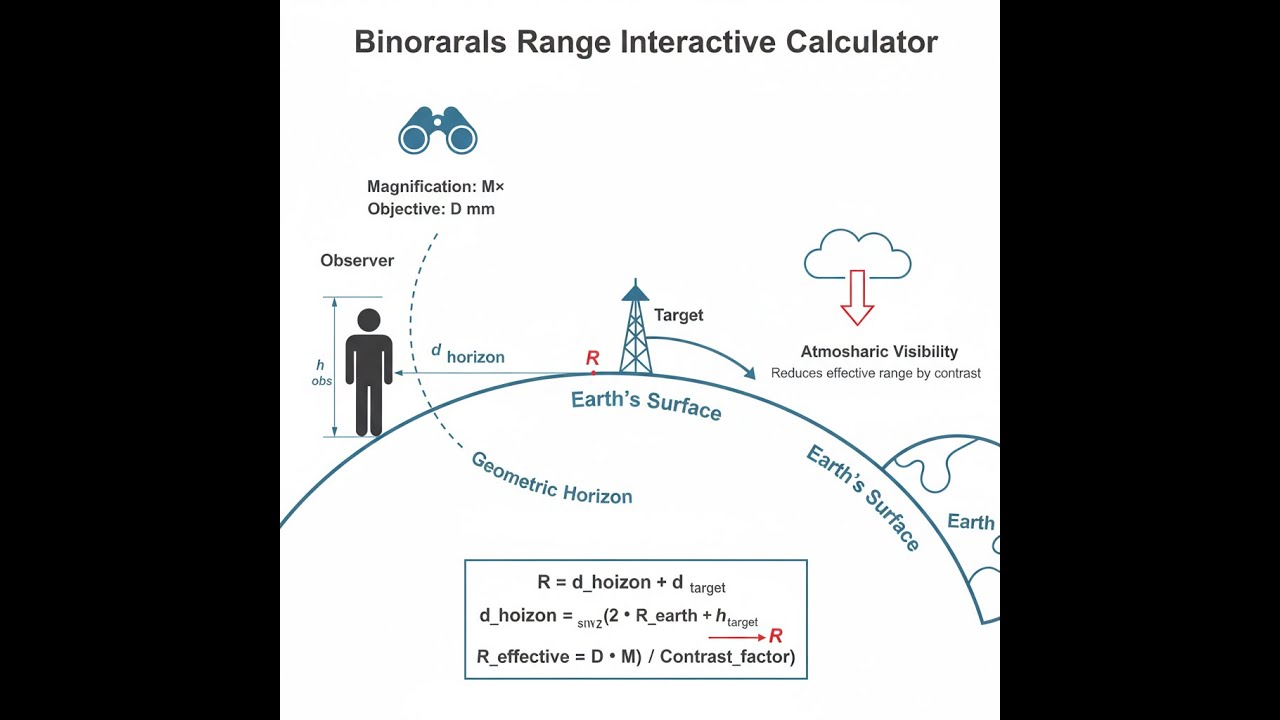
Visual Diagram: Binocular Range Geometry

Binoculars Range Calculator
How to Use This Calculator
This calculator is intended for education, concept evaluation, and preliminary design. Results are based on the equations and assumptions described on this page, but cannot account for every real-world load case, tolerance, material property, environmental condition, installation detail, safety factor, code, or regulatory requirement. Verify all inputs, assumptions, units, and results independently before selecting components or using the result in a real application. Safety-critical, structural, medical, lifting, transportation, or regulated applications must be reviewed by a qualified engineer.
Questions about this calculator or found an error? Message our engineering team.
- Choose what you want to calculate—maximum observable range, horizon distance, how high you'd have to be to see a certain range, and so on.
- Plug in your binoculars' specs: magnification and lens diameter. Fill in heights and visibility if those apply to your chosen calculation.
- Match the values to your actual conditions—atmospheric visibility can have a bigger impact than you'd think.
- Hit Calculate to see your answer.
Binoculars Range Interactive Visualizer
See how magnification, lens diameter, observer height, and atmospheric conditions affect your maximum observable range. Watch the horizon curve and atmospheric limits change in real-time.
MAXIMUM RANGE
15.4 km
HORIZON LIMIT
16.2 km
ATMOSPHERE LIMIT
15.4 km
FIRGELLI Automations — Interactive Engineering Calculators
Governing Equations
Use the formula below to calculate geometric horizon distance.
Geometric Horizon Distance
dhorizon = 3.57 × √hobs + 3.57 × √htarget
dhorizon = total horizon distance (km)
hobs = observer height above surface (m)
htarget = target height above surface (m)
3.57 = empirical constant for Earth's curvature with atmospheric refraction
Use the formula below to calculate optical resolution limit.
Optical Resolution Limit
θ = 120 / Dobjective
θeffective = θ / M
θ = angular resolution (arcseconds)
Dobjective = objective lens diameter (mm)
M = magnification power (×)
θeffective = effective resolution through binoculars (arcsec)
Use the formula below to calculate atmospheric visibility limit.
Atmospheric Visibility Limit
k = 3.912 / Vmet
datm = -ln(Cthreshold) / k
k = extinction coefficient (km-1)
Vmet = meteorological visibility (km)
Cthreshold = contrast threshold (typically 0.05 or 5%)
datm = atmospheric range limit (km)
Use the formula below to calculate exit pupil and relative brightness.
Exit Pupil and Relative Brightness
EP = Dobjective / M
RB = EP²
EP = exit pupil diameter (mm)
RB = relative brightness index (dimensionless)
Dobjective = objective lens diameter (mm)
M = magnification power (×)
Use the formula below to calculate minimum resolvable target size.
Minimum Resolvable Target Size
Smin = (d × θeffective) / 206265
Smin = minimum resolvable target size (m)
d = distance to target (m)
θeffective = effective angular resolution (arcsec)
206265 = conversion factor (arcseconds per radian)
Simple Example
10× binoculars, 50 mm objective, observer at 2 m height, target at 2 m height, atmospheric visibility 20 km:
- Geometric horizon: 3.57 × √2 + 3.57 × √2 = 10.10 km
- Atmospheric limit: —ln(0.05) / (3.912 / 20) = 15.33 km
- Optical limit: far exceeds both at typical target sizes
- Maximum range = 10.10 km — limited by the geometric horizon
Theory & Practical Applications
Geometric Horizon Constraints
Earth's curvature is usually the main thing limiting what you can see. Even with the best optics, if the target's below the horizon line, it's just not visible—no matter what. The formula for horizon distance (using h in meters, d in km) is d ≈ 3.57√h, which factors in a typical atmosphere. In practice, if you stand 10 meters above the water, you see about 11.3 km to your own horizon. If the target is tall—say, a 20-meter ship mast—you add another 16 km or so, getting just over 27 km before the ship’s hull slips out of sight. That's why lookout posts on ships are placed as high as possible: more height always buys you more range above the water, about 3.57 times the square root of each extra meter you gain.
Optical Resolution and Diffraction Limits
After the geometric limit, the next thing to check is the resolving power of your binoculars. There's a physical cutoff here, set by diffraction at the lens opening. The Rayleigh criterion gives you a practical number for this, and the standard quick formula with visible light is θ ≈ 120/D (D in mm, θ in arcseconds). Your magnification divides this angle, so 10×50 binoculars go from 2.4 arcsec to 0.24 arcsec. But in reality, the atmosphere (not your optics) is often the actual limit: on the ground, air turbulence—called "seeing"—can mess up fine resolution and blur details to about 1–2 arcseconds, regardless of lens size. So even really good binoculars get held back by wobbly air more often than by diffraction, except under very steady conditions.
Atmospheric Extinction and Visibility
The third wall you hit is how clear the air is. Scattering and things like haze, mist, or smoke lower contrast with distance, all measured by how quickly image brightness drops—a process described by Beer-Lambert law. The meteorological visibility (Vmet) is roughly the range at which you barely see a target at 2% contrast. Through binoculars, you usually want at least 5% contrast to see a dim object, so your practical atmospheric limit will be closer than what weather reports claim. If a clear day gives Vmet = 20 km, you get a ~15.3 km usable viewing range for most practical purposes. Wind, humidity, pollution, and smoke can turn that down sharply and frequently do, so field results may differ by large amounts day-to-day. Professional users account for these swings as standard practice.
Exit Pupil and Low-Light Performance
Exit pupil (EP = D/M) tells you how wide the light beam is coming out of the ocular end. It should match the observer’s pupil in the current light—around 2 mm in bright sun, up to 7–8 mm for young people in darkness. Classic 7×50 binoculars output 7.1 mm, which matches a fully dark-adapted eye. If your exit pupil is larger than your own pupil, you just lose that extra light—it never hits your retina. If it’s smaller, you won’t be getting all the brightness you could from the scene. RB = EP² gives you a handle on how much brighter your binoculars make things appear, but only when EP matches your eye. Too big or too small either wastes light or underutilizes the lens, so marine and patrol binos tend to stick to 5–7 mm exit pupils for this reason, particularly for night or dusk operation.
Industry Applications Across Domains
Out at sea, operators rely on these calculations for safe navigation and spotting hazards. Standards for nav lights expect certain visibility, and the equipment is specced around typical practical ranges—hence the popularity of 7×50 or 8×56 binoculars in the field. Signal recognition relies on knowing target size and subtended angle, which only works out to a few kilometers in anything short of perfect atmospheric conditions. Wildlife users split the difference between getting enough detail and not causing disturbance; higher magnifications bring features into view but cut field of view and often suffer atmospheric distortion by midday. Security agents usually care about spotting human-sized objects before they cross a boundary; here, again, atmosphere usually limits range more than optics. For astronomy, bigger binoculars (20×80 and so on) can in theory reach tiny angular resolutions, but terrestrial air turbulence plus the need for a rock-steady tripod keep practical use more modest than the numbers might suggest.
Worked Example: Coastal Lighthouse Observation
Here's a real-world case. If you’re on a bluff 25 meters up and want to spot a lighthouse with a 45-meter focal height, using 10×50 binoculars and the air is rated at 18 km visibility:
Step 1: Calculate Geometric Horizon Distance
For you: 3.57 × √25 = 17.85 km
For the lighthouse: 3.57 × √45 ≈ 23.95 km
Summed, the theoretical combined horizon is 41.8 km.
Step 2: Calculate Optical Resolution Limit
Lens gets 2.40 arcsec, divided by 10× gives 0.24 arcsec. For a structure 8 meters wide, the calculated distance limit is thousands of kilometers—so optics are not the bottleneck here.
Step 3: Calculate Atmospheric Visibility Limit
At 18 km meteorological visibility, and needing 5% contrast, your limit is 13.78 km.
Step 4: Determine the Limiting Factor and Maximum Range
Even though you could see 41.8 km geometrically and your optics are more than capable, the air only allows 13.78 km of usable viewing.
Step 5: Calculate Exit Pupil
50/10 = 5.0 mm exit pupil, giving a relative brightness of 25. This suits most daylight observation at the coast.
What does this mean? Even if the geometry says you could see 41.8 km, haze drops you to 13.78 km. If weather clears and that number doubles, you’ll be horizon-limited, not atmosphere-limited. That’s why coast watch stations are built high, and why mariners and spotters keep watch on changing atmospheric conditions.
Edge Cases and Non-Ideal Conditions
Special weather situations can throw off all these numbers. A warm layer over cold water (superior mirage) can boost visible range 20–30%, while inferior mirages or surface ducts might give you brief, fuzzy glimpses further out or of reflected images. Table corrections exist for these cases, but the quality degrades fast. Lower-quality binoculars also suffer: poor glass or bad prism designs will lower your contrast and resolution, and the difference is obvious in tough conditions. Professional models come with extras like rangefinding reticles to help you estimate distances directly—handy for finding out if that small blip is worth further attention at the edge of practical range.
For more engineering calculations and optical tools, visit our engineering calculator library.
Frequently Asked Questions
Free Engineering Calculators
Explore our complete library of free engineering and physics calculators.
Browse All Calculators →🔗 Explore More Free Engineering Calculators
About the Author
Robbie Dickson — Chief Engineer & Founder, FIRGELLI Automations
Robbie Dickson brings over two decades of engineering expertise to FIRGELLI Automations. With a distinguished career at Rolls-Royce, BMW, and Ford, he has deep expertise in mechanical systems, actuator technology, and precision engineering.
Video Walkthrough - How to Use This Calculator
Need to implement these calculations?
Explore the precision-engineered motion control solutions used by top engineers.


