Equipment doesn't hold value over time—what cost $50,000 in 2005 may need a very different budget today. Inflation chips away at purchasing power each year, and when you're dealing with a project that spans decades, that effect compounds quickly. If you don't account for it, you risk major budget gaps. This Inflation Adjusted Value Calculator is a direct, no-nonsense tool to compare the "real" cost of capital or labor across years. Enter the original value, an inflation rate that suits your industry (not just a generic average), and the time period. You'll get an adjusted figure that's useful for planning replacements, estimating lifecycle costs, and negotiating multi-year contracts. You'll also find the basic formulas, an industrial pricing example, some plain talk about inflation theory, and a practical FAQ—all with an eye toward how this actually plays out in real-world engineering.
What is Inflation Adjustment?
When you adjust for inflation, you're translating a dollar amount from one year to its equivalent in another year, based on how prices have shifted. This lets you figure out what something would have cost in the past—or what it'll cost in the future—if you keep purchasing power consistent.
Simple Explanation
Here's the idea: say a coffee was $1 in 1990, but is $3 today. That's not about better beans; your money just doesn't stretch as far. The same applies to any big-ticket expense—machines, pay, or materials. When you adjust for inflation, you're lining up those numbers so you can make a fair year-to-year comparison.
📐 Browse all 1000+ Interactive Calculators
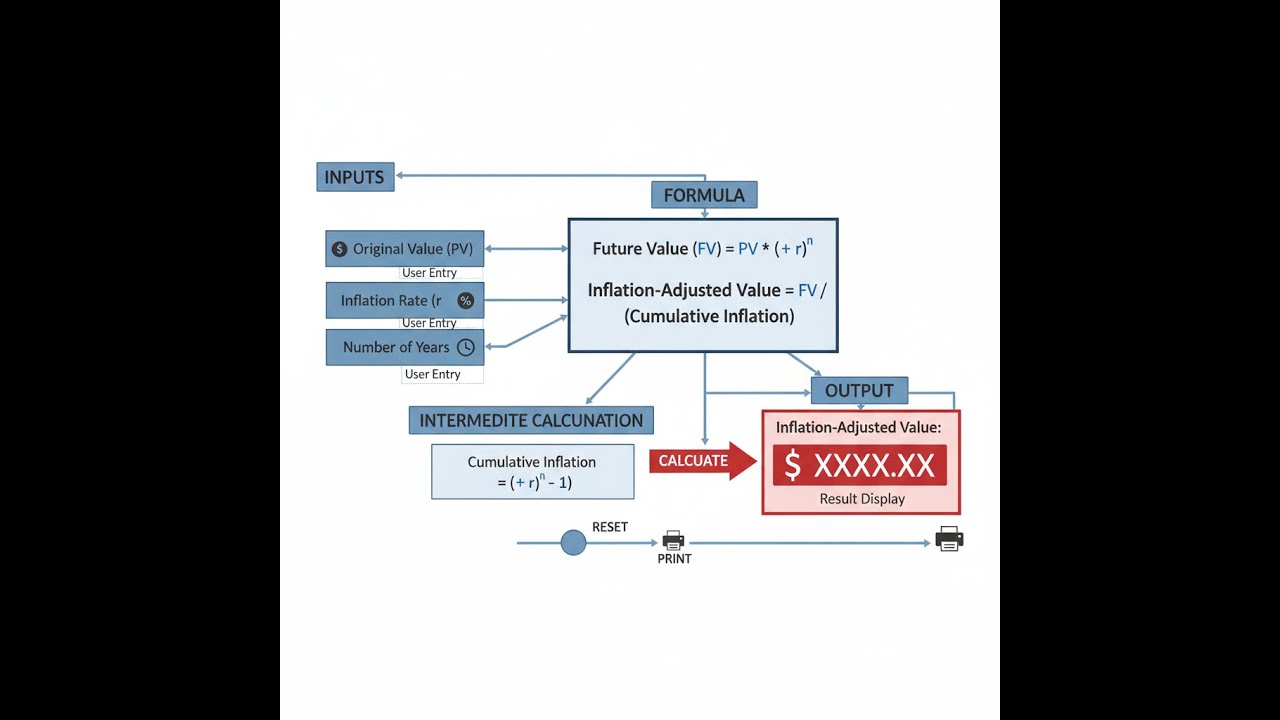
Diagram

Inflation Adjusted Value Calculator
How to Use This Calculator
This calculator is intended for education, concept evaluation, and preliminary design. Results are based on the equations and assumptions described on this page, but cannot account for every real-world load case, tolerance, material property, environmental condition, installation detail, safety factor, code, or regulatory requirement. Verify all inputs, assumptions, units, and results independently before selecting components or using the result in a real application. Safety-critical, structural, medical, lifting, transportation, or regulated applications must be reviewed by a qualified engineer.
Questions about this calculator or found an error? Message our engineering team.
- Pick the Calculation Mode—decide if you're after future value, past value, required inflation rate, time period, real return, or purchasing power loss.
- Enter your Original Value in dollars—the starting price.
- Enter the Annual Inflation Rate (%) and Time Period (years). Real Return mode also needs the Nominal Return Rate (%).
- Click Calculate and review the result.
Inflation Adjusted Value Interactive Visualizer
See how compound inflation changes purchasing power over time. You can tweak value, inflation rate, and years to watch future costs and the total inflation effect update live.
FUTURE VALUE
$80,050
INFLATION FACTOR
1.601×
TOTAL INCREASE
60.1%
FIRGELLI Automations — Interactive Engineering Calculators
Equations
To adjust for inflation, use the following formula.
Future Value (Forward Inflation Adjustment)
FV = PV × (1 + r)n
FV = Future value (inflated dollars)
PV = Present value (original dollars)
r = Annual inflation rate (decimal)
n = Number of years
Past Value (Backward Inflation Adjustment)
PV = FV / (1 + r)n
PV = Past value (equivalent purchasing power in earlier period)
FV = Future/current value (today's dollars)
r = Annual inflation rate (decimal)
n = Number of years between periods
Required Inflation Rate
r = (FV / PV)1/n - 1
r = Implied annual inflation rate (decimal)
FV = Final value
PV = Initial value
n = Number of years
Time Period Required
n = ln(FV / PV) / ln(1 + r)
n = Number of years required
ln = Natural logarithm
FV = Target future value
PV = Starting present value
r = Annual inflation rate (decimal)
Real Rate of Return (Fisher Equation)
rreal = [(1 + rnominal) / (1 + rinflation)] - 1
rreal = Real rate of return adjusted for inflation (decimal)
rnominal = Nominal rate of return (decimal)
rinflation = Inflation rate (decimal)
Cumulative Inflation Factor
IF = (1 + r)n
IF = Inflation factor (multiplier for price increase)
r = Annual inflation rate (decimal)
n = Number of years
Simple Example
Say you bought equipment for $10,000 today. With 3% annual inflation over 10 years:
FV = $10,000 × (1 + 0.03)10 = $10,000 × 1.3439 = $13,439
The same equipment will run about $13,440 in 10 years. Plan your budgets with that in mind.
Theory & Engineering Applications
Inflation adjustment sits at the core of engineering economics, capital budgeting, and lifecycle cost analysis. The catch is that inflation compounds—one year stacks on top of the last—so costs grow quickly over long stretches. If you're running a project over 20-30 years, skipping inflation is a direct path to bad estimates and surprise expenses when it comes time to replace or upgrade equipment later on.
Compound Interest Mathematics and Exponential Growth
The formula FV = PV × (1 + r)ⁿ describes how inflation compounds—each increase builds on last year's total. This same math turns up in plenty of other places: decay, population, or chemistry models. The "Rule of 72" gives a rough shortcut: 3% inflation means prices double in about 24 years (72 ÷ 3), while 6% cuts that to 12 years. A critical reality: if you think inflation simply "adds up" each year, you’ll fall short—3% over 30 years isn’t a 90% increase, it’s 142.7%. The math isn’t linear, it’s exponential.
If you want to solve for any one value (rate, years, etc), the exponential formula can be rearranged with logarithms. It’s all the same core structure—understanding this helps when you’re switching between “present value,” “future value,” or return rate problems. The math fits all of them; it’s just how you label the variables for your application.
Real Versus Nominal Values: The Fisher Equation
The Fisher Equation highlights the gap between what's on paper (nominal) and what actually increases your purchasing power (real). The two are only roughly equal for very low rates. If you’re working with more than a few percent, don’t just subtract the inflation rate—use the actual formula. For example, at 8% returns with 3% inflation, the simple difference gives ~5%; the true figure is actually a bit lower, and over years that “small” difference adds up. In real terms, even tenths of a percent have consequences when you’re talking about long timelines and big budgets.
If you’re doing any serious capital planning for industrial or infrastructure projects, skip the shortcut and use the exact Fisher Eqaution. Over just twenty years, a few hundredths of a point is no longer negligible.
Historical Inflation Variability and Predictive Limitations
Don't make the mistake of assuming all inflation rates are created equal. What you see in the U.S. CPI is an average; individual sectors—industrial equipment, healthcare, education, or copper—move at their own speeds, sometimes much higher or lower than the general inflation rate. For instance, semiconductors have gotten drastically cheaper over time (deflation), while medical equipment has gone up faster than general CPI. If you use the wrong inflation rate, your numbers won’t match the real world, and your cost projections will be off—in some cases, by a lot.
When you need to estimate costs, reach for a sector-specific index, not just CPI. For industrial work, that usually means PPI for your equipment or ENR’s indices for construction. Plugging 3% CPI into a project that actually sees 4.7% inflation will put your 20-year replacement budget 27% off target. That’s not just a rounding error—it’s a real dollar mistake on large projects.
Lifecycle Cost Analysis and Net Present Value
Inflation isn't something to tack on at the end—it mixes directly with time value of money. To compare big costs over time, inflate all future expenses, then discount them back to today’s value. Use the real discount rate (which combines nominal discount and inflation). This makes it possible to compare systems with different lives and costs on equal footing. Often, spending more up front on longer-lived gear is the smarter move once you tally the full, inflation-adjusted lifecycle costs. That rarely shows up if you only look at sticker prices.
Worked Example: Industrial Robot Replacement Planning
Take this for a typical scenario: a car plant bought robots in 2004 for $87,500 each. It now needs to budget for replacement in 2024. Over those 20 years, these robots have seen 2.3% annual inflation. The plant runs 18 robots and wants a fair number for budgeting, not just a guess based on general inflation.
Step 1: Calculate time period
n = 2024 - 2004 = 20 years
Step 2: Calculate inflation factor for industrial robots
IF = (1 + 0.023)²⁰ = (1.023)²⁰ = 1.5736
Step 3: Calculate 2024 equivalent cost per robot
FV = $87,500 × 1.5736 = $137,690 per robot
Step 4: Calculate total fleet replacement budget
Total budget = $137,690 × 18 robots = $2,478,420
Step 5: Compare to CPI-based estimate
CPI inflation factor = (1.026)²⁰ = 1.6755
CPI-based estimate = $87,500 × 1.6755 = $146,606 per robot
CPI-based total = $146,606 × 18 = $2,638,908
Step 6: Calculate estimation error
Overestimation = $2,638,908 - $2,478,420 = $160,488
Percentage error = ($160,488 / $2,478,420) × 100% = 6.48%
Analysis: If the plant had based its numbers on CPI instead of the robot equipment index, the overbudget would be about $160,000—not a small amount when specifying capital or negotiating with finance. It’s all due to a 0.3% difference in average annual inflation, which at first glance looks insignificant. Over long intervals, it’s not. This is why you use the rates tied to your equipment, not generic averages.
Further calculation for lifecycle analysis: Now, if the robots last until 2039 (another 15 years), project forward:
2039 replacement cost = $137,690 × (1.023)¹⁵ = $137,690 × 1.4063 = $193,696 per robot
Total 2039 fleet replacement = $193,696 × 18 = $3,486,528
To build a replacement fund with 5.5% nominal (2.5% real after 3% inflation), the fund formula gives:
FV = PMT × [(1 + i)ⁿ - 1] / i
$3,486,528 = PMT × [(1.055)¹⁵ - 1] / 0.055
$3,486,528 = PMT × 23.1239
PMT = $150,787 annual deposit
All this adds up to realistic project budgeting. Inflation adjustment isn't academic—it's the line between a controlled cost and a project overrun.
Practical Applications
Scenario: Municipal Infrastructure Bond Planning
A civil engineer is updating a 30-year plan for water treatment plant replacement. The original plant cost $14.2 million in 1994. Using a sector-specific 4.1% annual inflation rate, she finds the 2024 equivalent is $47.8 million. This justifies a new $52 million bond—without crunching these numbers, historical vs. current prices would look like a huge jump, but most of the "increase" is just regular inflation. This approach prevents sticker shock and makes for a more fact-based discussion with decision makers.
Scenario: Aerospace Career Salary Negotiation
An engineer looks at their $127,000 salary in 2024 and wants to see how that stacks up to $68,500 earned in 2009, once inflation is out of the picture. Turns out, $68,500 becomes $96,820 in 2024 dollars using 2.4% inflation over 15 years. The real gain is about $30,000, or 31% over 15 years. This puts hard numbers on career progression—not just percentages—and helps guide future negotiations using actual purchasing power, not just pay stubs.
Scenario: Pharmaceutical Manufacturing Equipment Replacement Reserve
A facilities manager running a $3.8 million replacement fund for HVAC equipment wants to check if 6.2% investment return will meet a 12-year target, once inflation is considered. General inflation is 2.8%, but sector-specific is 3.7%. After correcting for the higher equipment inflation, the real return is down to 1.43%, not 2.35%, which puts the reserve about 25% short by the end. This highlights the need for either bigger annual contributions or higher-yield investments—simply leaving the fund as-is leads to a future shortfall and fewer options when it's time to replace equipment.
Frequently Asked Questions
▼ What's the difference between nominal and real inflation-adjusted values?
▼ Should I use CPI or sector-specific inflation rates for engineering cost estimation?
▼ How do I account for inflation in international projects with multiple currencies?
▼ Why doesn't my investment return equal the inflation-adjusted result when I subtract inflation from nominal return?
▼ How far into the future can I reliably project inflation-adjusted costs?
▼ What inflation rate should I use for salary and labor cost projections in engineering workforce planning?
Free Engineering Calculators
Explore our complete library of free engineering and physics calculators.
Browse All Calculators →🔗 Explore More Free Engineering Calculators
About the Author
Robbie Dickson — Chief Engineer & Founder, FIRGELLI Automations
Robbie Dickson brings over two decades of engineering expertise to FIRGELLI Automations. With a distinguished career at Rolls-Royce, BMW, and Ford, he has deep expertise in mechanical systems, actuator technology, and precision engineering.
Video Walkthrough - How to Use This Calculator
Need to implement these calculations?
Explore the precision-engineered motion control solutions used by top engineers.


