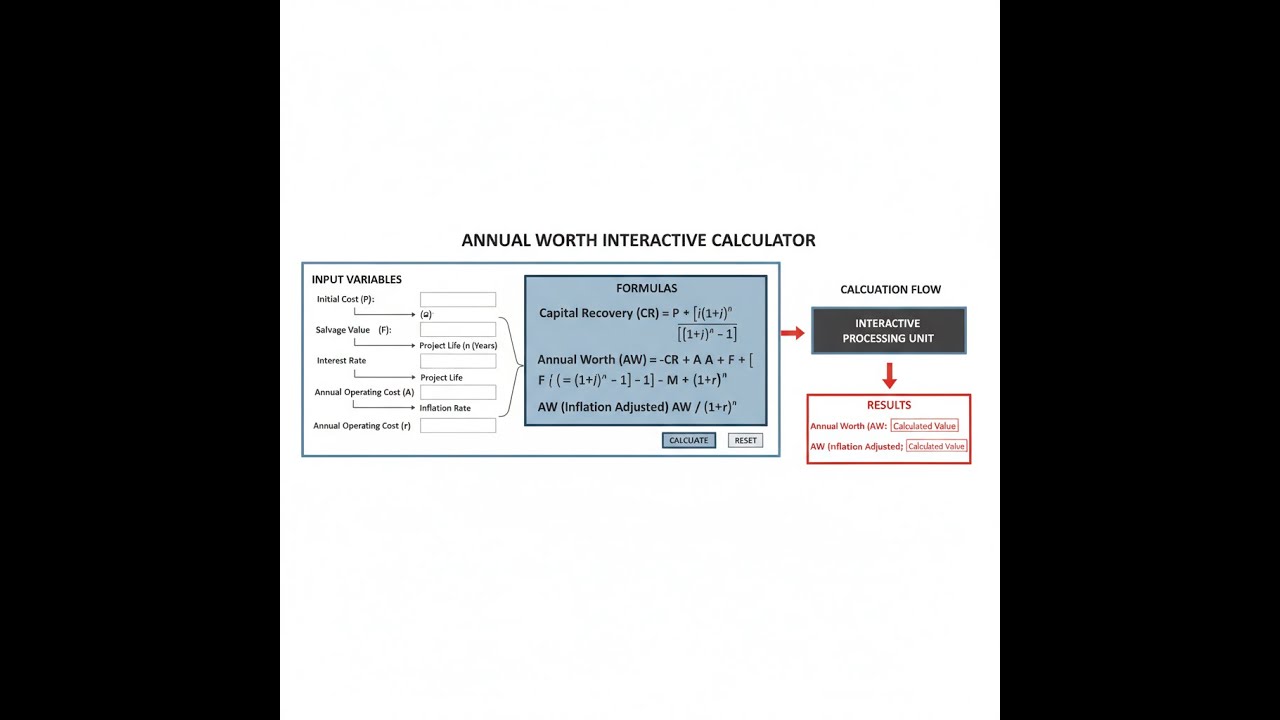
A machine can show a positive operating receipt every year and still have a negative annual worth once you include the purchase. Compare the actual cash flows with an equal amount at each year-end, then change the rate, service life or terminal value.
📐 Browse all 1000+ Interactive Calculators
Turn a project’s cash flows into equal annual payments
Buying equipment costs money today. Its benefits, running costs and final sale arrive later. Compare those cash flows with a level annual amount that has the same value today.
Two schedules with the same present worth
Both charts use the same dollar scale. Receipts rise above zero and payments fall below it. Year 0 is today.
Each dot marks the same +$1,065.02 receipt at the end of a year.
Year 8 combines +$10,000.00 in operating cash flow and +$5,000.00 from the final sale, giving +$15,000.00. The equivalent schedule pays +$1,065.02.
Operating cash flow is +$10,000.00 per year. Including the final sale or disposal, the annual capital recovery cost is $8,934.98.
Year-by-year cash flows
| Year | Actual | Equivalent |
|---|
Annual Worth Interactive Calculator
How to use the calculator
- Choose a single project, two alternatives, capital recovery, a perpetual stream, an arithmetic gradient or a target annual worth.
- Enter the purchase price as a positive cost at year 0 and annual operating expenses as positive costs. Enter net terminal proceeds as a positive amount, or a disposal payment as a negative amount. In fields labeled net cash flow, receipts are positive and payments are negative.
- Use an effective annual discount rate in percent and a whole number of years. Finite cases accept 0%. All annual flows occur at year-end, and the final year includes both the normal annual flow and the terminal amount.
- Select Calculate or Try Example. Annual worth is a level amount at each year-end with the same present worth as the modeled cash flows.
This calculator is intended for education, concept evaluation, and preliminary design. Results are based on the equations and assumptions described on this page, but cannot account for every real-world load case, tolerance, material property, environmental condition, installation detail, safety factor, code, or regulatory requirement. Verify all inputs, assumptions, units, and results independently before selecting components or using the result in a real application. Safety-critical, structural, medical, lifting, transportation, or regulated applications must be reviewed by a qualified engineer.
Questions about this calculator or found an error? Message our engineering team.
Annual worth from a cash-flow timeline
Let P be the purchase cost at time 0, C the net operating receipt at the end of each year, S the net terminal receipt at the end of year n, and i the effective annual discount rate written as a decimal. Charges reduce net annual worth. The dollar sign on the results represents the currency units used for all inputs.
AW = C − P(A/P) + S(A/F). The capital recovery factor A/P converts an amount at time 0 to its year-end equivalent. The sinking fund factor A/F converts a single amount in year n. For i ≠ 0, A/P = i/[1 − (1+i)−n] and A/F = i/[(1+i)n − 1]. At 0% both factors equal 1/n, so AW = C − (P − S)/n.
To check any finite result, sum the signed present values of the actual flows. For this project, PW = −P + Σ[C/(1+i)t] + S/(1+i)n, where the sum runs from t = 1 through n. Multiplying PW by A/P gives AW. Discounting n equal AW payments back to year 0 recovers the same PW. See the NIST Life Cycle Costing Manual, section 17.4.
Capital recovery, a changing annual stream and perpetuity
- Capital recovery. The annual cost of owning the capital, before operating cash flows, is P(A/P) − S(A/F). A net disposal payment increases that cost.
- Arithmetic gradient. A first-year receipt C₁ and annual change G give cash flow C₁ + (t − 1)G in year t. Its annual equivalent before purchase cost is C₁ + G(A/G), with A/G = 1/i − n/[(1+i)n − 1]. At zero rate A/G = (n − 1)/2. A one-year project has no gradient increment.
- Perpetuity. For i > 0, a single initial outlay P and a constant net year-end receipt C forever give AW = C − Pi. This model has no replacement or terminal payment. A constant nonzero stream extending forever has no finite present worth at zero or negative rates.
- Required terminal value. To achieve a target T, solve S = [T − C + P(A/P)]/(A/F). The sale price or disposal cost would still need an independent estimate.
Worked example with an eight-year machine
The machine costs $50,000 today. At each year-end it produces $12,000 of benefits and costs $2,000 to operate. It sells for $5,000 at the end of year 8. The actual timeline is −$50,000 at year 0, +$10,000 at years 1 through 7, and +$15,000 in year 8.
At 10%, A/P ≈ 0.1874440 and A/F ≈ 0.0874440. The purchase costs about $9,372.20 per year on this basis, and salvage returns about $437.22 per year. That leaves a net capital recovery cost of $8,934.98 per year. Subtract it from the $10,000 operating receipt to get annual worth of $1,065.02. Both the actual flows and eight equal annual equivalents have a present worth of about $5,681.80.
Set the rate to 0% and annual worth becomes $10,000 − ($50,000 − $5,000)/8 = $4,375 per year. Discounting at 10% reduces the value of the later receipts relative to the purchase today.
Comparing alternatives with different lives
Alternatives should deliver comparable service for the same required time. Comparing the annual worth of one six-year cycle with one ten-year cycle assumes each can be renewed on equivalent terms for as long as the service is needed. The comparison inputs take the annual net operating receipt after recurring costs. A cost-only alternative has a negative annual net receipt.
If service ends on a known date, build both cash-flow schedules to that date. Include actual replacements and the remaining value or disposal cost of any equipment then in service. Annualize both schedules over that common period. For an example of the common-period and residual-value approach see FHWA’s life-cycle cost analysis supplement.
Frequently Asked Questions
When should I use Annual Worth analysis instead of Present Worth or Internal Rate of Return? +
How do I properly account for inflation in Annual Worth calculations? +
What discount rate should I use for engineering economic analysis? +
How should I estimate salvage value for equipment and machinery? +
Can Annual Worth analysis handle projects with mid-year cash flows or irregular timing? +
How do I incorporate tax effects into Annual Worth calculations? +
Free Engineering Calculators
Explore our complete library of free engineering and physics calculators.
Browse All Calculators →🔗 Explore More Free Engineering Calculators
About the Author
Robbie Dickson — Chief Engineer & Founder, FIRGELLI Automations
Robbie Dickson brings over two decades of engineering expertise to FIRGELLI Automations. With a distinguished career at Rolls-Royce, BMW, and Ford, he has deep expertise in mechanical systems, actuator technology, and precision engineering.