Predicting how long it takes a clay soil to settle under load is one of the most consequential calculations in geotechnical engineering — get it wrong and you're looking at cracked foundations, failed embankments, or blown construction schedules. Use this Coefficient of Consolidation Calculator to calculate Cv, settlement time, degree of consolidation, and permeability using drainage path length, consolidation time, and compressibility inputs. It's directly applicable to foundation design, highway embankment construction, and landfill liner assessment. This page includes the governing formulas, a worked multi-stage example, full theory, and an FAQ covering common field vs. lab discrepancies.
What is the Coefficient of Consolidation?
The coefficient of consolidation (Cv) is a soil property that describes how quickly a saturated clay soil drains water and compresses when a load is applied. A higher Cv means faster settlement — the soil reaches its final compressed state sooner.
Simple Explanation
Think of saturated clay like a water-logged sponge under a heavy book. The book slowly squeezes water out, and the sponge compresses over time. Cv measures how fast that squeeze happens — a stiff, open-pored sponge drains quickly (high Cv), while a dense, fine-pored one drains slowly (low Cv). The drainage path length is critical: double the distance water has to travel, and settlement takes 4 times as long.
📐 Browse all 1000+ Interactive Calculators
Table of Contents
Consolidation Process Diagram

How to Use This Calculator
- Select your calculation mode from the dropdown — choose from Cv from t50, Cv from t90, settlement time, degree of consolidation, or permeability.
- Enter the relevant time value (t50 or t90 in seconds or minutes, or time elapsed in years or days) and the drainage path length H in mm for lab specimens or m for field conditions.
- If using the permeability or degree of consolidation modes, also enter Cv, volume compressibility (mv), and unit weight of water (γw) as required by the selected mode.
- Click Calculate to see your result.
Interactive Coefficient of Consolidation Calculator
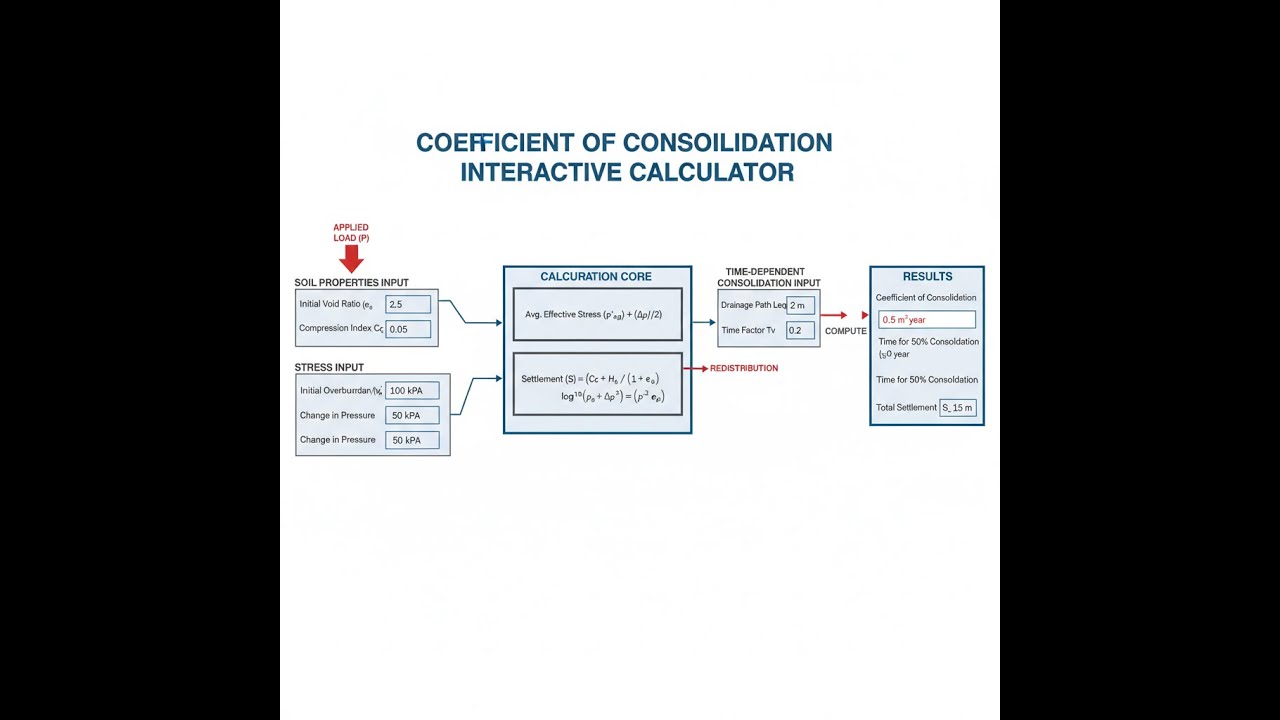
Coefficient of Consolidation Interactive Visualizer
Watch how saturated clay soil consolidates over time as water drains from pores under applied load. Adjust drainage path length and soil properties to see how these factors dramatically affect settlement timing and the coefficient of consolidation.
COEFFICIENT CV
0.15 mm²/s
TIME FACTOR
0.39
SETTLEMENT
50%
FIRGELLI Automations — Interactive Engineering Calculators
Governing Equations
Use the formula below to calculate the coefficient of consolidation from laboratory test data.
Coefficient of Consolidation from Laboratory Test
Cv = (Tv × H2) / t
Where:
- Cv = coefficient of consolidation (m²/year, cm²/s, or other area/time units)
- Tv = time factor (dimensionless): 0.197 for 50% consolidation, 0.848 for 90% consolidation
- H = drainage path length (m, cm): half the specimen height for double drainage, full height for single drainage
- t = time to reach specific degree of consolidation (years, seconds, etc.)
Time Factor
Use the formula below to calculate the dimensionless time factor Tv.
Tv = (Cv × t) / H2
Where:
- Tv = time factor relating time, drainage distance, and consolidation rate
- All other variables as defined above
Degree of Consolidation
Use the formula below to calculate the degree of consolidation U at a given time.
For Tv < 0.217: U = √((4 × Tv) / π) × 100%
For Tv ≥ 0.217: U = (1 - e(-π²Tv/4)) × 100%
Where:
- U = degree (or percent) of consolidation at time t
- π = 3.14159...
Permeability from Consolidation Parameters
Use the formula below to calculate hydraulic conductivity from consolidation test results.
k = Cv × mv × γw
Where:
- k = hydraulic conductivity or permeability (m/s, cm/s)
- mv = coefficient of volume compressibility (m²/kN or 1/kPa)
- γw = unit weight of water (typically 9.81 kN/m³)
Simple Example
A lab oedometer test on a soft clay specimen gives t50 = 245 seconds with a drainage path H = 12.5 mm (double drainage, so H = half specimen thickness).
Cv = (0.197 × 12.5²) / 245 = (0.197 × 156.25) / 245 = 30.78 / 245 = 0.1256 mm²/s
This is a moderate Cv — typical of a silty clay. Expect reasonable consolidation rates in the field, but verify drainage boundary conditions before scaling to field layer thickness.
Theory & Engineering Applications
The coefficient of consolidation represents the rate at which excess pore water pressure dissipates in saturated fine-grained soils under sustained loading. Unlike permeability alone, Cv incorporates both the soil's drainage characteristics and its compressibility, making it the critical parameter for predicting time-dependent settlement. This fundamental relationship stems from Terzaghi's one-dimensional consolidation theory, which describes how water flows out of soil voids as the soil skeleton gradually takes on more effective stress.
Physical Meaning and Controlling Factors
When load is applied to saturated clay, the initial response is an increase in pore water pressure because water cannot instantaneously drain from the fine pores. Over time, this excess pressure dissipates as water flows toward drainage boundaries, and the soil skeleton compresses. The coefficient of consolidation quantifies how quickly this process occurs, with higher values indicating faster consolidation. Three primary factors control Cv:
Permeability (k): Soils with larger or more interconnected pores allow water to escape more readily. A tenfold increase in permeability typically produces a proportional increase in Cv. However, clay mineralogy matters significantly—smectite clays with plate-like particles and high plasticity exhibit much lower permeability than kaolinite clays of similar void ratio.
Compressibility (mv or av): More compressible soils generate smaller pore volume changes per unit pressure increase, meaning less water must be expelled for a given settlement. Counter-intuitively, this can make highly compressible organic clays consolidate relatively quickly despite low permeability, because the total volume of water requiring drainage is large but distributed over substantial initial void space.
Stress History: Overconsolidated clays exhibit higher Cv values than normally consolidated clays at the same void ratio because their stiffer structure resists compression while maintaining reasonable drainage paths. The overconsolidation ratio (OCR) can cause Cv to vary by a factor of three or more as stress increases and the soil reaches virgin compression.
Laboratory Determination Methods
The oedometer (or consolidometer) test remains the standard method for determining Cv in the laboratory. A laterally confined soil specimen, typically 50-75 mm diameter and 19-25 mm thick, undergoes one-dimensional compression under incrementally applied loads. Dial gauges or displacement transducers record vertical deformation versus time during each load increment, producing characteristic consolidation curves.
Two graphical procedures extract Cv from time-deformation data:
Taylor Square Root of Time Method (t50): Plotting deformation versus the square root of time yields an initial straight line whose slope relates to early-stage consolidation (Tv < 0.6). The intersection of this line with a corrected curve determines the time for 50% consolidation (t50). Using Tv = 0.197, the calculation Cv = 0.197H²/t50 provides the coefficient. This method works best when initial compression is rapid and clear, which often occurs in laboratory tests with thin specimens and short drainage paths.
Casagrande Logarithm of Time Method (t90): Plotting deformation versus logarithm of time produces an S-shaped curve. Casagrande's graphical construction identifies the time for 90% primary consolidation (t90) using the intersection of tangents to the curve's initial and final straight portions. With Tv = 0.848, the coefficient becomes Cv = 0.848H²/t90. This method proves more reliable when secondary compression initiates before primary consolidation completes, a common scenario in organic soils and highly plastic clays.
Modern automated testing equipment often calculates Cv continuously using curve-fitting algorithms, but engineers should verify results against these classical methods and assess data quality. Disturbance during sampling, incomplete saturation, or temperature variations can significantly affect measured values—laboratory Cv values for soft clays may be 50-200% of field values due to sample disturbance effects.
Field Applications and Settlement Prediction
In field conditions, predicting settlement timing requires careful consideration of drainage boundary conditions. For a clay layer with permeable sand above and below, water can escape in both directions, making the effective drainage path half the layer thickness. Single drainage occurs when clay sits on impermeable bedrock or very thick clay layers, doubling the drainage path and quadrupling settlement time.
The relationship between degree of consolidation U and time factor Tv allows engineers to predict what percentage of ultimate settlement has occurred at any time. For U < 60% (Tv < 0.287), a simplified equation U ≈ 2√(Tv/π) provides adequate accuracy. Beyond 60%, the exponential relationship U = 1 - exp(-π²Tv/4) applies, asymptotically approaching 100% consolidation. In practice, reaching 90% consolidation typically represents completion for engineering purposes, though secondary compression continues indefinitely.
Design Considerations for Large Projects
Highway embankments over soft clay demonstrate practical Cv application. Consider a 6-meter thick soft clay deposit with Cv = 2.8 m²/year, underlying a 4-meter high embankment. With double drainage, H = 3 meters. For 90% consolidation: Tv = 0.848, therefore t90 = 0.848 × 9 / 2.8 = 2.73 years. If the construction schedule requires opening the road in 18 months, surcharging or vertical drains become necessary to accelerate consolidation.
Prefabricated vertical drains (PVDs) radically alter drainage geometry. Installing drains at 1.5-meter spacing transforms drainage from vertical to radial, reducing the effective drainage path from meters to centimeters and potentially accelerating consolidation by factors of 10-50. The radial consolidation coefficient (Ch) typically exceeds the vertical value (Cv) by 1.5-3 times due to soil fabric anisotropy, further enhancing effectiveness.
Worked Example: Multi-Stage Settlement Analysis
A proposed industrial warehouse will impose 85 kPa additional stress on a site with the following profile: 1.8 meters of medium dense sand (neglect settlement), overlying 7.3 meters of soft normally consolidated clay (Cv = 3.2 m²/year), underlain by dense glacial till (impermeable). Laboratory consolidation testing determined the clay will undergo 340 mm ultimate primary consolidation under the imposed stress. The project requires knowing settlement at 6 months, 1 year, 2 years, and time for 90% consolidation.
Step 1: Establish drainage conditions. Sand provides top drainage; till is impermeable. Single drainage condition exists. Drainage path H = 7.3 meters (full layer thickness).
Step 2: Calculate time factor at each evaluation time.
At t = 0.5 years: Tv = (3.2 m²/year × 0.5 year) / (7.3 m)² = 1.6 / 53.29 = 0.0300
At t = 1 year: Tv = (3.2 × 1) / 53.29 = 0.0600
At t = 2 years: Tv = (3.2 × 2) / 53.29 = 0.1201
Step 3: Calculate degree of consolidation. All Tv values are less than 0.217, so use U = √((4Tv)/π) × 100%.
At t = 0.5 years: U = √((4 × 0.0300)/3.14159) × 100% = √0.03820 × 100% = 19.5%
At t = 1 year: U = √((4 × 0.0600)/3.14159) × 100% = √0.07639 × 100% = 27.6%
At t = 2 years: U = √((4 × 0.1201)/3.14159) × 100% = √0.1529 × 100% = 39.1%
Step 4: Calculate settlement at each time. Settlement = U × Ultimate Settlement.
At t = 0.5 years: Settlement = 0.195 × 340 mm = 66.3 mm
At t = 1 year: Settlement = 0.276 × 340 mm = 93.8 mm
At t = 2 years: Settlement = 0.391 × 340 mm = 133.0 mm
Step 5: Calculate time for 90% consolidation. For U = 90%, Tv = 0.848 (from tables or equation).
t90 = (Tv × H²) / Cv = (0.848 × 53.29 m²) / (3.2 m²/year) = 45.19 / 3.2 = 14.1 years
Interpretation: The soft clay's consolidation progresses slowly. After one year (25% of the project design life), only 28% of settlement has occurred (94 mm of 340 mm). Reaching 90% consolidation requires 14.1 years—unacceptable for most development schedules. This analysis would prompt investigation of soil improvement techniques such as surcharge preloading combined with wick drains to reduce the effective drainage path and achieve acceptable settlement within 12-18 months.
Advanced Considerations and Limitations
Terzaghi's consolidation theory assumes constant Cv throughout consolidation, but real soils exhibit stress-dependent behavior. As effective stress increases during consolidation, void ratio decreases non-linearly, causing both permeability and compressibility to change. The coefficient may decrease by factors of 2-5 as consolidation progresses, though the average value typically provides reasonable settlement time predictions.
Three-dimensional drainage geometry in the field often differs dramatically from one-dimensional laboratory conditions. Corner effects, lateral drainage, and irregular layer geometry can accelerate field consolidation beyond predictions based solely on vertical drainage. Finite element analysis with proper boundary conditions provides more accurate modeling for complex geometries, though simple hand calculations using conservative assumptions remain valuable for preliminary design and validation.
Secondary compression, which occurs after excess pore pressure dissipates, is not captured by Cv. Organic soils and highly plastic clays exhibit significant secondary settlement that can equal or exceed primary consolidation over decades. The secondary compression index (Cα) quantifies this behavior, requiring separate evaluation for complete settlement prediction.
For more geotechnical engineering calculations and soil mechanics tools, visit the complete engineering calculator library.
Practical Applications
Scenario: Highway Embankment Construction Schedule
Jennifer, a highway project engineer, faces a critical decision on a $23 million roadway expansion. The planned embankment will cross 850 meters of soft clay terrain with Cv = 1.9 m²/year and 8.2 meters average thickness. Her preliminary calculations show that natural consolidation would require 8.3 years to reach 90% completion with the clay's single drainage condition (H = 8.2 m). However, the project timeline allows only 14 months from embankment placement to pavement construction. Using this calculator, she evaluates accelerated consolidation options: installing prefabricated vertical drains at 1.2-meter spacing reduces the effective drainage path to 0.6 meters in radial direction, and assuming Ch = 1.5 × Cv = 2.85 m²/year, she calculates t90 = 0.107 years (39 days) for radial consolidation alone. Combined with surcharge loading to induce additional settlement beforehand, the improved design meets schedule requirements while adding only $840,000 to construction costs—far less than delays would cost.
Scenario: Foundation Settlement Monitoring for High-Rise
Marcus, a geotechnical consultant monitoring a 28-story residential tower, needs to verify that foundation settlement is progressing as predicted. The 12-meter thick clay layer beneath the raft foundation has Cv = 4.1 m²/year based on consolidation tests from the site investigation. Two years after construction completed, survey monuments show 87 mm of settlement, while the design predicted 145 mm ultimate settlement. Using this calculator with double drainage conditions (H = 6 m), he determines Tv = (4.1 × 2) / 36 = 0.228, which corresponds to U = 51.2% consolidation. The expected settlement at this stage is 0.512 × 145 mm = 74.2 mm. The measured 87 mm exceeds predictions by 17%, prompting Marcus to conduct additional borehole extensometer measurements at three depths within the clay. These reveal that the upper 4 meters is consolidating faster than expected due to undetected sand lenses providing additional drainage paths, while the lower clay behaves normally. His revised analysis predicts ultimate settlement of 156 mm instead of 145 mm, still within acceptable limits but requiring adjustment to architectural finishes and mechanical penetrations through the foundation slab.
Scenario: Landfill Liner Quality Control
Dr. Aisha Rahman, an environmental engineer, evaluates compacted clay liner performance for a hazardous waste containment facility. Regulations require permeability less than 1 × 10⁻⁹ m/s, but direct permeability testing takes 3-6 months per sample due to extremely slow flow rates. Instead, she conducts consolidation tests that take only 2-3 days per sample, measuring Cv = 0.0019 m²/year and volume compressibility mv = 0.00094 m²/kN for the compacted liner. Using this calculator's permeability mode with γw = 9.81 kN/m³, she calculates k = 0.0019 × 0.00094 × 9.81 = 1.75 × 10⁻⁵ m/year = 5.5 × 10⁻¹³ m/s—well below the regulatory limit and confirming that her compaction specifications produce acceptable liner quality. This indirect method allows her to qualify each 500 m² liner section within one week rather than waiting months, keeping the $47 million project on schedule while maintaining full regulatory compliance. When one test section shows unexpectedly high Cv = 0.0067 m²/year, immediate re-testing reveals incomplete moisture conditioning, prompting re-compaction before installing the geomembrane cover.
Frequently Asked Questions
Why does coefficient of consolidation vary with stress level? +
How do I account for multi-layer soil profiles in consolidation analysis? +
What causes laboratory and field Cv values to differ? +
Can vertical drains really reduce consolidation time by factors of 10-50? +
How should I interpret different Cv values from t50 versus t90 methods? +
What Cv values should I expect for different soil types? +
Free Engineering Calculators
Explore our complete library of free engineering and physics calculators.
Browse All Calculators →🔗 Explore More Free Engineering Calculators
About the Author
Robbie Dickson — Chief Engineer & Founder, FIRGELLI Automations
Robbie Dickson brings over two decades of engineering expertise to FIRGELLI Automations. With a distinguished career at Rolls-Royce, BMW, and Ford, he has deep expertise in mechanical systems, actuator technology, and precision engineering.
Need to implement these calculations?
Explore the precision-engineered motion control solutions used by top engineers.


