If you’re dealing with dewatering, sizing drainage, or tracing how contaminants move underground, the real question is always this: how fast does water actually travel through the ground? That’s what hydraulic conductivity (K) tells you. Use this calculator to work out conductivity (K), velocity (q), hydraulic gradient (i), cross-sectional area (A), flow rate (Q), or head loss (Δh) using your real field or lab numbers and Darcy’s Law. Getting your K value wrong by a factor of ten can turn a solid design into a failure, so it's worth slowing down and checking your numbers. The info here covers the basic formulas, a concrete dewatering example, lookup for typical material K values, and a practical FAQ on measurement, anisotropy, and units.
What is hydraulic conductivity?
Hydraulic conductivity (K) describes how easily water moves through a porous material—soil, sand, rock—when there’s a pressure difference. High K, water moves easily; low K, water hardly moves. K has units of velocity, usually m/s or ft/day.
Simple Explanation
Think of hydraulic conductivity like how fast water pours through a sponge. If you’ve got coarse gravel, it’s like a loose sponge: water runs right through—high K. Fine clay is like squeezing water through a dense sponge—it barely drips—low K. Darcy’s Law is a practical rule: more force (gradient) and a more open material (K) combine to push more water through.
📐 Browse all 1000+ Interactive Calculators
How to Use This Calculator
- Pick which unknown you want to solve for in the dropdown (K, q, i, A, Q, or Δh).
- Enter the values you know into the relevant fields—velocity, gradient, conductivity, area, flow, head loss, or flow length as needed.
- Keep units consistent (all metric or all imperial) for all inputs before solving.
- Hit Calculate to get your result.
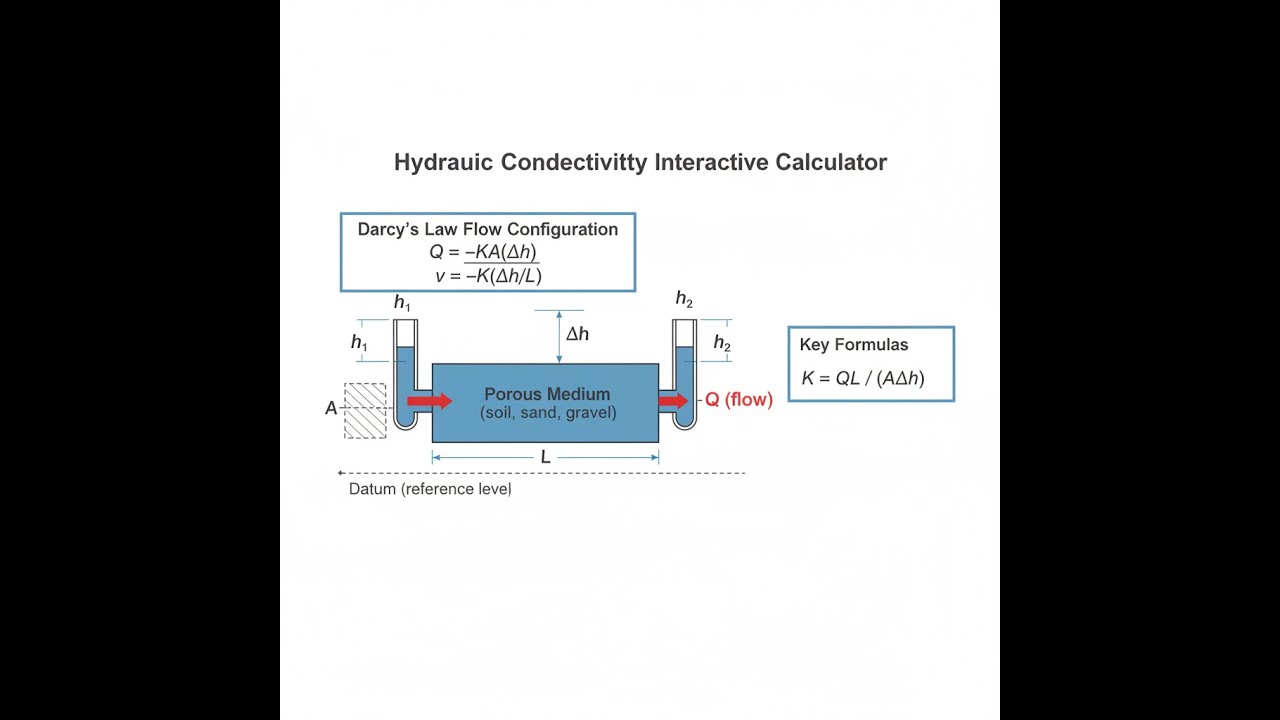
System Diagram: Hydraulic Flow Through Porous Media

Hydraulic Conductivity Calculator
This calculator is intended for education, concept evaluation, and preliminary design. Results are based on the equations and assumptions described on this page, but cannot account for every real-world load case, tolerance, material property, environmental condition, installation detail, safety factor, code, or regulatory requirement. Verify all inputs, assumptions, units, and results independently before selecting components or using the result in a real application. Safety-critical, structural, medical, lifting, transportation, or regulated applications must be reviewed by a qualified engineer.
Questions about this calculator or found an error? Message our engineering team.
Hydraulic Conductivity Interactive Visualizer
Use the sliders to see for yourself how changing hydraulic conductivity, gradient, or area alters the water flow. This gives a direct sense of how the core variables in Darcy’s Law are tied together.
DISCHARGE VELOCITY
0.010 m/s
FLOW RATE
0.050 m³/s
MATERIAL TYPE
Clean Gravel
FIRGELLI Automations — Interactive Engineering Calculators
Governing Equations
The following formulas let you calculate hydraulic conductivity, velocity, flow, and head loss using Darcy’s Law. Use these for both hand checks and software verification.
Darcy's Law (One-Dimensional Flow)
q = K · i
Q = K · i · A
Where:
- q = Discharge velocity (Darcy velocity) [m/s or ft/day]
- K = Hydraulic conductivity [m/s or ft/day]
- i = Hydraulic gradient (dimensionless) [Δh/L]
- Q = Volumetric flow rate [m³/s or gal/min]
- A = Cross-sectional area perpendicular to flow [m² or ft²]
- Δh = Hydraulic head loss [m or ft]
- L = Flow path length [m or ft]
Hydraulic Gradient
i = Δh / L = (h₁ - h₂) / L
The hydraulic gradient tells you the change in head per unit distance—basically, how hard you’re pushing water through the ground. It drives groundwater flow in all practical designs.
Seepage Velocity (Actual Pore Water Velocity)
vs = q / n = (K · i) / n
Where:
- vs = Seepage velocity (actual velocity through pores) [m/s or ft/day]
- n = Porosity (dimensionless, typically 0.25-0.45 for soils)
The actual speed of water moving through the pores is higher than the Darcy velocity, since water only moves through open space between grains, not through the solid particles themselves.
Simple Example
Given: discharge velocity q = 0.005 m/s, hydraulic gradient i = 0.01.
Solve for K: K = q / i = 0.005 / 0.01 = 0.5 m/s.
Material classification: clean gravel (highly permeable).
Flow rate through A = 2 m²: Q = K × i × A = 0.5 × 0.01 × 2 = 0.01 m³/s.
Theory & Practical Applications
Fundamental Physics of Darcy's Law
Darcy’s Law was built from physical experiments—Henry Darcy observed how water moved through sand filters. It ties together discharge velocity and hydraulic gradient in porous materials but assumes flow is slow and smooth (laminar): once you get Reynolds numbers above about 1–10 (depends on pore shape), it stops working and you may need to consider turbulent effects or alternate equations. This comes up in fractured rock or coarse gravel, where you can’t just use Darcy blindly.
K isn’t just a property of the solid—it combines the material’s pore structure (intrinsic permeability k) and the properties of the fluid (density, viscosity). The full relation is K = (k·ρ·g)/μ. K will change if you switch from water to oil, or change the temperature, because viscosity changes quite a bit. If fluid type or temperature varies, work those in from the start or your design will be off.
Scale Effects and Heterogeneity in Real Systems
Lab K measurements and field K measurements are rarely the same—differences of a factor of 10 or 100 aren’t unusual. Natural soils and rocks aren’t uniform; you get layering, blotchy patches, or different K depending on direction (anisotropy). Horizontal K (Kh) usually runs much higher than vertical K (Kv) in anything with bedding, sometimes by over a hundred times. Measuring K at multiple scales—slugs, pumping, tracer tests—gives you a better picture, since each captures features at different sizes. Don’t assume a single “average” K will do for every design.
If you just use an average K (or assume it’s the same in all directions) in layered systems, you can make large errors. For horizontally-bedded aquifers with clay, sand, and gravel in layers, compute effective K one way for flow along layers (arithmetic mean by thickness), and differently for flow across layers (harmonic mean, which ends up dominated by the slowest layer). One low-permeability layer can throttle vertical movement by orders of magnitude.
Engineering Applications Across Disciplines
Groundwater Resource Management: Pumping rates from wells are directly set by K and aquifer thickness (transmissivity). Drawdown curves and yield calculations all start from Darcy’s Law. If you over-pump from low-conductivity layers, you risk land subsidence—as seen in several cities worldwide.
Environmental Remediation: Cleanup systems (like pump-and-treat) rely on getting the capture zone right, which depends on knowing real K values in situ. Dense contaminants can sneak through low-K windows you might have missed, changing migration paths. Remediation barriers with materials like zero-valent iron need a K high enough for groundwater contact. Missing this causes poor remediation or breakthrough.
Dam and Levee Seepage Analysis: Seepage prediction isn’t theoretical—it’s the difference between stable and failing embankments. Darcy’s Law helps you locate the phreatic surface and estimate piping risk. Exit gradient and critical i values warn you when sand boils or piping failure are likely. Seepage control comes down to reducing K enough over the seepage path (cutoff or slurry walls, grouting programs) to keep rates manageable.
Agricultural Drainage Design: Drain spacing and design is all about the soil’s K value. Poorly-drained soils oblige tight drain spacing; better-drained soils get wider spacing. The formulas include K, drain depth, and placement. Generic catalog K values can help early on, but you’ll always want site tests before final layout.
Worked Example: Dewatering System Design
Problem Statement: A 12-meter excavation is going into a confined aquifer: K = 4.7×10⁻⁴ m/s (medium sand), aquifer thickness b = 18 m, starting head at ground. You’re after: (a) required pump rate to drop the water table 3.2 m at 24 m out, (b) the hydraulic gradient at the well, (c) seepage velocity with porosity n = 0.35, and (d) drawdown at the well location.
Solution:
Part (a): Pumping Rate Using Thiem Equation (Steady-State)
For steady-state in a confined aquifer with a fully penetrating well:
Q = (2πKb(h₁ - h₂)) / ln(r₁/r₂)
Set r₁ = 24 m (excavation radius), r₂ = 300 m (radius of influence), and calculate Δh. Plug in your K and b, solve for Q.
h₁ = 18 - 3.2 = 14.8 m (head at excavation perimeter)
h₂ = 18 m (head at radius of influence)
Δh = 18 - 14.8 = 3.2 m
Q = (2π × 4.7×10⁻⁴ m/s × 18 m × 3.2 m) / ln(300/24)
Q = (1.696×10⁻¹ m³/s) / 2.526
Q = 6.71×10⁻² m³/s = 67.1 L/s = 1,062 gallons per minute
Part (b): Hydraulic Gradient at Well Screen (rw = 0.3 m)
The gradient at any radius is found from the rearranged flow equation. Near the well screen, gradients get steep—plan for high forces and sand control.
i = Q / (2πrbK)
At the well screen radius rw = 0.3 m:
i = (6.71×10⁻² m³/s) / (2π × 0.3 m × 18 m × 4.7×10⁻⁴ m/s)
i = (6.71×10⁻²) / (1.595×10⁻²)
i = 4.21 (dimensionless)
It’s normal to see high gradients right at the well—if you don’t design the screen for it, expect instability or sand pumping.
Part (c): Seepage Velocity at Excavation Perimeter
At r = 24 m, work out q (discharge velocity), then scale by porosity to get real seepage velocity.
q = Q / (2πrb) = (6.71×10⁻² m³/s) / (2π × 24 m × 18 m)
q = (6.71×10⁻²) / (2.714×10³)
q = 2.47×10⁻⁵ m/s
Then:
vs = q / n = (2.47×10⁻⁵ m/s) / 0.35
vs = 7.06×10⁻⁵ m/s = 6.10 m/day
This is the real movement rate for water and anything it carries (dissolved contaminants, for example).
Part (d): Drawdown at Well Location
Use the Thiem equation again, this time close-in at the well screen.
sw = Q·ln(r₂/rw) / (2πKb)
sw = (6.71×10⁻² × 6.908) / (5.340×10⁻²)
sw = 8.67 meters
Set your pump below this level or you risk drawing air. This set of formulas and steps covers what you need to size pumps, check velocities, and estimate hydraulics for typical dewatering jobs.
Non-Darcy Flow and Limitations
There are clear cases where Darcy’s Law doesn’t work: high-velocity flow (turbulence), fluids that aren’t simple water (like slurries or polymer solutions), or when you have several phases moving together (air and water, oil and water, etc.). In fractured rock, water moves mostly through the cracks, so a bulk K doesn't tell you much—here, network modeling matters more. If you try to use Darcy’s Law in these situations, your predictions will be way off. Always check: laminar and single-phase? If not, it’s time for a more advanced model.
Frequently Asked Questions
Free Engineering Calculators
Explore our complete library of free engineering and physics calculators.
Browse All Calculators →🔗 Explore More Free Engineering Calculators
- Pneumatic Valve Flow Coefficient (Cv) Calculator
- Darcy-Weisbach Friction Loss Calculator
- Bernoulli Equation Calculator
- Irrigation Flow Rate Calculator — GPM per Acre
- Broad Crested Weir Calculator
- Carburetor Cfm Calculator
- Pump Horsepower Calculator
- Pneumatic Gripper Force Calculator
- Density Calculator — Mass Volume Density
- Kinetic Energy Calculator
About the Author
Robbie Dickson — Chief Engineer & Founder, FIRGELLI Automations
Robbie Dickson brings over two decades of engineering expertise to FIRGELLI Automations. With a distinguished career at Rolls-Royce, BMW, and Ford, he has deep expertise in mechanical systems, actuator technology, and precision engineering.
Video Walkthrough - How to Use This Calculator
Need to implement these calculations?
Explore the precision-engineered motion control solutions used by top engineers.


