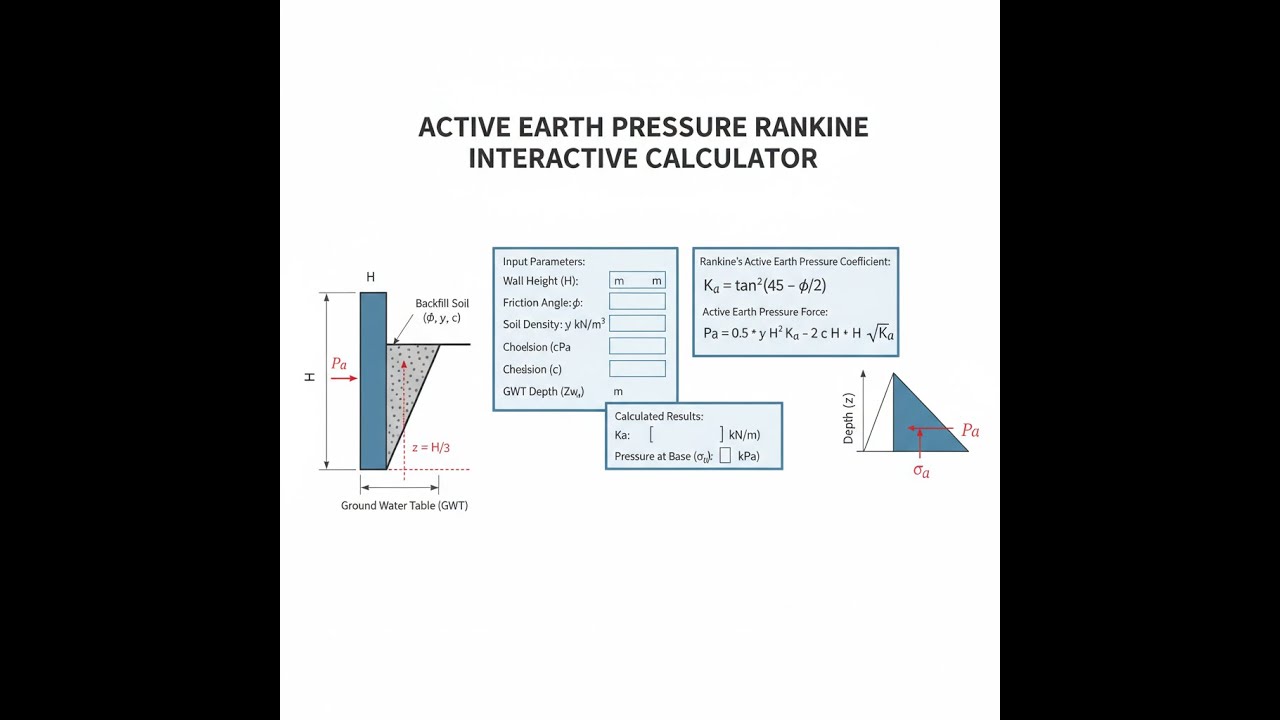
Soil pushes harder against a retaining wall near its base. A uniform surface surcharge adds sideways pressure along the entire height. The diagram shows how these two loads combine and where their resultant force acts.
When does active pressure develop?
A wall that moves away from the backfill can allow the soil to reach its active limit. The diagram assumes a smooth vertical wall, level dry granular backfill and enough outward movement to reach that state. The numerical calculator also accepts an effective cohesion intercept for a separate dry contact model.
📐 Browse all 1000+ Interactive Calculators
Table of Contents
Where does the soil push on the wall?
Move the depth probe down the wall. Soil weight adds pressure with depth, while a uniform surface load adds the same lateral pressure all the way down.
The leftward arrow acts 1.5 m above the base for a one-metre strip of wall.
Pressure at probe 16 kPa (12 kPa from soil + 4 kPa from surcharge).
- Active coefficient Kₐ
- 0.3333
- Surface pressure
- 4 kPa
- Base pressure
- 28 kPa
- Total thrust Pₐ
- 64 kN/m
- Height above base
- 1.5 m
- Moment about base
- 96 kN·m/m
The soil triangle contributes 48 kN/m at H/3. The surcharge rectangle contributes 16 kN/m at H/2. This Rankine model assumes a smooth vertical wall, dry level cohesionless backfill and enough outward movement to mobilize active pressure.
Active Earth Pressure Rankine Calculator
How to Use This Calculator
This calculator is intended for education, concept evaluation, and preliminary design. Results are based on the equations and assumptions described on this page, but cannot account for every real-world load case, tolerance, material property, environmental condition, installation detail, safety factor, code, or regulatory requirement. Verify all inputs, assumptions, units, and results independently before selecting components or using the result in a real application. Safety-critical, structural, medical, lifting, transportation, or regulated applications must be reviewed by a qualified engineer.
Questions about this calculator or found an error? Message our engineering team.
- Choose pressure, horizontal force, moment, pressure coefficient or an inverse calculation.
- Enter the retained height in metres, soil unit weight in kN/m³, friction angle in degrees and uniform surface surcharge in kPa as requested. Use zero effective cohesion for granular backfill.
- Check that the ground is level, the soil layer is uniform and the wall can move enough to develop the active state. Water pressure requires a separate calculation.
- Select Calculate. Forces and moments are reported per metre along the wall. The force height is measured upward from the base.
Equations and units
Measure depth z downward from the backfill surface and height y upward from the wall base. The active coefficient Kₐ is dimensionless. For a smooth vertical wall with level ground, Kₐ = tan²(45° − φ′/2), where φ′ is the effective friction angle.
For a uniform dry soil with c′ = 0, the lateral pressure is p(z) = Kₐ(γz + q). Soil unit weight γ is weight per unit volume in kN/m³. If you have mass density ρ in kg/m³, convert it first using γ = ρg/1000, with g in m/s². Surface surcharge q and lateral pressure p are both in kPa.
- Soil weight. The triangular pressure diagram gives Fₛ = KₐγH²/2. Its force acts H/3 above the base.
- Uniform surcharge. The rectangular diagram gives Fq = KₐqH. Its force acts H/2 above the base.
- Combined load. Pₐ = Fₛ + Fq. The moment about the base is M = FₛH/3 + FqH/2. The horizontal force acts at y = M/Pₐ above the base.
Force is in kN/m along the wall and moment is in kN·m/m. With positive soil weight and surcharge, the combined force lies between H/3 and H/2 above the base. Set q to zero and the force returns to H/3.
Worked example for a 5 m wall
With γ = 18 kN/m³, φ′ = 30°, c′ = 0 and q = 10 kPa, Kₐ = 1/3. Lateral pressure starts at 3.33 kPa and reaches 33.33 kPa at the base. The soil contributes 75.00 kN/m at 1.667 m. The surcharge contributes 16.67 kN/m at 2.50 m.
The combined force is 91.67 kN/m. Its base moment is 166.67 kN·m/m and its line of action is 1.82 m above the base.
Effective cohesion and loss of contact
The numerical calculator can also apply p(z) = max[0, Kₐ(γz + q) − 2c′√Kₐ]. Where this expression reaches zero, the dry contact model assigns zero soil pressure. Integrating the remaining compressed area gives the force. Its centroid gives the height above the base. The inverse calculations use the same distribution.
A predicted gap can hold water. Cracked soil, drainage, softening and minimum prescribed pressures can govern a real wall. A zero soil-contact result in this model cannot establish a zero design load. The FHWA Soils and Foundations Reference Manual, volume II, chapter 10 discusses effective stress, tension cracks and water pressure.
Choosing the load case
To see what a broad surface load changes, hold the soil properties and wall height fixed and compare zero surcharge with a positive surcharge. The pressure at the top rises immediately. Because the extra force acts at mid-height, it also raises the combined line of action.
The uniform load model represents a surcharge spread over the backfill. A wheel close to the wall, a strip footing or a stockpile with a limited footprint needs its own load distribution. A restrained basement wall may require at-rest pressure. Groundwater, seismic loading and compaction stresses also require separate assessment. See Caltrans Bridge Design Practice, section 11.2.1.3.4.1.
Frequently Asked Questions
▼ What is the difference between active and passive earth pressure, and when does each occur?
▼ Why do Rankine and Coulomb methods sometimes give different results, and which should I use?
▼ How do I account for groundwater in active earth pressure calculations?
▼ Should I include cohesion in my active pressure calculations for clay soils?
▼ How do I determine if my retaining wall has moved enough to reach the active pressure condition?
▼ What safety factors should be applied when using Rankine active pressure calculations in design?
Free Engineering Calculators
Explore our complete library of free engineering and physics calculators.
Browse All Calculators →🔗 Explore More Free Engineering Calculators
About the Author
Robbie Dickson — Chief Engineer & Founder, FIRGELLI Automations
Robbie Dickson brings over two decades of engineering expertise to FIRGELLI Automations. With a distinguished career at Rolls-Royce, BMW, and Ford, he has deep expertise in mechanical systems, actuator technology, and precision engineering.