How do you build a hidden TV lift and pop-up bar?
A hidden TV lift is a motorized vertical-travel mechanism — typically a lead-screw or ball-screw column driven by a 12V DC motor — that raises and lowers a television between a concealed position inside a cabinet and a viewing position above it. Pop-up bars, monitor lifts, and concealed-appliance mechanisms use the same engineering: a linear actuator, a guided travel path, limit switches, and a load-balanced carriage. This guide walks through both a complete TV lift system (the FA-TVL-170) and a custom pop-up bar built from individual linear actuators, based on a real-world installation featured on the DIY Network's House Crashers.
Guide the load properly — the actuator should not become the guide. A TV lift column drives motion; it should not be the part fighting twist, side load, or misalignment. That job belongs to the cabinet structure, the guide rails, and a level mounting base.
"On a back-to-back TV lift, the mechanism doesn't fail from total weight — it fails from imbalance. If one side is even ten pounds heavier, you put a constant twisting load on the column that the lead screw was never designed to handle. Center the load, balance the bracket, and the same mechanism that drives one TV will happily drive two." — Robbie Dickson, Founder and Chief Engineer of FIRGELLI Automations
In this comprehensive guide, we'll walk through a real-world installation featured on the DIY Network's House Crashers, where FIRGELLI Automations TV lifts and linear actuators were used to create both a hidden television system and an innovative pop-up bar cabinet. Whether you're planning a single TV lift or a more complex back-to-back installation, understanding the engineering principles and component selection will help you execute a professional-grade installation.
The versatility of modern TV lift mechanisms means they can accommodate far more than just televisions. From wine cabinets to home theater projectors, artwork, and even computer monitors, these systems provide elegant solutions for concealing and revealing various elements of your home.
Watch the Professional Installation
This DIY Network House Crashers episode demonstrates exactly how versatile electric lift mechanisms can be in a single installation. You'll see both a TV lift and a pop-up bar actuator in action, along with the clever engineering behind a back-to-back dual TV configuration:
The installation showcases several advanced techniques that many homeowners ask about, particularly the back-to-back TV mounting system that uses a single lift mechanism to control two displays simultaneously. This approach significantly reduces cost and mechanical complexity while delivering a stunning visual effect.
How does a TV lift mechanism work?
The fundamental principle behind any TV lift system is surprisingly straightforward: an electric actuator provides vertical motion along a guided track, raising and lowering the television on demand. However, the engineering that makes this smooth, quiet, and reliable involves precision components working in concert.
How TV Lift Systems Work
A complete TV lift assembly consists of several key components. The lift column itself contains the electric motor and drive mechanism, typically a lead screw or ball screw system that converts rotational motion into linear travel. This column is mounted to a sturdy base plate that secures to the bottom of your cabinet or furniture piece. At the top of the column, a carriage plate travels up and down, providing the mounting surface for your television.
The electronics include a motor controller that manages speed and direction, limit switches that prevent over-travel in either direction, and input connections for your control system—whether that's a simple up/down switch, an infrared remote control, or integration into a whole-home automation system. Quality TV lift mechanisms operate quietly (typically under 50 decibels) and smoothly, with no jerking or hesitation during travel.
Beyond Television: Versatile Applications
While these mechanisms are marketed as TV lifts, their applications extend far beyond television mounting. The same system that raises a 55-inch display can just as easily lift a wine cabinet, liquor storage, a decorative art piece, or even a home office monitor setup. The key is matching the lift capacity to your load weight and ensuring proper balance.
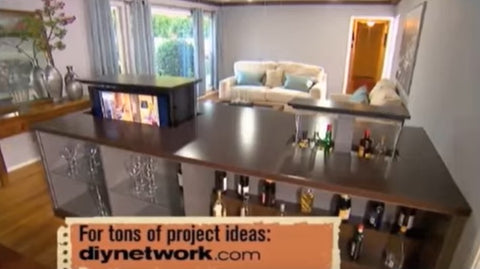
In the House Crashers installation, you'll notice the same FIRGELLI TV lift mechanism serves double duty—lifting both the television and a wine cabinet. This demonstrates the adaptability of quality lift systems. The mechanism doesn't care what it's lifting, as long as the weight falls within specification and the load is properly centered on the carriage plate.
How do you engineer a back-to-back TV lift with one mechanism?
One of the most frequently asked questions we receive at FIRGELLI concerns back-to-back TV installations: how do you mount televisions on both sides of a cabinet divider and control them with a single lift mechanism? The House Crashers project provides an excellent example of this technique in action.
Single Mechanism, Dual Display Setup
The engineering solution is elegant in its simplicity. Rather than installing two separate lift mechanisms (which would be costly and require synchronized control), a custom bracket is fabricated to extend from both sides of the lift carriage. Each TV mounts to its respective side of this bracket, with the lift mechanism positioned in the center.
The critical considerations for this configuration include:
- Weight balance: The combined weight of both televisions must not exceed the lift mechanism's capacity, and the weight should be evenly distributed on both sides to prevent torque and binding
- Clearance: Adequate space must exist in the cabinet for both displays to travel without interference from cabinet walls, shelving, or other obstacles
- Bracket rigidity: The custom bracket must be sufficiently rigid to prevent flexing or sagging under the combined television weight
- Cable management: Both displays need power and signal cables, requiring thoughtful routing to prevent tangling during travel
Custom Bracket Fabrication
For the back-to-back configuration, fabricating a suitable bracket typically requires steel or aluminum construction. The bracket should bolt securely to the lift carriage using the existing mounting brackets or holes, then extend horizontally on both sides. Each extension arm requires VESA mounting holes matching your television specifications—most modern TVs use standard VESA patterns of 200x200mm, 400x400mm, or larger (VESA Mounting Interface Standard — VESA MIS-D, MIS-E, MIS-F).
If you're not comfortable with metal fabrication, many local machine shops can create this bracket from your specifications for a reasonable cost. Provide them with your TV VESA measurements, the distance between displays, and the mounting hole pattern on your lift carriage.
What are the FA-TVL-170 TV lift specifications?
The specific model used in this installation is the FIRGELLI FA-TVL-170, a robust lift mechanism designed for displays up to approximately 70 inches. Understanding the specifications of your lift mechanism is crucial for a successful installation.
Key Technical Specifications
The FA-TVL-170 offers a stroke length (vertical travel distance) of 17 inches, which accommodates most standard television installations where the TV needs to rise from a concealed position to viewing height. The lift capacity handles displays in the typical weight range for modern flat-panel TVs, though you should always verify your specific television weight against the mechanism's rated capacity.
The lift operates on standard 12V DC power, which is provided by an included power supply that plugs into any standard household outlet. The 12V system is inherently safer than line-voltage alternatives and simplifies wiring, particularly if you're integrating with automation systems.
Installation Requirements and Clearances
Proper installation requires adequate clearance in your cabinet or furniture piece. The mechanism needs vertical clearance equal to the stroke length plus the collapsed height of the mechanism itself. You'll also need horizontal clearance around the lift column to allow for maintenance access and cable routing.
The base plate must be secured to a solid surface capable of supporting the combined weight of the mechanism, television, and dynamic loads during operation. We recommend mounting to a plywood base of at least 3/4-inch thickness, which is then secured to your cabinet structure. The mounting surface must be level—even slight misalignment can cause binding and premature wear.
How do you build a hidden pop-up bar with linear actuators?
The second impressive feature in this installation is the motorized pop-up bar, which demonstrates how linear actuators can create custom motion solutions beyond the standard TV lift application. While TV lifts are pre-engineered complete systems, using individual linear actuators gives you flexibility to create unique lifting, pushing, pulling, or tilting mechanisms.
Selecting the Right Linear Actuator
Choosing the appropriate linear actuator requires evaluating three primary specifications: stroke length (how far the actuator extends), force capacity (how much weight it can move), and speed (how quickly it operates). For a pop-up bar application, you typically need:
- Stroke length: Measure the vertical distance your bar top needs to travel, then add 10-20% margin for mounting considerations
- Force capacity: Calculate the total weight of your bar top, bottles, glasses, and any other stored items, then multiply by a safety factor of 1.5 to 2.0
- Speed: Bar lift applications typically work well with moderate speeds around 0.5 to 1.0 inches per second—fast enough to be impressive but slow enough to be safe
FIRGELLI offers an extensive range of linear actuators with stroke lengths from 2 inches to 60 inches, force capacities from 10 pounds to over 2,000 pounds, and various speed options. For most pop-up bar applications, a mid-range actuator with 12-18 inches of stroke and 200-400 pounds of force capacity provides ample capability.
Pop-Up Bar Actuator Selection — Quick Reference
| Spec | Typical Range | How to Choose |
|---|---|---|
| Stroke length | 12–18 in | Measure vertical travel of bar top + 10–20% margin |
| Force capacity | 200–400 lb | Total load (bar top + bottles + glasses) × 1.5–2.0 safety factor |
| Speed | 0.5–1.0 in/sec | Fast enough to be impressive, slow enough to be safe |
| Voltage | 12V DC | Standard residential, safer than line voltage |
| Mounting | Vertical preferred | Angle reduces effective lift force and adds side load |
Mounting Configuration and Mechanical Advantage
The mounting geometry of your linear actuator significantly affects its performance. The most common configuration for a pop-up bar is to mount the actuator vertically or at a slight angle, with the fixed end attached to the cabinet base and the extending rod pushing up on the underside of the bar platform.
When mounting at an angle rather than perfectly vertical, you trade some lifting capacity for smoother motion. The steeper the angle, the less force the actuator can effectively apply to the load. However, angled mounting can provide more stable guidance and reduce side loading. For simple vertical lift applications, a vertical mounting with proper linear guides or drawer slides to prevent twisting typically works best.
What control and automation options work with a TV lift?
Modern TV lifts and actuator systems offer sophisticated control options that go far beyond simple toggle switches. Understanding your control options helps you create a system that matches your lifestyle and technical comfort level.
Basic Control Options
The simplest control method is a wired up/down switch, typically a momentary rocker switch that activates the lift mechanism when pressed and stops when released. This approach is reliable, inexpensive, and requires no additional electronics beyond what's included with your lift mechanism.
Wireless remote control systems provide more convenience, allowing you to operate your TV lift or bar from anywhere in the room. Quality RF (radio frequency) remotes offer better range and reliability than infrared systems, particularly if your lift mechanism is enclosed in a cabinet where line-of-sight becomes an issue.
Advanced Automation Integration
For those with whole-home automation systems, integrating your TV lift and bar actuators creates seamless smart home functionality. Most automation platforms can interface with actuator systems through relay controls or specialized integration modules.
Popular integration scenarios include:
- Voice control through Amazon Alexa, Google Home, or Apple HomeKit
- Automatic TV lift activation when your audio/video system powers on
- Scene programming that raises the TV and dims lights simultaneously
- Integration with home security systems to lower the TV when activating away mode
If you're interested in custom control programming, FIRGELLI offers Arduino-compatible controllers and development resources for creating sophisticated control logic tailored to your specific needs.
How do you plan a hidden TV lift and bar installation?
Successful installations begin with thorough planning. Before purchasing components or cutting any wood, invest time in careful measurement, design, and preparation.
Critical Measurements and Design Considerations
Start by measuring your television dimensions precisely—not just the screen size, but the actual height, width, and depth of the TV including the bezel. Add at least 2 inches of clearance on all sides for cable management and to prevent binding. Measure your viewing location to determine the ideal TV height when raised—typically, the center of the screen should be at seated eye level.
For the cabinet itself, you'll need sufficient depth to accommodate the TV thickness plus the lift mechanism width, plus clearance for cables. Height must allow for the TV in its lowered position, the lift stroke, and adequate clearance above when raised. Don't forget to account for any existing cabinet features like false drawer fronts or decorative elements that need to move with the lift.
Electrical Planning and Cable Management
All lift mechanisms and actuators require power, and your television needs both power and signal cables. Plan your electrical routing early to avoid conflicts with the lift mechanism's travel path. Many installers run power and cables through the lift column itself or use cable carriers that follow the lift motion.
Consider installing a power outlet inside the cabinet at the base to simplify connections. If integrating with a home theater system, plan conduit runs for HDMI, component, or other signal cables. Using a recessed outlet box keeps cable connections organized and prevents interference with the lift mechanism.
Structural Support and Load Distribution
The cabinet or furniture housing your TV lift must be structurally sound enough to support the weight and dynamic loads. Television and lift mechanism weight creates significant moment forces, particularly when the TV is fully raised. Reinforce your cabinet structure with solid plywood construction—avoid particle board or MDF for critical structural elements.
The lift mechanism base should mount to a continuous plywood panel at least 3/4-inch thick, ideally spanning multiple cabinet support members. Use through-bolts rather than screws wherever possible for maximum strength. If your cabinet sits on a floor, ensure the floor structure beneath can support the concentrated load—this is particularly important for second-floor installations.
What are the best practices for installing a TV lift?
Professional installers follow proven techniques that ensure smooth, trouble-free operation for years. These best practices make the difference between a mediocre installation and an exceptional one.
Precision Alignment and Leveling
Nothing is more critical to smooth operation than perfect alignment. Use a quality carpenter's level to ensure your lift mechanism base plate is perfectly level in both directions before securing it permanently. Even 1-2 degrees of misalignment can cause binding, uneven wear, and eventual mechanism failure.
When installing guide rails or slide rails to stabilize your TV during travel, take time to align them parallel to the lift column with consistent spacing. Test fit all components before final assembly to identify any interference points or alignment issues.
Professional Cable Management
Clean cable management separates professional installations from amateur work. Use cable carriers or flexible conduit to organize and protect cables during lift travel. Secure cables at regular intervals to prevent sagging or tangling, but leave enough slack for full range of motion.
Label all cables clearly before final assembly—you'll thank yourself later during troubleshooting or upgrades. Consider using quick-disconnect connectors at the TV end to simplify service or TV replacement. Route cables away from moving parts and pinch points, and use cable grommets where cables pass through wood or metal edges.
Testing and Fine-Tuning
Before declaring your installation complete, conduct thorough testing through multiple complete lift cycles. Watch for any binding, unusual noises, or hesitation during travel. Verify that limit switches properly stop travel at both extremes without allowing over-travel.
Check cable routing through the entire travel range to ensure cables don't catch or create excessive resistance. Test your control system from various locations to verify reliable operation. If using wireless controls, check range and reliability from your typical viewing positions.
How do you maintain and troubleshoot a TV lift?
Well-maintained TV lift systems and actuators can provide decades of reliable service with minimal attention. Understanding basic maintenance and troubleshooting extends the life of your investment.
Routine Maintenance Schedule
Every six months, inspect your lift mechanism for any signs of wear, loose fasteners, or cable damage. Clean any dust or debris from guide rails and moving parts using compressed air or a soft brush. Check all mounting bolts and screws for tightness—vibration during operation can gradually loosen fasteners.
Most lift mechanisms use sealed bearings and maintenance-free drive systems that require no lubrication. However, if your installation includes separate guide rails or sliding components, apply a light coat of dry lubricant (PTFE spray) to keep motion smooth. Avoid oil-based lubricants that attract dust and can gum up over time.
Common Issues and Solutions
If your lift mechanism becomes noisy or jerky during operation, check for binding caused by misalignment or interference with cables or cabinet components. Verify that the lift column remains perfectly vertical and that guide rails haven't shifted from their original positions.
Erratic operation or failure to respond to controls often indicates electrical issues. Check all wire connections for tightness, inspect cables for damage, and verify proper voltage at the power supply output. Most lift systems include inline fuses that should be checked if the system completely fails to operate.
Uneven lifting or tilting typically results from load imbalance. Verify that your TV or load remains centered on the carriage plate and that weight is distributed evenly. For back-to-back TV configurations, ensure both displays have similar weight.
What usually goes wrong with a hidden TV lift install?
Most TV lift failures trace back to a small number of repeating root causes. Catching these in the planning and installation phase prevents the kind of damage that ends with a heavy display on the floor.
- Misaligned mounting base. A base that isn't level in both axes loads the lead screw with side force every cycle. Symptoms: jerky motion, audible binding, premature column wear.
- Imbalanced back-to-back load. A heavier TV on one side puts constant torque on the carriage and bracket. Symptoms: visible tilt at full extension, increased motor current draw, bracket fatigue at the weld or bolt line.
- Cable interference during travel. Cables that aren't slack-managed catch on cabinet walls or pinch at the lift column. Symptoms: control failure, cable damage, sudden stall.
- Weak mounting substrate. MDF or particle board bases flex under dynamic load. Symptoms: wobble at the top of stroke, loose fasteners after 50–100 cycles, eventual base failure.
- Over-travel from missing or bypassed limit switches. Results in mechanical damage at the stroke ends and possible motor burnout.
Where else does this engineering apply?
The same guided-actuator-and-carriage approach used for a hidden TV lift adapts to a wide range of motorized furniture and concealed-mechanism projects:
- Smart furniture: motorized desks, hidden monitor lifts, lift-top coffee tables
- Marine and RV: stowable TVs, hidden galley appliance lifts, drop-down cabinets in tight cabins
- Retail display: pop-up product showcases, hidden POS terminals, lift-reveal demo units
- Hospitality: bar-top TVs, hidden mini-bars, conference-table monitor lifts
- Home automation: scene-triggered TV reveals integrated with lighting and audio systems
The mechanism is the same — a guided linear actuator with a load-balanced carriage. Only the cabinet around it changes.
How do you bring a custom hidden TV lift and bar together?
The House Crashers installation demonstrates that professional-quality hidden TV lifts and motorized bars are achievable for DIY enthusiasts willing to invest in quality components and careful planning. Whether you're building a single TV lift, a back-to-back dual display system, or adding a pop-up bar, the same engineering principles apply: precise alignment, adequate structural support, proper component selection, and attention to detail.
FIRGELLI Automations provides the core motion control components—from complete TV lift mechanisms to versatile linear actuators—that make these installations possible. Combined with solid woodworking skills and electrical fundamentals, you can create custom hidden storage and display solutions that rival high-end custom installations at a fraction of the cost.
If you're planning your own hidden TV lift or pop-up bar project and need assistance selecting the right components, sizing actuators for your application, or troubleshooting installation challenges, our technical support team is available at support@firgelliauto.com. We work with DIY builders and professional installers daily, helping transform creative ideas into functional reality.
Frequently Asked Questions
How much weight can a TV lift mechanism support?
TV lift capacity varies by model, but most residential TV lift mechanisms support displays weighing between 80 and 150 pounds, which accommodates televisions up to 70 inches or larger depending on the specific model. When using a back-to-back configuration with two TVs on a single mechanism, the combined weight of both displays must stay within the lift's rated capacity. Always check the specific weight rating for your chosen lift model and weigh your actual television—some high-end displays with heavy glass panels or integrated soundbars can exceed typical weight assumptions. For heavier applications, industrial-grade lifts are available with capacities exceeding 200 pounds.
What stroke length do I need for my TV lift installation?
Stroke length depends on your specific cabinet design and viewing requirements. Measure the vertical distance your TV needs to travel from its fully concealed position to the desired viewing height. Most installations work well with 17 to 24 inches of stroke, which allows the TV to rise from hidden below a cabinet top to a comfortable viewing position. If your cabinet has a particularly thick top or you want the TV to rise higher for viewing from a standing position or elevated seating, you may need longer stroke. Remember that the cabinet must have clearance for both the retracted lift mechanism and the TV when fully lowered, plus the full stroke length when raised.
Can I retrofit a TV lift into an existing cabinet or furniture piece?
Retrofitting a TV lift into existing furniture is possible but requires careful evaluation of the cabinet's internal structure and dimensions. The cabinet must have sufficient width, depth, and height to accommodate the lift mechanism and TV travel. Critically, the cabinet structure must be reinforced to handle the weight and dynamic loads—most ready-made furniture wasn't designed for this purpose and needs substantial structural upgrades. You'll need to create or modify the cabinet bottom to provide a solid mounting surface for the lift base plate and ensure adequate clearance for the mechanism. If the existing cabinet has drawers or doors in the area where the TV will travel, these need to be removed or modified. In many cases, building a new cabinet specifically designed for the lift proves easier than extensively modifying existing furniture.
How loud are TV lifts and linear actuators during operation?
Quality TV lift mechanisms operate quietly, typically producing 45-50 decibels during operation—about the volume of a quiet conversation or refrigerator hum. You'll hear a gentle motor sound and mechanical movement, but it shouldn't be intrusive or disturbing in a normal living environment. Linear actuators used for pop-up bars and other applications have similar noise levels. If noise is a critical concern, look for models specifically rated for quiet operation, and ensure your installation uses proper mounting techniques with vibration isolation. Poor installation with loose fasteners or resonant cabinet structures can amplify mechanical noise significantly. Binding or misalignment also increases noise levels, so proper setup is essential for quiet operation.
What happens during a power failure—will my TV be stuck in position?
During a power outage, TV lifts and linear actuators will stop in their current position and remain there until power is restored. Most quality mechanisms include internal braking systems that prevent the load from drifting or dropping when power is lost, so your TV won't crash down if the power goes out while it's raised. When power returns, the lift will typically not move until you activate the control system—it won't automatically return to a home position. If you're concerned about power reliability, consider installing your lift system on an uninterruptible power supply (UPS), though this is rarely necessary for residential applications. Some advanced systems include battery backup options specifically designed for completing a lowering cycle during power loss.
Is there a manual way to lower the TV if the motor fails?
Most TV lift mechanisms do not include manual override capabilities because the internal lead screw or ball screw drive systems are self-locking—this is actually a safety feature that prevents the load from falling. If a motor failure occurs, the TV will remain safely in position, but manual lowering requires disassembly of the mechanism or disconnecting the load. For critical applications where access to manual override is important, some industrial actuators include manual crank provisions, but this is uncommon in residential TV lift systems. The best protection against motor failure is choosing quality components from reputable manufacturers and following proper installation practices. If you're concerned about reliability, opt for lift mechanisms with proven track records and good warranty coverage rather than seeking manual override capabilities.
Industry tags: home automation, smart furniture, hospitality, marine and RV, retail display, DIY motorized furniture, hidden storage
Mechanism tags: TV lift, linear actuator, lead-screw column, pop-up bar, monitor lift, wine cabinet lift, back-to-back display, VESA mount
About the author: Written by Robbie Dickson, Founder and Chief Engineer of FIRGELLI Automations. Robbie's engineering career includes Rolls-Royce, BMW, Isuzu, and Ford before founding FIRGELLI in 2002. More background: Wikipedia.


