
A tiny house bed lift saves floor space by raising the mattress and platform when you do not need it. Size the actuator from the moving load, number of lifting points, travel, safety factor, and guide system. The actuator lifts. The guides keep the bed square.
What is a tiny house bed lift?
A tiny house bed lift is a powered mechanism that raises or lowers a bed platform to free usable floor space. Most designs use a straight vertical lift, a guided platform, a hinged Murphy-style bed, or a track/cable mechanism.
What is the simple explanation?
Treat the bed like a moving platform, not just a mattress. Add the mattress, frame, bedding, storage, and anything attached to the platform. Then divide that load across the actuators and add margin for uneven loading.
Use the formula below for a straight vertical bed platform.
Force per actuator = (total moving load ÷ number of actuators) × uneven load allowance × safety factor
Which bed lift mechanism should you use?
Use a straight vertical lift when the bed moves up into ceiling space. Use a hinged Murphy-style mechanism when the bed folds against a wall. Use a track or cable mechanism when you need to hide the actuator or move the bed along rails.
Do not use the same calculator for all 3. A vertical platform uses load sharing. A hinged bed uses torque around a pivot. A cable lift uses pulley geometry and cable tension.
What should the calculator inputs be?
This calculator handles the most common tiny house case: a straight vertical bed platform. It does not pretend a hinged Murphy bed and a ceiling bed use the same math.
How do you use this calculator?
- Add the weight of the bed platform, mattress, bedding, and storage.
- Choose the number of actuators or lifting points.
- Add uneven load allowance, safety factor, and travel.
- Click Calculate to see your result.
What is a simple example?
A bed platform and mattress weigh 180 lbs. Storage under the platform adds 60 lbs. Total moving load is 240 lbs.
With 2 actuators, 25% uneven load allowance, and a 1.5 safety factor:
Force per actuator = (240 ÷ 2) × 1.25 × 1.5
Force per actuator = 120 × 1.875 = 225 lbs
That means each actuator should rate above 225 lbs before you check stroke, speed, duty cycle, control, guide rails, and mounting.
Why do guide rails matter so much?
The guides matter because beds are wide. If one corner moves faster than another, the frame twists. Once it twists, the actuator sees side load and the lift starts to bind.
Use rails, slides, corner posts, cables, or a rigid frame to control alignment. The actuator should push or pull in line. It should not act like a drawer slide.
How should you control multiple actuators?
For 2 or 4 independent actuators, synchronization matters. Feedback-based control can keep actuators moving together and stop them at repeatable positions. That is where the FCB-2 makes sense.
For a single actuator driving a guided linkage, a normal switch can be enough. Simple is good when the mechanism itself handles alignment.
Recommended FIRGELLI setup
Which FIRGELLI products fit a tiny house bed lift?
The product-first check did not find a public FIRGELLI bed lift kit. For a custom tiny house bed lift, start with actuators, guides, brackets, and controls that match the mechanism.
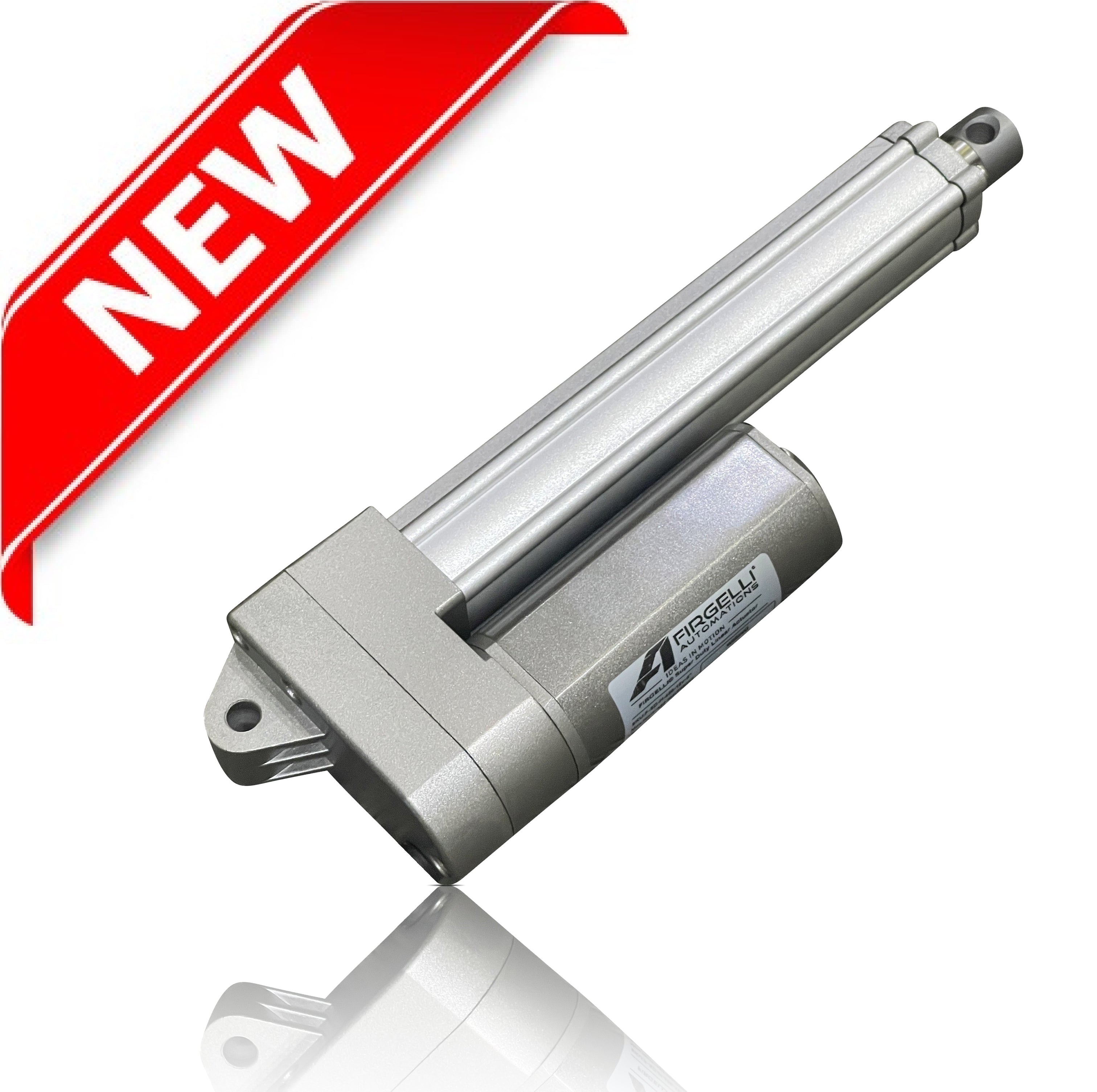
Super Duty Electric Linear Actuator
Use this when a custom bed lift needs strong actuator options and feedback-capable control. You can use feedback with the FCB-2, or ignore it and use simple switch control for basic extend/retract motion.
View Super Duty Actuators
Industrial Linear Actuators
Use these for heavier custom lifts where force and durability matter. They can be specified with optional feedback wiring when the system needs position-aware control.
View Industrial Actuators
Heavy Duty Track Actuator
Use a track actuator when the mechanism works better with a moving carriage than a rod pushing between 2 brackets.
View Heavy Duty Track ActuatorFor synchronized feedback control, use the FCB-2 actuator controller. For simple full up/full down motion, choose a control from the FIRGELLI switches collection. Use mounting brackets that let the actuator align without side loading.
What should you check before ordering?
- Total moving load
- Number of lifting points
- Vertical travel needed
- Available actuator closed length
- Where the bed goes at full height
- Guide rails or slides
- Hard stops at top and bottom
- Anti-drop backup or mechanical lock
- Wire routing through the full travel
- Emergency manual access
Frequently Asked Questions
Can I lift a tiny house bed with 1 actuator?
Sometimes, but 1 actuator needs a guided lift or linkage that prevents twisting. A wide bed platform usually works better with 2 or 4 lifting points, or with a single actuator driving a guided mechanism.
Do actuators replace guide rails in a bed lift?
No. Actuators provide force. Guides, rails, drawer slides, or a frame keep the bed square and carry side load. Letting an actuator rod guide the bed usually bends hardware or causes binding.
Do I need feedback for a bed lift?
Use feedback when multiple actuators must stay synchronized or stop at repeatable positions. A single actuator with a well-guided mechanism can often use simple switch control for full up and full down travel.
What safety factor should I use for a bed lift?
Use at least 1.5x for a clean guided lift. Use more if the platform can bind, carry off-center storage, or see rough use. Safety factor does not fix poor guides or a frame that twists.
What is the biggest mistake in tiny house bed lifts?
The biggest mistake is asking the actuator to lift and guide the bed at the same time. The actuator should push or pull in line. Rails, slides, cables, or a rigid frame should control alignment.


