Building a Pop-Up TV Lift: Complete Engineering Guide
Modern home automation increasingly demands furniture that does more than simply store electronics—it needs to conceal them entirely. A motorized TV lift transforms living spaces by hiding televisions inside cabinets, countertops, or custom furniture until needed, then smoothly raising them into view at the press of a button. Whether you're designing a minimalist living room, outfitting a yacht, building a custom RV, or creating a outdoor entertainment space, understanding how to properly build and install a TV lift system is essential for achieving professional results.
🎥 Video — How to Build a TV Lift
The engineering behind tv lifts has evolved significantly from early scissor-lift mechanisms and exposed chain drives to today's sophisticated linear actuator systems. These modern systems use precision worm-gear drives that operate virtually silently while lifting loads up to 135 pounds through strokes ranging from 25 to 36 inches. This guide covers everything from selecting the right mounting configuration to choosing the optimal lid mechanism, installation best practices, and critical safety considerations that separate professional installations from amateur attempts.
This comprehensive guide draws on real-world applications across residential, marine, and commercial installations to provide actionable technical information for both DIY enthusiasts and professional installers.
Choosing Between Rear-Mount and Floor-Mount Configurations
The first critical decision when building a TV lift is selecting the appropriate mounting configuration. FIRGELLI Automations offers two primary mounting systems, each engineered for specific cabinet geometries and installation requirements.
Rear-Mount TV Lift Systems
Rear-mount configurations attach the lift mechanism to the back wall of a cabinet while incorporating vibration-absorbing feet that rest on the cabinet floor. This hybrid approach provides the stability of floor mounting with the clean appearance of a wall-mounted system. The video above demonstrates a rear-mount installation, showing how the mechanism integrates seamlessly within standard cabinet construction.
Rear-mount systems work best when you have a cabinet with a flat, vertical back panel strong enough to support the mounting hardware. The back panel should be at least ¾-inch plywood or equivalent material. This configuration is ideal for entertainment centers, credenzas, and bedroom footboards with traditional rectangular construction.
Floor-Mount TV Lift Systems
Floor-mount configurations bolt the entire lift mechanism directly to the cabinet base, making them the solution of choice for irregular cabinet shapes, curved designs, or situations where the back panel cannot support the mounting loads. The image below shows a floor-mounted installation necessitated by a non-rectangular cabinet profile.

Floor mounting provides maximum versatility when working with custom furniture designs, granite or stone countertops, or marine applications where hull geometry dictates irregular cabinet shapes. The trade-off is that floor-mount brackets may require slightly more vertical clearance within the cabinet.
Load Distribution and Structural Requirements
Regardless of mounting style, the cabinet base must adequately distribute the combined weight of the TV, mounting hardware, and lift mechanism—potentially exceeding 200 pounds for large installations. Reinforce cabinet floors with additional cross-bracing or double-layer construction for displays larger than 55 inches. Marine and RV applications should use marine-grade plywood and stainless steel fasteners to withstand vibration and moisture.
Selecting the Right Lid Mechanism for Your Application
The lid mechanism determines both the safety characteristics and functional versatility of your TV lift installation. There are three primary approaches, each with distinct engineering trade-offs.

Flip-Back Hinge Lid Method
The flip-back hinge design remains the most popular lid configuration for residential installations. As the TV lift rises, a roller fixture mounted on top of the lift mechanism contacts the underside of a hinged cabinet lid, forcing it to rotate backward on hinges mounted at the rear of the cabinet. This method is demonstrated in the installation video above.

The primary advantage of this approach is its inherent safety mechanism. If fingers or objects are present at the top of the cabinet during lowering, they encounter only the weight of the hinged lid—typically 5 to 15 pounds—rather than the full force of the linear actuator system. This passive safety feature makes flip-back designs particularly appropriate for family rooms and spaces accessible to children.
The limitation of flip-back lids is that objects placed on the closed lid will slide or tip backward when the TV rises. A coffee cup left on the cabinet will spill as the lid flips back. For this reason, flip-back configurations work best when the closed cabinet top is not used as a display surface.
Fixed Lid: Direct Mount Method (Not Recommended)
Directly attaching the cabinet lid to the top of the lift mechanism creates a fixed lid that rises and falls with the television. While this allows objects to remain on top of the cabinet during operation, it introduces significant safety concerns.

When the lid is rigidly attached, the closing action creates a scissoring effect with dangerous pinch points. While modern TV lift systems incorporate electronic overload protection that stops movement when encountering resistance, this protection may take up to one second to activate—potentially long enough to cause injury. We do not recommend direct fixed-lid mounting despite seeing it widely adopted in DIY projects.
Fixed Lid: Magnetic Coupling Method (Recommended)
The optimal solution for fixed-lid installations uses rare-earth magnets to create a detachable coupling between the cabinet lid and lift mechanism. This is the method FIRGELLI employs in its outdoor TV lift cabinets and represents the best engineering compromise between functionality and safety.

Magnetic coupling provides several critical advantages:
- Automatic disconnection: If an object or body part is caught during lowering, the magnetic coupling releases before dangerous force is applied, allowing the lid to separate from the lift mechanism
- Power-outage access: The lid can be manually lifted off without tools or power, providing immediate access to cabinet contents during electrical failures—critical in marine applications
- Alignment tolerance: Magnets self-align within a reasonable tolerance, eliminating the precise positioning required by mechanical fasteners
- Adjustable holding force: Adding or removing magnets allows you to tune the holding force for different lid weights and materials
- Controlled disengagement: The lift mechanism can lower beyond the lid's flush position, allowing the magnetic coupling to release naturally as the lid seats on the cabinet frame
Implementing Magnetic Coupling

For standard wooden lids weighing 10-20 pounds, four rare-earth magnets with 1-inch diameter provide adequate holding force. These should be countersunk into the underside of the cabinet lid at positions corresponding to the four corners of the TV lift's top plate. Use wood screws or epoxy to secure the magnets, ensuring they sit flush or slightly recessed to prevent interference with the closing action.

For heavier lids—including granite, marble, or thick hardwood—increase the number and size of magnets proportionally. FIRGELLI has successfully tested this method with granite lids weighing approximately 80 pounds using four 1-inch rare-earth magnets. Stone lids require steel plates epoxied to the underside to provide magnetic attraction, as the stone itself is non-ferromagnetic.
TV Lift System Specifications and Selection Criteria
FIRGELLI TV lift systems use precision linear actuators with worm-gear drives—the quietest actuation technology available, operating at just 5 dB above ambient noise levels. This makes them suitable for bedroom installations and theater environments where mechanical noise is unacceptable.
Model Selection by TV Size and Stroke Length
Three primary models accommodate different television sizes and stroke requirements:
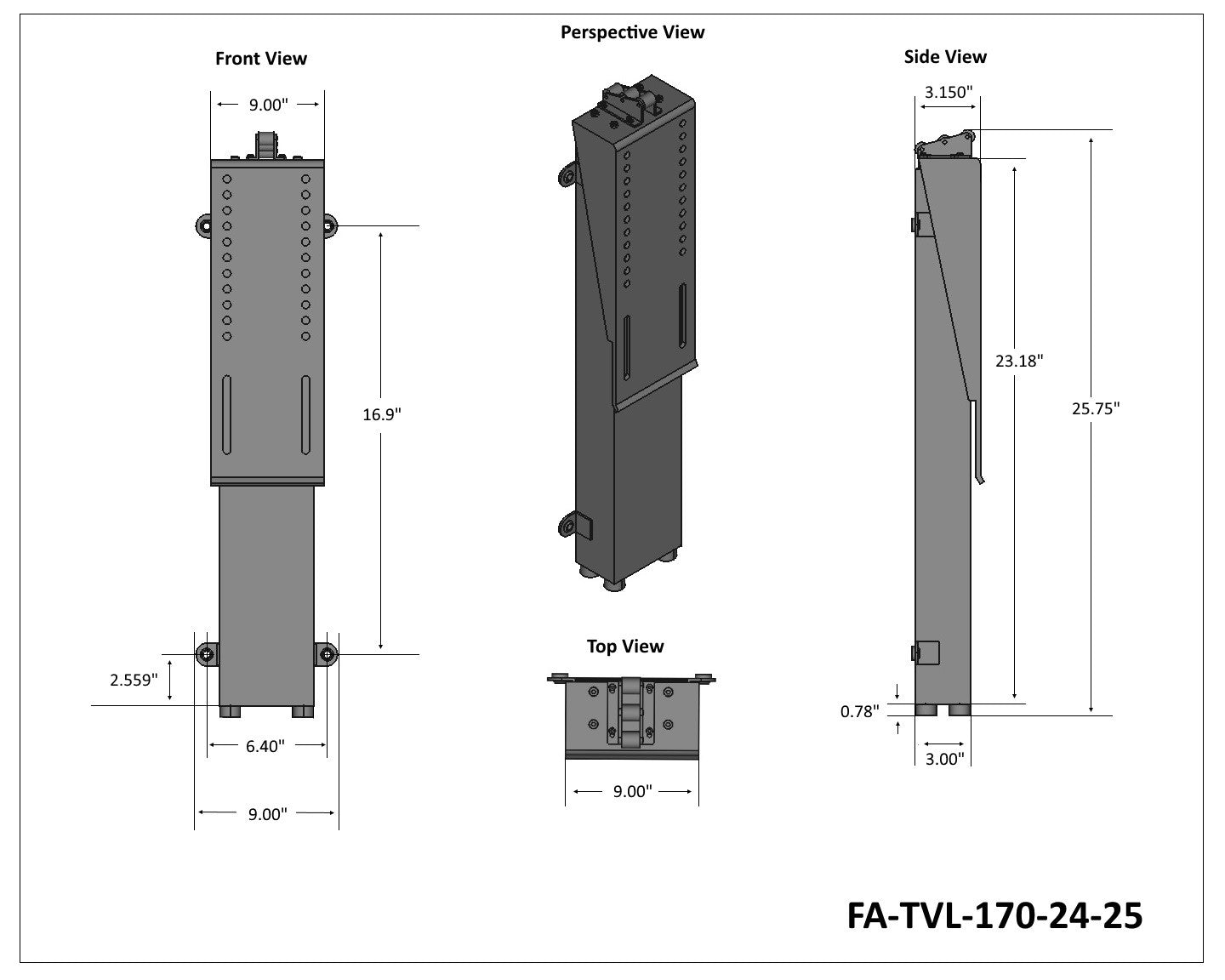
FA-TVL-170-24-25 — 25.6-inch stroke, designed for 32" to 43" televisions. The compact 22.44-inch retracted length makes this ideal for smaller cabinets and applications where vertical space is limited.
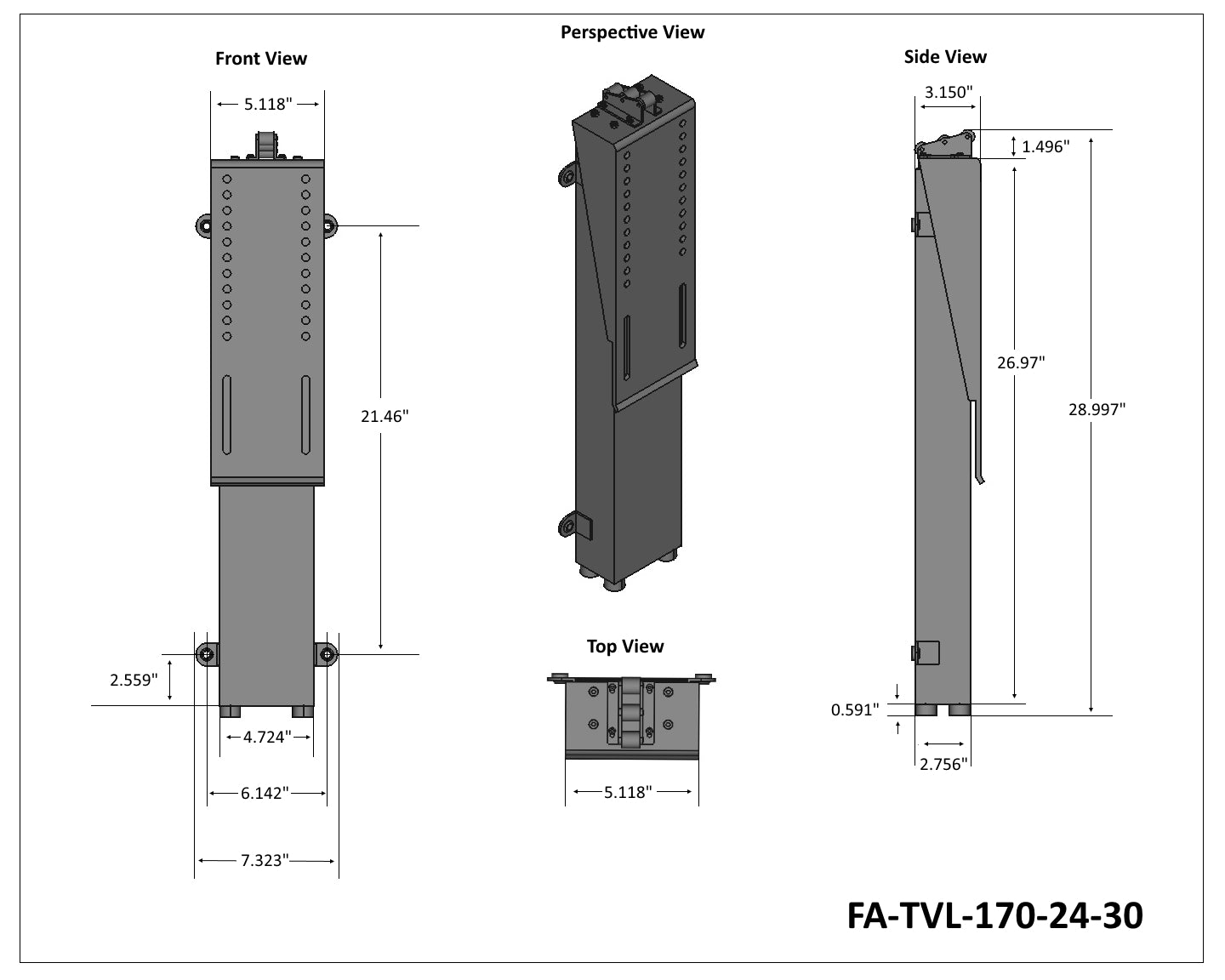
FA-TVL-170-24-30 — 30.71-inch stroke, optimized for 40" to 55" displays. This mid-range model balances stroke length with retracted dimensions, fitting standard cabinet depths while providing adequate viewing height.
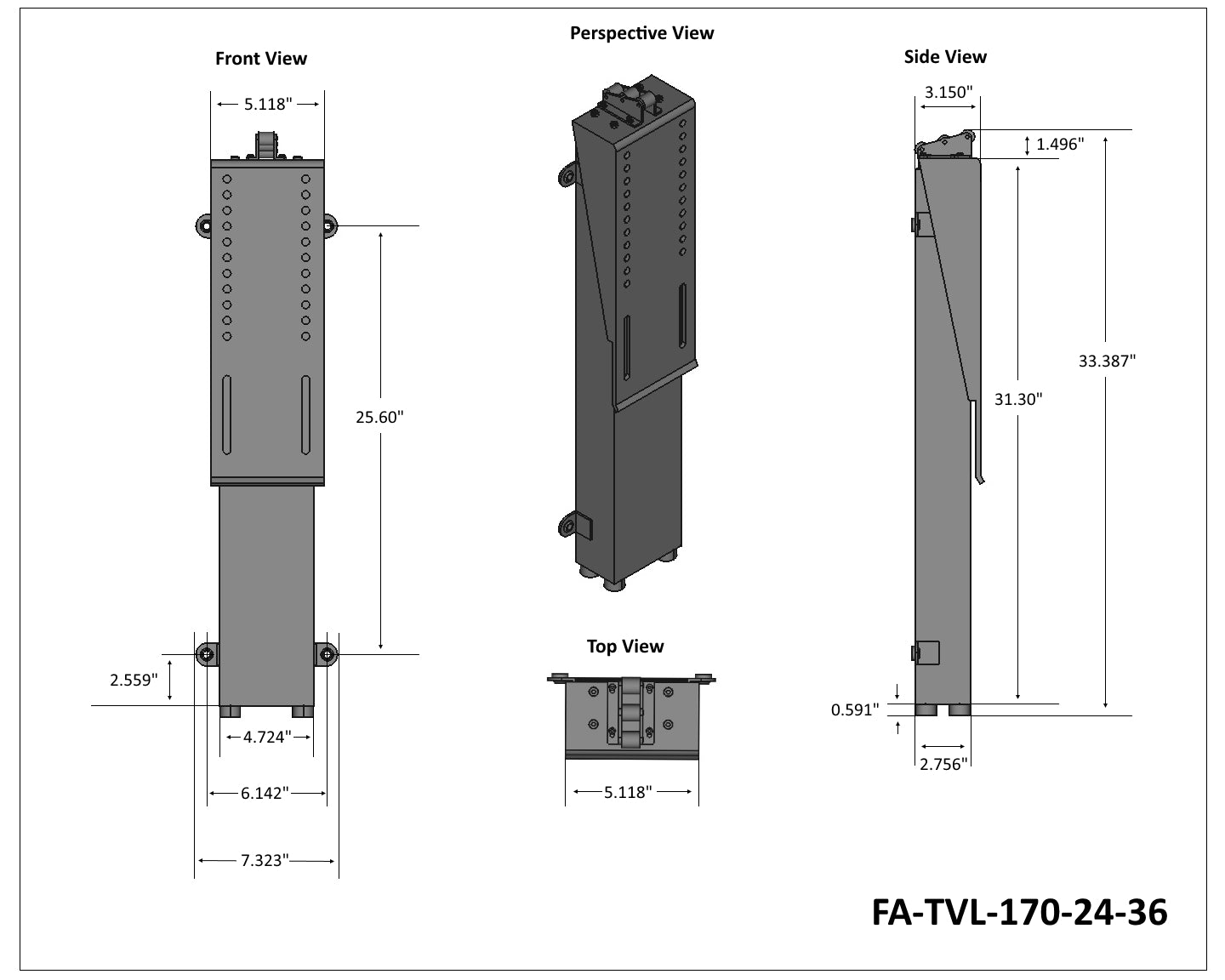
FA-TVL-170-24-36 — 35.98-inch stroke, engineered for 50" to 70" televisions. The extended stroke raises large displays to appropriate viewing heights in applications like bedroom footboards where the viewer may be 15-20 feet from the screen.
All three models share identical specifications beyond stroke length: 135-pound lift capacity, 20mm/second travel speed, and identical electrical requirements. The stroke length you select should provide enough vertical travel to raise the top of your television to the desired viewing height while accounting for the lift's retracted length within the cabinet.
Electrical Specifications and Control Systems
FIRGELLI TV lifts operate on a universal input power supply accepting 100-240V AC at 50/60Hz, making them suitable for global deployment without modification. The power supply outputs 29V DC at 2.5 amps to the lift mechanism.
Each system includes both RF wireless and wired remote control options. The RF remote operates through walls and cabinet materials, allowing concealed installation of the receiver module. Internal limit switches automatically stop the mechanism at the end of each stroke, eliminating the need for manual timing or external limit sensors.
Built-In Safety and Protection Features
Electronic overload protection continuously monitors motor current. When the lift encounters unexpected resistance—indicating an obstruction or overload condition—the control system automatically stops movement and can reverse direction. This protection activates within approximately one second of detecting an obstruction, though this response time is why we recommend magnetic coupling over rigid lid attachment.
The worm-gear drive provides inherent self-locking capability, meaning the mechanism cannot be back-driven by external forces. If power is lost mid-stroke, the TV remains locked in position rather than crashing down under gravity. This safety feature is particularly important in marine applications where the vessel may experience sudden motion.
Installation Best Practices and Professional Techniques
Proper installation requires attention to alignment, load distribution, and electrical routing. While TV lift systems are designed for DIY installation by anyone comfortable mounting a television wall bracket, following professional techniques ensures optimal performance and longevity.
Cabinet Preparation and Reinforcement
Before installing the lift mechanism, verify that the cabinet structure can support the combined weight. For rear-mount installations, the back panel should be at least ¾-inch plywood securely fastened to the cabinet frame. Add horizontal blocking between cabinet sides to distribute loads across a wider area.
Floor-mounted installations benefit from doubled cabinet floors or strategic cross-bracing. The lift mechanism's footprint should be supported by solid material—not spanning an unsupported area. In custom furniture applications, consult the TV lift's technical drawings to plan structural reinforcement during the cabinet build phase rather than retrofitting afterward.
Television Mounting and Load Distribution
FIRGELLI TV lifts include adjustable TV mounting brackets that accommodate VESA patterns from small displays to 70-inch screens. The mounting bars can also support PVRs, DVD players, streaming devices, and other components that should rise with the television.
When mounting the television, distribute weight evenly across both mounting bars. For TVs approaching the 135-pound capacity limit, verify that the center of gravity falls between the mounting points. Offset loads can introduce lateral forces that increase mechanical wear and may cause binding during operation.
Cable Management for Clean Installations
Plan cable routing before final installation. HDMI cables, power cords, and audio connections must travel with the rising TV while maintaining adequate service loop to prevent tension at the extremes of travel. Use cable carriers or flexible conduit to protect wiring from abrasion against cabinet edges.
For installations incorporating soundbars, control boxes, or gaming consoles that mount to the lift mechanism, route all cables through the center of the lift structure where possible. This prevents cables from interfering with the cabinet opening or creating pinch points.
Alignment and Initial Testing
Before final installation, test the complete range of motion outside the cabinet to verify smooth operation. The lift mechanism should travel from fully retracted to fully extended without binding, unusual noise, or vibration. If you notice resistance at any point in the stroke, check for obstructions or misalignment of the TV mounting.
Once installed in the cabinet, test the lid mechanism through multiple complete cycles before securing wiring and closing up the installation. Verify that the flip-back roller or magnetic coupling engages reliably at the correct point in the stroke and that the lid seats properly in its closed position.
Real-World Applications and Project Examples
FIRGELLI pop-up TV lifts have been deployed across diverse applications worldwide, each demonstrating unique engineering solutions to specific installation challenges.
Residential Home Automation
In residential settings, TV lifts commonly hide displays in bedroom footboards, kitchen islands, living room cabinets, and outdoor entertainment spaces. The ability to conceal expensive electronics protects them from environmental exposure and theft while maintaining clean sight lines in minimalist interior designs.
Modern kitchens increasingly incorporate TV lifts in islands or countertops, allowing the display to rise for cooking shows or entertainment, then disappear to restore workspace. These installations often use the magnetic coupling method to accommodate granite or quartz countertops weighing 60-100 pounds.
Marine and RV Applications
Yacht and RV installations present unique challenges including vibration, space constraints, and the need for secure stowage during travel. The self-locking worm-gear drive makes FIRGELLI lifts particularly suitable for mobile applications—the mechanism cannot be back-driven by vessel motion or road vibration.
Marine installations should use stainless steel fasteners and apply marine-grade sealant to all electrical connections. The universal input power supply accommodates both shore power and generator power without modification. In sailboat applications, the low power consumption (approximately 75 watts during motion) makes TV lifts practical even when operating from battery banks through inverters.
Commercial and Staging Applications
Commercial applications range from hotel suites and conference rooms to theatrical staging and retail displays. The HGTV show "House Crashers" demonstrated FIRGELLI lifts in a particularly creative installation: a dual-purpose cabinet housing both a rising TV and a motorized bar that elevated bottles and glassware into view.
This back-to-back configuration used two independent lift mechanisms within a single cabinet structure, each controlled by separate remotes. The installation demonstrates how tv lifts can be adapted beyond simple television display to create dynamic, transformable furniture for entertainment spaces.
Outdoor Entertainment Spaces
Outdoor TV lift cabinets must withstand weather exposure while protecting sensitive electronics. FIRGELLI's outdoor cabinet designs use weatherproof enclosures with sealed lid systems that prevent water intrusion while allowing the TV to rise into viewing position.
These installations typically employ magnetic coupling with additional weatherstripping around the lid perimeter. The magnetic approach allows the lid gasket to compress fully when closed, creating a weather-tight seal, while still permitting the lid to release if children or debris interfere with closing.
Complete Technical Specifications Reference
The following specifications apply to all three stroke lengths in the FA-TVL-170-24 series:
- Maximum Load Capacity: 135 lbs (includes TV, mounting hardware, and any attached components)
- Travel Speed: 20mm/second (approximately 0.79 inches/second)
- Input Voltage: 100-240V AC, 50/60Hz, 1.5 amps (universal power supply)
- Output Voltage: 29V DC, 2.5 amps
- Noise Level: 5 dB above ambient (worm-gear drive system)
- Duty Cycle: Intermittent use (2 minutes on, 18 minutes off for continuous operation)
- Operating Temperature: 32°F to 104°F (0°C to 40°C)
- Certifications: CE and RoHS certified
- Warranty: 5-year comprehensive coverage
- Included Components: Lift mechanism, TV mounting brackets, RF remote, wired remote, power supply, mounting hardware
Model-Specific Dimensions
Model FA-TVL-170-24-25:
- Retracted Length: 22.44 inches
- Stroke Length: 25.60 inches
- Recommended TV Size: 32" to 43"
- Minimum Cabinet Depth: 24 inches
Model FA-TVL-170-24-30:
- Retracted Length: 26.97 inches
- Stroke Length: 30.71 inches
- Recommended TV Size: 40" to 55"
- Minimum Cabinet Depth: 28 inches
Model FA-TVL-170-24-36:
- Retracted Length: 31.30 inches
- Stroke Length: 35.98 inches
- Recommended TV Size: 50" to 70"
- Minimum Cabinet Depth: 33 inches
Maintenance and Long-Term Performance
FIRGELLI TV lift systems are designed as maintenance-free mechanisms. The sealed worm-gear drive requires no lubrication or periodic service under normal operating conditions. Unlike chain-drive or scissor-lift mechanisms with exposed components requiring regular cleaning and lubrication, the enclosed design protects all moving parts from dust and debris.
Periodic Inspection Recommendations
While the lift mechanism itself requires no maintenance, periodic inspection of the installation ensures continued safe operation:
- Verify that all mounting bracket fasteners remain tight—vibration over time can loosen hardware
- Check cable routing to ensure no abrasion or pinching has developed
- Test the RF remote battery and replace as needed (typically annually)
- Verify that the cabinet lid moves freely on its hinges (flip-back designs) or that magnets remain securely attached (magnetic coupling designs)
- Clean the roller fixture on flip-back lid systems to prevent debris buildup that could mar the underside of the lid
Common Issues and Troubleshooting
If the lift mechanism fails to respond to remote commands, verify power supply connection and check the circuit breaker or GFCI outlet. The RF remote has a range of approximately 50 feet through typical construction materials—verify you're within range and that the remote battery is functional.
If the mechanism stops mid-stroke, the overload protection may have activated. Remove any obstructions and press the remote button to resume operation. If overload protection activates repeatedly without apparent cause, verify that the total load (TV plus mounting hardware) does not exceed 135 pounds and that cables are not creating binding during motion.
Unusual noise during operation typically indicates loose mounting hardware or that the TV mounting has shifted, creating an unbalanced load. Lower the TV fully, verify all fasteners are tight, and ensure the television is centered on the mounting brackets.
Conclusion: Engineering Meets Practical Design
Building a professional-grade TV lift installation requires balancing mechanical engineering principles with practical furniture design. The choice between rear-mount and floor-mount configurations depends on cabinet geometry; the selection of flip-back hinge versus magnetic coupling lid mechanisms involves trade-offs between safety characteristics and functional requirements; and proper installation demands attention to load distribution, alignment, and electrical routing.
FIRGELLI's worm-gear drive systems represent the current state-of-the-art in quiet, reliable TV lift technology. The 135-pound capacity accommodates everything from modest bedroom displays to large home theater screens. The maintenance-free design and five-year warranty provide confidence for permanent installations in residential, marine, and commercial applications.
Whether you're creating a minimalist living space, outfitting a luxury yacht, or building custom furniture for a client, understanding these engineering principles and installation best practices ensures your TV lift project delivers professional results that will perform reliably for years to come.
Frequently Asked Questions
How do I determine what stroke length I need for my TV?
The stroke length should provide enough vertical travel to raise the top of your television to the desired viewing height while accounting for the mechanism's retracted length within your cabinet. Measure from the bottom of your cabinet to your desired TV top height, then subtract the height of your TV itself. Add 2-4 inches of clearance for the closed lid. This gives you the minimum stroke length required. For a 50-inch TV in a bedroom footboard where you want the top of the screen 48 inches above the floor, and your cabinet base sits 12 inches high with a 30-inch tall TV, you would need: 48" (desired height) - 12" (cabinet base) - 30" (TV height) + 3" (clearance) = 9 inches minimum. However, most installations benefit from raising the TV higher for optimal viewing angles, so you would typically select the longest stroke length that fits your cabinet depth—in this case, the 30-inch or 36-inch stroke model would provide much better viewing geometry.
Can I lift a TV heavier than 135 pounds?
The 135-pound maximum load capacity includes the television, mounting hardware, and any components attached to the lift (soundbars, media players, etc.). Exceeding this limit risks damaging the linear actuator mechanism and may void the warranty. For very large displays exceeding 135 pounds, consider whether the TV can be safely supported, or explore industrial actuator solutions designed for heavier loads. Most 70-inch LED TVs weigh between 70-90 pounds, leaving adequate capacity for mounting hardware and accessories, but always verify your specific TV's weight before purchasing a lift system.
What happens if the power goes out while the TV is raised?
The worm-gear drive mechanism is self-locking, meaning it cannot be back-driven by gravity. If power fails while the TV is in the raised position, it will remain locked in that position until power is restored. You cannot manually push the TV down. For installations using magnetic coupling, you can manually lift the cabinet lid off the top of the mechanism to access the interior, but the TV itself remains locked in position. This self-locking feature is a critical safety advantage over cable-driven or hydraulic systems that may slowly descend when power is lost. When power is restored, simply press the remote button to lower the TV normally.
Can TV lifts be used outdoors or in high-humidity environments?
FIRGELLI TV lift mechanisms are designed for indoor use with standard temperature and humidity ranges (32°F to 104°F, non-condensing humidity). For outdoor applications, the lift mechanism must be installed within a weatherproof cabinet that protects all components from direct water exposure. The outdoor TV lift cabinets offered by FIRGELLI use sealed enclosures with weatherstripping and strategic drainage to protect the mechanism while allowing the TV to rise into viewing position. Marine applications should use stainless steel fasteners and apply dielectric grease to all electrical connections. The RF remote control receiver should be installed in a protected location where it will not be exposed to direct water spray. With proper cabinet design, TV lifts perform reliably in covered outdoor spaces, pool houses, and marine environments.
Do I need a special cabinet or can I retrofit an existing piece of furniture?
You can retrofit many existing cabinets, but they must meet structural requirements. The cabinet needs sufficient internal depth to accommodate the retracted lift length plus your TV width (TVs install in portrait orientation within the lift). Measure your existing cabinet's internal dimensions carefully—for a 55-inch TV with the FA-TVL-170-24-30 model, you need at least 28 inches of internal depth and clearance equal to your TV's height plus 4-6 inches. The cabinet base must be strong enough to support the combined weight; you may need to add reinforcement. For flip-back lid designs, you'll need to modify the existing lid to hinge at the back. Floor-mounted installations are often easier to retrofit since they don't require a structural back panel. Custom-built cabinets allow you to optimize dimensions, incorporate cable routing channels, and integrate proper reinforcement during construction, but many standard credenzas and entertainment centers can be successfully modified to accept TV lift mechanisms.


