If you're sizing a filter, putting together an energy storage bank, or setting up a DC bus for a motor drive, you'll run into the same practical question: what's the true combined capacitance of a set of capacitors in parallel, and how does that add up in terms of charge, stored energy, and current during transients? The calculator below handles equivalent capacitance, charge split, total energy, and inrush current, based on your actual values for the capacitors, voltage, resistance, and timing. This isn't theoretical — in real-world gear like VFDs, flash units, or audio amps, getting the calculation wrong leads to genuine failures. This page includes the equations you need, a detailed example for a motor drive, straightforward explanations, and an FAQ that tackles ESR, tolerances, and voltage ratings.
What is a parallel capacitor circuit?
In a parallel circuit, you connect two or more capacitors directly across the same two points. Each one sees the same voltage. Their total capacitance is just the simple sum of all the capacitors you added.
Simple Explanation
Picture each capacitor as a bucket holding charge. Hooking them up in parallel is like placing the buckets side by side under one tap — every bucket fills to the same height (same voltage). The more you add, the more total "water" (charge and energy) you can collect. The total is just the sum of the bucket (capacitor) sizes.
📐 Browse all 1000+ Interactive Calculators
How to Use This Calculator
- Pick a calculation mode from the menu — you can figure out things like equivalent capacitance, individual charge, total energy, required voltage, unknown capacitance, or charging current.
- Enter values (μF for each capacitor, plus voltage, resistance, or time as appropriate).
- Hit the Try Example button if you want to see the tool with some sample numbers plugged in.
- Click Calculate to get your result.
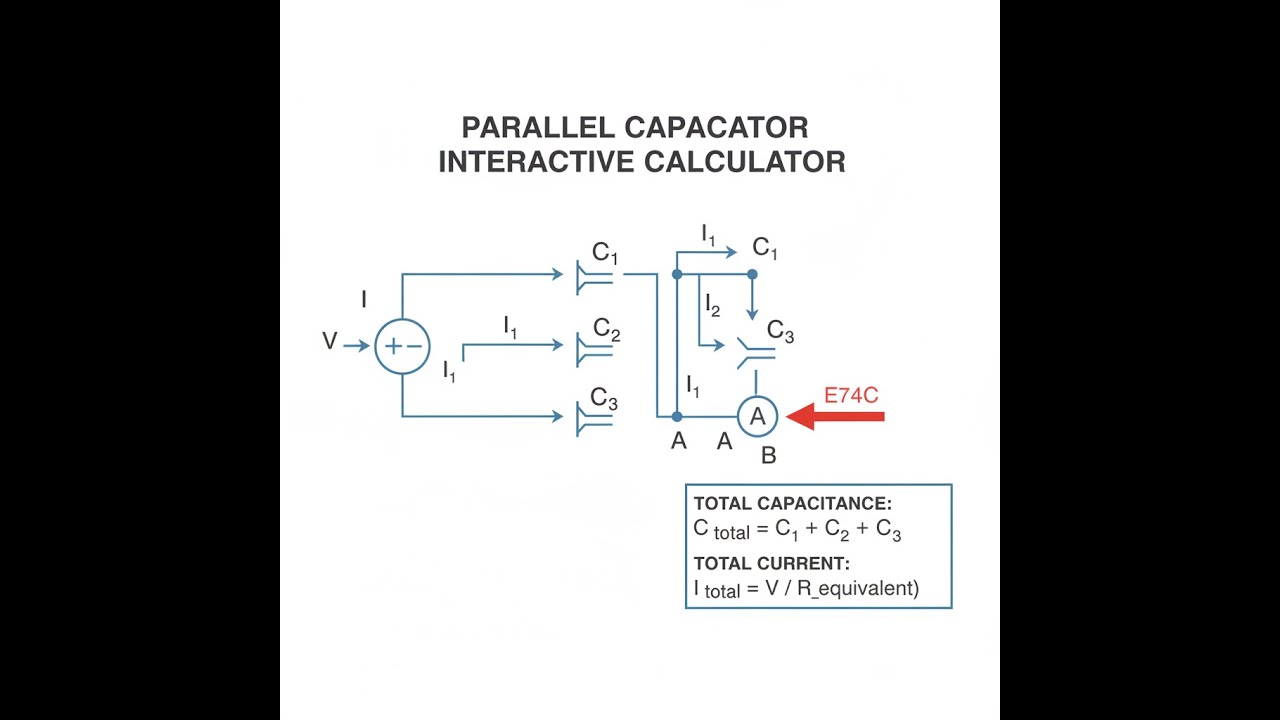
Circuit Diagram

Interactive Calculator
This calculator is intended for education, concept evaluation, and preliminary design. Results are based on the equations and assumptions described on this page, but cannot account for every real-world load case, tolerance, material property, environmental condition, installation detail, safety factor, code, or regulatory requirement. Verify all inputs, assumptions, units, and results independently before selecting components or using the result in a real application. Safety-critical, structural, medical, lifting, transportation, or regulated applications must be reviewed by a qualified engineer.
Questions about this calculator or found an error? Message our engineering team.
Parallel Capacitor Interactive Visualizer
Use the visualizer to see how parallel capacitors split charge and how total capacitance, charge, and stored energy respond as you adjust values.
EQUIVALENT CAPACITANCE
110 μF
TOTAL CHARGE
1320 μC
TOTAL ENERGY
7.92 mJ
FIRGELLI Automations — Interactive Engineering Calculators
Governing Equations
Use this formula to get the combined capacitance of capacitors in parallel.
Equivalent Capacitance (Parallel):
Ceq = C1 + C2 + C3 + ... + Cn
Charge on Individual Capacitor:
Qi = Ci × V
Total Charge:
Qtotal = Q1 + Q2 + Q3 + ... + Qn
Total Energy Stored:
E = ½ Ceq V2
Charging Current (RC Circuit):
I(t) = (V / R) × e-t/τ
where τ = R × Ceq
Variable Definitions:
- Ceq = Equivalent capacitance (μF)
- Ci = Individual capacitance of capacitor i (μF)
- Qi = Charge stored on capacitor i (μC)
- V = Applied voltage across parallel combination (V)
- E = Total energy stored (mJ)
- I(t) = Current at time t (mA)
- R = Series resistance (Ω)
- τ = Time constant (ms)
- t = Time (ms)
Simple Example
Say you have three capacitors: 10 μF, 20 μF, and 30 μF, all in parallel and powered with 12 V:
Ceq = 10 + 20 + 30 = 60 μF
Total charge: Q = 60 μF × 12 V = 720 μC
Total energy: E = ½ × 60 μF × 12² = 4.32 mJ
Theory & Practical Applications
Fundamental Principles of Parallel Capacitance
Connect capacitors in parallel, and each one gets the same voltage across it. Unlike series connections, the charges these capacitors store simply add up, and the voltage doesn't divide. The equivalent capacitance is just all the individual capacitances added together. This comes up a lot in power electronics design, especially when you need a specific cap value that's not available as a single part.
The analogy that works for me: Adding capacitors in parallel is like increasing the total plate area—the thing that actually controls capacitance. If you look at the standard formula C = ε₀εᵣA/d, what you're really doing by paralleling caps is upping the area A while keeping distance d the same. That's why the maths always gives you a bigger capacitance in parallel.
Charge Distribution and Current Sharing
Each capacitor in parallel gets charged depending on its own capacitance: Qi = CiV. In practice, this means bigger caps pull more charging current during voltage steps. For example, a 10 μF capacitor charging at 1000 V/s will draw 10 mA. If you have a 47 μF unit in the same spot, it'll want 47 mA at the same ramp rate. This has consequences for the sizing of traces and connectors—ignore it and you can get nasty hotspots.
The total charge stored by the whole setup is Qtotal = (sum of each C) × V. This rule holds for all cap types, whether electrolytic, ceramic, film, or supercaps, as long as you don't exceed any voltage ratings. In something like a flash unit, parallel caps can quickly store enough charge for single-shot pulsed loads without stressing just one part.
Energy Storage and Power Density
Energy in a parallel set is E = ½ Ceq V², so voltage plays a big part—double the voltage, and you get four times the energy. You see this in motor drives that need a lot of energy on tap for acceleration spikes or voltage dips. Sometimes that bulk capacitance is vital for keeping things up and running briefly when the supply can't.
Each capacitor stores its portion of the total energy based on its capacitance. If one's 100 μF and another is 10 μF, the 100 μF one has ten times the energy—provided the voltage across both is the same. This difference matters when you check for heating during cycles: larger caps will take more share of the I²R loss over repeated use.
Transient Response and RC Time Constants
If you charge the bank through a resistor, time constant τ = R × Ceq tells you how quickly it gets there. The more caps you have in parallel, the higher the total C, so the longer it takes to charge. For three typical caps (say, 10 μF + 22 μF + 47 μF = 79 μF) on a 100 Ω resistor, τ is 7.9 ms, and it takes about 40 ms to get close to the supply voltage.
At t=0, the charging current is just V/R. Inrush can be huge if you aren't careful—you'll see this every time you switch on a power supply and watch the fuse pop if the upstream resistance is too low. Most industrial gear uses NTC thermistors or simple resistors in the precharge circuit to keep inrush down to a sane level, at least until the caps are up to voltage.
Real-World Engineering Applications
You'll find parallel capacitor banks wherever there's a need for DC bus stability, like in the DC link on variable frequency drives (VFDs). There, a bank in the range of a few thousand microfarads smooths out voltage as motors ramp up and down and handles energy returned during braking. Another spot is professional flash equipment—multiple high-voltage electrolytics are banked in parallel, efficiently sharing current stress so you don't have one cap doing all the work, which helps with both lifetime and recharge speed.
In audio power amps, parallel film caps keep ESR and ESL low at the output, which matters more for transient and high-frequency performance than reaching a big capacitance number. Using several smaller caps in parallel drops the overall ESR, reducing heat and helping get truer, cleaner output at high power or frequencies.
Practical Design Considerations and Edge Cases
If you're building a bank from several capacitors, remember—capacitance tolerances stack. Using three 100 μF electrolytics with ±20% tolerance, the combined value could be anywhere from 240 to 360 μF. That's a much wider range than the nominal 300 μF suggests. In jobs where precision matters, you need to either buy better-tolerance parts or bin and match by actual measurement.
All capacitors in parallel see the same voltage, so the lowest voltage rating in the bank is your limiting factor. You can't run a 250 V cap and a 450 V cap in parallel at 300 V; the lower-rated part will fail first, no matter how much you're under the average. For long-term reliability, it's common to run electrolytic caps at half, or thereabouts, of their nameplate voltage, to account for dry-out and other aging effects over time, especially at elevated temperatures.
If you're operating above a few tens of kilohertz or using physically large components, the non-ideal behavior starts to show—especially lead and trace inductance. Lead inductance divides just like parallel resistors, but it's only practical if your PCB layout gives each cap truly low and matched impedance paths. Otherwise, high-frequency performance can level off or even get worse as you add more parts. Low-ESL packages and careful layout help, but there's always a practical limit—there's no point adding capacitors if your layout can't support them.
Worked Example: Motor Drive Bus Capacitor Selection
Problem Statement: Size a DC bus capacitor for a 22 kW VFD running on 480 VAC input (DC bus ~678 V). The motor can push back 8.3 kW regeneration for 150 ms when braking hard. Bus voltage must stay below 750 VDC without the brake resistor kicking on. Pre-charge inrush must be limited to below 5 A using a 150 Ω resistor. Pick capacitor values and voltages, and check how pre-charge will behave.
Solution:
Step 1 - Capacitance Needed:
Energy to absorb: E = 8300 W × 0.150 s = 1245 J
Allowed voltage rise: ΔV = 750 V - 678 V = 72 V
E = ½C(V₂² - V₁²) => C = (2 × 1245) / (750² - 678²) = 24,200 μF
Step 2 - Standard Cap Arrangement:
If you only have standard 450 V 4700 μF electrolytics, you'd need at least six in parallel (totaling 28,200 μF). But six 450 V caps can't directly handle almost 700 VDC—you'll need to go for fewer in parallel with higher voltage rated caps, say, six 800 V 3900 μF units (giving 23,400 μF). That gets you just within the calculated minimum, and the voltage margin is about 15%—workable for most designs if the application isn't continuous.
Step 3 - Check Pre-charge:
τ = 150 Ω × 0.0234 F = 3.51 s
At 3τ (about 10.5 s), you'll be at 95% voltage. Initial inrush is 678 V / 150 Ω = 4.52 A (safely under the 5 A limit). Five seconds in, the current's dropped to just over an amp and the voltage is nearing 76% of final value.
Step 4 - Energy Storage:
You'll have about 5.4 kJ stored at normal voltage, and 6.6 kJ when just under the overvoltage limit, giving about a 1.2 kJ margin for absorption during fast braking. The actual voltage rise, working backward, is only a couple volts over the 750 V target—not enough to trigger an overvoltage trip in normal conditions.
Conclusion: Six parallel 800 V 3900 μF caps give enough energy storage, the voltage rating checks out, and precharge time is typical for industrial VFDs. Costs, physical space, and inrush are all within workable levels for a 22 kW drive.
Frequently Asked Questions
Free Engineering Calculators
Explore our complete library of free engineering and physics calculators.
Browse All Calculators →🔗 Explore More Free Engineering Calculators
- LED Resistor Calculator — Current Limiting
- Capacitor Charge Discharge Calculator — RC Circuit
- Resistor Color Code Calculator
- I2C Pull-Up Resistor Calculator
- Current Divider Calculator
- Capacitors In Series Calculator
- Parallel Resistor Calculator
- Voltage Divider Calculator — Output Voltage from Two Resistors
- Voltage Divider Calculator
- Power Factor Calculator and Correction
About the Author
Robbie Dickson — Chief Engineer & Founder, FIRGELLI Automations
Robbie Dickson brings over two decades of engineering expertise to FIRGELLI Automations. With a distinguished career at Rolls-Royce, BMW, and Ford, he has deep expertise in mechanical systems, actuator technology, and precision engineering.
Video Walkthrough - How to Use This Calculator
Need to implement these calculations?
Explore the precision-engineered motion control solutions used by top engineers.


