Designing a mechanical system without accounting for friction losses is a fast path to undersized motors, overheated components, and missed efficiency targets. Use this Friction Loss Interactive Calculator to calculate friction force, coefficient of friction, normal force, or power loss using inputs like mass, velocity, surface coefficient, and incline angle. It matters across conveyor system design, brake assembly engineering, and linear actuator specification — anywhere friction directly affects power draw or thermal load. This page includes the core formulas, a worked conveyor example, friction theory, and an FAQ covering real-world behavior.
What is friction loss?
Friction loss is the energy wasted when two surfaces slide against each other. It shows up as heat, slows moving parts down, and forces your motor to work harder than it would in a frictionless system.
Simple Explanation
Think of pushing a heavy box across a floor — the rougher the floor, the harder you have to push. That extra effort is friction loss. The tighter two surfaces press together, and the rougher they are, the more energy gets wasted as heat instead of doing useful work.
📐 Browse all 1000+ Interactive Calculators
Friction Force Diagram

How to Use This Calculator
- Select a calculation mode from the dropdown — choose what you want to solve for (friction force, coefficient, normal force, power loss, incline friction, or stopping distance).
- Enter the required input values that appear for your selected mode — such as coefficient of friction, normal force, mass, velocity, or incline angle.
- Use the Try Example button to load a pre-filled worked example if you want to see how the calculator behaves before entering your own numbers.
- Click Calculate to see your result.
Friction Loss Interactive Calculator
📹 Video Walkthrough — How to Use This Calculator
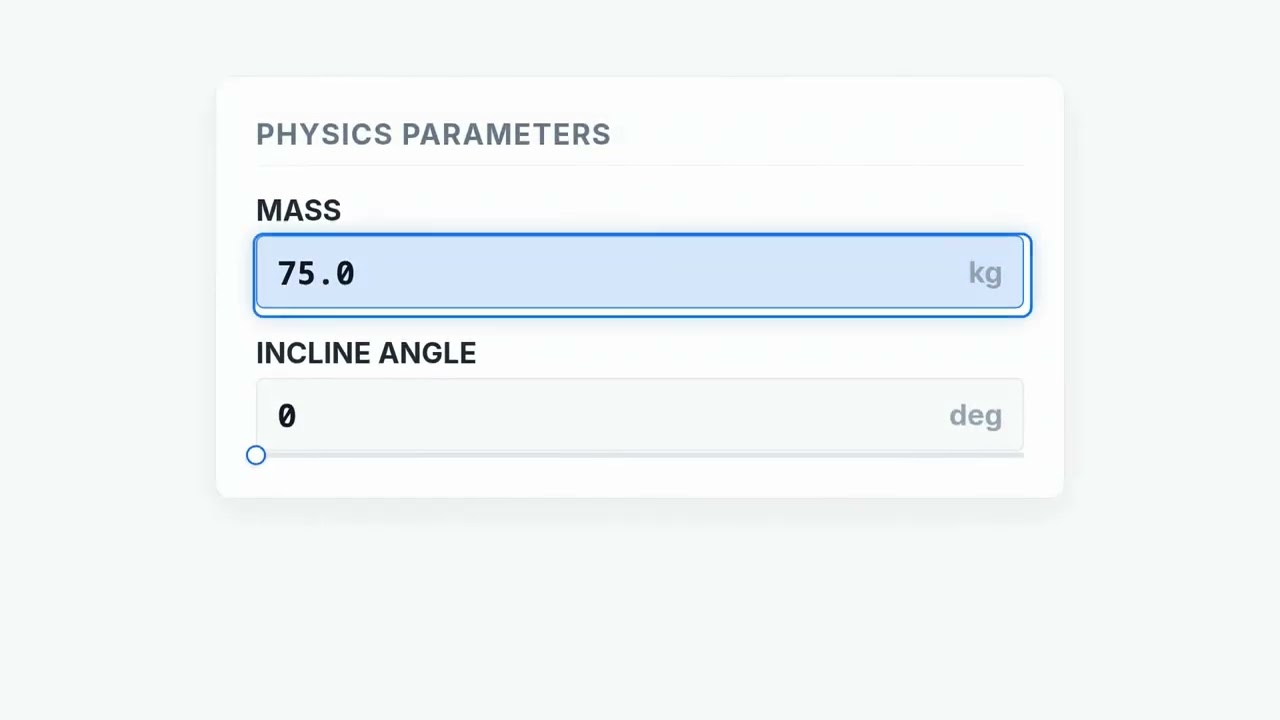
Friction Loss Interactive Visualizer
Watch how friction force, surface roughness, and normal force interact to create power loss in real-time. Adjust the coefficient of friction and normal load to see instant changes in energy dissipation and heat generation.
FRICTION FORCE
175 N
POWER LOSS
350 W
HEAT RATE
350 J/s
FIRGELLI Automations — Interactive Engineering Calculators
Friction Equations
Use the formula below to calculate friction force.
Fundamental Friction Force
Ff = μ × FN
Ff = Friction force (N)
μ = Coefficient of friction (dimensionless)
FN = Normal force (N)
Use the formula below to calculate power loss due to friction.
Power Loss Due to Friction
Ploss = Ff × v
Ploss = Power dissipated (W)
v = Relative velocity between surfaces (m/s)
Use the formula below to calculate friction on an inclined plane.
Friction on an Inclined Plane
Ff = μ × m × g × cos(θ)
FN = m × g × cos(θ)
m = Mass (kg)
g = Gravitational acceleration (9.81 m/s²)
θ = Angle of incline (degrees or radians)
Use the formula below to calculate stopping distance with friction.
Stopping Distance with Friction
d = v02 / (2 × μ × g)
d = Stopping distance (m)
v0 = Initial velocity (m/s)
Simple Example
A 50 kg steel block sits on a horizontal surface with a coefficient of friction μ = 0.35.
- Normal force: FN = 50 × 9.81 = 490.5 N
- Friction force: Ff = 0.35 × 490.5 = 171.7 N
- Power loss at 2 m/s: P = 171.7 × 2 = 343.4 W
Theory & Practical Applications
The Physics of Friction: Microscopic Origins and Macroscopic Models
Friction arises from the microscopic interactions between surface asperities—the peaks and valleys present even on apparently smooth surfaces. When two materials are pressed together, these asperities interlock and deform, creating adhesive and mechanical resistance to relative motion. The classical Amontons-Coulomb friction model, represented by Ff = μFN, is remarkably effective for engineering calculations despite its simplifications. This model assumes that friction force is independent of contact area and proportional only to the normal force—a counterintuitive result that holds because increased area reduces pressure, maintaining roughly constant real contact area at the asperity level.
The coefficient of friction μ is not a material property in the strict sense but rather a system property dependent on both materials, surface finish, temperature, contamination, and even sliding velocity. Static friction coefficients (μs) typically exceed kinetic coefficients (μk) by 10-50% because stationary surfaces have time to form stronger adhesive bonds. This difference creates the stick-slip phenomenon observed in squeaking hinges and precision positioning systems—a critical consideration when designing control systems for linear actuators operating near zero velocity. Engineers must account for the Stribeck effect: at very low velocities, friction becomes velocity-dependent and can increase dramatically, complicating low-speed motion control.
Material Pairings and Surface Engineering
Typical coefficient values span an enormous range: PTFE (Teflon) on polished steel achieves μ ≈ 0.04, lubricated journal bearings reach μ ≈ 0.02-0.08, dry steel-on-steel yields μ ≈ 0.6-0.8, and rubber on dry concrete can exceed μ = 1.2. These values are not constants but design targets achieved through careful surface preparation. A machined steel surface with Ra = 0.8 μm (32 microinches) will exhibit different friction than a ground surface at Ra = 0.2 μm, even with identical material composition.
Industrial applications leverage this sensitivity strategically. Brake systems intentionally maximize friction through high-μ materials (sintered metal pads on cast iron rotors, μ ≈ 0.35-0.45) while managing thermal dissipation—a 1500 kg vehicle decelerating from 25 m/s at μ = 0.7 dissipates 468 kJ of kinetic energy entirely as heat. Conveyor systems minimize friction through precision roller bearings (μ ≈ 0.001-0.005 effective coefficient) to reduce drive motor requirements. A 500 kg payload on a 20-meter belt conveyor operating at 1.2 m/s experiences continuous power loss of P = μmgv = 0.015 × 500 × 9.81 × 1.2 ≈ 88 W with good bearings, but would require 3.5 kW with plain sliding contact at μ = 0.6—a 40× difference that determines motor sizing and energy costs.
Thermal Management and Temperature Effects
Friction power dissipation creates localized heating that can fundamentally alter system behavior. High-speed machinery, brake assemblies, and linear actuators under continuous load all face thermal management challenges. The power equation P = Ff × v reveals that thermal issues scale with both load and speed. A linear guide rail supporting 800 N normal force with μ = 0.12 (typical for lubricated hardened steel) moving at 0.5 m/s dissipates 48 W continuously. Without adequate heat removal, this raises component temperature by ΔT = P × Rthermal, where thermal resistance depends on geometry and conduction paths.
Temperature rise affects friction coefficients non-linearly. Many polymer-based bearing materials see μ increase 15-30% between 20°C and 80°C, while lubricant viscosity drops exponentially (roughly halving every 15-20°C increase), reducing hydrodynamic film thickness in fluid bearings. This creates positive feedback: higher temperature → lower viscosity → increased boundary contact → higher friction → more heating. Designers must either limit duty cycles, provide active cooling, or select materials with flat friction-temperature curves. High-performance linear actuators incorporate heat sinks, forced air cooling, or even liquid cooling channels when continuous high-speed operation is required.
Worked Example: Conveyor Belt Drive Motor Sizing
A manufacturing facility requires a horizontal belt conveyor to transport steel assemblies totaling 750 kg over a 15-meter path at a constant velocity of 0.8 m/s. The belt rides on steel rollers with an effective coefficient of friction μ = 0.018 (combination of bearing friction and belt flexure resistance). Determine the required motor power, energy consumption per 8-hour shift, and thermal dissipation requirements.
Step 1: Calculate Normal Force
On a horizontal conveyor, the normal force equals the weight:
FN = m × g = 750 kg × 9.81 m/s² = 7357.5 N
Step 2: Calculate Total Friction Force
Ff = μ × FN = 0.018 × 7357.5 = 132.4 N
Step 3: Calculate Mechanical Power Required
Pmechanical = Ff × v = 132.4 N × 0.8 m/s = 105.9 W
Step 4: Account for Motor and Drive Efficiency
Assuming a 85% efficient motor and 92% efficient gear reducer:
ηtotal = 0.85 × 0.92 = 0.782
Pinput = Pmechanical / ηtotal = 105.9 / 0.782 = 135.4 W
A standard 200 W motor provides adequate margin for startup transients and load variations.
Step 5: Calculate Daily Energy Consumption
For an 8-hour shift:
E = Pinput × t = 135.4 W × 8 hours = 1.08 kWh per day
Annual consumption (250 working days): 270 kWh/year
At $0.12/kWh industrial rate: $32.40 annual energy cost
Step 6: Thermal Dissipation Analysis
Heat generated in the friction interface: 105.9 W
Additional heat from motor inefficiency: (200 - 105.9) × (1 - 0.85) = 14.1 W
Total heat load: 120 W
This heat dissipates through natural convection to ambient air. For a 15-meter belt system with approximately 2 m² of exposed surface area, the temperature rise is:
ΔT ≈ Q / (h × A) where h ≈ 10 W/(m²·K) for natural convection
ΔT ≈ 120 / (10 × 2) = 6°C above ambient
This modest temperature rise requires no active cooling. However, if the facility operates in a 35°C ambient environment, components will reach 41°C—well within safe operating limits for standard bearings (typically rated to 80-100°C).
Step 7: Alternative Scenario - Increased Speed
If production requirements double the belt speed to 1.6 m/s:
Pmechanical = 132.4 × 1.6 = 211.8 W
Heat generation doubles to 212 W, causing ΔT ≈ 10.6°C
This remains acceptable, but further speed increases would require thermal management evaluation.
Dynamic Friction in Control Systems
In precision motion control, friction creates multiple challenges beyond simple energy loss. Position-dependent friction variations (often periodic with ball screw lead or track segment length) appear as ripple in velocity profiles. Velocity-dependent friction causes the Stribeck effect at low speeds, where friction actually increases as velocity approaches zero—counterintuitive and problematic for control algorithms designed around constant friction assumptions. Load-dependent variations mean that friction changes with payload, requiring adaptive control strategies.
Feed-forward friction compensation in servo systems requires accurate friction models. The LuGre dynamic friction model captures stick-slip, Stribeck effect, and viscous damping through a bristle deflection analogy. However, implementation requires system identification experiments to determine model parameters—typically involving constant-velocity tests at multiple speeds and loads, plus slow ramp tests to capture static-to-kinetic transition behavior. The payoff is significant: properly compensated systems achieve positioning accuracy improvements of 5-10× compared to uncompensated PID control alone, critical for applications like semiconductor wafer handling or precision assembly.
Industrial Applications Across Sectors
Automotive brake systems represent perhaps the most demanding friction application, requiring consistent performance across temperature ranges from -40°C to 800°C at the rotor surface during extreme braking. A typical disc brake system on a 1800 kg vehicle must dissipate the kinetic energy from 100 km/h (27.78 m/s) to rest: E = ½mv² = 0.5 × 1800 × 27.78² = 694 kJ. With four-wheel disc brakes sharing this load, each rotor absorbs ~174 kJ. The temperature rise depends on rotor mass and specific heat capacity; a 6 kg cast iron rotor (cp = 460 J/kg·K) experiences ΔT = 174,000 / (6 × 460) = 63°C per stop. Repeated stops without cooling cause fade as friction coefficients drop with extreme temperature.
Manufacturing automation uses friction calculations to size actuators and predict maintenance intervals. A linear actuator extending a 45 kg tooling arm over 600 mm in 2.5 seconds against μ = 0.22 guide friction requires force F = μmg = 0.22 × 45 × 9.81 = 97.1 N just to overcome friction, plus additional force for acceleration. Power during constant-velocity phases: P = 97.1 × (0.6/2.5) = 23.3 W. Over 200,000 cycles annually, this friction work totals 4.66 MJ of heat dissipation into the guide system—necessitating either periodic lubrication or replacement of wear components like bronze bushings.
For more physics and engineering tools, explore the complete calculator library.
Frequently Asked Questions
Free Engineering Calculators
Explore our complete library of free engineering and physics calculators.
Browse All Calculators →🔗 Explore More Free Engineering Calculators
- Centripetal Force Calculator — Circular Motion
- Velocity Jacobian Matrix Calculator
- Torque to Force Converter Calculator
- Screw Jack Calculator — Lifting Force and Torque
- Elastic Constants Calculator
- Simple Harmonic Motion Calculator
- Magnitude Of Acceleration Calculator
- Cylinder Volume Calculator — Tank Pipe Capacity
- Duct Sizing Calculator — Velocity Pressure
- Extension Spring Calculator — Initial Tension and Load
About the Author
Robbie Dickson — Chief Engineer & Founder, FIRGELLI Automations
Robbie Dickson brings over two decades of engineering expertise to FIRGELLI Automations. With a distinguished career at Rolls-Royce, BMW, and Ford, he has deep expertise in mechanical systems, actuator technology, and precision engineering.
Need to implement these calculations?
Explore the precision-engineered motion control solutions used by top engineers.


