When you're laying out a fiber optic link, you need to figure out every single decibel of loss—fiber, connectors, splices—before thinking about whether your transceivers and amplifiers will cut it, or if your planned run is too long. This Optical Fiber Attenuation Calculator lets you plug in the numbers for fiber length, attenuation rate, how many connectors there are, and splices to see how much signal you'll lose overall. It's a step you can't skip for any telecom system, data center links, or subsea cables—if you get the math wrong, the link might not work. Scroll down for the main calculation, a real-world example, detailed engineering notes, and quick answers to frequent questions.
What is optical fiber attenuation?
Optical fiber attenuation is just how much optical signal you lose as it travels through the fiber. It's measured in decibels (dB). You need to know how many dB you'll lose over the length of fiber and through each connector or splice along the route.
Simple Explanation
It's a bit like water pressure dropping the longer and more complicated your hose gets. In fiber, every kilometer, connector, and splice chips away at your signal level. Add them up—that’s your total loss to plan for.
📐 Browse all 1000+ Interactive Calculators
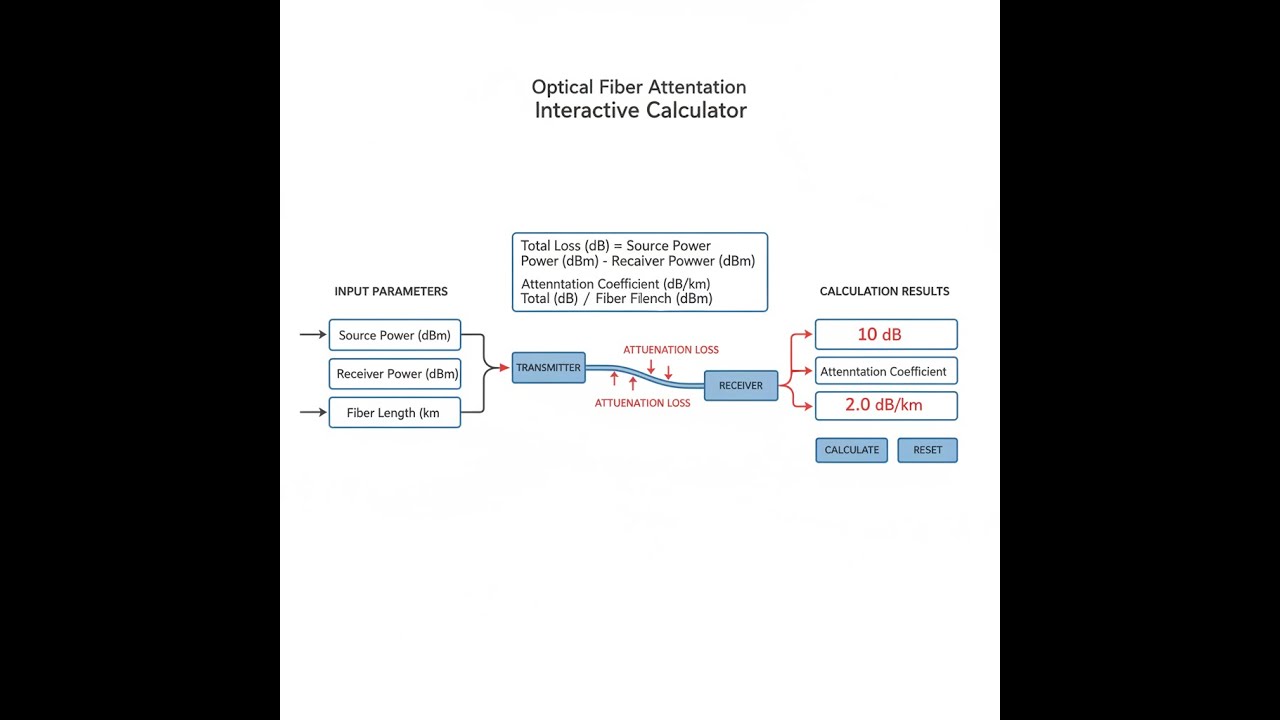
Fiber Attenuation Diagram

Optical Fiber Attenuation Calculator
How to Use This Calculator
This calculator is intended for education, concept evaluation, and preliminary design. Results are based on the equations and assumptions described on this page, but cannot account for every real-world load case, tolerance, material property, environmental condition, installation detail, safety factor, code, or regulatory requirement. Verify all inputs, assumptions, units, and results independently before selecting components or using the result in a real application. Safety-critical, structural, medical, lifting, transportation, or regulated applications must be reviewed by a qualified engineer.
Questions about this calculator or found an error? Message our engineering team.
- Pick the calculation mode—total loss, output power, max length, etc.
- Enter your fiber length (km), the fiber’s attenuation rate (dB/km), how many connectors and splices you're using, and their loss values.
- If your calculation needs it, add in input or output power values.
- Hit Calculate to see the answer.
Optical Fiber Attenuation Interactive Visualizer
Watch how signal power drops through fiber length, connectors, and splices. Adjust parameters to see real-time attenuation calculations for fiber optic link design.
TOTAL ATTENUATION
6.05 dB
OUTPUT POWER
-6.05 dBm
LINK MARGIN
23.95 dB
FIRGELLI Automations — Interactive Engineering Calculators
Attenuation Equations
Here’s the equation for total attenuation in a fiber run.
Total Fiber Attenuation
Atotal = α × L + Nc × Ac + Ns × As
Where:
Atotal = Total attenuation (dB)
α = Attenuation coefficient (dB/km)
L = Fiber length (km)
Nc = Number of connectors
Ac = Loss per connector (dB)
Ns = Number of splices
As = Loss per splice (dB)
Here’s the formula for output power after losses in your link.
Output Power Calculation
Pout = Pin - Atotal
Where:
Pout = Output power (dBm)
Pin = Input power (dBm)
Atotal = Total attenuation (dB)
Here's how you solve for the maximum fiber length before you run out of power budget.
Maximum Fiber Length
Lmax = (Pbudget - Nc × Ac - Ns × As) / α
Where:
Lmax = Maximum fiber length (km)
Pbudget = Available power budget (dB)
α = Attenuation coefficient (dB/km)
Link margin tells you how much signal headroom you have at the receiver.
Link Margin
M = Pout - Pmin
Where:
M = Link margin (dB)
Pout = Output power at receiver (dBm)
Pmin = Minimum receiver sensitivity (dBm, typically -30 dBm)
Simple Example
Say your fiber is 10 km long, the attenuation coefficient is 0.35 dB/km, you have 2 connectors at 0.5 dB each, 3 splices at 0.1 dB each, and your input power is 0 dBm.
Fiber loss: 0.35 × 10 = 3.5 dB. Connector loss: 2 × 0.5 = 1.0 dB. Splice loss: 3 × 0.1 = 0.3 dB.
Total attenuation: 3.5 + 1.0 + 0.3 = 4.8 dB. Output power: 0 − 4.8 = −4.8 dBm.
Theory & Engineering Applications
Fiber attenuation is the main thing that limits how far and reliably you can send optical signals. Once you know the loss, you can plan how long a run you can use before you need an amplifier or regeneration, or whether your chosen transceivers will work for that distance. This matters in telecom, data centers, underwater links, and sensor networks—a proper estimate keeps you from running into signal shortfalls or overspending on unnecessary upgrades.
Physical Mechanisms of Fiber Attenuation
Signal loss in fiber comes down to two main causes: absorption and scattering. Absorption happens when light gets absorbed by the glass itself, either from the material’s atomic bonds (intrinsic) or from impurities (extrinsic) like OH⁻ ions left over from manufacturing, with a strong effect near 1383 nm. Modern fiber is pretty clean—"low water peak" fiber is standard—so this is mostly under control if you buy decent product.
Rayleigh scattering—invisible, tiny variations in the glass—limits how good fiber can get. It’s much worse at shorter wavelengths because scattering scales with λ⁻⁴ (wavelength to the -4). That’s why single-mode fiber at 1550 nm is far lower loss than multimode fiber at 850 nm. For real numbers, expect 2.5 dB/km at 850 nm (multimode), 0.35 dB/km at 1310 nm, and down to 0.20 dB/km or better at 1550 nm for typical single-mode fiber if the manufacturer’s specs check out.
Connector and Splice Losses
Aside from the fiber itself, you also get loss at every connector and splice. Connectors lose signal mostly through misalignment, dirt, imperfect end-faces, and tiny air gaps. Basic PC-type connectors are about 0.3–0.5 dB loss on a good day; APC (angled type) connectors reduce back-reflection at the expense of sometimes a bit more insertion loss (maybe 0.5–0.8 dB). If you keep connectors clean and mated properly, you stay near the low end of that range.
Splices are better—but only if done right. Fusion splices (real arc-welds) are usually under 0.1 dB each; mechanical splices are more variable, from 0.1 up to 0.3 dB. In a long route with lots of patch panels and repair joints, splice and connector loss can actually beat fiber loss itself, so keep joint count as low as you can, and spec good installers.
Wavelength-Dependent Attenuation and Spectral Windows
Telecom gear sticks to certain wavelength windows for good reason: 1310 nm (O-band) has zero chromatic dispersion in standard single-mode fiber but a bit more loss, while 1550 nm (C-band) has minimum loss and supports standard EDFAs (fiber amplifiers), making it the main choice for long-distance systems. L-band (above 1565 nm) gets used if you really need the bandwidth and can handle the slight penalty in loss.
Temperature changes matter, but are easy to overlook. As temperature rises, fiber loss goes up by about 0.001 dB/km per °C above 20°C, which can add up over tens of kilometers or in harsh locations. For critical long runs, plan a margin for the environment—don’t trust a single lab measurement at room temperature.
Worked Example: Data Center Interconnect Link Budget
Suppose you need to run a 15.7 km fiber link at 1310 nm between two data centers. The transceivers put out +2 dBm, you know the minimum receiver spec is -18 dBm, and you want a 3 dB margin. There will be 6 connectors (let’s assume 0.4 dB loss each) and 2 fusion splices (0.08 dB each).
Step 1: Available Power Budget
Budget = Output power - Receiver sensitivity - Margin = (+2) - (–18) – (3) = 17 dB
Step 2: Connector Loss
6 × 0.4 = 2.4 dB
Step 3: Splice Loss
2 × 0.08 = 0.16 dB
Step 4: Budget Left for Fiber
17 – 2.4 – 0.16 = 14.44 dB
Step 5: Max Allowable Fiber Loss
14.44 dB over 15.7 km is 0.92 dB/km. That’s much higher than typical fiber, so the link is fine. If your actual fiber is 0.35 dB/km, real fiber loss is 15.7 × 0.35 = 5.50 dB.
Step 6: Check Total Loss and Margin
All-in link loss: 5.50 + 2.4 + 0.16 = 8.06 dB. Received power: +2 – 8.06 = –6.06 dBm. That’s 11.94 dB above the receiver sensitivity spec, so you have margin for aging, future repairs, fiber stress, and climate shifts. If that's too much margin, you might downgrade to a cheaper transceiver or stretch for a longer link.
Nonlinear Effects and High-Power Limitations
For most fiber runs, linear loss is all you need to worry about. But at higher launch powers (usually above +6 or +10 dBm), fiber starts exhibiting non-linear effects: Stimulated Raman Scattering transfers energy between channels, while Stimulated Brillouin Scattering sends some light backwards, capping how much power gets through on a single channel. For dense WDM systems, Four-Wave Mixing can inject unwanted signals into neighboring channels, especially at high power density or low channel spacing. These effects mean that past a certain power, extra input doesn't help—your limiting factor changes from receiver sensitivity to whatever the fiber itself can tolerate.
Amplifier Spacing and Regeneration Requirements
Long-haul links (hundreds or thousands of km) use optical amplifiers (EDFAs, usually) to boost the signal periodically. The real-world spacing between amplifiers depends on fiber loss and how much loss-per-span your amplifiers can handle. With 0.20 dB/km loss at 1550 nm and a typical 20–30 dB amplifier gain, you get 80–100 km per hop before OSNR (noise ratio) becomes the issue. Subsea cable designs push this with specialty fiber (0.16 dB/km or so) and carefully spaced repeaters. But no matter what, you eventually hit the wall with accumulated amplifier noise and fundamental fiber loss. That’s what sets the true long-distance records—and drives up the cost per kilometer.
For more engineering calculators, check out the engineering calculator library.
Practical Applications
Scenario: Telecommunications Network Expansion
Marcus, a telecom engineer, wants to check if an existing 73.2 km fiber run can handle new 100G coherent optical equipment. OTDR testing shows 0.22 dB/km fiber loss, 8 connectors (0.45 dB each), and 3 fusion splices (0.06 dB each). Total link loss adds up to 19.80 dB. The transceiver gives a power budget of 28 dB and demands a 4 dB margin minimum, so the link is viable with 4.2 dB excess margin. That means no need for extra amplifiers—saving budget and time, with a quick check from the calculator.
Scenario: Data Center Migration Planning
Jennifer, working on building a new availability zone for a cloud provider, checks how far she can stretch 10G optical links using her stock of transceivers (+1 dBm output, -14 dBm sensitivity). She wants at least 5 dB of link margin. With 10 connectors (0.5 dB each) and 4 splices (0.1 dB each), the max fiber distance comes out to 49.3 km (assuming 0.35 dB/km standard single-mode fiber). She then narrows the shortlist of possible sites, nixing anything further than about 50 km to keep the link within equipment spec—no guessing required.
Scenario: Field Troubleshooting Degraded Link
David, a field tech, gets called for random data errors on a 28 km campus fiber link. Power meter says -16.2 dBm at the receiver; transmitter spec is +3 dBm, receiver needs at least -18 dBm. Total measured loss is 19.2 dB. If you subtract out the expected loss from 6 connectors (0.4 dB each) and 2 splices (0.1 dB each), the fiber loss works out to 0.60 dB/km, much worse than spec (0.35 dB/km). That's a red flag—either bad fiber (water damage?) or undocumented repairs. OTDR finds three hidden mechanical splices at 1.2 dB loss. Once those are swapped for fusion splices, the link's back in spec with extra margin to spare.
Frequently Asked Questions
▼ What is the difference between attenuation and loss in fiber optics?
▼ Why do different wavelengths have different attenuation values?
▼ How much link margin should I design into fiber optic systems?
▼ Can fiber optic cables actually improve or have negative attenuation?
▼ How do I account for fiber bends and coiling in attenuation calculations?
▼ What causes attenuation to increase over time in installed fiber?
Free Engineering Calculators
Explore our complete library of free engineering and physics calculators.
Browse All Calculators →🔗 Explore More Free Engineering Calculators
About the Author
Robbie Dickson — Chief Engineer & Founder, FIRGELLI Automations
Robbie Dickson brings over two decades of engineering expertise to FIRGELLI Automations. With a distinguished career at Rolls-Royce, BMW, and Ford, he has deep expertise in mechanical systems, actuator technology, and precision engineering.
Video Walkthrough - How to Use This Calculator
Need to implement these calculations?
Explore the precision-engineered motion control solutions used by top engineers.


