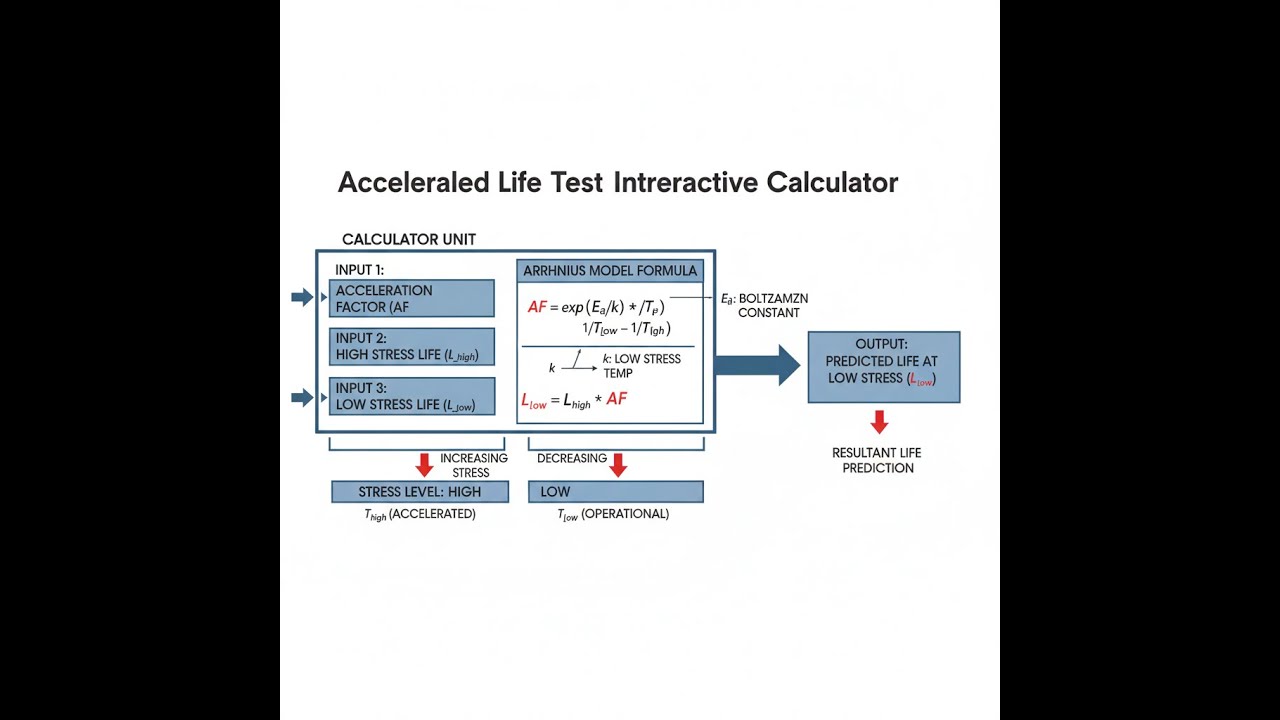
How many hours at operating temperature correspond to a shorter hot test? Enter the two temperatures and the activation energy for the failure mechanism you want to study. The calculator translates exposure time between the two conditions.
What does an Arrhenius acceleration factor mean?
If a thermally activated process runs ten times as fast in the test, one test hour represents ten use hours for that process. A lifetime measured to a defined endpoint, such as a 10% loss of output, scales by the same factor when the same mechanism governs both conditions. Merely running the test for an hour does not establish when the component fails.
📐 Browse all 1000+ Interactive Calculators
Compare test hours with equivalent use hours
Choose two temperatures for the same aging mechanism. Move the exposure slider to see how much time at the use temperature corresponds to the time spent in the test chamber.
- Acceleration factor
- 96×
- Full equivalent use time
- 96,000 h
- In 365-day years
- 10.96 yr
One hour at 85 °C represents approximately 96 hours at 25 °C for this mechanism.
The model assumes one thermally activated failure mechanism with the same activation energy at both temperatures. Equivalent exposure describes modeled aging. Estimating service life also requires failure or degradation data.
Accelerated Life Test Arrhenius Calculator
How to Use This Calculator
- Choose the result you need, such as equivalent use time, acceleration factor or activation energy.
- Enter the temperatures requested by that mode in degrees Celsius. The calculation converts them to kelvin.
- Supply the remaining measurements or assumptions. For activation energy from two tests, enter times to the same endpoint. For a rate, enter the unit count, first failures and average observed hours per unit.
- Click Calculate to see the result.
This calculator is intended for education, concept evaluation, and preliminary design. Results are based on the equations and assumptions described on this page, but cannot account for every real-world load case, tolerance, material property, environmental condition, installation detail, safety factor, code, or regulatory requirement. Verify all inputs, assumptions, units, and results independently before selecting components or using the result in a real application. Safety-critical, structural, medical, lifting, transportation, or regulated applications must be reviewed by a qualified engineer.
Questions about this calculator or found an error? Message our engineering team.
Arrhenius Equations
Use the formula below to calculate the acceleration factor for Arrhenius accelerated life testing.
Acceleration Factor
AF = exp[Ea/k × (1/Tuse - 1/Tstress)]
AF = Acceleration factor (dimensionless)
Ea = Activation energy (eV, electron volts)
k = Boltzmann's constant (8.617333 × 10⁻⁵ eV/K)
Tuse = Use temperature (Kelvin)
Tstress = Test/stress temperature (Kelvin)
Field Life Prediction
Lfield = Ltest × AF
Lfield = Equivalent duration or characteristic life at use temperature (hours)
Ltest = Test duration or characteristic life to the same endpoint (hours)
Activation Energy from Two Tests
Ea = [ln(L2/L1) × k] / (1/T2 - 1/T1)
L1, L2 = Lifetimes at two different test temperatures (hours)
T1, T2 = Test temperatures (Kelvin)
Test Temperature for Desired Acceleration
Tstress = 1 / [(1/Tuse) - (ln(AF) × k / Ea)]
Used to determine the test temperature needed to achieve a specific acceleration factor
Failure Rate Translation
λfield = λtest / AF
λfield = Field failure rate (FIT, failures per billion hours)
λtest = Test failure rate (FIT)
Mean time to failure at use = 109 / λfield hours when the constant rate is expressed in FIT
Worked example at 85 °C and 25 °C
Assume a single failure mechanism with an activation energy of 0.70 eV. The use temperature of 25 °C is 298.15 K, and the test temperature of 85 °C is 358.15 K. Substituting these into the equation gives exp[(0.70 / 0.0000861733) × (1/298.15 − 1/358.15)] ≈ 96.0.
A 1,000-hour test represents about 96,000 hours at the use temperature, nearly 11.0 years for this mechanism. Conversely, to reach 8,760 equivalent use hours, run the hot test for about 91.3 hours. Equal temperatures give a factor of one. A cooler test gives a factor below one and takes longer to accumulate the same exposure.
Choosing a failure mechanism and activation energy
Use the temperature at the location where degradation occurs. The junction of a powered electronic component can be hotter than the surrounding air. Record both test and use temperatures at the same physical location when estimating the ratio.
Activation energy describes the temperature sensitivity of a particular degradation process. For a two-temperature estimate, measure the same life statistic at each temperature, such as the median time to the same loss of output. If the hotter samples reach that endpoint sooner, the slope of log life against reciprocal absolute temperature is positive and equals Ea/k. Additional temperatures and failure analysis help establish whether the same mechanism persists across the range.
A failure-free test contributes exposure. Under a constant failure rate, three first failures in 100,000 observed device-hours give an estimated test rate of 30,000 FIT. With a factor of 96, the corresponding use rate is about 313 FIT. For zero observed failures, the calculator instead gives a one-sided 95% upper rate bound and the corresponding lower bound on mean time to failure. These calculations treat the chosen acceleration factor as known.
The NIST/SEMATECH Arrhenius model explains the temperature ratio. Its companion section on constant-rate estimates and confidence bounds explains how to interpret a failure count and total observed hours.
For additional reliability calculations including thermal cycling, humidity acceleration, and system-level MTBF predictions, explore the complete collection at the FIRGELLI engineering calculator library, which includes tools for mechanical stress analysis, fatigue life prediction, and statistical reliability modeling.
Practical applications
Select a test duration. An engineer comparing two seal materials can choose a common endpoint, such as a specified reduction in elasticity. Use a separate activation energy for each material when the test data support different temperature sensitivities.
Interpret a component test. Suppose 50 devices run for an average of 800 hours before first failure or test end. That is 40,000 device-hours of exposure. Record the actual time observed for each unit, since devices removed early contribute fewer hours.
Check a proposed test temperature. Solve for temperature using a target factor, then compare the result with the component’s known operating conditions. A temperature that softens an adhesive or introduces a new failure mode cannot represent ordinary service through the same factor.
Frequently Asked Questions
What is a typical activation energy value, and how do I find it for my product? +
How high can I safely set my test temperature to maximize acceleration? +
Can I use Arrhenius acceleration for mechanical failures like solder fatigue? +
What sample size do I need for statistically valid accelerated life testing? +
How do I handle products with multiple failure mechanisms with different activation energies? +
What's the difference between Arrhenius and Eyring models, and when should I use each? +
Free Engineering Calculators
Explore our complete library of free engineering and physics calculators.
Browse All Calculators →🔗 Explore More Free Engineering Calculators
About the Author
Robbie Dickson — Chief Engineer & Founder, FIRGELLI Automations
Robbie Dickson brings over two decades of engineering expertise to FIRGELLI Automations. With a distinguished career at Rolls-Royce, BMW, and Ford, he has deep expertise in mechanical systems, actuator technology, and precision engineering.