When designing motion control systems or selecting motors for automation projects, one of the most fundamental decisions you'll face is choosing between brushed and brushless DC motors. This choice affects everything from system efficiency and maintenance requirements to initial cost and control complexity. While both motor types convert electrical energy into mechanical rotation, they accomplish this through fundamentally different mechanisms—and understanding these differences is critical for engineers, hobbyists, and product designers alike.
The distinction between brushed and brushless motors isn't merely academic. In practical applications ranging from linear actuators to TV lifts, the motor type directly impacts performance, longevity, and total cost of ownership. Brushed motors have dominated the market for over a century due to their simplicity and low cost, while brushless technology—originally developed for aerospace applications—has become increasingly accessible and now powers everything from precision robotics to electric vehicles.
This comprehensive guide examines the technical architecture, operating principles, control methods, and practical considerations for both motor technologies. Whether you're retrofitting existing equipment, designing a new automation system, or simply trying to understand which motor technology best suits your application, this article provides the engineering insight you need to make informed decisions.
Fundamental Architecture Differences Between Brushed and Brushless Motors
The primary distinction between brushed and brushless DC motors lies in their commutation method—the process of switching current direction in the motor windings to maintain continuous rotation. This fundamental difference drives nearly every other characteristic that distinguishes these two technologies.

Commutation method: Brushed motors employ mechanical brushes and a segmented commutator to physically switch current direction in the rotor windings. As the motor shaft rotates, spring-loaded carbon or graphite brushes slide across the commutator segments, energizing different windings in sequence. This mechanical switching is elegantly simple but introduces friction, electrical arcing, and wear. Brushless motors eliminate this mechanical interface entirely, instead using electronic controllers with magnetic position sensors—typically Hall effect sensors or back-EMF detection—to switch current through the stator windings at precisely the right moments.
Magnetic field arrangement: The physical layout of magnets and windings is inverted between the two designs. In brushed motors, permanent magnets are mounted to the stationary stator housing, while the electromagnetic windings reside on the rotating armature (rotor). This configuration necessitates the brush-and-commutator system to deliver power to the spinning windings. Brushless motors reverse this arrangement: permanent magnets are mounted on the rotor, while the electromagnetic coils are fixed to the stator. This "inside-out" design eliminates the need for physical electrical contact with rotating components, since stationary windings can be powered directly.
Control complexity: Brushed motors are inherently self-commutating—once connected to a DC power source, the mechanical commutator automatically handles the switching sequence. Speed control requires only voltage adjustment through simple resistive or PWM circuits. Brushless motors, conversely, require dedicated electronic speed controllers (ESCs) that must precisely time the energization of each stator phase based on rotor position feedback. This electronic commutation demands more sophisticated control circuitry but enables far more precise speed and torque management.
Brushless Motor Technology: Architecture and Operating Principles
Brushless DC motors represent a more modern approach to electric motor design, leveraging power electronics to overcome the inherent limitations of mechanical commutation. Their construction and operation reflect decades of advancement in semiconductor technology, magnetic materials, and control algorithms.

Internal Construction and Components
A brushless motor's rotor consists of high-strength permanent magnets—typically neodymium-iron-boron (NdFeB) for high magnetic flux density—arranged in alternating north and south poles around the rotor circumference. These magnets may be surface-mounted or embedded within the rotor structure depending on the application requirements. The rotor assembly connects directly to the output shaft with no electrical connections required, eliminating the primary wear mechanism found in brushed designs.
The stator housing contains precisely wound copper coils arranged in multiple phases—most commonly three-phase configurations with windings positioned 120�� apart. These coils are wound around laminated iron cores to concentrate and direct the magnetic flux. Unlike brushed motors where windings must be compact enough to fit on a rotating armature, brushless stator windings can be larger and more robust since they remain stationary, enabling better thermal management and higher current capacity.
Magnetic position sensors, typically Hall effect devices, are strategically positioned around the stator to detect the rotor's angular position. These sensors output digital signals when they detect the north pole of a rotor magnet passing by, providing the controller with real-time feedback about rotor position. Some advanced brushless motors use sensorless control techniques that infer rotor position from back-EMF measurements, eliminating the Hall sensors entirely but requiring more sophisticated control algorithms.

Electronic Commutation Process
To understand brushless motor operation, consider a simplified two-pole, three-phase model. The rotor contains a single pair of magnets (one north, one south pole), each spanning 180° of the rotor circumference. Three Hall sensors positioned 120° apart monitor rotor position, while three stator coil sets (phase U, V, and W) are also spaced 120° apart but offset 60° from the Hall sensors.
When the electronic controller energizes a stator phase, it creates a magnetic pole on the inner surface of the stator. Current flowing one direction creates a south pole that attracts the rotor's north pole; reversing the current creates a north pole that repels the rotor's north pole and attracts its south pole. By sequentially energizing different phase combinations based on Hall sensor feedback, the controller creates a rotating magnetic field that pulls the rotor magnets around in continuous rotation.

The commutation sequence follows a precise pattern: at any given moment, two of the three phases are energized while the third remains inactive. As the rotor advances and Hall sensors detect position changes, the controller switches which phases carry current and in what direction. This electronic switching happens rapidly—potentially thousands of times per second at high speeds—with timing precision impossible to achieve through mechanical commutation.
Speed Control in Brushless Motors
Controlling brushless motor speed requires modulating the power delivered to the stator windings through the electronic speed controller (ESC). The ESC accomplishes this through pulse-width modulation (PWM), rapidly switching power MOSFETs or IGBTs on and off to control the average voltage applied to each motor phase.
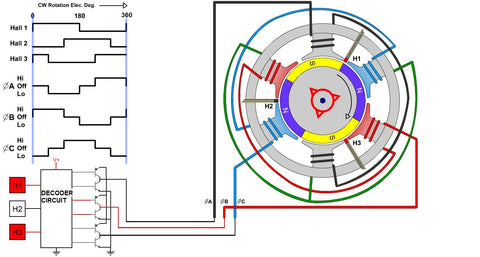
The basic speed control process involves several coordinated steps. First, Hall effect sensors continuously monitor rotor position and transmit this data to the ESC. The controller's logic determines the appropriate stator phase energization sequence based on this position feedback. Power transistors within the ESC then switch current to the correct phase windings at the proper time. Meanwhile, PWM signals regulate motor speed and torque by adjusting the duty cycle—the ratio of on-time to off-time in each switching cycle. A higher duty cycle delivers more average power and increases speed; a lower duty cycle reduces power and speed.
Many brushless motor applications incorporate additional feedback mechanisms beyond basic Hall sensors. Position encoders provide high-resolution rotor angle data for precision control. Current sensors monitor phase currents to enable torque control and overcurrent protection. Some systems use back-EMF (electromotive force) monitoring for sensorless control or to detect mechanical load conditions. This comprehensive feedback enables sophisticated control strategies like field-oriented control (FOC) or direct torque control (DTC) that optimize efficiency and performance across varying speed and load conditions.
The ESC itself must be carefully matched to the motor specifications. Key parameters include voltage rating (matching the system supply voltage), current capacity (exceeding the motor's peak current draw), phase configuration (matching the motor's pole and phase count), and control protocol compatibility (PWM input, serial communication, or analog control). Applications requiring synchronized multiple motors—such as multi-axis linear actuators in a standing desk—need ESCs with coordination capabilities or an external control box managing all motor controllers.
Brushed Motor Technology: Time-Tested Simplicity
Brushed DC motors have powered electrical devices for over 130 years, and their fundamental design has remained remarkably consistent because it elegantly solves the commutation challenge through purely mechanical means. While newer brushless technology offers certain advantages, brushed motors continue to dominate applications where simplicity, cost, and ease of control are paramount.

Mechanical Architecture and Key Components
The brushed motor's rotor—commonly called the armature—forms the heart of the design. Copper wire is wound around an iron core (in traditional designs) or formed into a self-supporting structure (in coreless designs) to create electromagnets. These windings connect to a commutator, a cylindrical assembly of copper segments insulated from each other and mounted to the rotor shaft. Each commutator segment connects to a specific armature winding, creating an electrical interface that rotates with the shaft.
The stator in a brushed motor is conceptually simpler than its brushless counterpart. Permanent magnets mount to the inner surface of the stator housing, creating a fixed magnetic field. Depending on motor size and application, these may be ceramic ferrite magnets (economical, adequate field strength), neodymium magnets (high field strength, compact size), or in some older designs, electromagnetic field coils. The stator requires no complex windings or electronic components—just the magnets and structural housing.
Brushes provide the critical sliding electrical contact between the stationary power source and rotating commutator. These spring-loaded components—traditionally made from carbon, graphite, or copper-graphite compounds—press against the commutator surface with controlled force. As the commutator rotates, the brushes maintain electrical contact while sequentially energizing different armature windings. The brush material must balance several competing requirements: adequate electrical conductivity, low friction coefficient, appropriate hardness to avoid excessive wear on the commutator, and the ability to form a conductive oxide layer that reduces arcing.

Commutation Through Mechanical Switching
When DC voltage is applied to a brushed motor's terminals, current flows through the brushes into the commutator and through the armature windings. These energized windings become electromagnets, creating a magnetic field around the rotor. This rotor field interacts with the stator's permanent magnetic field through attraction and repulsion, generating torque that causes the rotor to rotate toward alignment with the stator field.
The ingenious aspect of brushed motor design is that the commutator automatically switches the current to different windings as the rotor turns, preventing the rotor from simply locking into alignment with the stator field. Each time a commutator segment passes from one brush to another, the current path changes, energizing a different set of armature windings and effectively advancing the rotor's magnetic field. This continuous switching maintains the angular offset between rotor and stator fields, sustaining rotation as long as power is applied.
The commutation process isn't perfectly smooth—there are brief moments when brushes bridge between commutator segments, momentarily short-circuiting windings. This creates small arcs and current spikes, contributing to electrical noise and gradual erosion of both brush and commutator surfaces. Motor designers minimize these effects through careful selection of commutator segment width, brush width and spacing, and the number of armature poles. High-quality brushed motors incorporate additional design features like compensating windings or interpoles to reduce arcing and improve commutation quality.
Speed Control Techniques for Brushed Motors
Brushed motors offer remarkably simple speed control because the mechanical commutator handles the switching automatically—the motor effectively acts as a self-commutating device. Speed correlates directly with the applied voltage: higher voltage produces faster rotation, lower voltage produces slower rotation. This straightforward voltage-to-speed relationship makes brushed motors exceptionally easy to control, particularly for hobbyists or in applications where sophisticated control isn't required.

The most basic speed control method involves varying the supply voltage through a simple variable resistor (rheostat). While straightforward, this approach wastes considerable energy as heat in the resistor and provides poor torque at low speeds. A far more efficient method employs pulse-width modulation (PWM), rapidly switching the full supply voltage on and off. The motor responds to the average voltage determined by the PWM duty cycle, delivering good torque even at reduced speeds while minimizing power dissipation in the control circuit.
For applications requiring bidirectional rotation—such as linear actuators that extend and retract—an H-bridge circuit reverses current flow through the motor. This configuration uses four switches (typically MOSFETs or relays) arranged so that closing one diagonal pair drives the motor forward, while closing the opposite pair reverses it. Many industrial actuators incorporate H-bridge control with PWM for variable speed bidirectional operation.
Closed-loop speed control adds a feedback sensor—tachometer, optical encoder, or Hall effect sensor—to measure actual motor speed. A controller compares this measured speed against the desired setpoint and adjusts the drive voltage accordingly. This feedback regulation maintains consistent speed despite varying mechanical loads, though it adds cost and complexity. Feedback actuators often incorporate such position or speed sensing for precise motion control.
Practical Wiring and Switch Control
One of brushed motors' most significant advantages is their straightforward wiring, particularly for simple on-off or reversing applications. A basic two-wire connection to a DC power supply is sufficient for unidirectional operation—connect positive and negative terminals and the motor spins.

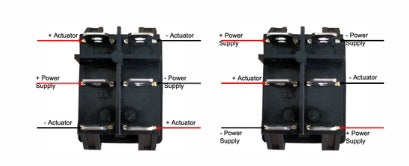
For reversible operation, a double-pole, double-throw (DPDT) rocker switch provides a simple manual control solution commonly used with linear actuators in DIY applications. The DPDT switch has six terminals: two center terminals connect to the power supply (positive and negative), two terminals on one end connect to one motor lead, and two terminals on the opposite end connect to the other motor lead.

When the switch is pressed to one position, it connects the top and middle terminals internally, routing positive voltage to one motor lead and negative to the other—the motor spins in one direction. Pressing the switch to the opposite position connects the bottom and middle terminals, reversing the polarity to the motor and reversing rotation. The center position leaves the switch open, stopping the motor. This same principle applies when controlling multiple motors—each motor connects to its own channel of the switch.
For more sophisticated control, particularly when managing multiple actuators in synchronized motion (such as in TV lifts or furniture applications), dedicated control boxes simplify wiring and provide additional features. These units typically include built-in H-bridges, synchronization logic, overcurrent protection, and inputs for remote controls or switches, significantly reducing installation complexity compared to building equivalent circuits from discrete components.
Performance Characteristics and Efficiency Analysis
The architectural differences between brushed and brushless motors translate into measurable performance distinctions across multiple parameters. Understanding these differences is essential for application-appropriate motor selection.
Efficiency and Power Density
Brushless motors consistently demonstrate superior efficiency—typically 85-90% compared to 75-80% for equivalent brushed motors. This advantage stems from eliminating the resistive losses and friction in the brush-commutator interface. Brushes require continuous spring pressure against the commutator, creating friction that converts input power to waste heat. Additionally, the electrical resistance at the brush-commutator contact point dissipates power proportional to the square of the current passing through it.
The efficiency gap widens under demanding conditions. At high speeds, brush friction increases and commutation quality degrades, reducing brushed motor efficiency further. Under heavy loads requiring high current, brush contact resistance becomes increasingly problematic. Brushless motors maintain more consistent efficiency across their operating range because electronic commutation precisely controls current flow without sliding contacts or friction beyond the bearing friction common to both motor types.
This efficiency difference has direct practical implications. In battery-powered applications, brushless motors provide longer runtime from the same battery capacity. In continuous-duty applications like industrial actuators, reduced power consumption translates to lower operating costs and less waste heat to dissipate. The better thermal performance allows higher power density—more output power from a given motor size—because brushless motors can safely handle higher currents without excessive heating.
Maintenance Requirements and Operational Lifespan
Service life represents one of the most significant practical differences between these motor technologies. Brushed motors have a finite lifespan determined primarily by brush wear. As brushes slide against the commutator, both surfaces gradually erode. Brush life typically ranges from 1,000 to 5,000 hours of operation depending on duty cycle, load, speed, and environmental conditions, though some applications may achieve 10,000 hours or more with high-quality components and favorable operating conditions.
When brushes wear down to their minimum length, they must be replaced—a maintenance task requiring disassembly, brush replacement, and often commutator cleaning or resurfacing. The commutator surface itself gradually develops grooves or ridges that degrade commutation quality and accelerate brush wear, eventually necessitating machining or replacement. Environments with dust, moisture, or contamination accelerate wear and may cause premature failure through abrasion or electrical tracking.
Brushless motors eliminate this primary wear mechanism entirely. With no brushes or commutator, the motor's mechanical lifespan is limited primarily by bearing wear—the same factor that eventually limits brushed motors even after brush replacement. Quality brushless motors commonly achieve 20,000 to 30,000 hours of operation, with some industrial-grade units specified for 50,000 hours or more. This extended lifespan makes brushless technology particularly attractive for applications where motor replacement is difficult or costly, such as sealed assemblies, installed building systems, or remote installations.
The maintenance-free operation of brushless motors provides additional advantages beyond lifespan. There are no consumable parts requiring periodic replacement, no scheduled maintenance intervals to track, and no gradual performance degradation between service intervals. For equipment manufacturers, this translates to lower warranty costs and fewer service calls. For end users, it means higher reliability and lower total cost of ownership despite the higher initial purchase price.
Acoustic Noise and Electromagnetic Interference
Brushed motors generate characteristic acoustic and electrical noise from the brush-commutator interface. The mechanical contact produces audible scratching or humming sounds that increase with motor speed and load. Arcing at the commutator creates electromagnetic interference (EMI) across a broad frequency spectrum, potentially disrupting nearby electronic devices or radio communications. While this EMI can be mitigated through filtering capacitors or RF shielding, it remains an inherent characteristic of the commutation mechanism.
Brushless motors operate much more quietly because they lack mechanical commutation noise. The primary sound sources are bearing noise and aerodynamic noise from air movement around the rotor—both typically much quieter than brush noise. Electromagnetically, brushless motors generate less interference because electronic commutation switches at controlled frequencies with properly designed switching transitions. The ESC may generate some EMI from its power switching, but this occurs at predictable frequencies and can be filtered effectively. Applications requiring quiet operation—medical equipment, library or office automation, audio/video equipment—strongly favor brushless technology.
Cost Analysis and Market Positioning
The economic comparison between brushed and brushless motors involves balancing initial purchase cost against total lifecycle costs including energy consumption, maintenance, and replacement frequency. The answer to "which is more cost-effective" depends heavily on the specific application requirements and operating profile.
Initial Investment and Component Costs
Brushed motors maintain a significant initial cost advantage, typically priced 30-50% lower than comparable brushless motors. This price differential reflects their simpler construction: no Hall sensors, no complex stator windings, no requirement for precision rotor magnet placement, and simpler manufacturing processes. The DC power supply requirements are also straightforward—basic rectified DC without sophisticated control electronics.
Brushless motors command higher prices due to their precision manufacturing requirements and the necessary electronic controller. The motor itself requires accurately positioned Hall sensors, precisely wound and balanced stator coils, and high-quality permanent magnets properly magnetized and secured to the rotor. The essential ESC adds substantial cost—a basic brushless motor controller may cost as much or more than the motor itself, while sophisticated controllers with advanced features represent significant additional investment.
For projects with tight budgets or applications where the motor's limitations aren't critical, brushed motors offer an economically attractive solution. Simple micro actuators for consumer products, hobby projects, and light-duty automation often employ brushed motors specifically for cost reasons. The ability to control them with simple, inexpensive circuits—or even direct battery connections for non-critical applications—further reduces system cost.
Lifecycle Cost Considerations
Total cost of ownership (TCO) analysis reveals a more nuanced picture. For intermittent-use applications with modest lifespan requirements—perhaps 1,000-2,000 hours over several years—brushed motors often remain more economical even accounting for eventual replacement. The initial cost savings outweigh the longer lifespan of brushless alternatives, especially if replacement is straightforward and labor costs are minimal.
The economic calculus shifts for high-duty-cycle applications. Consider an industrial automation system operating 12 hours daily, five days weekly. A brushed motor might require replacement after 18-24 months, while a brushless motor could operate 5-7 years before bearing replacement. Factor in labor costs for replacement, system downtime, and stocking spare motors, and the brushless motor's higher initial cost is recovered within 2-3 replacement cycles. Add the energy savings from higher efficiency—potentially 10-15% lower power consumption—and brushless technology becomes increasingly attractive as operating hours accumulate.
Applications requiring extremely long service life—such as industrial actuators in building infrastructure or slide rails in commercial installations—justify brushless motors on lifespan alone. The ability to specify maintenance-free operation for 10-20 years eliminates the complexity of planning service access, maintaining spare parts inventory, and scheduling preventive maintenance.
Current Market Distribution and Typical Applications
Despite brushless technology's performance advantages, brushed motors continue to dominate the overall motor market, constituting an estimated 70-80% of DC motor installations. This dominance reflects several factors: the enormous installed base of existing brushed motor applications, the suitability of brushed motors for countless moderate-duty applications, cost sensitivity in consumer and light commercial markets, and the simplicity advantage for users without electronics expertise.
Brushed motors remain the default choice for consumer products (power tools, appliances, toys), automotive auxiliary systems (window lifts, seat adjusters, HVAC blowers), light industrial equipment, educational and hobby applications, and any application where simplicity and low cost outweigh efficiency and longevity concerns. Products like track actuators and bullet actuators for consumer furniture frequently employ brushed motors to meet market price expectations while delivering adequate performance for typical residential use patterns.
Brushless motors have captured growing market share in applications where their advantages justify the higher cost: electric and hybrid vehicles (traction motors, power steering, brake systems), high-performance power tools, HVAC systems (energy-efficient compressors and blowers), computer cooling fans and hard drives, drones and RC aircraft, precision industrial automation, and medical devices. The ongoing reduction in power electronics costs and increasing energy efficiency regulations continue expanding brushless market penetration, particularly in industrial and commercial applications where lifecycle costs dominate purchasing decisions.
Application-Specific Selection Criteria
Choosing between brushed and brushless motors requires evaluating multiple factors specific to your application. The following framework guides this decision-making process.
Performance Requirements Assessment
Begin by defining the performance envelope: required torque or force output, speed range, duty cycle (continuous vs. intermittent operation), and operating environment (temperature range, moisture exposure, contamination concerns). Applications demanding high continuous power output favor brushless motors for their superior thermal performance. Situations requiring frequent starts and stops or rapid speed changes benefit from brushless motors' precise electronic control and absence of brush bounce effects.
Precision requirements also influence the choice. If position accuracy within a few degrees suffices, brushed motors work well. Applications needing arc-minute or better positioning accuracy—such as precision feedback actuators in laboratory equipment—benefit from brushless motors' compatibility with high-resolution encoders and advanced control algorithms. Similarly, speed regulation requirements matter: brushed motors exhibit more speed variation under changing loads unless equipped with closed-loop control, while brushless ESCs inherently provide tighter speed regulation.
Environmental and Installation Factors
Operating environment significantly affects motor longevity and maintenance requirements. Dusty or contaminated environments accelerate brush wear in brushed motors, potentially reducing lifespan by 50% or more. Moisture and corrosion similarly degrade brush and commutator surfaces. Applications in these conditions—outdoor installations, food processing, woodworking, mining—strongly favor sealed brushless motors. Conversely, clean, climate-controlled indoor environments minimize brushed motor maintenance concerns.
Accessibility for maintenance represents another critical factor. Motors easily reached for periodic service make brushed technology's maintenance requirements less problematic. Motors installed in sealed assemblies, mounted in difficult-to-access locations, or built into products shipped to end users benefit enormously from brushless technology's maintenance-free operation. Consider whether the end user possesses the technical capability to perform brush replacement—consumer products generally must avoid user maintenance requirements.
Control System Integration Requirements
The control system's sophistication influences motor selection. Simple applications requiring only on-off control or basic speed adjustment work perfectly with brushed motors and elementary control circuits. Complex systems needing coordinated multi-axis motion, programmable motion profiles, torque control, or integration with digital control systems may justify brushless motors despite higher cost—the ESC provides the digital interface and control capabilities the system needs anyway.
For DIY and hobbyist applications, consider your electronics expertise. Brushed motors connect directly to batteries or simple power supplies and control circuits, making them accessible to beginners. Brushless motors require properly configured ESCs and understanding of three-phase drive principles—steeper learning curve but widely


