
Snow plow actuators and snow blower actuators move different mechanisms. A chute deflector lifts like a small hinged flap. A plow blade angles horizontally around a pivot. Size the actuator around the real motion, then protect the wiring from salt, slush, ice, and vibration.
What are snow plow actuators?
Snow plow actuators are electric linear actuators used to position parts on snow equipment. They can angle a blade, move a snow blower chute deflector, lift a small cover, or adjust a scraper mechanism.
What is the simple explanation?
Actuators do not just need enough force. They need enough force at the worst bracket angle, enough stroke for the full movement, enough current capacity in the wiring, and enough sealing for winter use.
Use the formulas below to calculate the 2 most common snow equipment cases.
Chute deflector: F = (W × L ÷ 2) ÷ (A × sin(θ))
Plow blade angle: F = (S × R) ÷ (A × sin(θ))
When should you use an actuator on snow equipment?
Use an electric actuator when you need controlled movement and you can protect the actuator from impact loads. Chute deflectors, chute rotation linkages, blade angle arms, small lift doors, and cab-controlled adjustments all fit this pattern.
Do not use the actuator as a structural stop. A plow blade should hit a mechanical stop, trip mechanism, spring system, or frame member before it drives shock load through the actuator rod.
What is different about a plow blade and a snow blower chute?
A chute deflector usually moves in a vertical arc. Gravity matters. The actuator fights the weight of the flap and any packed snow or ice on it.
A plow blade angle mechanism usually moves horizontally. Gravity does not create the main force. Side load, snow pressure, friction, and pivot geometry create the force. That is why hatch math gives the wrong answer for a plow angle actuator.
How do you size the actuator force?
Start with the mechanism, then pick the formula. Add a safety factor after the base calculation.
For snow equipment, use at least 2x when the actuator sees outdoor exposure, salt spray, packed snow, or uncertain friction. Use more margin when the mechanism can ice up.
What should the calculator inputs be?
Choose the mechanism first. The calculator changes the input labels and diagram so you do not accidentally use chute math for a plow blade.
How do you use this calculator?
- Choose snow blower chute deflector or snow plow blade angle.
- Enter the moving load and pivot distances for that mechanism.
- Enter the actuator angle and safety factor.
- Click Calculate to see your result.
What is a simple chute deflector example?
A snow blower deflector weighs 8 lbs. The deflector measures 14 inches from hinge to far edge. You mount the actuator 9 inches from the hinge with a 5 inch base drop and use a 2x safety factor.
The calculator estimates the center of gravity at 7 inches from the hinge. It then calculates the force from the hinge torque and the actuator push angle.
That kind of small deflector usually needs modest force, but it still needs weather protection and wiring that can handle the current.
What is a simple plow blade example?
Say the blade angle mechanism sees 120 lbs of estimated side load at a point 42 inches from the pivot. The actuator attaches 24 inches from the pivot and sits at a 30 degree angle to the blade arm.
F = (120 × 42) ÷ (24 × sin(30 degrees))
F = 5,040 ÷ 12 = 420 lbs
Add a 2x safety factor:
Fsafe = 420 × 2 = 840 lbs
This does not mean the actuator can take plow impacts. It means the actuator can position the blade under the estimated side load. Mechanical stops and trip hardware still need to protect the actuator.
How should you wire a snow plow actuator?
Use wire sized for current and length, not whatever happens to be on the bench. Cold weather raises friction, high load raises current, and long wire runs create voltage drop.
Put the fuse close to the battery or power source. Route wiring away from pinch points, sharp frame edges, exhaust heat, and moving linkages. Use sealed connectors and strain relief wherever the wire enters the actuator zone.
How do you weatherproof an actuator installation?
Start with the mount. Keep the rod as shielded as possible, avoid side load, and place the actuator where snow does not pack around the rod seal every cycle.
Then protect the wiring. Use drip loops, sealed connectors, heat shrink where appropriate, and dielectric grease on serviceable connections. Do not trap water inside a sealed-looking bundle with no way out.
IP rating matters, but installation matters more. A good actuator can still fail early if the bracket twists the rod or the wiring points straight into road spray.
Recommended FIRGELLI setup
Which FIRGELLI actuators fit snow equipment?
Snow equipment needs force, sealed wiring, and sensible mounting. A linear actuator can position a chute deflector, rotate a light chute, or angle a blade mechanism, but the frame must take impact loads. Do not make the actuator the snow plow's crash stop.

Industrial Actuators
Use these for heavy-duty exposed equipment where force and durability matter. They can be specified with optional feedback wiring when the system needs position-aware control.
View Industrial Actuators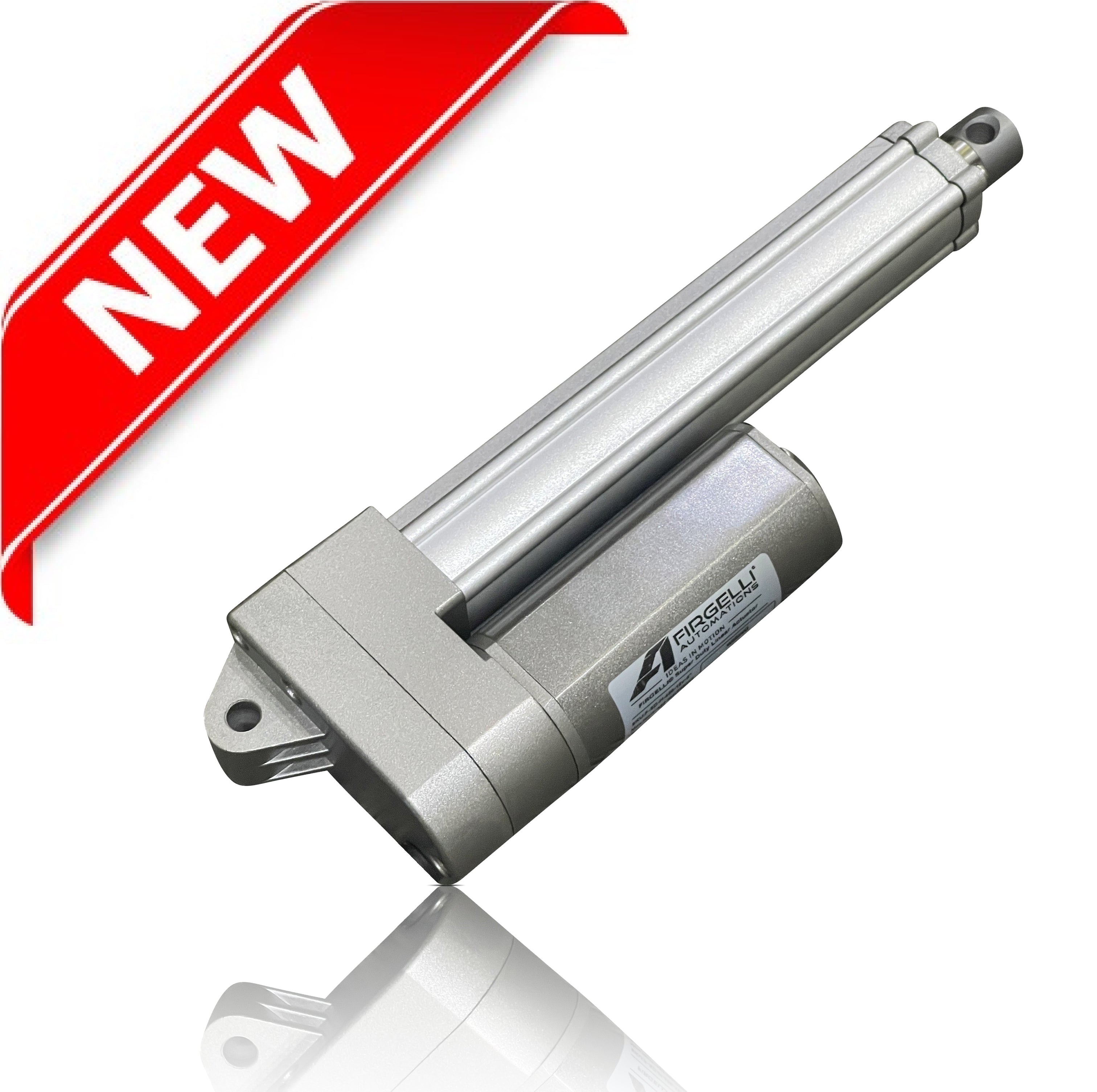
Super Duty Electric Linear Actuator
Use this when you need more stroke, force, and speed options. Built-in feedback can work with the FCB-2, but you can still run basic extend/retract motion with a regular rocker or toggle switch.
View Super Duty Actuators
Utility Linear Actuator
Use this for smaller chute deflectors, covers, and compact winter equipment. It is compact and quiet, with built-in feedback available for FCB-2 control when you need it.
View Utility ActuatorsFor basic 2-wire control, use a 2-wire toggle switch or another option from the FIRGELLI switches collection.
What should you check before ordering?
- Mechanism type: vertical deflector, horizontal blade angle, rotation linkage, or lift door
- Moving weight or estimated side load
- Pivot distance to load
- Pivot distance to actuator mount
- Worst actuator angle
- Required stroke
- Available mounting space
- Current draw, switch rating, fuse, and wire length
- Exposure to salt, slush, ice, and vibration
- Mechanical stops at both ends of travel
Frequently Asked Questions
Can a linear actuator replace hydraulics on a snow plow?
Sometimes, but only for the right job. Electric actuators work well for position control, light blade angle systems, chute deflectors, and small adjustments. Hydraulics still make sense for high-force lift and high-impact commercial plow work.
Can I use hatch calculator math for a snow plow blade?
No. A hatch lifts upward around a hinge, so gravity creates the main torque. A plow blade angles horizontally around a pivot. Side load and blade leverage create the force. Use horizontal pivot math for blade angle systems.
Do I need actuator feedback for snow equipment?
No. Feedback helps when you need preset positions, FCB-2 control, synchronization, or repeatable stops. A simple chute deflector or blade angle mechanism can use a 2-wire actuator with a rocker or toggle switch if full extend and retract positions work.
What usually kills actuators on snow equipment?
Side load, impact load, water ingress, salt, undersized wiring, and frozen mechanisms cause most failures. The actuator should push and pull straight along its rod. Brackets, pivots, stops, and the plow frame should take side and impact loads.
Where should the fuse go?
Put the fuse close to the battery or power source. That protects the wire run if insulation rubs through or a connector shorts. A fuse near the actuator protects less of the circuit and leaves more wire exposed to fault current.


