Picking the wrong cutoff frequency — or the wrong R and C values — can easily mess up a sensor signal, create aliasing in an ADC setup, or let power rail noise slide by untouched. The calculator below helps you figure out cutoff frequency, capacitance, resistance, or full frequency response using any combination of the values you have. It covers both low-pass and high-pass setups—useful for audio crossovers, anti-aliasing in data acquisition, or filtering out noise in biomedical gear. You’ll find the basic equations, a worked example for an anti-aliasing filter, a plain-language breakdown, and a FAQ with practical detail.
What is an RC Filter?
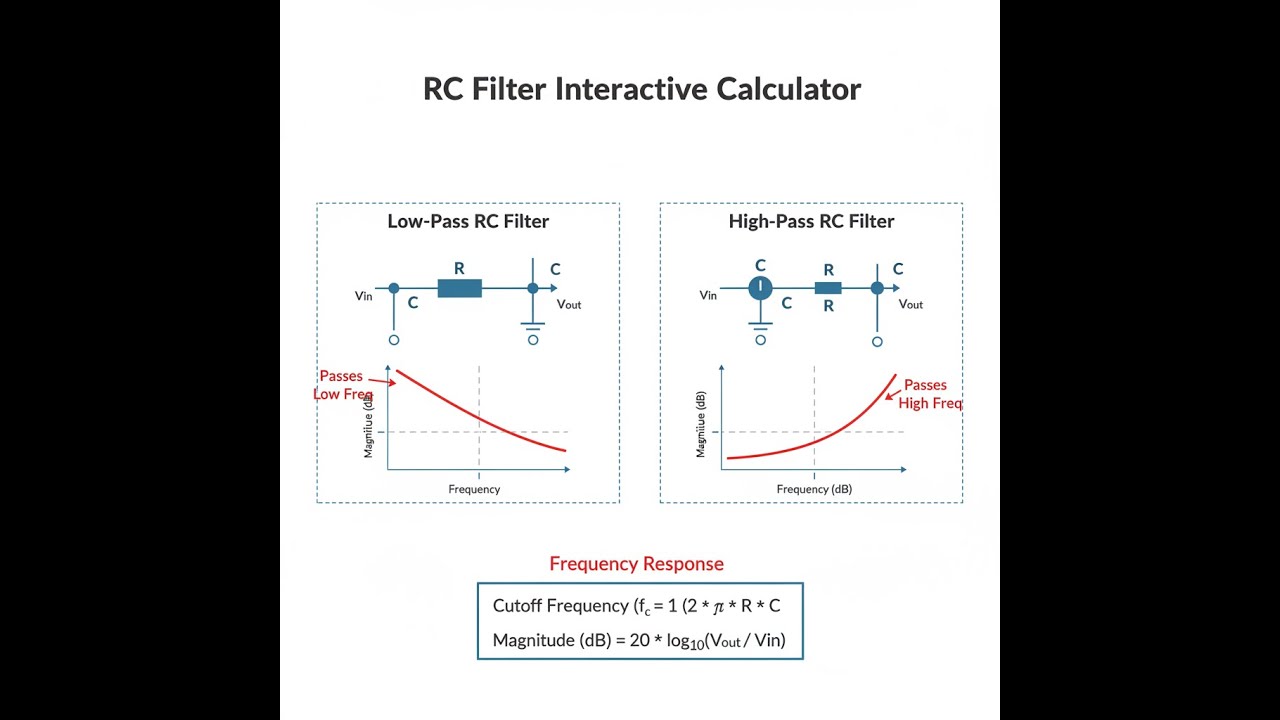
An RC filter is just a resistor and a capacitor hooked up to pass some frequencies and block others. How you connect them decides if low or high frequencies get through. Set it up one way and you get low-pass (lets low frequencies through, blocks highs); flip the configuration, and you have a high-pass (lets highs through, blocks lows).
Simple Explanation
Picture an RC filter as a gate that reacts to how fast the signal changes. A low-pass RC filter acts like a slow gate: slow signals get through easily, while faster changes are damped. The resistor and capacitor values set how “slow” or “fast” this gate reacts—this is your cutoff frequency.
📐 Browse all 1000+ Interactive Calculators
RC Filter Circuit Diagram

How to Use This Calculator
- Pick your filter type and what you want to solve for—cutoff frequency, capacitance, resistance, or frequency response. Choose low-pass or high-pass depending on your scenario.
- Fill in the known values. Depending on your selection, that's resistance (Ω), capacitance (F), cutoff frequency (Hz), or whatever the mode asks for.
- If you’re stuck for values, the Try Example button loads a typical set for you.
- Click Calculate to get your result.
RC Filter Interactive Calculator
This calculator is intended for education, concept evaluation, and preliminary design. Results are based on the equations and assumptions described on this page, but cannot account for every real-world load case, tolerance, material property, environmental condition, installation detail, safety factor, code, or regulatory requirement. Verify all inputs, assumptions, units, and results independently before selecting components or using the result in a real application. Safety-critical, structural, medical, lifting, transportation, or regulated applications must be reviewed by a qualified engineer.
Questions about this calculator or found an error? Message our engineering team.
RC Filter Interactive Visualizer
Adjust resistance and capacitance and see their impact on RC filter frequency response instantly. As you change values, you’ll see the cutoff move and spot how much sharper low-pass and high-pass settings behave.
CUTOFF FREQ
15.9 Hz
GAIN
0.707
PHASE
-45°
FIRGELLI Automations — Interactive Engineering Calculators
RC Filter Equations
Use this equation for the cutoff frequency of a basic RC filter.
Cutoff Frequency
fc = 1 / (2πRC)
Where:
fc = cutoff frequency (Hz)
R = resistance (Ω)
C = capacitance (F)
π ≈ 3.14159
Angular Cutoff Frequency
ωc = 2πfc = 1 / (RC)
Where:
ωc = angular cutoff frequency (rad/s)
Time Constant
τ = RC
Where:
τ = time constant (seconds)
This represents the time for the output to reach 63.2% of its final value
Low-Pass Filter Transfer Function
H(jω) = 1 / √(1 + (ω/ωc)2)
Where:
H(jω) = voltage gain magnitude at frequency ω
ω = operating angular frequency (rad/s)
High-Pass Filter Transfer Function
H(jω) = (ω/ωc) / √(1 + (ω/ωc)2)
Where:
H(jω) = voltage gain magnitude at frequency ω
Attenuation in Decibels
AdB = 20 log10(|H(jω)|)
Where:
AdB = attenuation in decibels (dB)
At fc, low-pass and high-pass filters have -3.01 dB attenuation
Phase Shift
φLP = -arctan(ωRC)
—HP = 90° - arctan(ωRC)
Where:
φ = phase shift in degrees
LP = low-pass filter, HP = high-pass filter
Simple Example
If you want a low-pass filter with R = 10,000 Ω and C = 1 μF (0.000001 F):
- fc = 1 / (2π × 10,000 × 0.000001) = 15.92 Hz
- Time constant τ = 10,000 × 0.000001 = 10 ms
- At fc, gain = 0.707 (–3.01 dB), phase shift = –45°
Theory & Practical Applications of RC Filters
Fundamental Operating Principles
RC filters work because a capacitor's impedance changes with frequency: lower at higher frequencies, higher at slower ones. This lets you shape the response to pass or reject frequencies. First-order RC filters don't sharply cut off—they roll off at 20 dB per decade (6 dB per octave) beyond the cutoff. Sometimes that slope helps keep things simple; sometimes it's not enough. The cutoff point—where R and the capacitive reactance match—creates a 45° phase shift and voltage drops to about 0.707 of the input. That’s less about a mystical number, more about where energy storage and dissipation start to balance. Phase shift isn’t academic: if you're building audio or control systems, it can matter as much as amplitude cutoff.
Low-Pass Filter Applications and Non-Obvious Limitations
Low-pass RC filters are often the first thing tried for anti-aliasing before ADCs. But a single RC roll-off is slow—20 dB/decade isn't nearly enough unless you sample slow, use a really low cutoff, or tolerate some aliasing in your noise floor. For decent ADC performance (say 12 bits), you need around 72 dB of attenuation above Nyquist to keep quantization clean. With a single RC, that means placing your cutoff frequency decades below your target stopband—often a non-starter. You can cascade stages for more rolloff, but each RC adds phase distortion and worsens tolerance stacking. For sharp cutoff, use a multi-pole active filter.
Filtering power rails with RCs can be tricky at high frequencies. Above about 10 MHz, real ceramic caps act more like inductors thanks to lead and internal inductance. There's a self-resonance point (fres = 1/(2π√(LC))) where impedance hits a minimum, then rises above it—meaning your "filter capacitor" can amplify noise rather than suppress it at those frequencies. Really solving a power integrity problem takes a spread of cap values placed close to chips, not just a single RC calculation.
High-Pass Filter Applications in AC Coupling and Signal Conditioning
High-pass RC filters are a go-to for stripping off DC and low drift—especially on sensor lines. Bioelectric instruments, like ECG or EEG systems, need high-pass cutoffs down near 0.1 Hz to clear baseline wander but pass the main signal band. The RC time constant sets how fast signals settle after, say, a step or power-up event. For a 0.1 Hz cutoff, your time constant is about 1.6 seconds, and you'll wait several seconds for things to settle after a big voltage step. That can lead to annoying startup wait times if you're too aggressive with low-frequency rejection.
With audio, high-pass coupling caps and the source's output resistance determine where the bass rolls off. If you design for 10 Hz with a 10 kΩ resistor and 1.59 μF cap, but your source is a 150 Ω mic, you'll actually get a slightly lower cutoff. Small shifts add up across several stages and can change how bass is handled, especially in pro audio.
Worked Example: Anti-Aliasing Filter Design for Industrial Temperature Monitoring
Problem: Design a low-pass RC anti-aliasing filter for a thermocouple-based temperature monitoring system with the following specifications:
- 16-bit ADC with 1 kHz sample rate (Nyquist frequency = 500 Hz)
- Thermocouple signal bandwidth: DC to 2 Hz (thermal time constant dominated)
- Desired stopband attenuation at Nyquist frequency: ≥80 dB to prevent corruption of 16-bit resolution
- Input impedance requirement: R ≥ 100 kΩ to avoid loading the high-impedance thermocouple
- Standard E12 capacitor values available
Part A: Determine Required Filter Order
One RC stage gives just 20 dB/decade. For 80 dB attenuation, you need:
Number of decades = 80 dB / (20 dB/decade) = 4 decades
Required frequency ratio = 104 = 10,000
If we place the cutoff frequency at fc, the stopband frequency would be:
fstop = fc × 10,000 = 500 Hz (Nyquist frequency)
Therefore: fc = 500 Hz / 10,000 = 0.05 Hz
This cutoff is far below our signal bandwidth of 2 Hz, which would cause unacceptable signal attenuation. A single-stage filter is insufficient. Let's cascade two identical RC stages to achieve 40 dB/decade rolloff:
Number of decades = 80 dB / (40 dB/decade) = 2 decades
Required frequency ratio = 102 = 100
fc = 500 Hz / 100 = 5 Hz
At our maximum signal frequency of 2 Hz, the two-stage filter attenuation is:
Frequency ratio = 5 Hz / 2 Hz = 2.5
Single-stage attenuation = 20 log10(1/√(1 + 2.5²)) = 20 log10(0.371) = -8.6 dB
Two-stage attenuation = 2 × (-8.6 dB) = -17.2 dB (passband droop of 13.7%)
This is marginally acceptable for slow-changing temperature signals. A professional design would use a third-order Butterworth active filter, but we'll proceed with the two-stage RC approach for this example.
Part B: Component Selection for First Stage
Using the cutoff frequency equation:
C = 1 / (2πRfc)
With R1 = 100 kΩ (minimum value to avoid loading):
C1 = 1 / (2π × 100,000 Ω × 5 Hz)
C1 = 1 / (3,141,593) = 3.18 × 10⁻⁷ F = 0.318 μF
Nearest E12 value: 0.33 μF (chosen to err on the side of slightly lower cutoff)
Actual cutoff with 0.33 μF:
fc1 = 1 / (2π × 100,000 × 0.33 × 10-6) = 4.82 Hz
Part C: Second Stage Design with Buffering Consideration
Cascading two RC stages without buffering causes the second stage to load the first, shifting both cutoff frequencies. The combined response is NOT simply the product of individual responses. For accurate two-pole behavior, we need an op-amp voltage follower between stages. Assuming this buffer is present:
For the second stage, we can use identical values:
R2 = 100 kΩ, C2 = 0.33 μF, fc2 = 4.82 Hz
Part D: Verification at Nyquist Frequency
At f = 500 Hz, each stage has frequency ratio:
ω/ωc = 500 / 4.82 = 103.7
Single-stage response: |H| = 1/√(1 + 103.7²) = 1/√10,754 = 0.00964
Two-stage response: |Htotal| = (0.00964)² = 9.29 × 10⁻⁵
Attenuation in dB: 20 log10(9.29 × 10⁻⁵) = -80.6 dB ✓
Part E: Time Constant and Settling Behavior
Time constant for each stage:
τ = R × C = 100,000 Ω × 0.33 × 10-6 F = 0.033 seconds = 33 milliseconds
For a two-stage system, the overall settling time to 99% of final value is approximately:
tsettle ≈ 7τ = 7 × 33 ms = 231 milliseconds
This settling time is acceptable for temperature monitoring applications where thermal response times are on the order of seconds to minutes.
Part F: Practical Implementation Considerations
Component tolerance analysis: With 5% resistors and 10% capacitors, the worst-case cutoff frequency range is:
fc,min = 1 / (2π × 105,000 × 0.363 × 10-6) = 4.17 Hz
fc,max = 1 / (2π × 95,000 × 0.297 × 10-6) = 5.63 Hz
This ±17% variation is acceptable for anti-aliasing applications. For more critical filtering requirements, 1% metal film resistors and 5% film capacitors would be specified.
Impedance Considerations and Source/Load Interactions
Filter input and output impedance matter a lot in real use. For a typical low-pass RC, the input impedance looking into the resistor is just R at DC; the output impedance seen from the cap node depends on frequency. At DC, output impedance is basically zero (an ideal cap looks like an open circuit at DC, tying you to ground); at high frequencies, it climbs to R. At cutoff, output impedance is R/2. If the load resistance isn’t at least 10× the filter resistor, your filter performance may shift significantly.
For high-pass RC, input impedance is very high at low frequencies (blocked by the capacitor), and drops toward R as frequency increases. Output impedance for high-pass is R at all frequencies. That means high-pass RC is less sensitive to variations at the load end, but more sensitive to what's driving it. In more demanding applications, buffer each RC stage with an op-amp, or use active filter topologies to keep impedances under control.
For more complex filtering scenarios, check the engineering calculator library for active filter, impedance matching, and frequency response calculators.
Temperature Coefficient Effects in Precision Applications
Capacitor values move with temperature, sometimes a lot. Most ceramics (X7R, Y5V) drift from -750 ppm/°C to +15,000 ppm/°C. For an X7R across -40°C to +85°C, the value can swing almost 10%. Add resistor TC (carbon films: ±350 ppm/°C) and you’re looking at possible 12% cutoff shift over that range. If you need tighter specs, C0G/NP0 ceramic or polypropylene capacitors, paired with metal film resistors, hold values much steadier as temperature changes.
Frequently Asked Questions
Free Engineering Calculators
Explore our complete library of free engineering and physics calculators.
Browse All Calculators →🔗 Explore More Free Engineering Calculators
- Low-Pass RC Filter Calculator — Cutoff Frequency
- LED Resistor Calculator — Current Limiting
- I2C/SPI Bus Speed & Pull-up Resistor Sizing
- Capacitor Charge Discharge Calculator — RC Circuit
- High Pass Filter Calculator
- Lc Filter Calculator
- Free Space Path Loss Calculator
- Transformer Turns Ratio Calculator
- Voltage Divider & ADC Resolution Calculator
- Ohm's Law Calculator — V I R P
About the Author
Robbie Dickson — Chief Engineer & Founder, FIRGELLI Automations
Robbie Dickson brings over two decades of engineering expertise to FIRGELLI Automations. With a distinguished career at Rolls-Royce, BMW, and Ford, he has deep expertise in mechanical systems, actuator technology, and precision engineering.
Video Walkthrough - How to Use This Calculator
Need to implement these calculations?
Explore the precision-engineered motion control solutions used by top engineers.


