Radiation exposure isn’t just paperwork—it’s about making sure your procedures or designs don’t put people at unnecessary risk. If you need to convert between rem and sievert, or calculate biological dose equivalent using absorbed dose and quality factors, this Radiation Dose Rem Sv Calculator gets it done. You’ll use these numbers in fields like nuclear medicine, radiography, power plants, or any job that involves shielding from ionizing radiation. Here you’ll find the essential formulas, a worked sample, plain explanations of dose quantities, and answers to the practical questions engineers usually run into.
What is Radiation Dose Equivalent?
Radiation dose equivalent is a measure of how much biological harm ionizing radiation causes to human tissue. It combines the raw energy deposited in tissue with a weighting factor that reflects how damaging a particular type of radiation is — so you get a single number that represents actual health risk, not just physical energy.
Simple Explanation
Think of absorbed dose as the raw energy hitting your body — like the wattage of a heater. But not all radiation "heats" your cells the same way: alpha particles punch holes in DNA far more aggressively than X-rays, even at the same energy level. Dose equivalent adjusts for that difference, so you can compare apples to apples when assessing radiation risk from different sources.
📐 Browse all 1000+ Interactive Calculators
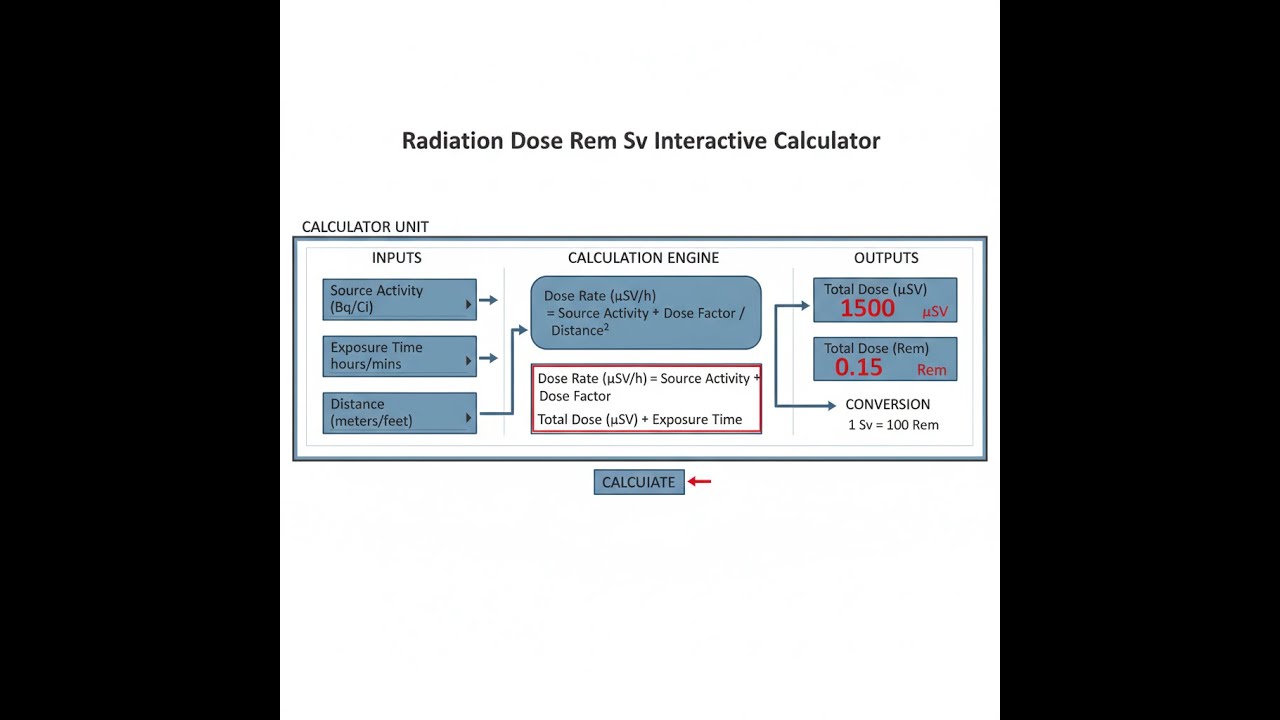
Diagram

Radiation Dose Calculator
How to Use This Calculator
- Select a calculation mode from the dropdown — choose from unit conversion, dose equivalent, effective dose, absorbed dose, or annual limit assessment.
- Enter the required input values for your chosen mode — absorbed dose in Gy, dose in rem or Sv, equivalent dose, or annual dose in mSv.
- Where applicable, select the radiation type or tissue/organ from the dropdown to apply the correct weighting factor.
- Click Calculate to see your result.
This calculator is intended for education, concept evaluation, and preliminary design. Results are based on the equations and assumptions described on this page, but cannot account for every real-world load case, tolerance, material property, environmental condition, installation detail, safety factor, code, or regulatory requirement. Verify all inputs, assumptions, units, and results independently before selecting components or using the result in a real application. Safety-critical, structural, medical, lifting, transportation, or regulated applications must be reviewed by a qualified engineer.
Questions about this calculator or found an error? Message our engineering team.
Radiation Dose Interactive Visualizer
Watch how different radiation types and doses translate into biological risk through real-time unit conversion and weighting factor visualization. Adjust absorbed dose and radiation type to see immediate changes in dose equivalent and safety thresholds.
DOSE EQUIVALENT
40.0 Sv
IN REM UNITS
4,000 rem
SAFETY LEVEL
EXTREME
FIRGELLI Automations — Interactive Engineering Calculators
Equations
Use the formula below to calculate radiation dose unit conversions.
Unit Conversion
1 Sv = 100 rem
1 rem = 0.01 Sv = 10 mSv
where:
Sv = Sievert (SI unit of dose equivalent)
rem = Roentgen equivalent man (traditional unit)
mSv = millisievert (10-3 Sv)
Use the formula below to calculate dose equivalent from absorbed dose.
Dose Equivalent
H = D × wR
where:
H = dose equivalent (Sv or rem)
D = absorbed dose (Gy or rad)
wR = radiation weighting factor (dimensionless)
Use the formula below to calculate effective dose across multiple tissues.
Effective Dose
E = Σ (HT × wT)
where:
E = effective dose (Sv)
HT = equivalent dose to tissue T (Sv)
wT = tissue weighting factor for tissue T (dimensionless)
Σ = summation over all tissues
Use the formula below to calculate absorbed dose from dose equivalent.
Absorbed Dose
D = H / wR
where:
D = absorbed dose (Gy)
H = dose equivalent (Sv)
1 Gy = 100 rad
1 rad = 0.01 Gy
Radiation Weighting Factors (wR)
| Radiation Type | wR |
|---|---|
| X-rays, gamma rays, electrons | 1 |
| Protons, charged pions | 2 |
| Neutrons (energy dependent) | 5-20 |
| Alpha particles, fission fragments | 20 |
Simple Example
Mode: Dose Equivalent (H = D × wR)
Absorbed dose: 2 Gy
Radiation type: Alpha particles (wR = 20)
Dose equivalent: 2 × 20 = 40 Sv
In rem: 40 × 100 = 4,000 rem
Theory & Engineering Applications
Radiation dosimetry represents one of the most critical intersections of physics, biology, and regulatory science. The quantification of radiation dose equivalent bridges the gap between physical energy deposition in tissue and the biological harm that results from ionizing radiation exposure. Understanding the distinctions between absorbed dose, equivalent dose, and effective dose is essential for radiation protection, medical applications, nuclear facility operations, and emergency response planning.
Fundamental Dose Quantities
Absorbed dose (D) measures the fundamental physical quantity: energy deposited per unit mass of material. Expressed in Gray (Gy) in SI units or rad in traditional units (1 Gy = 100 rad), absorbed dose represents joules per kilogram and forms the foundation for all subsequent dose calculations. However, absorbed dose alone fails to account for the varying biological effectiveness of different radiation types.
Different radiation types produce dramatically different biological effects even when depositing identical amounts of energy. A 1 Gy dose of alpha particles causes approximately twenty times more biological damage than 1 Gy of gamma rays due to differences in linear energy transfer (LET). High-LET radiation like alpha particles and neutrons deposits energy in dense, localized ionization tracks that produce complex, difficult-to-repair DNA damage. Low-LET radiation like X-rays and gamma rays creates more widely spaced ionization events that result in simpler, more readily repairable lesions.
Dose equivalent (H) incorporates this biological variation through the radiation weighting factor wR, which scales absorbed dose according to radiation type: H = D × wR. The International Commission on Radiological Protection (ICRP) establishes wR values based on extensive radiobiological research, epidemiological studies of radiation-exposed populations, and microdosimetric modeling. For photons and electrons, wR = 1 serves as the reference. Protons receive wR = 2, reflecting their slightly higher biological effectiveness. Neutron wR values range from 5 to 20 depending on energy, with maximum values occurring around 1 MeV where neutron interactions with tissue produce maximum ionization density. Alpha particles and heavy ions receive wR = 20, acknowledging their devastating localized damage potential.
Effective Dose and Tissue Sensitivity
Effective dose (E) extends dose equivalent by incorporating tissue-specific radiosensitivity through tissue weighting factors wT. Not all organs respond equally to radiation: bone marrow, lungs, stomach, and colon show high sensitivity due to rapid cell division rates, while bone surface, skin, and brain exhibit lower sensitivity. The effective dose calculation sums contributions from all irradiated tissues: E = Σ (HT × wT), where the tissue weighting factors sum to unity across the entire body.
This approach enables meaningful comparison of partial-body exposures with different geometries. A 10 mSv thyroid dose (wT = 0.04) contributes 0.4 mSv to effective dose, while the same equivalent dose to lung tissue (wT = 0.12) contributes 1.2 mSv—reflecting lung tissue's three-fold greater cancer risk per unit dose. Medical physicists use effective dose to optimize imaging protocols, balancing diagnostic benefit against stochastic risk, while radiation protection professionals use it to demonstrate ALARA compliance and manage occupational exposure.
One crucial but often overlooked aspect: effective dose calculations assume uniform exposure conditions and cannot be accurately applied to highly non-uniform exposures or acute high-dose scenarios where deterministic effects dominate. The linear no-threshold (LNT) model underpinning effective dose calculations remains valid for low-dose chronic exposures but breaks down above approximately 100 mSv where tissue reactions and acute radiation syndrome risks emerge.
Unit Conventions and Historical Context
The rem (roentgen equivalent man) dominated radiation protection from the 1940s through the 1980s, when international standardization efforts promoted SI units. The Sievert, adopted in 1977 and named for Swedish medical physicist Rolf Sievert, equals exactly 100 rem. Despite decades of SI adoption, the rem persists in United States regulations, legacy equipment, and emergency response procedures. Radiation workers must maintain fluency in both systems: regulatory dose limits appear as 5 rem/year in Title 10 CFR Part 20 while the same limit appears as 50 mSv/year in international standards.
Practical dosimetry often employs submultiples: millisievert (mSv = 10-3 Sv) for occupational and environmental doses, microsievert (μSv = 10-6 Sv) for background and medical imaging, millirem (mrem = 10-3 rem) in U.S. contexts. A typical chest X-ray delivers approximately 0.1 mSv (10 mrem), annual natural background radiation totals 2-3 mSv (200-300 mrem), and occupational limits permit 50 mSv (5 rem) per year under controlled conditions.
Worked Example: Nuclear Medicine Technologist Exposure Assessment
Consider a nuclear medicine technologist who administers technetium-99m radiopharmaceuticals. During a particularly busy shift handling 25 patient doses, her electronic personal dosimeter (EPD) records an absorbed dose of 0.0047 Gy to her hands and 0.00018 Gy to her torso from scattered gamma radiation.
Given:
- Hand absorbed dose: Dhand = 0.0047 Gy
- Torso absorbed dose: Dtorso = 0.00018 Gy
- Radiation type: Tc-99m gamma rays (140.5 keV photons, wR = 1)
- Primary exposed tissues: Skin (hands), remainder organs (torso)
- Tissue weighting factors: wT,skin = 0.01, wT,remainder = 0.12
Calculate: Hand equivalent dose, torso equivalent dose, total effective dose, annual projection, and regulatory compliance status.
Solution:
Step 1: Calculate equivalent doses
For photon radiation with wR = 1:
Hhand = Dhand × wR = 0.0047 Gy × 1 = 0.0047 Sv = 4.7 mSv
Htorso = Dtorso × wR = 0.00018 Gy × 1 = 0.00018 Sv = 0.18 mSv
Step 2: Calculate tissue contributions to effective dose
Ehand = Hhand × wT,skin = 4.7 mSv × 0.01 = 0.047 mSv
Etorso = Htorso × wT,remainder = 0.18 mSv × 0.12 = 0.0216 mSv
Step 3: Calculate total effective dose for the shift
Etotal = Ehand + Etorso = 0.047 + 0.0216 = 0.0686 mSv
Converting to traditional units: 0.0686 mSv × 100 = 6.86 mrem per shift
Step 4: Project annual exposure
Assuming 240 working days per year (48 weeks × 5 days):
Eannual = 0.0686 mSv/shift × 240 shifts = 16.46 mSv/year
In traditional units: 16.46 mSv × 100 = 1,646 mrem/year or 1.646 rem/year
Step 5: Regulatory compliance assessment
Occupational dose limit: 50 mSv/year (5 rem/year) for total effective dose
Extremity limit: 500 mSv/year (50 rem/year) for hands and feet
Percentage of total effective dose limit: (16.46 / 50) × 100% = 32.9%
Percentage of extremity limit: (4.7 mSv/shift × 240) / 500 = (1,128 / 500) × 100% = 225.6% — EXCEEDS LIMIT
Step 6: ALARA analysis and corrective actions
The technologist's projected annual hand dose of 1,128 mSv (112.8 rem) exceeds the regulatory extremity limit by more than a factor of two. This analysis reveals inadequate hand shielding during dose preparation and administration. Required corrective actions include: implementing lead-glass syringe shields, utilizing remote handling tongs for vial manipulation, optimizing workflow to minimize hand-source proximity time, and providing additional dosimetry (ring badges) for accurate extremity monitoring. With proper shielding, hand doses typically reduce by 75-90%, bringing annual exposure well within limits while maintaining the same patient throughput.
This example demonstrates the critical importance of distinguishing between absorbed dose (energy deposition), equivalent dose (biological effectiveness), and effective dose (cancer risk). The technologist's torso receives far less absorbed dose than her hands, but both contribute to regulatory compliance evaluation through different pathways: extremity dose versus total effective dose. Real-world radiation protection requires continuous monitoring, trend analysis, and proactive intervention when exposure patterns indicate potential limit exceedances.
Applications Across Industries
Nuclear power operations rely on comprehensive dosimetry programs tracking worker exposures during maintenance outages, refueling operations, and routine surveillance. Reactor cavity diving, steam generator tube inspections, and control rod drive mechanism maintenance can deliver significant doses despite extensive shielding and time controls. Outage planning software models dose accumulation using three-dimensional radiation field mapping, optimizing task sequences to maintain cumulative doses below administrative limits typically set at 10-20% of regulatory maximums.
Medical applications span diagnostic radiology, interventional procedures, and radiation therapy. Fluoroscopy-guided interventional cardiologists and radiologists receive among the highest occupational doses in medicine, with procedures potentially delivering 0.1-1.0 mSv per case to the operator despite lead aprons. Cumulative effective doses for high-volume interventionalists can approach 5-10 mSv annually, necessitating real-time dosimetry, leaded eyewear for lens protection, and suspended lead shields. Radiation therapy facilities manage both patient therapeutic doses (measured in Gray, typically 40-70 Gy total) and minimized staff exposures through comprehensive shielding, interlocks, and rigorous procedures.
Industrial radiography for pipeline inspection, structural weld verification, and quality control uses high-activity gamma sources (iridium-192, cobalt-60) or X-ray generators producing intense radiation fields. Radiographers work with dose rates exceeding 1 Sv/hour at one meter from unshielded sources, making equipment malfunctions or procedural violations potentially catastrophic. Survey meters, alarming dosimeters, and strict adherence to exclusion zone protocols prevent accidental exposures while routine doses remain modest—typically under 5 mSv annually for experienced technicians.
Research facilities using particle accelerators, reactor facilities, and radioactive materials balance scientific productivity against exposure management. Accelerator operations produce mixed neutron-photon fields requiring sophisticated spectroscopy for accurate dose assessment. Neutron doses prove particularly challenging due to energy-dependent weighting factors and difficulty in measurement—tissue-equivalent proportional counters and Bonner sphere spectrometers provide detailed characterization but require expert interpretation.
For additional radiation safety calculations and dose assessment tools, explore the complete collection at FIRGELLI's engineering calculator library, featuring specialized calculators for shielding design, decay calculations, and contamination assessment.
Practical Applications
Scenario: Hospital Radiation Safety Officer Annual Compliance Review
Dr. Martinez, the radiation safety officer at a 400-bed teaching hospital, reviews annual dosimetry reports for 147 radiation workers across radiology, nuclear medicine, and radiation oncology departments. One interventional cardiologist's badge reading shows 38.7 mSv for the year—concerning because it represents 77% of the 50 mSv annual limit. She uses this calculator to convert the dose to 3,870 mrem for the hospital's legacy radiation safety committee reports, compare it against departmental averages (typically 8-12 mSv for interventionalists), and identify this physician for immediate counseling on technique optimization and shielding utilization. The calculator's annual limit assessment mode confirms the cardiologist can receive only 11.3 mSv more before triggering a regulatory investigation. Dr. Martinez implements additional oversight including real-time dosimetry during procedures, peer observation of radiation safety practices, and mandatory review of the ALARA principle in her next quarterly safety meeting. By catching this trend with nine months of data, she prevents a potential regulatory limit exceedance and reduces both the physician's cancer risk and the hospital's liability exposure.
Scenario: Nuclear Power Plant Emergency Response Coordinator
James, an emergency response coordinator at a pressurized water reactor facility, receives notification that a criticality alarm has activated in the spent fuel pool area during routine maintenance. Three workers were present: two maintenance technicians at 25 meters who received estimated absorbed doses of 0.0012 Gy and 0.0015 Gy, and a health physics technician at 8 meters who received 0.0085 Gy, all from mixed neutron-gamma radiation. James immediately opens this calculator and determines the equivalent doses using a conservative neutron weighting factor of 10 (assuming 1 MeV neutrons) combined with the gamma component (wR = 1). For the health physics technician, assuming 70% neutron and 30% gamma composition: H = (0.0085 × 0.7 × 10) + (0.0085 × 0.3 × 1) = 0.0595 + 0.00255 = 0.06205 Sv or 62.05 mSv (6.205 rem). This single event consumed 124% of the technician's annual allowance, triggering immediate medical evaluation, temporary reassignment from radiation areas, and a comprehensive incident investigation. The calculator's conversion features let James rapidly communicate doses to medical staff (who prefer mSv), regulators (who use rem in the U.S.), and international assistance teams (who use Sv exclusively). The two maintenance workers received 13.6 mSv and 16.95 mSv respectively—significant but within annual limits—allowing them to continue essential recovery operations after medical clearance.
Scenario: Aerospace Engineer Calculating Crew Radiation During Deep Space Mission
Elena, a space radiation physicist at NASA, designs radiation shielding for a proposed Mars mission. During the 8-month transit through interplanetary space, astronauts face continuous exposure to galactic cosmic rays (GCR) consisting of high-energy protons (85%), alpha particles (12%), and heavy ions (3%). Based on radiation transport simulations through the spacecraft hull, she calculates that crew members behind 20 g/cm² aluminum shielding will accumulate absorbed doses of: 0.145 Gy from protons, 0.021 Gy from alphas, and 0.008 Gy from heavy ions. Using the calculator's dose equivalent mode with appropriate radiation weighting factors—wR = 5 for the proton-dominated field (accounting for their elevated biological effectiveness at space radiation energies), wR = 20 for alphas, and wR = 20 for heavy ions—she determines total mission dose equivalent: H = (0.145 × 5) + (0.021 × 20) + (0.008 × 20) = 0.725 + 0.42 + 0.16 = 1.305 Sv or 130.5 rem. This exceeds NASA's career limit for a 35-year-old female astronaut (0.6 Sv for 3% lifetime excess cancer mortality), requiring Elena to redesign the habitat with enhanced polyethylene shielding that reduces the total mission dose to 0.54 Sv—just within acceptable limits. The calculator's flexibility with different radiation types and weighting factors proves essential for this complex mixed-field exposure scenario where simplified conversion factors would dangerously underestimate risk.
Frequently Asked Questions
Why do we use different radiation units (rem vs Sievert) and when should I use each? +
What's the difference between absorbed dose, equivalent dose, and effective dose? +
How do radiation weighting factors account for different types of ionizing radiation? +
What radiation dose levels are considered safe, dangerous, or immediately life-threatening? +
How does tissue weighting factor selection affect effective dose calculations in medical imaging? +
Why do neutron exposures require special consideration in dose calculations? +
Free Engineering Calculators
Explore our complete library of free engineering and physics calculators.
Browse All Calculators →🔗 Explore More Free Engineering Calculators
About the Author
Robbie Dickson — Chief Engineer & Founder, FIRGELLI Automations
Robbie Dickson brings over two decades of engineering expertise to FIRGELLI Automations. With a distinguished career at Rolls-Royce, BMW, and Ford, he has deep expertise in mechanical systems, actuator technology, and precision engineering.
Video Walkthrough - How to Use This Calculator
Need to implement these calculations?
Explore the precision-engineered motion control solutions used by top engineers.


