How long can an actuator run on a 12V car battery?
When designing off-grid automation systems, mobile installations, or emergency backup mechanisms, one critical question emerges: how long will a linear actuator operate on a standard 12V car battery? Whether you're building a solar-powered hatch opener, designing an RV slide-out system, or creating a battery-powered access control mechanism, understanding the relationship between actuator current draw and battery capacity is essential for reliable operation.
🎥 Video — How Long Can an Actuator Last on a 12V Car Battery?
Measure the hard part of travel, not the easy middle — practical constraints matter more than catalog numbers.
"Battery runtime calculations using nameplate current are almost always optimistic. The actuator draws what the load demands — a unit rated at 4 A no-load can pull 6 A or more under real working force, and that's the number you size the battery against." — Robbie Dickson, Founder and Chief Engineer of FIRGELLI Automations
Engineering principle: size the battery for the loaded current, not the catalog current. The hard part of the stroke — the moment of peak force — sets the draw, and the duty cycle sets how long you can sustain it.
The answer depends on three fundamental variables: the battery's amp-hour capacity, the actuator's current consumption under load, and the duty cycle of your application. A typical automotive battery rated at 50 Ah can theoretically deliver substantial runtime, but the actual performance varies dramatically based on actuator specifications, load conditions, and stroke requirements. In this comprehensive guide, we'll walk through the engineering calculations, examine real-world factors that affect performance, and provide practical tools to estimate runtime for your specific application.
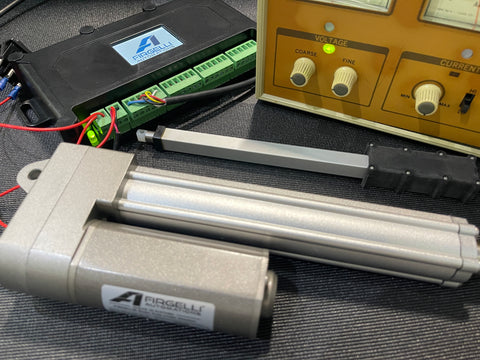
Using a FIRGELLI Utility model actuator with a 6-inch stroke as our reference example—drawing approximately 4A while exerting 100 lbs of force—we'll demonstrate how to calculate expected battery lifespan, discuss optimization strategies, and explore supplementary power solutions like solar integration for extended operation.
How do you calculate battery capacity for an actuator?
The operational duration of any electric linear actuator on a 12V battery is governed by a straightforward relationship between amp-hour capacity and current draw. A battery's capacity, measured in ampere-hours (Ah), indicates how much current it can supply over a specific period. A 50 Ah battery can theoretically deliver 1 amp for 50 hours, 5 amps for 10 hours, or 50 amps for 1 hour—though real-world performance deviates from this linear relationship due to Peukert's law and discharge rate effects (Peukert's law, W. Peukert, 1897; characterized in IEC 60896 lead-acid battery standards).
For our example calculation, we'll use a standard automotive battery with 50 Ah capacity powering a Utility actuator drawing 4A under a 100 lb load. The basic formula for determining runtime is:
Battery Lifespan (hours) = Battery Capacity (Ah) / Current Drawn (A)
Applying this formula: 50 Ah / 4 A = 12.5 hours of continuous operation
Converting to seconds for stroke calculation: 12.5 hours × 3,600 seconds/hour = 45,000 seconds of total runtime
If a single 6-inch stroke takes 10 seconds to complete (typical for mid-speed actuators at 0.6 inches per second), we can calculate the number of complete extension and retraction cycles: 45,000 seconds / 10 seconds per stroke = 4,500 strokes before battery depletion.
This theoretical maximum represents continuous operation with no rest periods. In practical applications, actual performance will be influenced by factors including battery state of health, ambient temperature, discharge rate effects, and the actuator's duty cycle rating. Most industrial actuators specify a duty cycle (typically 10-25% for standard models, up to 100% for heavy-duty variants), which limits continuous operation time to prevent overheating.
What factors change an actuator's current draw?
The current consumption of an electric linear actuator is not constant—it varies significantly based on several operational parameters. Understanding these variables is crucial for accurate runtime calculations and system design.
Load Force and Current Consumption
Current draw increases proportionally with the mechanical load applied to the actuator. An actuator exerting its maximum rated force will draw substantially more current than one operating under light or no load. For example, a bullet actuator rated for 200 lbs might draw 2A at 50 lbs of load but 6A at 180 lbs. Always consult the manufacturer's current-versus-load graphs when calculating runtime for your specific application.
No-load current (the power consumed just moving the actuator's internal components) is typically 25-40% of the maximum current draw. This means applications with minimal resistance—such as opening lightweight panels or hatches—will achieve significantly longer battery life than those overcoming substantial resistance or lifting heavy loads.
| Applied Load | Approx. Current | % of Max Draw |
|---|---|---|
| No-load | 1.5–2.4 A | 25–40% |
| 50 lb | ~2 A | ~33% |
| 180 lb | ~6 A | 100% |
Example values for a 200 lb-rated bullet actuator operating at 12 V; consult your specific model's current-vs-load curve.
Speed and Stroke Length Impact
Faster actuators generally consume more current to achieve higher linear speeds. A high-speed model rated at 2 inches per second will typically draw more power than a slower 0.5 inches per second unit of equivalent force capacity. Additionally, stroke length directly impacts the total energy consumed per cycle: a 12-inch stroke takes twice as long to complete as a 6-inch stroke, consuming twice the total energy per extension-retraction cycle.
When calculating total strokes available, consider that the actuator consumes power during both extension and retraction. A complete cycle consists of extending the actuator fully and then retracting it to the starting position, effectively doubling the per-stroke energy consumption.
Temperature and Efficiency Effects
Ambient temperature significantly affects both battery capacity and actuator efficiency. Cold temperatures reduce effective battery capacity by 20-40%, while also increasing actuator friction and current requirements. Conversely, high temperatures can improve initial performance but may trigger thermal protection cutoffs in the actuator or accelerate battery self-discharge.
Interactive Battery Life Calculator
To simplify runtime calculations for your specific application, use our interactive calculator below. This tool accounts for your battery capacity, actuator current draw, and stroke length to estimate the number of complete cycles you can expect. Before using the calculator, refer to the product page of your specific actuator model to determine its current draw under your anticipated load conditions—these values are typically provided in performance graphs showing amperage versus force.
Actuator Battery Life Calculator
Battery Capacity (Ah):
Current Drawn by Actuator (A):
Stroke Length (inches):
Results:
Battery Lifespan: 12.5 hours (45,000 seconds)
Estimated Number of Strokes: 4,500
How do you extend battery runtime for an actuator?
Several practical approaches can extend the operational duration of actuators on battery power, making off-grid and mobile applications more viable.
How do you select the right actuator for battery operation?
Avoid over-specifying actuator force capacity. An actuator rated for 400 lbs operating at 100 lbs of load is less efficient than a 150 lb actuator operating near its optimal range. Smaller motors drawing less current when appropriately matched to application requirements will maximize battery runtime. Consider micro linear actuators for applications requiring minimal force—these compact units typically draw 1-2A, potentially tripling or quadrupling the number of cycles compared to larger models.
What duty cycle should you use for battery-powered actuators?
Most actuators are rated for intermittent operation with specific duty cycles (the percentage of time the actuator operates versus rests). A 20% duty cycle means for every 10 seconds of operation, the actuator should rest for 40 seconds. Adhering to these specifications prevents overheating and maintains efficiency, which indirectly preserves battery capacity by preventing excessive current draw from a hot, less-efficient motor.
How does position feedback reduce battery drain?
Installing feedback actuators with built-in position sensors allows your control system to stop the actuator precisely when the desired position is reached, rather than relying on time-based control or limit switches. This prevents the motor from stalling against mechanical stops while drawing maximum current—a common source of wasted battery capacity in simple on/off control schemes.
Which 12V battery type works best for actuators?
Not all 12V batteries perform identically. Deep-cycle batteries designed for sustained discharge (common in marine and RV applications) provide better performance and longevity when regularly discharged to 50% capacity compared to automotive starting batteries, which are optimized for brief high-current bursts. For frequent cycling applications, consider lithium iron phosphate (LiFePO4) batteries, which maintain voltage better throughout discharge and tolerate deeper discharge cycles without damage.
| Battery Type | Typical Depth of Discharge | Cycle Life | Best Use Case |
|---|---|---|---|
| Automotive starting | 10–20% | Low (shallow cycling only) | Engine starting; brief high-current bursts |
| Deep-cycle lead-acid (flooded) | ~50% | Moderate | RV/marine house bank, regular cycling |
| AGM deep-cycle | 50–60% | Moderate–high | Sealed installations, vibration environments |
| LiFePO4 | 80%+ | High (thousands of cycles) | Frequent cycling, cold weather, weight-sensitive |
How do you add solar panels to a battery-powered actuator system?
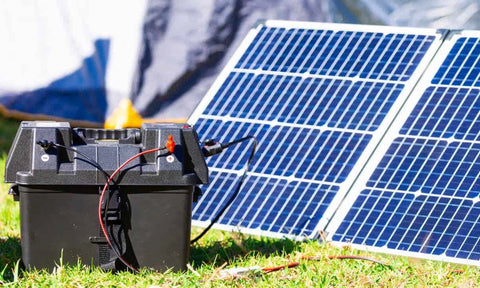
For applications requiring extended autonomous operation—such as remote gate operators, wildlife camera installations, or off-grid automation systems—integrating solar panels with battery storage creates a sustainable power solution that can operate indefinitely under appropriate conditions.
Sizing Solar Panels for Actuator Applications
To determine appropriate solar panel capacity, calculate the total amp-hours consumed per day by your actuator. If your application requires 50 strokes per day, with each cycle (extend and retract) lasting 20 seconds total and drawing 4A, the daily consumption is: (50 cycles × 20 seconds × 4A) / 3,600 seconds/hour = 1.11 Ah per day.
Accounting for charging inefficiencies, battery self-discharge, and reduced solar production during non-ideal conditions, multiply this figure by a factor of 3-4 to determine minimum solar panel output. In this example, a 5-10 watt panel would theoretically suffice, though a 20-30 watt panel provides better reliability across varying weather conditions and seasonal sunlight variations.
Implementing Proper Charge Control
Always use a solar charge controller between the panel and battery to prevent overcharging and regulate voltage. For 12V systems with moderate power requirements, a simple PWM (Pulse Width Modulation) controller suffices, though MPPT (Maximum Power Point Tracking) controllers extract 15-20% more energy from the panel—valuable for installations with limited solar exposure or larger actuator loads.
System Design Best Practices
When designing solar-powered actuator systems, consider seasonal variations in sunlight availability. A system that works flawlessly in summer may fail during winter months when day length decreases and sun angles lower. Panel orientation matters significantly—in the northern hemisphere, south-facing panels tilted at an angle approximately equal to your latitude maximize annual energy collection. For critical applications, oversizing the battery bank provides reserve capacity during extended cloudy periods.
Where are battery-powered actuators used in practice?
Understanding theoretical calculations is valuable, but examining practical implementations illustrates how battery-powered actuator systems perform in real conditions.
RV Slide-Out Systems
Recreational vehicle slide-outs commonly use track actuators or rack-and-pinion systems powered by the vehicle's house batteries. A typical 12-foot slide-out might use two synchronized actuators, each drawing 8-10A under load. With a 200 Ah deep-cycle battery bank, the system can perform 50-100 complete extension/retraction cycles before requiring recharge—far more than needed for typical camping trips where slides are deployed upon arrival and retracted at departure.
Automated Hatch Covers
Agricultural applications such as automated greenhouse vents or chicken coop doors operate on minimal force requirements, making them ideal for long-term battery operation. A micro actuator drawing 1.5A to lift a lightweight hatch can perform 2,000+ cycles on a modest 35 Ah battery, potentially operating for months between charges when cycling only twice daily. Adding a small 10W solar panel makes such systems virtually maintenance-free.
Marine Hatch and Access Systems
Boat applications demand corrosion-resistant actuators and reliable operation in harsh environments. Marine actuators typically feature IP66 or IP69K ratings and stainless steel construction (IP ratings defined in IEC 60529; IP69K defined in ISO 20653 for road vehicles). Operating from the vessel's house battery bank, these systems must account for other electrical loads. A 40-inch industrial actuator opening a large engine hatch might draw 6A under load, consuming approximately 1.5-2 Ah per complete cycle—modest compared to other marine electrical demands like bilge pumps, navigation equipment, and lighting.
Why is your actuator getting fewer cycles than expected?
If your actuator system delivers significantly fewer cycles than calculations predict, several factors may be responsible.
Battery Degradation and Health
Batteries lose capacity over time and charge-discharge cycles. A battery rated for 50 Ah when new may provide only 30-35 Ah after several years of service. Sulfation in lead-acid batteries progressively reduces capacity, particularly if batteries are stored in partial discharge states or subjected to frequent deep discharges. Testing battery capacity with a load tester or battery analyzer reveals actual versus rated capacity.
Voltage Sag Under Load
As batteries discharge, terminal voltage drops. Most 12V actuators operate across a range (typically 10-14V), but performance degrades as voltage decreases. An actuator drawing 4A at 12V might draw 5A at 10.5V to maintain the same mechanical output, accelerating battery depletion. Using larger capacity batteries or maintaining higher states of charge prevents excessive voltage sag under load.
Parasitic Current Draws
Control systems, remote receivers, and limit switches consume standby power even when actuators aren't operating. A control box or remote control receiver drawing 50mA continuously consumes 1.2 Ah per day—seemingly trivial, but accumulating to 36 Ah monthly. In systems with intermittent operation, parasitic loads may exceed actuator consumption. Implementing sleep modes or master power switches minimizes this drain.
How can you optimize power management on a battery-powered actuator?
For sophisticated applications requiring optimized battery utilization, implementing intelligent power management extends operational capability.
Microcontroller-Based Control Systems
Using Arduino or similar microcontrollers enables precise monitoring of battery voltage, current consumption, and actuator position. These systems can implement low-voltage cutoff protection to prevent battery damage, schedule operations during peak solar production hours, and adjust actuator speed or force based on available battery capacity—operating more slowly when reserves are low to extend runtime.
Regenerative Considerations
Some actuator applications involve lowering loads under gravity assist. While consumer-grade DC motor actuators rarely implement regenerative braking (recovering energy during reverse motion), understanding this principle helps optimize system design. When an actuator lowers a load that naturally wants to descend, the motor acts as a brake, and theoretically could generate current. Standard motor controllers dissipate this energy as heat, but specialized controllers in high-end systems can redirect it back to the battery, modestly extending runtime in applicable scenarios.
Conclusion: Maximizing Battery-Powered Actuator Performance
Calculating how long an actuator will operate on a 12V car battery requires understanding the relationship between battery capacity, actuator current draw, and operational duty cycle. Using our example of a 50 Ah battery powering a Utility actuator drawing 4A, we demonstrated that approximately 4,500 strokes are theoretically possible—though real-world factors like battery health, temperature, and duty cycle limitations affect actual performance.
Success in battery-powered actuator applications comes from careful system design: selecting appropriately sized actuators for the required force, implementing proper duty cycles, monitoring battery state of charge, and where applicable, integrating solar charging for sustained operation. Whether you're designing a mobile installation, off-grid automation system, or backup power application, the principles outlined here provide a foundation for reliable battery-powered linear motion control.
How should you test the system before trusting the runtime estimate?
Theoretical numbers are a starting point; repeated cycles with real load prove the design. Before deploying a battery-powered actuator system, run the following checks:
- Measure actuator current under actual load with a clamp meter — not at no-load. Record peak current at the hardest point of the stroke (typically end-of-travel against the resisting load), and use that value, not the nameplate figure, in the runtime formula.
- Load-test the battery with a carbon-pile tester or electronic load to confirm actual amp-hour capacity. A battery rated 50 Ah may only deliver 30–35 Ah after a few years of service.
- Run a representative cycle test: extend and retract the actuator under real load for at least 10 complete cycles, monitoring battery terminal voltage. Voltage that sags below about 11.5 V under load indicates the battery cannot sustain the application.
- Verify duty-cycle compliance by touch-testing or thermocoupling the actuator housing after the worst-case cycle pattern. If the housing is hot, the duty cycle is too aggressive regardless of what the math says.
Frequently Asked Questions
How do I calculate runtime when using multiple actuators simultaneously?
When operating multiple actuators from a single battery, add their individual current draws together to determine total system current consumption. For example, two actuators each drawing 4A will consume 8A when operated simultaneously, cutting available runtime in half. However, if your application operates actuators sequentially rather than simultaneously, calculate runtime based on the highest individual current draw—the battery sees only one actuator's load at a time. For synchronized systems requiring simultaneous operation of multiple actuators (common in TV lifts or dual-arm mechanisms), ensure your battery can supply the combined peak current without excessive voltage sag.
Can I use a regular car battery, or do I need a deep-cycle battery?
Standard automotive starting batteries are designed for brief high-current bursts to start engines, not sustained discharge. They tolerate only shallow discharge cycles (typically 10-20% depth of discharge) before suffering permanent damage. For actuator applications involving regular cycling or significant discharge, deep-cycle batteries—designed for 50-80% depth of discharge—provide better performance and longevity. Marine or RV deep-cycle batteries offer a good balance of capacity and durability. For the most demanding applications with frequent cycling, lithium iron phosphate (LiFePO4) batteries tolerate thousands of deep discharge cycles and maintain voltage better throughout discharge, though at higher initial cost.
What's the most effective way to extend battery life in an off-grid actuator system?
The most effective approach combines several strategies: First, size your actuator appropriately—don't over-specify force capacity, as larger motors draw more current. Second, implement proper duty cycles with adequate rest periods between operations to prevent excessive current draw from overheated motors. Third, use feedback actuators with position sensing to avoid stalling against limits while drawing maximum current. Fourth, integrate solar charging sized at 3-4 times your daily amp-hour consumption to maintain battery charge. Finally, incorporate low-voltage disconnect protection to prevent battery damage from excessive discharge. These combined strategies can extend battery life from days to months or enable indefinite operation with sufficient solar capacity.
How does cold weather affect actuator runtime on batteries?
Cold temperatures significantly reduce both battery capacity and actuator efficiency. At 0°F (-18°C), a lead-acid battery may provide only 50-60% of its rated capacity compared to 80°F (27°C) operation. Additionally, cold temperatures increase friction in actuator mechanisms and thicken internal lubricants, requiring more current to achieve the same mechanical output. The combined effect can reduce available cycles by 40-50% in freezing conditions. For cold-weather applications, compensate by oversizing battery capacity by 1.5-2x, using cold-weather rated lubricants in the actuator, and if possible, insulating the battery or maintaining it at moderate temperatures. Lithium batteries maintain capacity better in cold conditions than lead-acid, though they require protection from charging at temperatures below freezing.
At what voltage should I stop operating the actuator to protect my battery?
For lead-acid batteries (including AGM and gel types), cease operation at 10.5V under load to prevent damage from excessive discharge. Regularly discharging below this point causes sulfation and permanent capacity loss. Most actuators continue operating down to 9-10V, but doing so damages the battery. For lithium batteries, the appropriate cutoff voltage is typically 10.0-11.0V depending on chemistry—consult manufacturer specifications. Implementing automated low-voltage disconnect protection using a voltage-sensing relay or smart controller prevents accidental over-discharge. If you plan to store the system for extended periods, recharge batteries to 12.4-12.6V (50-75% state of charge for lead-acid) before storage to minimize self-discharge and sulfation. For lithium batteries, storage at 40-60% capacity (approximately 13.0-13.2V for LiFePO4) optimizes longevity.
About the author: Robbie Dickson is the Founder and Chief Engineer of FIRGELLI Automations. He spent his career at Rolls-Royce, BMW, Isuzu, and Ford before founding FIRGELLI in 2002. See Wikipedia for biographical details.


