The industrial automation landscape has undergone a remarkable transformation over the past two decades. Where hydraulic cylinders and pneumatic systems once dominated factory floors and machinery, electric linear actuators have steadily gained ground across manufacturing, medical equipment, agricultural machinery, and countless other sectors. This shift isn't merely a trend—it represents a fundamental rethinking of how motion control systems should be designed, implemented, and maintained.
🎥 Video — Five Benefits of Electromechanical Actuators
Electromechanical actuators convert electrical energy directly into linear or rotary mechanical motion, eliminating the need for compressed air systems or hydraulic fluid infrastructure. As industries increasingly prioritize efficiency, precision, and connectivity in their automation systems, the advantages of electric actuation become impossible to ignore. While hydraulic actuators still excel in certain high-force applications and pneumatics remain cost-effective for simple on-off tasks, the performance envelope of electromechanical systems continues to expand, making them the preferred choice for an ever-growing range of applications.
Understanding the specific benefits of electromechanical actuators helps engineers and designers make informed decisions when specifying motion control systems. Here are five compelling advantages that explain why electric actuation has become the default choice for modern automation projects.
Unmatched Precision and Repeatability
Precision control represents perhaps the most significant advantage of electromechanical actuators over their hydraulic and pneumatic counterparts. Electric linear actuators can achieve positioning accuracy measured in fractions of a millimeter—a level of control that's nearly impossible to replicate with fluid power systems.
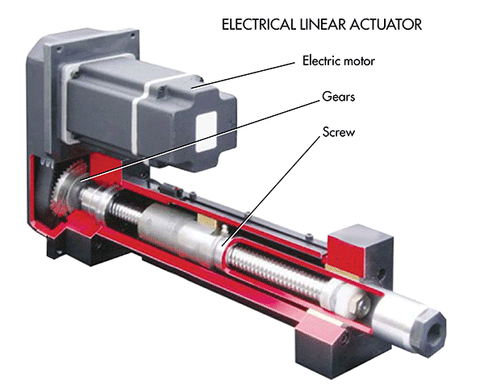
The mechanical advantage of electromechanical systems stems from their direct drive design. A stepper motor or servo motor drives a lead screw or ball screw mechanism that converts rotational motion into precise linear displacement. Unlike hydraulic cylinders that must overcome fluid compressibility and seal friction, or pneumatic actuators fighting against air compression, electric actuators deliver deterministic, repeatable motion profiles every single cycle.
Positioning Accuracy in Real Applications
In medical equipment applications, where patient safety depends on exact positioning, electromechanical actuators enable surgical tables, imaging equipment, and patient lifts to move with millimeter-level precision. Industrial actuators in semiconductor manufacturing similarly require sub-millimeter accuracy for wafer handling and positioning operations where even microscopic errors can ruin expensive materials.
The smooth operation of electric actuators also eliminates the jerky motion characteristic of pneumatic cylinders or the stick-slip behavior common in hydraulic systems operating at low speeds. This smoothness is critical in applications like TV lifts and automated furniture where visible vibration or sudden movements would be unacceptable.
Repeatability Over Lifecycle
Electromechanical actuators maintain their precision throughout their operational life. Hydraulic systems gradually lose accuracy as seals wear and fluid viscosity changes with temperature. Pneumatic systems face similar degradation as seals age and air pressure fluctuates. Electric actuators, by contrast, maintain consistent performance for hundreds of thousands of cycles with minimal degradation, assuming proper lubrication of mechanical components.
Comprehensive Motion Control Capabilities
Modern electromechanical actuators offer unprecedented control over every aspect of motion. Engineers can precisely program acceleration rates, velocity profiles, deceleration curves, and end-position behavior. This level of control enables optimization for specific application requirements—from gentle motion that prevents sloshing in liquid handling to rapid indexing in high-speed manufacturing.
Integrated Feedback Systems
Feedback actuators incorporate position sensors such as potentiometers, hall-effect sensors, or optical encoders that provide real-time data about actuator position, velocity, and even force. This feedback enables closed-loop control systems that automatically compensate for loads, environmental variations, and mechanical wear.
The ability to monitor and control force is particularly valuable in applications where over-force conditions could damage equipment or workpieces. An electric actuator with current sensing can detect when it encounters unexpected resistance and stop or reverse, preventing damage. This force control capability makes electric actuators ideal for applications like automated assembly where parts must be pressed together firmly but not crushed.
Programmable Motion Profiles
With appropriate control systems, electromechanical actuators can execute complex motion sequences. Multi-point positioning allows the actuator to move to different positions in sequence. Speed ramping enables gentle starts and stops that reduce mechanical shock and extend equipment life. Position-dependent velocity profiles allow the actuator to slow down automatically as it approaches its target position.
These programmable capabilities eliminate the need for mechanical limit switches, cushioned stops, and flow control valves required by hydraulic and pneumatic systems. The entire motion profile exists in software, making it easily adjustable without mechanical modifications.
Seamless Integration with IoT and Industry 4.0
The digital nature of electromechanical actuators makes them naturally suited for connected manufacturing environments and Internet of Things (IoT) applications. While hydraulic and pneumatic systems remain fundamentally analog—requiring extensive sensor additions and interface hardware for digital connectivity—electric actuators are inherently digital devices that communicate easily with modern control systems.
Network Connectivity and Data Collection
Electric actuators can be networked using industrial communication protocols like CANbus, Modbus, or Ethernet/IP, enabling centralized monitoring and control. This connectivity allows maintenance teams to track performance metrics including cycle counts, operating hours, temperature, power consumption, and fault conditions across entire fleets of actuators.
Predictive maintenance becomes practical when actuators report their operational status continuously. Trending analysis of current draw, for example, can reveal developing mechanical problems before they cause failures. An actuator drawing incrementally higher current over time may indicate bearing wear or lead screw contamination—issues that can be addressed during scheduled maintenance rather than causing unexpected downtime.
Rapid Reconfiguration and Updates
Manufacturing flexibility increasingly demands equipment that can be quickly reprogrammed for different products or processes. Electromechanical actuators excel in this environment because their behavior is defined by software parameters that can be modified remotely without mechanical adjustments. Changing stroke length, speed, or acceleration profiles requires only parameter updates, not hardware modifications.
For integrators and OEMs building equipment that must be customized for different end users, this programmability significantly reduces commissioning time. The same basic hardware can be configured through software to meet varying application requirements.
Quiet Operation for Improved Work Environments
Noise pollution in industrial and commercial environments has become a significant health and productivity concern. Hydraulic power units generate substantial noise from pumps and motors, while pneumatic systems produce characteristic hissing sounds from air exhaust. Electromechanical actuators operate at dramatically lower noise levels—typically in the 45-60 dB range compared to 70-85 dB for hydraulic and pneumatic systems.
Noise Reduction Benefits
The quiet operation of electric actuators makes them essential in applications where noise must be minimized. Medical facilities, laboratories, broadcast studios, and office environments all benefit from the near-silent operation of electromechanical systems. Even in traditional manufacturing environments, reducing noise levels improves worker comfort, reduces hearing protection requirements, and enables better communication on the factory floor.
Micro linear actuators are particularly quiet, making them ideal for applications like home automation, adjustable furniture, and consumer products where any mechanical noise would be objectionable. The whisper-quiet operation of electric standing desks and drawer slides illustrates how electromechanical actuation enables products that would be impractical with noisy pneumatic or hydraulic systems.
Vibration Considerations
Beyond acoustic noise, electromechanical actuators also minimize vibration transmission. Hydraulic systems can transmit pump pulsations through fluid lines, while pneumatic exhausts create impulse vibrations. Electric actuators mounted with appropriate mounting brackets generate minimal vibration, which is critical for precision equipment and sensitive instrumentation.
Environmental and Energy Efficiency Advantages
Environmental considerations increasingly influence equipment design and purchasing decisions. Electromechanical actuators offer compelling environmental advantages that extend beyond eliminating hydraulic fluid leaks.
Elimination of Fluid Contamination Risks
Hydraulic systems pose inherent environmental risks from fluid leaks. Even small, slow leaks can accumulate over time, contaminating soil and groundwater. In food processing, pharmaceutical manufacturing, and clean rooms, hydraulic fluid contamination can ruin products and require expensive cleanup. Electromechanical actuators completely eliminate these risks because they contain no hydraulic fluid or lubricating oil that could leak into the environment or contaminate products.
The maintenance burden associated with hydraulic systems—including fluid changes, filter replacements, and leak cleanup—also disappears with electric actuation. This reduces waste generation and the environmental impact of disposal.
Superior Energy Efficiency
Energy efficiency represents a major advantage of electromechanical systems. Hydraulic power units must run continuously to maintain pressure, consuming energy even when no actuators are moving. Pneumatic systems similarly waste energy compressing air, with typical system efficiencies below 20% due to leakage and heat losses.
Electric actuators, by contrast, consume power only during motion. When holding position or at rest, power consumption drops to near zero. This on-demand energy use can reduce overall system energy consumption by 50-80% compared to equivalent hydraulic or pneumatic systems. With appropriate power supplies, electric actuators can also regenerate energy during deceleration, further improving efficiency.
Reduced Infrastructure Requirements
Installing hydraulic or pneumatic systems requires substantial infrastructure: hydraulic power units, reservoirs, and distribution piping, or air compressors, dryers, and distribution lines. This infrastructure consumes space, requires maintenance, and represents significant capital investment. Electromechanical actuators eliminate this infrastructure entirely—they require only electrical power, which is already available in most facilities. This simplification reduces installation costs, ongoing maintenance requirements, and facility space consumption.
Selecting the Right Electromechanical Actuator
With the advantages of electromechanical actuation established, selecting the appropriate actuator for specific applications requires evaluating several key parameters.
Force and Stroke Requirements
Actuators are rated by maximum force capacity (typically in pounds or Newtons) and stroke length (distance traveled). Applications requiring high force—above 2,000 pounds—may benefit from industrial actuators with robust construction and heavy-duty drive mechanisms. For lower force applications, standard linear actuators offer excellent value and performance.
Stroke length must accommodate the full range of motion required, with some safety margin. Actuators with longer strokes typically move slower at a given motor speed due to lead screw pitch considerations.
Speed and Duty Cycle
Speed requirements influence motor selection and gear ratio. Faster speeds generally require sacrificing force capacity, as actuators follow a force-speed curve where maximum force is available only at lower speeds. Applications requiring frequent cycling need actuators rated for continuous duty rather than intermittent operation.
Environmental Considerations
Operating environment affects actuator selection significantly. Outdoor applications, washdown environments, or corrosive atmospheres require actuators with appropriate IP ratings and corrosion-resistant materials. Extreme temperatures may necessitate special lubricants or heater elements to maintain operation.
Implementation Best Practices
Successfully implementing electromechanical actuators requires attention to several practical considerations beyond simply selecting an actuator with adequate specifications.
Mounting and Mechanical Installation
Proper mounting is critical for actuator longevity and performance. Misalignment between the actuator and the load creates side loading that accelerates wear and may cause premature failure. Using appropriate mounting brackets and ensuring alignment within manufacturer specifications prevents these issues.
For applications requiring guided motion, combining actuators with slide rails or linear guides prevents rotation and side loading while ensuring smooth, precise movement.
Electrical Considerations
Selecting appropriate power supplies ensures reliable operation. Power supplies must provide adequate current for the actuator's peak demand, not just its average consumption. Voltage drops in long cable runs can reduce available force and speed, so wire gauge must be sized appropriately.
Control systems range from simple switches and remote controls to sophisticated programmable control boxes and microcontroller platforms like Arduino. The control method should match the application's complexity and the user's technical capabilities.
Maintenance and Longevity
While electromechanical actuators require less maintenance than hydraulic or pneumatic systems, they aren't maintenance-free. Periodic inspection of mechanical components, ensuring proper lubrication of lead screws, and verifying mounting bolt tightness extends service life. Feedback actuators provide early warning of developing problems through monitoring of performance parameters.
Conclusion
The advantages of electromechanical actuators—precision control, comprehensive motion capabilities, IoT integration, quiet operation, and environmental benefits—make them the preferred choice for modern motion control applications across diverse industries. As electric actuator technology continues to advance, with improvements in force capacity, speed, and environmental robustness, the applications where hydraulic or pneumatic systems remain necessary continue to shrink.
For engineers and designers specifying motion control systems, electromechanical actuators should be the default consideration, with alternative technologies evaluated only when specific application requirements truly demand them. The lower total cost of ownership, improved performance, and enhanced flexibility of electric actuation typically outweigh any initial cost premium, making them not just the technologically superior choice but also the economically sensible one.
Frequently Asked Questions
What are the main differences between electric, hydraulic, and pneumatic actuators?
Electric actuators convert electrical energy directly into mechanical motion using motors and drive mechanisms like lead screws. They offer precise control, quiet operation, and require only electrical power. Hydraulic actuators use pressurized fluid to generate motion and excel at high-force applications but require pumps, reservoirs, and maintenance. Pneumatic actuators use compressed air and are simple and inexpensive for basic on-off motion but lack precision and require compressed air infrastructure. Electric actuators generally offer the best combination of precision, control, efficiency, and ease of integration for most modern applications.
How much force can electromechanical actuators generate?
Electromechanical actuators are available in a wide range of force capacities, from just a few pounds for micro actuators to over 10,000 pounds for heavy-duty industrial actuators. Common applications use actuators in the 100-2,000 pound range. Force capacity depends on motor size, gear ratio, and lead screw pitch. Higher forces typically mean slower speeds due to mechanical advantage trade-offs. For specialized high-force applications requiring tens of thousands of pounds, hydraulic systems may still be more practical, but the force capabilities of electric actuators continue to expand.
Can electric actuators operate outdoors or in harsh environments?
Yes, many electromechanical actuators are designed for harsh environment operation with appropriate IP (Ingress Protection) ratings. Actuators rated IP65 or higher protect against dust ingress and water jets, making them suitable for outdoor installation or washdown environments. Stainless steel construction provides corrosion resistance for marine or chemical environments. Temperature-rated actuators can operate in extreme heat or cold. However, it's essential to select actuators specifically designed for the environmental conditions they'll face. Standard actuators designed for indoor, clean environments will fail prematurely if exposed to moisture, contamination, or temperature extremes without proper protection.
What is the typical lifespan of an electromechanical actuator?
Electromechanical actuator lifespan varies significantly based on duty cycle, load, speed, and operating conditions. Under moderate use, quality actuators typically provide 100,000 to several million cycles before requiring service or replacement. Actuators operating continuously at high loads and speeds wear faster than those used intermittently at partial capacity. Proper installation, adequate lubrication, and avoiding side loading significantly extends service life. Feedback actuators help predict end-of-life by monitoring performance degradation. In well-designed applications with appropriate actuator selection and proper maintenance, electromechanical actuators can provide many years of reliable service.
How do I control multiple actuators to move synchronously?
Synchronizing multiple actuators requires matched actuators and appropriate control strategies. For simple applications, using actuators with identical specifications powered from the same controller provides basic synchronization. More precise synchronization requires feedback actuators with position sensors connected to a controller that actively adjusts each actuator's position to maintain alignment. This closed-loop approach compensates for load variations and manufacturing tolerances. Specialized control systems designed for multi-actuator applications simplify setup and provide reliable synchronized motion. For demanding applications requiring precise synchronization, using mechanical connections between actuators or employing gantry-style systems with a single drive motor may be more appropriate than independent actuators.


