What is a second-class lever with angled force application?
A second-class lever places the load between the fulcrum and the applied force, giving mechanical advantage. When a linear actuator drives that lever at an angle (not perpendicular to the arm), only the perpendicular component of the actuator's force — F × sin(θ) — produces useful torque. The remainder pushes laterally into the pivot and does no lifting work. This page gives the formula, a calculator, and worked examples for sizing an actuator under that geometry.
When designing motion control systems with linear actuators, understanding lever mechanics is crucial for calculating the actual force requirements. While perpendicular force application is often covered in basic engineering calculations, real-world installations rarely operate under ideal 90-degree conditions. Most automated systems—whether you're building a custom TV lift, an adjustable hatch, or an industrial lifting mechanism—involve actuators mounted at angles to accommodate spatial constraints, aesthetic requirements, or mechanical packaging limitations.
🎥 Video — Calculator for a Second Class Lever - On an ANGLE
Engineering principle: Size the actuator for the hard part of the travel, not the easy middle. In an angled lever, the worst-case force usually lives at the angle extremes — that is the number that matters.
"When an actuator pushes a lever at an angle, you are paying for force twice — once for the perpendicular component that does the lifting, and once for the parallel component that just side-loads the pivot and the actuator's own bearings. Size for the worst angle in the stroke, not the easy middle." — Robbie Dickson, FIRGELLI Automations founder and former Rolls-Royce, BMW, and Ford engineer
This presents a critical engineering challenge: when a linear actuator applies force at an angle to the lever arm, only a portion of that force contributes to the rotational torque needed to move the load. The remainder is wasted as a lateral component that merely pushes sideways against the pivot point. Without accounting for this angular relationship, you risk undersizing your actuator, leading to system failure, or oversizing it, wasting money and energy. This guide provides the engineering framework and practical calculator you need to accurately size actuators for angled second-class lever applications.
Whether you're a DIY enthusiast designing your first automated project or an engineer specifying components for industrial automation, understanding these force vector relationships will save you from costly mistakes and ensure reliable system performance.
How does a second-class lever work?
Before diving into angled force calculations, let's establish the fundamental characteristics of a second-class lever. In this lever configuration, the load sits between the fulcrum (pivot point) and the point where force is applied. This arrangement provides mechanical advantage—meaning you can lift a heavier load with less input force—making it ideal for applications involving linear actuators where minimizing actuator size and power consumption is desirable.
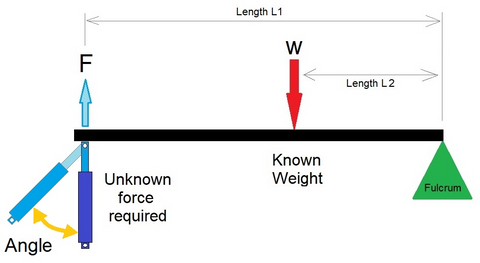
Common examples include wheelbarrows, nutcrackers, and bottle openers. In automation, second-class levers appear frequently in hatch mechanisms, lift-assist systems, and adjustable furniture applications. The key advantage is that as you increase the distance from the fulcrum to the force application point (L2) relative to the distance from the fulcrum to the load (L1), you proportionally reduce the force required to move the load.
In a simplified perpendicular scenario, the force calculation is straightforward: F = (Load × L1) / L2. However, this formula assumes the actuator pushes or pulls at exactly 90 degrees to the lever arm—a condition rarely achieved in practical installations due to mounting constraints, space limitations, or the natural geometry of the application.
How does angle affect the force the actuator must produce?
When force is applied at an angle, it must be decomposed into two vector components: one perpendicular to the lever arm (effective for creating rotation) and one parallel to the lever arm (wasted as lateral load on the pivot). This is fundamental vector mathematics, but it has significant practical implications for actuator selection and mounting bracket design.
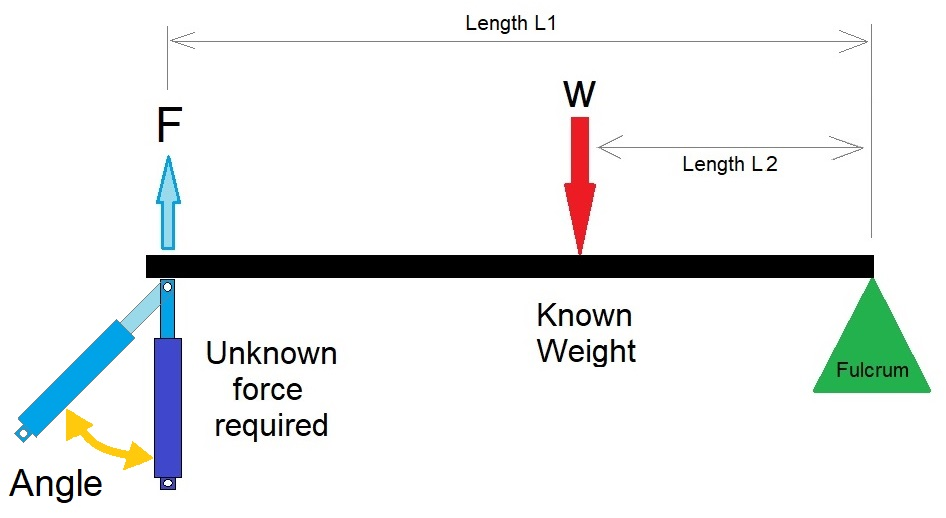
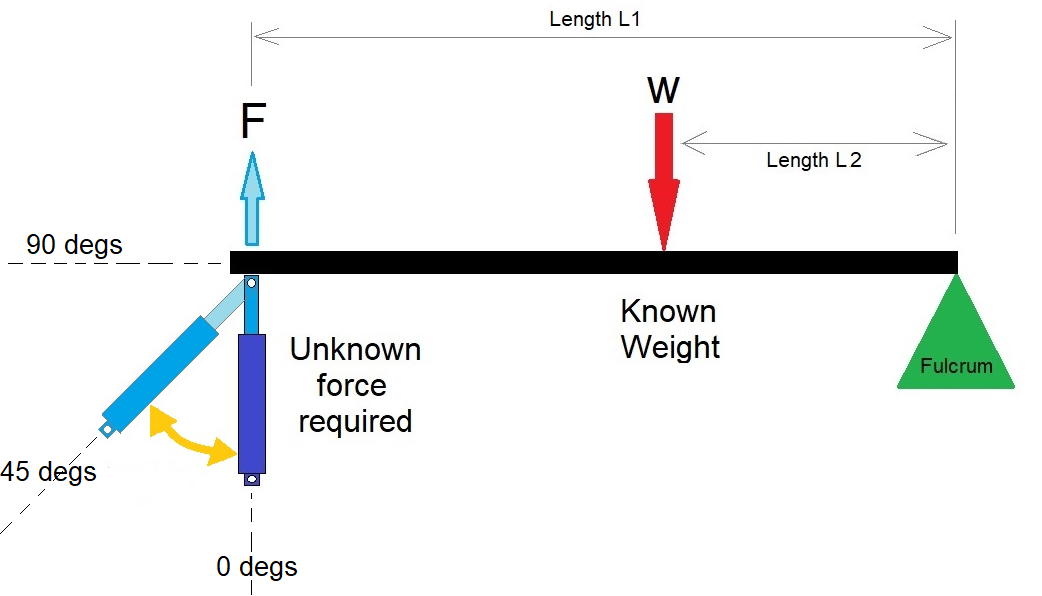
The perpendicular component—the only portion that contributes to rotational torque—can be calculated using the sine function. Specifically, if your actuator applies force at angle θ (theta) relative to the horizontal plane, the effective perpendicular force is F × sin(θ). As the angle decreases from 90 degrees toward horizontal, the sine value decreases, meaning you need progressively more actuator force to achieve the same lifting capability.
For example, at 90 degrees (perpendicular), sin(90°) = 1, so 100% of the actuator force is effective. At 45 degrees, sin(45°) ≈ 0.707, meaning only about 71% of the force contributes to rotation. At 30 degrees, sin(30°) = 0.5, so you're wasting half your actuator's force capability. This has direct implications for whether you need an industrial actuator rated for higher forces or if a standard unit will suffice.
| Angle θ | sin θ | Useful force fraction | Required actuator force multiplier vs perpendicular |
|---|---|---|---|
| 90° | 1.000 | 100% | 1.00× |
| 75° | 0.966 | 97% | 1.04× |
| 60° | 0.866 | 87% | 1.15× |
| 50° | 0.766 | 77% | 1.31× |
| 45° | 0.707 | 71% | 1.41× |
| 40° | 0.643 | 64% | 1.56× |
| 30° | 0.500 | 50% | 2.00× |
| 20° | 0.342 | 34% | 2.92× |
| 15° | 0.259 | 26% | 3.86× |
Read: at 30°, the actuator must produce 2× the force it would need at 90° to lift the same load.
What formula calculates the required actuator force?
The complete formula for calculating the force required from a linear actuator in an angled second-class lever application is:
F = (w1 × L2) / (L1 × sin(θ))
Where:
- F = Force required from the actuator (newtons, pounds, etc.)
- w1 = Weight of the load being moved (newtons, pounds, etc.)
- L1 = Distance from the fulcrum to the load (meters, millimeters, inches, etc.)
- L2 = Distance from the fulcrum to the point where actuator force is applied (same units as L1)
- θ = Angle between the actuator's line of action and the horizontal plane (degrees or radians)
This formula reveals several critical insights for system design. First, as the angle θ decreases, the sine value decreases, which increases the denominator's reduction effect, thereby increasing the required force F. Second, the ratio L2/L1 still provides mechanical advantage, but that advantage is diminished by the sin(θ) term. Third, you cannot simply specify an actuator based on the load weight alone—geometry matters enormously.
When working with feedback actuators in precision positioning applications, understanding these force relationships also helps you account for varying loads throughout the stroke, as the angle θ often changes as the mechanism moves through its range of motion.
How do you use the angled second-class lever calculator?
Use this calculator to determine the exact force requirements for your angled second-class lever application. Input your system dimensions, load weight, and actuator mounting angle to instantly calculate the necessary actuator force. This tool handles unit conversions automatically and provides results you can use directly for actuator selection.
Length from Load to Fulcrum (L1): mm cm m inches feet
Length from Actuator to Fulcrum (L2): mm cm m inches feet
Angle of Force: degrees
Weight of Load (w1): g kg lbs N
Force Required:
When using this calculator for real-world applications, remember to add a safety factor of at least 1.2-1.5× to account for friction, acceleration forces, and mechanical efficiency losses. For industrial actuators in critical applications, a 2× safety factor is often recommended.
Where are angled second-class levers used in real systems?
The Classic Wheelbarrow Analysis
The wheelbarrow represents the archetypal second-class lever with angled force application. When you lift the handles, you're applying force at an acute angle to the horizontal plane—typically between 30 and 60 degrees depending on your height and the wheelbarrow's design. The load (soil, concrete, or materials) sits in the bucket between the wheel (fulcrum) and your hands (force application point).
Consider a wheelbarrow loaded with 100 pounds of material positioned 18 inches from the wheel, with handles 48 inches from the wheel, lifted at a 40-degree angle. Using our formula: F = (100 lbs × 48 in) / (18 in × sin(40°)) = 4,800 / (18 × 0.643) = 4,800 / 11.57 ≈ 415 pounds. However, because you're using both hands and lifting dynamically (not statically), the actual biomechanics differ from a linear actuator installation. Still, this illustrates why wheelbarrows feel lighter as you increase the handle-to-load distance ratio and why they become harder to lift when heavily loaded—the angle becomes more acute, reducing mechanical efficiency.
Automated Hatch Mechanisms
Marine applications, RV access panels, and industrial equipment frequently use actuator-driven hatches operating as second-class levers. A typical scenario: a 50-pound hatch door needs to open from horizontal to 85 degrees. The hinge (fulcrum) is at one edge, the center of mass is 12 inches from the hinge, and the linear actuator attaches 20 inches from the hinge. The mounting geometry creates a 35-degree angle at the closed position.
At the start of travel: F = (50 lbs × 20 in) / (12 in × sin(35°)) = 1,000 / (12 × 0.574) = 1,000 / 6.89 ≈ 145 pounds required. However, as the hatch opens, the angle changes continuously, altering force requirements throughout the stroke. At 45 degrees open, the actuator might be pushing at 60 degrees to horizontal, requiring only F = (50 × 20) / (12 × sin(60°)) = 1,000 / (12 × 0.866) ≈ 96 pounds. This variable loading is why feedback actuators with current monitoring can be beneficial—they can detect these changing loads and adjust accordingly.
Adjustable Furniture Applications
Modern TV lifts and standing desks often incorporate second-class lever mechanisms with angled actuator mounting to save space and create cleaner aesthetics. A cabinet-mounted TV lift might use a 30-pound television positioned 16 inches from the pivot, with the actuator mounted 24 inches from the pivot at a 50-degree angle to minimize the actuator's visual profile.
Required force: F = (30 lbs × 24 in) / (16 in × sin(50°)) = 720 / (16 × 0.766) = 720 / 12.26 ≈ 59 pounds. When selecting actuators for furniture applications, also consider stroke length requirements and the need for synchronized motion if using multiple actuators, which may require a control box for coordination.
Why mount a linear actuator at an angle?
Mechanical Advantage Optimization
While angled mounting reduces force efficiency compared to perpendicular installation, it still maintains the fundamental mechanical advantage of second-class levers. By positioning the linear actuator farther from the fulcrum than the load (L2 > L1), you reduce the total force requirement despite the angular inefficiency. This allows you to use smaller, more economical actuators than would be required for first-class lever configurations or direct lifting applications.
The key is finding the optimal balance between mechanical advantage and angular efficiency. In many cases, accepting a 45-50 degree mounting angle allows you to position the actuator in an aesthetically pleasing or spatially efficient location while still maintaining reasonable force requirements.
Enhanced Directional Control and Precision
Angled force application provides superior control over load movement direction. When a linear actuator pushes at an angle, you can direct force vectors to guide the load around obstacles, through constrained spaces, or along specific paths. This is particularly valuable in applications like articulated access panels, where the load must swing through a complex arc while clearing surrounding structures.
For precision positioning applications using feedback actuators, angular mounting can also reduce the sensitivity of position to small force variations, creating more stable holding positions against varying loads or external forces.
Ergonomic and Structural Benefits
In human-operated equipment like wheelbarrows or manual lifts, angled force application aligns better with natural body mechanics and comfortable working postures. For automated systems, angled actuator mounting often reduces structural stress concentrations at pivot points by distributing lateral and perpendicular force components across the mounting structure. This can extend service life and reduce the need for heavy-duty mounting brackets.
Additionally, angled mounting frequently permits more compact system packaging, allowing mechanisms to fit within smaller enclosures or tighter dimensional constraints—critical for applications like under-cabinet TV lifts or concealed access panels.
How do you select an actuator for an angled lever application?
Force Rating and Safety Factors
After calculating the theoretical force requirement using the angled lever formula, apply appropriate safety factors before selecting your actuator. For static or slow-moving loads with well-defined weights, a 1.25× safety factor is typically adequate. For dynamic loads, shock loading, or applications where the load weight may vary, use 1.5-2× safety factors. When specifying industrial actuators for critical infrastructure or safety-related applications, 2-3× safety factors are standard practice.
Remember that actuator force ratings typically represent maximum static force at specific voltage and temperature conditions. Continuous operation, elevated temperatures, or voltage variations can reduce available force by 10-20%, which your safety factor should accommodate.
Stroke Length Calculations
In angled applications, the required actuator stroke is not simply the linear distance the load must travel. Instead, you must calculate the change in distance between the actuator mounting points as the lever rotates through its full range of motion. This often involves trigonometric calculations using the law of cosines, considering both the starting and ending positions of the mechanism.
For complex geometries, creating a scale CAD drawing or physical mockup can prevent costly mistakes in stroke length specification. Underestimating stroke length is a common error that forces redesigns or mounting relocations after actuator delivery.
Speed and Duty Cycle Considerations
As actuation angle decreases (moving away from perpendicular), more of the actuator's speed capability is consumed producing the perpendicular motion component, while the parallel component contributes nothing to load movement. This means apparent mechanism speed may be slower than the actuator's rated speed would suggest.
Additionally, angled mounting often increases the total distance the actuator must travel, which increases cycle time. For high-frequency cycling applications, verify that your selected actuator's duty cycle rating can accommodate the actual on-time requirements, not just the theoretical cycle count. Some industrial actuators offer 100% duty cycle capability, while standard units may be limited to 20-25% duty cycles.
Mounting Hardware Requirements
Angled installations place both axial (along the actuator's length) and lateral (perpendicular to the actuator) loads on mounting points. Standard mounting brackets must handle these multi-directional forces without deflection or failure. For angles significantly away from perpendicular (less than 45 degrees or greater than 135 degrees), consider reinforced mounting brackets or custom fabricated mounts designed specifically for your application's force vectors.
The parallel force component also increases wear on actuator internal guide systems and bearings. For applications with severe angular mounting (30 degrees or less), consider track actuators or industrial actuators with enhanced lateral load capabilities.
What design mistakes are common in angled lever systems?
Ignoring Angle Changes Throughout Travel
Many designers calculate force requirements at only one position—typically the starting position—and assume that force remains constant throughout travel. In reality, as the lever rotates, the angle between the actuator and lever arm changes continuously, altering force requirements. The worst-case force requirement might occur at mid-stroke or end-of-stroke, not at the starting position.
Solution: Calculate force requirements at minimum intervals of 15-30 degrees throughout the full range of motion. Use the highest calculated force for actuator selection. For critical applications, create a force-versus-position graph to understand the complete loading profile.
Neglecting Friction and Efficiency Losses
The formulas presented assume frictionless pivots and perfect mechanical efficiency. Real-world systems include bearing friction at the fulcrum, sliding friction at any guides or supports, and wind resistance for outdoor applications. These can add 15-40% to actual force requirements beyond theoretical calculations.
Solution: Add empirical efficiency factors based on component selection. Ball bearing pivots typically have 95% efficiency, while plain bearings may be 85-90%. Add separate allowances for environmental factors like wind loading, ice accumulation, or seal drag in weatherproof applications.
Inadequate Control Systems
Variable force requirements throughout travel can cause simple on-off control systems to slam the mechanism at low-force positions or stall at high-force positions. Without proper control, actuators may also continue pushing against mechanical stops, overheating and failing prematurely.
Solution: For mechanisms with significant force variation, use feedback actuators with limit switches or positional feedback. Implement a proper control box with current limiting or soft-start/soft-stop capabilities. For DIY builders working with Arduino or similar platforms, implement PWM speed control that can be adjusted based on position feedback.
What advanced factors affect complex angled lever systems?
Multi-Actuator Synchronization
Large panels or heavy loads often require multiple linear actuators working in parallel. When these actuators are mounted at different angles or positions, each experiences different force requirements and angular changes throughout travel. Without synchronization, the mechanism can bind, twist, or place uneven stress on mounting points.
Proper synchronization requires either mechanical coupling (linkages that force actuators to move together) or electronic synchronization using feedback actuators with positional sensing. Electronic systems monitor each actuator's position and adjust speed to maintain alignment within specified tolerances, typically ±1-5mm depending on application requirements.
Dynamic Loading and Acceleration Effects
Static force calculations assume loads are moving at constant velocity or are stationary. During acceleration and deceleration, inertial forces add to gravitational loads. For a load accelerating at rate 'a', the effective force increases by F_inertia = (mass × a). Fast-moving mechanisms or high-mass loads can see inertial forces equal to or exceeding static gravitational forces.
Additionally, lever mechanisms experience rotational inertia effects proportional to the square of the distance from the fulcrum. Loads positioned far from the pivot create substantial rotational inertia that must be overcome during startup and controlled during stopping. These effects are particularly important for industrial actuators in high-speed automated systems.
Environmental Factors
Outdoor installations face wind loading, temperature extremes affecting material properties and actuator performance, and potential ice or debris accumulation adding unpredictable weight. Marine environments introduce corrosion concerns that may dictate industrial actuator selection with stainless steel construction and sealed components.
For outdoor applications, calculate wind loading using the projected area of the load and worst-case wind speeds for your location (typically 90-110 mph for permanent installations), following the framework in ASCE 7 (Minimum Design Loads and Associated Criteria for Buildings and Other Structures). Wind pressure of 20-30 psf is common for design purposes, which can add hundreds of pounds of effective load to large panels.
How should you install an angled lever actuator system?
Successful angled lever installations require attention to several practical details beyond force calculations. Ensure all pivot points use appropriate bearings—ball bearings for high-cycle applications, bronze bushings for low-speed, high-load scenarios. Lubricate regularly according to bearing manufacturer specifications.
When installing mounting brackets, verify that fasteners are sized for both tensile (pulling) and shear (sideways) loading. The parallel force component in angled installations places shear loads on mounting bolts that may exceed the primary axial loads. Use grade 8 or better fasteners (per SAE J429, the fastener grade standard) for critical mounting points, with appropriate thread engagement depth and locking mechanisms to prevent loosening under vibration.
For linear actuators with clevis-style mounting ends, ensure adequate pivot clearance to accommodate angular changes throughout the full range of motion. The actuator mounting point will sweep through an arc as the mechanism moves, and inadequate clearance will bind or create unintended side loading.
Test installations under no-load conditions first to verify smooth operation and absence of binding. Gradually add load while monitoring for unusual noises, vibration, or asymmetric motion that might indicate misalignment or inadequate force capacity. For systems using multiple actuators, verify synchronized operation before committing to final installation.
Conclusion
Calculating force requirements for second-class levers with angled actuator mounting requires understanding vector decomposition and applying proper trigonometric principles. While this adds complexity compared to perpendicular installations, the benefits—improved space efficiency, better directional control, and enhanced design flexibility—often make angled mounting the preferred or necessary solution.
The key to successful implementation is thorough analysis before actuator selection. Use the provided calculator to determine force requirements at multiple positions throughout your mechanism's range of motion. Account for friction, acceleration, environmental loads, and manufacturing tolerances with appropriate safety factors. Select linear actuators rated for worst-case loads, not just average or starting loads.
For applications requiring precise control, high duty cycles, or substantial forces, consider feedback actuators or industrial actuators specifically designed for demanding conditions. Invest in quality mounting brackets and hardware that can handle multi-directional loading. The cost difference between adequate and inadequate components is minor compared to the expense and disruption of field failures or redesigns.
How can you verify the calculator output is reasonable?
- Check the perpendicular baseline. Run the calculation with θ = 90°. The result should equal (w1 × L2) / L1 — the simple second-class lever formula with no sine penalty. If it does not, an input unit is wrong.
- Confirm the sine penalty. Halve the angle from 90° to 45° at the same loads and lengths. The required force should rise by about 1.41× (1 / sin 45°). From 90° to 30°, it should double. If your result does not track the sine ratio, recheck the angle field.
- Recompute at the worst angle in the stroke, not just the starting angle. If the angle reaches 30° somewhere in the travel, run the calculator at that angle and size for that number.
- Sanity-check against mechanical advantage. As long as L2 > L1, the required force should be less than the load weight at 90°. If the calculator output exceeds the load weight at a steep angle, that is expected — it means side-loading dominates and you should reconsider the geometry.
- Apply the safety factor outside the calculator. The calculator returns theoretical force. Multiply by 1.25–2× before selecting an actuator.
Frequently Asked Questions
What's the difference between perpendicular and angled lever force calculations?
In perpendicular force application, 100% of the actuator's force contributes to rotating the lever because the force vector aligns perfectly with the direction needed to create torque. The calculation is simply F = (Load × L1) / L2. When force is applied at an angle, only the perpendicular component of that force (calculated using sine of the angle) creates useful torque. The parallel component pushes sideways against the pivot without contributing to rotation. This means you need more total actuator force to achieve the same lifting capability. For example, at 45 degrees, you need approximately 41% more force than the perpendicular calculation would suggest, and at 30 degrees, you need twice as much force.
How do I handle applications where the angle changes throughout the stroke?
Most lever mechanisms experience continuously changing angles as they move through their range of motion. The proper approach is to calculate force requirements at multiple positions—typically every 15-30 degrees of lever rotation—and identify the worst-case scenario. This maximum force requirement should be used for actuator selection. You can calculate the angle at any position using the law of cosines with the distances between your three points (fulcrum, actuator mount, and load position) as the mechanism moves. For complex geometries, CAD software can automate these calculations throughout the full travel range. Applications with significant force variation may benefit from feedback actuators and variable-speed control to optimize performance and reduce peak power consumption.
What safety factor should I use when selecting an actuator for my application?
Safety factors depend on application criticality, load predictability, and operating conditions. For well-defined static loads in non-critical applications, use a minimum 1.25× safety factor. For dynamic loads or applications where load weight may vary, use 1.5-2× safety factors. Industrial or safety-critical applications should use 2-3× safety factors. Additional considerations include: add 10-15% for friction losses at pivots and bearings; add 15-25% for acceleration forces in fast-moving mechanisms; add 20-40% for outdoor applications subject to wind loading; and add 25-50% for severe environments with temperature extremes, contamination, or high duty cycles. It's better to oversize slightly than to undersize and experience premature failure or inadequate performance.
How do I calculate the required actuator stroke length for an angled lever application?
Actuator stroke length equals the change in distance between the actuator's two mounting points (one on the lever arm, one on the fixed structure) as the mechanism moves from fully closed to fully open. This is not the same as the linear distance the load travels. Calculate it using the law of cosines: at the starting position, determine the distance between mounting points using d1 = √(a² + b² - 2ab×cos(θ1)), where 'a' and 'b' are the fixed distances from each mount to the fulcrum, and θ1 is the angle between them. Repeat for the ending position to find d2. The required stroke is |d2 - d1|. Add 10-15% margin for mounting tolerances and to avoid running the actuator to absolute end-of-stroke, which can cause premature wear. For complex mechanisms, creating a scale CAD model and measuring the distance change directly is often simpler and more accurate than manual trigonometric calculations.
Can I use multiple actuators at different angles on the same lever?
Yes, but synchronization becomes critical. Each actuator will experience different force requirements based on its mounting angle and distance from the fulcrum. Unless mechanically linked, the actuators must be electronically synchronized to prevent binding, twisting, or uneven stress distribution. Use feedback actuators with positional sensing and a control box that can monitor each actuator's position and adjust speeds to maintain alignment. Calculate force requirements for each actuator individually using its specific mounting geometry. Size each actuator for its worst-case loading, which may occur at different positions in the travel range for each actuator. The total lifting capacity equals the sum of the perpendicular force components from all actuators, not their total rated forces.
What's the optimal mounting angle for a linear actuator in a lever application?
From a pure force efficiency standpoint, 90 degrees (perpendicular) is optimal because 100% of actuator force contributes to torque. However, practical constraints often prevent perpendicular mounting. Generally, maintaining angles above 45 degrees keeps efficiency losses manageable—at 45 degrees, you lose about 30% efficiency compared to perpendicular. Below 30 degrees, efficiency drops dramatically and side loading on the actuator increases significantly, potentially reducing service life. The optimal angle for your application balances force efficiency against space constraints, aesthetic requirements, and stroke length considerations. In compact installations, accepting a 50-60 degree angle often provides the best compromise between efficiency and packaging while keeping the actuator force requirements within the range of standard linear actuators without requiring oversized units.


