Furniture actuators are electric linear actuators used to add controlled motion to furniture — lifting a TV from a cabinet, raising a bar shelf, reclining a bed, or lowering a kitchen appliance — by converting motor rotation into precise push/pull travel under load.
The modern home is undergoing a quiet revolution. What was once static furniture — a TV cabinet, a bar, a bed frame — is now transforming into dynamic, adaptive pieces that respond to your needs at the touch of a button. Behind this transformation lies a technology that's been perfected over decades in aerospace and automotive engineering: the electric linear actuator.
Electric linear actuators convert rotational motion from an electric motor into precise linear movement, creating the muscle behind automated furniture. These compact devices can push, pull, lift, or lower with remarkable precision — often while carrying hundreds of pounds and operating so quietly you'll barely notice them. Whether you're building a custom TV lift, automating a hidden bar cabinet, or creating an adjustable workspace, understanding how actuators work in furniture applications is essential for successful implementation.
This comprehensive guide explores the most popular furniture automation applications, from entertainment centers to kitchen solutions, and provides the technical insights you need to select the right actuator for your project. We'll cover stroke lengths, force requirements, synchronization techniques, and mounting considerations that separate a smooth, professional installation from a frustrating DIY disaster.
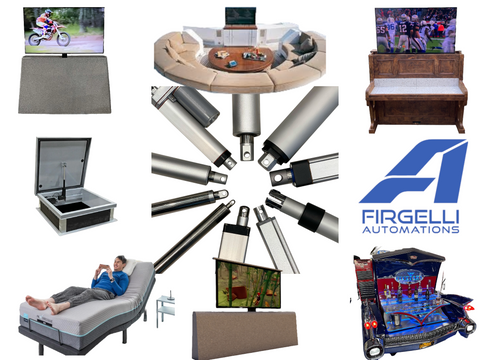
Motion design starts with geometry, not force alone. Guide the load with rails and bearings; let the actuator push and pull. Side loading destroys actuators long before bending forces do.
"The actuator's job is push and pull along its centerline — nothing else. The moment furniture geometry asks an actuator rod to act as the guide, you've already designed in premature wear. Slide rails, linear bearings, or pivoted mounts carry the side loads. The actuator just supplies the motion." — Robbie Dickson, Founder and Chief Engineer of FIRGELLI Automations
How do pop-up TV lifts work?
The pop-up TV lift represents one of the most sought-after furniture automation projects, addressing both aesthetic and practical concerns in modern living spaces. When space is at a premium and visual clutter needs minimizing, the ability to conceal a large television until needed transforms how rooms function and feel.
How TV Lift Mechanisms Work
At the heart of every TV lift system lies one or more linear actuators working in concert with a lifting mechanism. The actuator extends vertically from within a cabinet base, connected to a carriage that supports the television. As the actuator rod extends, it pushes the carriage and TV upward through a precisely machined channel or guide rail system.
The key to smooth operation lies in several factors: the actuator must provide sufficient force to lift the combined weight of the TV, mounting plate, and carriage mechanism — typically requiring 150-300 lbs of force depending on screen size. The stroke length must be carefully calculated to achieve the desired viewing height above the cabinet, with most installations requiring 20-36 inches of travel. Speed is another consideration; most TV lifts operate at 0.5-1.0 inches per second to provide a smooth, premium feel without rushing the mechanism.

Cabinet vs. Ceiling-Mounted Configurations
TV lifts come in two primary configurations. Cabinet-mounted systems lift the television up from below, ideal for footboards, media consoles, and kitchen islands. These typically use single or dual linear actuators mounted vertically within the cabinet structure.
Ceiling-mounted drop-down systems reverse the operation, lowering the TV from a concealed compartment above — perfect for theaters, bedrooms, or commercial displays. These require actuators capable of controlled lowering under load, which demands integrated limit switches and precise speed control to prevent abrupt stops that could damage the television.
Control Integration and User Experience
Modern TV lifts integrate with various control methods. The most basic systems use wired push-button switches mounted discreetly on furniture surfaces. Mid-range installations incorporate RF remote control systems, allowing operation from across the room. Premium systems can integrate with home automation platforms, enabling voice control or smartphone operation.
The control system must account for safety features: soft-start and soft-stop ramping to prevent jerky motion, obstacle detection to prevent crushing injuries, and position memory to return the TV to preferred viewing heights. Most quality systems include these features in the integrated control box that manages the actuator.
How are pop-up bar cabinets built with actuators?
The automated bar cabinet takes a static piece of furniture and transforms it into an interactive entertainment centerpiece. By concealing bottles, glassware, and bar accessories behind elegant cabinetry, these systems maintain clean lines when not in use, then reveal a fully-equipped bar with the press of a button.

Design Considerations for Bar Lift Mechanisms
Bar cabinet automation typically involves lifting a heavy platform loaded with bottles, glassware, ice buckets, and other accessories — often totaling 50-150 pounds. This demands industrial actuators with higher force ratings than typical furniture applications. The Super Duty series actuators, capable of 500-1000 lbs of force, provide the necessary power while maintaining the quiet operation essential for home environments.
The lifting mechanism can take several forms. Simple vertical lifts raise the entire bar shelf from within the cabinet. More complex designs incorporate tilting platforms that angle bottles forward for better visibility and access. Some luxury installations combine linear and rotary motion, using rotary actuators to spin sections of the bar into view.
Mounting and Structural Reinforcement
The weight and leverage involved in bar lifts demand proper structural support. The cabinet base must be reinforced to prevent racking or twisting under load. Mounting brackets should be through-bolted to solid wood members, not simply screwed into thin panels. The lifting platform requires guide rails or slides to maintain alignment and prevent binding as it rises.
For heavier installations, dual synchronized actuators provide better weight distribution and prevent side-loading that could cause premature wear. The FIRGELLI FCB-1 control box ensures both actuators move in perfect unison regardless of load imbalance.
Noise Reduction Strategies
Since bar cabinets often operate during social gatherings, noise levels matter significantly. High-quality linear actuators incorporate precision-machined lead screws and quality bearings to minimize mechanical noise. The Super Duty models mentioned achieve operation levels below 45 decibels — quieter than normal conversation — making them ideal for premium furniture applications where the mechanism should be felt, not heard.
How do you automate trap doors and skylight windows?
Linear actuators excel at automating architectural elements that are difficult to reach or operate manually. Trap doors to hidden storage spaces, attic access panels, and skylight windows all become effortlessly operable when actuator-driven.

Skylight Window Automation
Skylights present unique challenges: they're often unreachable without a ladder, they must seal properly against weather, and they may need to support snow loads or resist wind forces. Actuators for skylight applications typically mount to the window frame, pushing the sash open at an angle through a scissor mechanism or direct push-rod connection.
The actuator must be rated for outdoor conditions if exposed to weather, requiring IP66 or higher ingress protection ratings (per IEC 60529, "Degrees of protection provided by enclosures — IP Code"). Stroke lengths of 8-16 inches typically provide adequate ventilation opening. Force requirements depend on window size but generally range from 100-400 lbs to overcome seal friction and handle wind resistance.
Hidden Trap Door Systems
Trap doors for concealed storage or secret rooms require actuators that can push heavy panels — often laden with flooring material to maintain disguise — upward against gravity. This demands high force ratings and robust mechanical advantage through lever arms or linkage systems.
Safety becomes paramount in trap door applications. The system must include obstacle detection to prevent closing on objects or people, manual release mechanisms for power failures, and secure locking when closed. Gas springs or counterbalance systems often work in conjunction with the actuator to reduce the load during operation and provide fail-safe support if power is lost.
Control and Safety Integration
Architectural automation benefits from wall-mounted control switches placed at convenient heights, with additional remote control options for flexibility. Rain sensors can automatically close skylights when precipitation is detected. Timer circuits can provide automated ventilation cycles. The key is ensuring manual override capability — you should never be trapped by automation failure.
What actuators are used in adjustable beds and recliners?
Adjustable beds and reclining chairs represent perhaps the most personal application of actuator technology in furniture. These systems must operate smoothly, quietly, and reliably while supporting the full weight of a person in various positions.
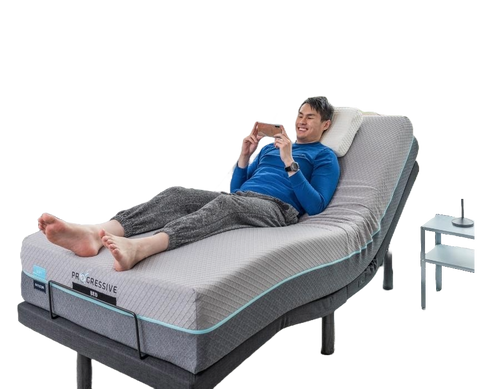
Adjustable Bed Configurations
Modern adjustable beds typically use multiple linear actuators to control different sections independently. A basic system might include two actuators: one for the head section and one for the foot section. Premium systems add additional actuators for lumbar support, under-bed lighting lifts, or massage features.
Force requirements for bed actuators depend on the weight of the mattress, bedding, and occupant(s) the section must lift. Head sections typically require 200-400 lbs of force, while foot sections may need 150-300 lbs. Stroke lengths of 8-14 inches provide the range of adjustment most users desire.
The actuators must incorporate soft-start and soft-stop features to prevent abrupt motion that could wake a sleeping partner or cause discomfort. Speed settings around 0.5-0.8 inches per second provide smooth, controlled movement. Quiet operation is critical — noise levels should remain below 50 decibels to avoid disturbing sleep environments.
Reclining Chair Applications
Recliner chairs present different challenges than beds. The actuator must push against significant leverage as the chair back tilts and the footrest extends. Most systems use either a single powerful actuator with a complex linkage system, or dual actuators for independent back and footrest control.
Space constraints in chair frames often require compact linear actuators or even micro linear actuators for smaller furniture pieces. The actuator mount points must be carefully positioned to avoid binding as the linkages move through their range of motion.
Control Systems for Comfort Furniture
User control for beds and chairs typically integrates into handheld wired remotes or wireless RF controllers. The control interface should be intuitive — clearly labeled buttons for common positions like "flat," "zero gravity," or "TV watching." Memory functions that recall preferred positions add significant value.
Premium systems incorporate feedback actuators that report their exact position to the control system. This enables precise position memory, programmable massage patterns, and gentle wake-up routines that slowly adjust the bed position over time.
How do kitchen appliance lifts work?
Professional-grade mixers, food processors, and coffee makers are essential kitchen tools, but their bulk consumes valuable counter space. Appliance lift systems use actuators to raise these heavy items from concealed cabinets, providing access when needed while maintaining clean countertop aesthetics.

Pop-Up vs. Drop-Down Configurations
Kitchen appliance lifts come in two main styles. Pop-up lifts raise the appliance from a lower cabinet through a spring-assisted platform. These typically use column lift actuators mounted vertically within the cabinet base. As the column extends, it pushes the appliance platform upward until it reaches counter height.

Drop-down lifts lower appliances from upper cabinets, bringing items stored overhead down to comfortable working height. These use standard linear actuators in a controlled descent mechanism. The actuator must manage the load carefully to prevent rapid dropping that could damage the appliance or mechanism.
Force and Stroke Requirements
Heavy kitchen appliances like stand mixers can weigh 20-30 pounds, while the lifting platform and mechanism add another 10-15 pounds. Factor in a safety margin, and most kitchen lift applications require actuators rated for 75-150 lbs of force. The stroke length depends on cabinet depth and desired lift height, but typically ranges from 10-16 inches for pop-up systems.
Column lifts offer particular advantages in appliance applications. Their telescoping design provides long stroke lengths while collapsed height remains minimal. They're specifically engineered for vertical lifting applications and include integrated guide systems that maintain stability under off-center loads — important when appliances aren't perfectly balanced on the platform.
Integration with Kitchen Design
Successful appliance lift installation requires coordination with cabinet design from the beginning. The cabinet must provide sufficient depth and height for the collapsed mechanism, reinforced mounting points for the actuator, and electrical access for both the actuator and the appliances it will support.
Control switches should be positioned for easy access but protected from splashes and spills. Many installations use recessed push-button switches mounted on the cabinet face or underside of the countertop. Soft-close features prevent slamming as the appliance returns to storage.
How do you synchronize dual actuators?
When furniture applications exceed the capacity of a single actuator or require even load distribution across a wide platform, dual synchronized actuators become necessary. However, running two actuators together introduces technical challenges that must be properly addressed.
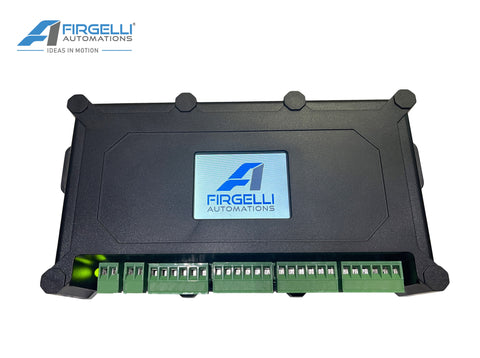
Why Synchronization Matters
Even actuators from the same production batch exhibit slight variations in speed due to manufacturing tolerances, load differences, and friction variations. When two unsynchronized actuators attempt to lift opposite ends of a platform, the faster actuator pulls ahead, creating a binding condition. This causes several problems: uneven stress on the mounting points, increased motor load leading to premature failure, binding that can damage the mechanism, and jerky, unprofessional operation.
The solution requires active feedback and control. Both actuators must communicate their position continuously, with the control system making real-time adjustments to keep them moving in unison regardless of load imbalances.
The FIRGELLI FCB-1 Control System
The FIRGELLI FCB-1 control box specifically addresses dual actuator synchronization. It works with any FIRGELLI feedback actuators — those with built-in position sensors that report their extension continuously.
The FCB-1 monitors position feedback from both actuators simultaneously. If one actuator begins to lead, the control box automatically reduces power to the faster unit while maintaining or increasing power to the slower one. This real-time adjustment keeps both actuators within ±1mm of synchronization throughout their travel — imperceptible to the user and eliminating binding stress on the mechanism.
The system supports standard switch inputs for manual control and can integrate with remote control systems. It includes built-in safety features like overload protection and emergency stop capability. Configuration is straightforward: connect both feedback actuators, provide appropriate power supplies, and the system automatically calibrates during the first operation cycle.
When to Use Dual Actuator Systems
Consider dual actuators when the load exceeds the rating of a single actuator, when the platform width exceeds 36 inches (requiring support on both sides), when the application demands redundancy for safety, or when the load may be unevenly distributed across the platform. Common applications include large TV lifts for screens over 65 inches, wide bed platforms, commercial-grade furniture, and architectural elements like large skylights or access panels.
How do actuators enable ergonomic and adaptive furniture?
Beyond specific furniture applications, linear actuators enable broader trends in ergonomic design and architectural aesthetics that are reshaping how we interact with our living and working spaces.

Height-Adjustable Workspaces
The health benefits of alternating between sitting and standing during work are well documented. Electric standing desk systems use dual synchronized actuators to raise and lower the entire work surface, allowing users to change positions throughout the day without disrupting their workspace.
These systems typically incorporate heavy-duty track actuators or specialized lifting columns capable of supporting 200-300 lbs of desktop, monitors, and equipment. Stroke lengths of 18-24 inches provide the range needed to accommodate users of different heights in both sitting and standing positions. Control systems include memory presets for individual users and collision detection to prevent damage if the desk encounters obstacles.
Concealed Storage and Reveal Mechanisms
Modern furniture design increasingly incorporates hidden compartments and reveal mechanisms that transform pieces from one function to another. A console table conceals a dining surface that extends when needed. A bookshelf pivots to reveal a hidden doorway. A floor panel lifts to access wine storage below.
These applications often use compact bullet actuators or specialized mechanisms combined with drawer slides and slide rails to create smooth, controlled motion in tight spaces. The actuator provides the primary force, while precision slides maintain alignment and support lateral loads.
Adaptive Furniture for Accessibility
Actuator-driven furniture plays a crucial role in accessibility, enabling individuals with limited mobility to adjust their environment independently. Lifting mechanisms can raise seating to standing-assist heights, lower kitchen cabinets to wheelchair-accessible levels, or adjust bed positions for easier transfers.
These applications demand robust safety features, reliable operation, and intuitive controls accessible to users with various physical limitations. The technology that enables luxury automation also provides essential independence for many users.
How do you select the right actuator for a furniture project?
Successful furniture automation depends on matching actuator specifications to application requirements. Several key factors determine which actuator is appropriate for your project.
Typical actuator specs by furniture application:
| Application | Force range | Stroke range | Speed | Notes |
|---|---|---|---|---|
| TV lift (cabinet/ceiling) | 150–300 lbs | 20–36 in | 0.5–1.0 in/sec | Soft start/stop required |
| Bar cabinet lift | 500–1000 lbs | 12–20 in | 0.5–0.8 in/sec | Heavy-duty / Super Duty class; dual actuators for wide platforms |
| Skylight window | 100–400 lbs | 8–16 in | 0.4–0.6 in/sec | IP66 or higher for outdoor exposure |
| Adjustable bed (head) | 200–400 lbs | 8–14 in | 0.5–0.8 in/sec | <50 dB target |
| Adjustable bed (foot) | 150–300 lbs | 8–14 in | 0.5–0.8 in/sec | <50 dB target |
| Kitchen appliance lift | 75–150 lbs | 10–16 in | 0.5–1.0 in/sec | Column lifts preferred for off-center loads |
| Standing desk | 200–300 lbs | 18–24 in | 1.0–1.5 in/sec | Dual synchronized, collision detection |
Calculating Force Requirements
The actuator must provide sufficient force to move the load throughout its entire range of motion. Start by calculating the total weight of everything the actuator must move: the furniture piece itself, any contents, and in some cases, the weight of users. Add a 25-50% safety margin to account for friction, misalignment, and aging of the mechanism.
Consider the geometry of your application. If the actuator pushes at an angle or through a lever arm, the effective force requirement increases. A mechanical advantage calculator or simple trigonometry can determine the actual force needed at the actuator mounting point.
Determining Stroke Length
Stroke length is the distance the actuator rod extends from fully retracted to fully extended. This must match or exceed the total travel distance required in your application. For linear vertical lifts, this calculation is straightforward — the stroke equals the lift height needed. For angled or pivoting applications, the geometry becomes more complex and may require careful measurement or CAD modeling to determine the required stroke.
Note that the actuator's collapsed length equals approximately the stroke length plus the actuator body. Ensure your furniture design provides sufficient space for the actuator in its fully retracted position.
Speed and Duty Cycle
Actuator speed is measured in inches per second. Furniture applications typically benefit from moderate speeds of 0.5-1.0 inches per second, providing smooth, controlled motion without rushing. Faster speeds may seem appealing but can create jerky motion and increased noise.
Duty cycle indicates how long an actuator can operate continuously before requiring rest time to prevent overheating. Most furniture applications have light duty cycles — operating for seconds or minutes at a time with long rest periods between. Standard actuators typically offer 20% duty cycles (10 minutes on, 40 minutes off), more than adequate for furniture use.
Power Supply and Voltage
Most furniture actuators operate on 12V or 24V DC power, requiring appropriate power supplies to convert household AC power. The power supply must provide sufficient current (amperage) to drive the actuator under full load — typically 3-6 amps for standard furniture actuators, higher for industrial models.
When using multiple actuators, total the current requirements and select a power supply rated accordingly. The FIRGELLI FCB-1 system, for example, manages two actuators through a single control box but requires a power supply adequate for both actuators operating simultaneously.
What are the installation best practices for furniture actuators?
Proper installation ensures smooth operation, longevity, and safety of your actuator-driven furniture.
Mounting and Alignment
Actuators must be mounted with proper alignment to prevent side-loading, which causes premature wear and binding. The actuator should push and pull along its centerline axis throughout the entire range of motion. Use quality mounting brackets that allow pivoting at connection points to accommodate slight angle changes as the mechanism moves.
Never mount an actuator rigidly at both ends if the mechanism geometry changes during operation. At least one end should use a pivot mount or spherical bearing to prevent binding. Through-bolt all mounting points to solid wood or metal structural members — screws into thin panels or particleboard will fail under load.
Guide Rails and Support
The actuator should provide push/pull force only, not support side loads or bending moments. Incorporate slide rails, linear guides, or pillow block bearings to maintain alignment and support lateral forces. This is especially critical for vertical lifting applications where any wobble or misalignment becomes immediately apparent.
For applications involving heavy or tall platforms, multiple guide points prevent tipping and ensure smooth motion. The guides should be mounted as far apart as practical to maximize stability.
Limit Switches and Safety
Most quality actuators incorporate internal limit switches that stop motion at full extension and retraction, preventing damage to the mechanism. However, additional external limit switches may be warranted in applications where over-travel could cause injury or property damage.
Consider incorporating obstacle detection — either through current sensing that detects when the actuator encounters resistance, or through physical switches that trigger if the moving platform contacts an obstruction. Emergency stop switches should be accessible in applications where users could be trapped or injured by the mechanism.
Wire Management and Protection
Actuator control wires must be protected from pinching, abrasion, or entanglement as the mechanism moves. Use flexible conduit or cable carriers to protect and guide wires through their range of motion. Ensure adequate wire length to reach full extension without pulling tight. Secure wiring to prevent dangling loops that could catch on furniture edges or other objects.
How do you maintain and troubleshoot furniture actuators?
Electric linear actuators are remarkably reliable when properly specified and installed, but understanding basic maintenance and troubleshooting ensures long-term performance.
Routine Maintenance Requirements
Quality actuators require minimal maintenance in furniture applications. Periodically check mounting bolts for tightness — vibration during operation can loosen fasteners over time. Inspect wiring for damage, particularly at flex points where wires bend during motion. Keep actuator rods clean; dust and debris can be drawn into seals causing premature wear.
If the actuator begins operating more slowly or struggles with loads it previously handled easily, the internal lubrication may be depleting. Most actuators are sealed units that cannot be user-serviced, but this symptom indicates approaching end of life and suggests planning for replacement.
Common Issues and Solutions
If an actuator fails to operate, verify power supply voltage and connections first — most "actuator failures" are actually power supply or wiring issues. Check that the control system is sending signals properly by testing with a multimeter. Verify that limit switches haven't been tripped, requiring a reversal command to reset.
If the actuator operates but motion is jerky or inconsistent, check for binding in the mechanism, inadequate guide support, or side-loading. Ensure mounting points remain secure and properly aligned. In dual actuator systems, verify synchronization — if one actuator is moving faster than its partner, the FCB-1 control box may need recalibration.
When to Replace vs. Repair
Most modern linear actuators are sealed units not designed for field repair. If internal components fail, replacement is typically more cost-effective than attempting repair. However, controllers, power supplies, and wiring can often be repaired or replaced independently of the actuator itself.
What usually goes wrong with furniture actuators?
Most furniture-actuator problems trace back to a handful of recurring issues. Each has a clear symptom and a structural fix:
- Side loading from a missing guide rail. If the actuator rod is the only thing holding the platform in alignment, every cycle wears the internal bushings. Symptom: increasing slop and noise after months of use. Fix: add slide rails or linear bearings so the actuator only pushes and pulls.
- Mounting into thin panels. Screws driven into 1/2 in particleboard or veneer panels back out under load. Fix: through-bolt to solid wood or metal structural members.
- Dual-actuator desynchronization. Without feedback control, two actuators drift apart, binding the platform and overloading motors. Fix: use feedback actuators with the FIRGELLI FCB-1 control box.
- Power supply undersized. Most "dead actuator" calls turn out to be a power supply that cannot deliver the required current under load. Verify supply amperage matches total actuator draw before suspecting the actuator itself.
- Pinched or abraded wiring. Wires routed through flex points without conduit eventually fail at the bend. Use cable carriers and leave enough slack for full stroke.
How should you test a furniture actuator install before trusting it?
A prototype that works once proves the idea; repeated cycles with real load prove the design. Before signing off on an install, work through this checklist:
- Cycle it under real load, not empty. A TV lift that runs smoothly with no TV on the carriage will tell you nothing. Mount the actual television (or a weighted dummy of equal mass) and run 20–30 full cycles.
- Test at the hard part of travel, not just the middle. Most binding shows up at the top or bottom of stroke where geometry tightens. Watch and listen at the end-of-travel zones, not the easy middle.
- Verify limit switch behavior. Run to full extension and full retraction; confirm motion stops cleanly and the next command reverses without manual intervention.
- For dual-actuator systems, check synchronization across the full stroke. Mark both rods, run to mid-travel, and confirm extension lengths match within a few millimeters.
- Check current draw under load with a clamp meter. If draw is near the actuator's rated maximum during normal operation, the system has no headroom for friction increase as it ages.


