The Ultimate Garage Statement Piece: A Motorized Cadillac Cocktail Couch
Imagine entertaining guests in your garage or man cave when suddenly, with the press of a button, a vintage Cadillac trunk lid rises to reveal a fully stocked bar complete with glassware, liquor, and LED lighting. This isn't a concept from a Hollywood set designer—it's a real project built by Jerome's Auto that transforms automotive nostalgia into functional furniture using precision-engineered linear actuators.
🎥 Video — Cadillac Cocktail Couch - Motorized Pop-up Liquor Cabinet
The Cadillac Cocktail Couch represents the perfect intersection of automotive passion, entertainment, and motion control engineering. What makes this project particularly impressive from a technical standpoint is the sequential automation system that coordinates two separate lifting mechanisms using just two actuators, micro switches, and relay logic. This case study demonstrates how electric linear actuation can transform ambitious custom furniture concepts into reliable, repeatable motion systems.
In this comprehensive guide, we'll break down exactly how this motorized pop-up bar was engineered, the motion control principles that make it work, and the design considerations that went into creating one of the most conversation-starting pieces of garage furniture ever built.
Project Overview and Design Concept
The Cadillac Cocktail Couch began with a straightforward concept: repurpose an authentic Cadillac rear end into a functional couch with a hidden, motorized bar. But as with any custom build that combines furniture, automotive parts, and motion control systems, the devil is in the details. Jerome's Auto approached this build with the understanding that reliability and smooth operation were just as important as visual impact.

The design incorporates the iconic styling of a classic Cadillac tail section mounted to a custom-built couch frame. When closed, it appears to be an automotive-themed sofa with authentic chrome bumper and tail lights. The magic happens when the system is activated: the trunk lid lifts upward, then a second stage elevates the entire bar assembly into view, complete with bottle storage, mixing area, and ambient lighting.
From an engineering perspective, this required solving several challenges: managing the weight distribution of both the heavy metal trunk lid and the loaded bar assembly, coordinating sequential motion between two independent actuators, ensuring consistent operation regardless of bar load, and maintaining the aesthetic integrity of the vintage automotive components.
How the Sequential Motion Control System Works
The brilliance of this build lies in its elegant control architecture. Rather than requiring a complex programmable controller, the system uses basic relay logic and limit switches to create perfectly timed sequential motion. This approach is both reliable and cost-effective, making it accessible for custom builders while maintaining professional-grade performance.
Stage One: Trunk Lid Opening Mechanism
The first stage uses a single linear actuator mounted inside the couch frame to lift the Cadillac trunk lid. This actuator doesn't work alone—it's assisted by two automotive-style gas springs mounted on either side of the trunk. This hybrid approach offers several engineering advantages:
- Reduced actuator load: The gas springs counterbalance most of the trunk lid's weight, allowing the actuator to focus on controlled motion rather than pure lifting force
- Faster operation: With reduced load requirements, a higher-speed actuator can be specified without sacrificing reliability
- Manual backup: If power is unavailable, the gas springs allow manual opening with minimal effort
- Extended actuator life: Operating well within force capacity significantly extends component lifespan
- Smooth deceleration: The gas springs dampen motion at the end of travel, preventing harsh stops

The actuator stroke length for this stage is relatively short—typically 8 to 12 inches depending on the specific trunk geometry. The key specification here is not maximum force but consistent speed and the presence of built-in limit switches to prevent over-extension.
Stage Two: Bar Elevation Mechanism
Once the trunk lid reaches its fully open position, an external micro switch is triggered. This switch sends a signal to a relay that activates the second actuator, which handles the dramatic bar elevation. This second actuator requires significantly different specifications:
- Longer stroke length: Typically 18 to 24 inches to raise the bar assembly to comfortable serving height
- Higher force capacity: Must lift the combined weight of the bar structure, bottles, glassware, and any decorative elements
- Stable extension: The actuator must maintain position under load without drift or creep
- Mounting geometry: Requires careful positioning to provide vertical lift while maintaining clearance from surrounding structure
This sequential approach—where one motion must complete before the next begins—prevents mechanical interference and ensures the trunk lid is fully clear before the bar begins its ascent. The timing is handled entirely through mechanical limit switches and relay logic, with no programming required.
Critical Component Selection and Specifications
Choosing the Right Linear Actuators
Selecting appropriate linear actuators for this application requires understanding the fundamental trade-off between speed and force. Electric linear actuators use internal gear reduction to convert motor rotation into linear motion. Higher gear ratios produce more force but slower speeds, while lower gear ratios enable faster movement at the cost of lifting capacity.
For the trunk lid actuator, specifications might include:
- Stroke length: 8-12 inches
- Force capacity: 100-200 lbs (with gas spring assistance reducing actual load to 50-75 lbs)
- Speed: 1.0-1.5 inches per second for smooth, visible motion
- Voltage: 12V DC for compatibility with automotive power supplies
- Built-in limit switches: Essential for reliable position control
The bar elevation actuator requires different priorities:
- Stroke length: 18-24 inches
- Force capacity: 300-500 lbs depending on bar assembly weight
- Speed: 0.5-1.0 inches per second (slower is acceptable for the dramatic reveal)
- Voltage: 12V DC to match the trunk actuator
- Static holding force: Must maintain position when fully extended without motor power

Gas Spring Integration
The gas springs used in this build are essentially the same as those found on automotive trunk lids, which is both appropriate and practical given the application. These nitrogen-charged cylinders provide consistent force throughout their stroke and require no external power. When sizing gas springs for a project like this:
- Calculate the total weight of the trunk lid and any attached hardware
- Determine the mounting geometry and leverage ratios
- Select gas springs that provide 60-80% of the required lifting force
- Leave the remaining 20-40% for the actuator to provide controlled motion
This balance is critical: too much gas spring force and the lid will want to slam open uncontrollably; too little and the actuator is overworked and slow.
Control System Components
Beyond the actuators themselves, the system requires several supporting components:
- Micro switches: Industrial-quality limit switches with at least 5A rating for relay control
- Relays: Automotive-style relays rated for the actuator current draw (typically 2-6A per actuator)
- Main switch: A momentary or maintained contact switch for user control, ideally with LED indication
- Power supply: A 12V DC power supply rated for at least 10A continuous to handle both actuators plus accessories
- Wiring: Minimum 16-gauge wire for power distribution, with proper strain relief at all connection points
Installation and Mounting Considerations
Structural Reinforcement
One aspect that cannot be overlooked in a project like this is the structural integrity of the couch frame. The forces generated by linear actuators—both during operation and when holding extended positions—place significant stress on mounting points. The frame must be engineered to handle:
- Point loads at actuator mounting locations
- Moment forces created by the extended bar assembly acting as a lever
- Dynamic loads during motion when momentum creates additional forces
- Vibration and cyclic loading over hundreds or thousands of operations
Steel or heavy aluminum framing is essential, with welded or bolted construction at all critical joints. Mounting brackets should be through-bolted with large washers to distribute loads across the frame members.
Actuator Mounting Geometry
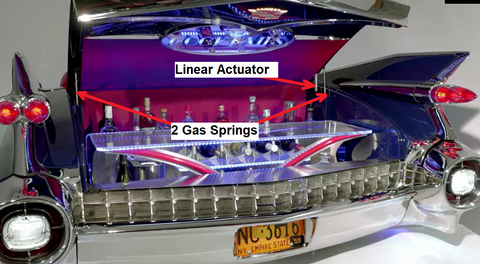
The mounting angle and position of each actuator significantly affects its mechanical advantage and the available force at different points in the stroke. For optimal performance:
- Mount actuators so they're operating in the middle 70% of their force range at critical positions
- Avoid mounting angles that create excessive side loading on the actuator rod
- Use clevis or eye-end fittings that allow rotational freedom at the connection points
- Ensure the actuator has adequate clearance throughout its full range of motion
- Position the bar-lift actuator as close to centered as possible to minimize tipping forces
Wiring and Electrical Routing
Professional-quality wiring is what separates a reliable installation from one that fails prematurely. Key practices include:
- Use automotive-grade wire with appropriate temperature and abrasion resistance
- Protect wiring runs with split loom or conduit, especially in areas with moving parts
- Provide service loops at all moving connections to prevent strain
- Use weatherproof connectors if the furniture will be used in unconditioned spaces
- Label all wires and include a wiring diagram stored with the furniture
- Fuse the power supply circuit appropriately for the wire gauge used
Understanding the Speed Versus Force Trade-Off in Linear Actuators
One of the most fundamental principles in electric linear actuator selection is the inverse relationship between speed and force. This isn't a limitation of specific products—it's a basic physical principle that applies to all mechanical systems using gear reduction.
Inside every linear actuator is an electric motor connected to a lead screw or ball screw through a gearbox. The gear ratio determines how many motor rotations are required to produce one inch of linear travel. A higher gear ratio (more motor rotations per inch) produces:
- Higher force capacity: The mechanical advantage of the gearing multiplies the motor's torque
- Slower speed: More rotations required means more time to cover the same distance
- Better holding force: High gear ratios are often self-locking, maintaining position without power
Conversely, a lower gear ratio produces:
- Faster linear speed: Fewer rotations needed per inch of travel
- Lower force capacity: Less mechanical advantage means lower force multiplication
- Reduced holding force: May require power to maintain extended positions
In the Cadillac Cocktail Couch project, this principle explains why the trunk lid actuator (low load, assisted by gas springs) can operate quickly, while the bar-lift actuator (high load, no mechanical assistance) operates more slowly. The design takes advantage of this trade-off rather than fighting against it.
For builders considering similar projects, this means you cannot simply "buy a faster actuator" if you discover you need more force—you must either accept slower speeds with higher force or reduce the load through mechanical assistance like gas springs, counterweights, or optimized mounting geometry.
Design Variations and Customization Options
Alternative Control Approaches
While the relay-and-microswitch control system used in this build is elegant and reliable, modern projects have additional options:
Arduino or microcontroller control: Using an Arduino board with motor drivers allows for programmable timing, adjustable speeds, and even smartphone control. This approach offers more flexibility but requires programming knowledge and increases system complexity.
Dedicated control boxes: Off-the-shelf control boxes designed for linear actuator applications can simplify wiring and provide features like adjustable speed, soft start/stop, and memory positions without custom programming.
Remote control operation: Adding a wireless remote control enables operation from across the room, ideal for entertaining situations where you want to control the reveal without reaching for a mounted switch.
Enhanced Features and Add-Ons
The basic build can be enhanced with features that elevate both functionality and entertainment value:
- LED lighting: RGB LED strips inside the bar area, triggered by the same relay system, create dramatic lighting effects during the reveal
- Audio integration: Small speakers and an amplifier can play themed music or sound effects during operation
- Position feedback: Using feedback actuators with built-in potentiometers allows for precise position control and partial extension options
- Safety sensors: Pressure sensors or optical sensors can detect obstructions and automatically reverse motion to prevent damage
- Glass securing: Magnetic or mechanical retention systems prevent glassware from shifting during motion
Adapting the Concept to Different Vehicles
The Cadillac rear end is iconic, but this concept can be adapted to virtually any vehicle styling:
- Muscle car trunk sections (Mustang, Camaro, Challenger) for American performance themes
- European luxury trunks (BMW, Mercedes, Jaguar) for sophisticated spaces
- Pickup truck tailgates for rustic or workshop environments
- Classic car trunks (Bel Air, Thunderbird) for vintage aesthetics
- Race car rear sections for motorsport-themed rooms
Each adaptation requires recalculating weights, adjusting actuator specifications, and modifying mounting geometry, but the fundamental sequential motion control approach remains the same.
Maintenance and Long-Term Performance
Routine Maintenance Schedule
To ensure reliable operation over years of use, establish a regular maintenance schedule:
Monthly checks:
- Verify smooth operation through full range of motion
- Listen for unusual sounds indicating worn components or loose hardware
- Check that all lighting and electrical accessories function properly
Quarterly maintenance:
- Inspect all mounting bolts and brackets for tightness
- Clean actuator rods with a lint-free cloth and light machine oil
- Verify micro switches trigger at correct positions
- Check electrical connections for corrosion or looseness
- Test gas spring force (should still provide easy manual lifting assistance)
Annual service:
- Full inspection of all moving components
- Lubricate hinges and pivot points
- Test actuator load capacity and speed (should match original specifications)
- Verify power supply output voltage under load
- Inspect wiring for any signs of wear or damage
Troubleshooting Common Issues
Slow or labored operation: May indicate increased load (bar overloaded with bottles), weakening gas springs, or binding in the mechanical linkage. Check for obstructions and verify gas spring function.
Uneven lifting: Typically caused by misaligned mounting, loose hardware, or unbalanced load distribution. Ensure the bar assembly is properly centered and secured.
Intermittent operation: Usually electrical—check all connections, verify switch operation, and test relay function. Corroded connections are the most common culprit.
Failure to complete sequence: If the trunk opens but the bar doesn't rise, verify the micro switch is being triggered at full trunk extension and that the relay is receiving the signal.
Conclusion: Engineering Meets Entertainment
The Cadillac Cocktail Couch represents far more than a novelty furniture piece—it's a practical demonstration of how electric linear actuation technology can bring ambitious custom projects to life. By understanding the engineering principles behind sequential motion control, leveraging mechanical assistance to optimize actuator performance, and implementing reliable control architecture, builders can create furniture that's both spectacular and dependable.
What makes this project particularly instructive is its accessibility. While the execution requires welding, electrical work, and careful planning, the fundamental principles—linear actuators, relay logic, and limit switches—are well within reach of serious DIY builders. The same motion control concepts used here scale to countless other applications, from TV lifts and automated drawer slides to custom automotive modifications and home automation projects.
For those inspired to tackle similar builds, the key takeaway is this: start with a clear understanding of your load requirements, select actuators appropriate for both force and speed needs, design robust mounting solutions that account for all operational forces, and implement control systems that prioritize reliability over complexity. With these principles in place, the only limit is imagination.
Frequently Asked Questions
What size linear actuators do I need for a motorized bar lift project?
The actuator size depends entirely on the weight of your bar assembly and mounting geometry. For a typical trunk lid with gas spring assistance, a 100-200 lb capacity actuator with 8-12 inch stroke is sufficient. The bar elevation actuator typically requires 300-500 lbs capacity with 18-24 inch stroke. Always calculate your actual load (including bottles and glassware when fully stocked) and add a 25-30% safety margin. The mounting angle also affects required force—actuators mounted at steep angles require higher force ratings than those mounted more horizontally.
Can I control the speed of the actuators independently?
Yes, with the right control system. The basic relay approach shown here operates actuators at their rated speed, but using a variable voltage power supply or PWM controller allows speed adjustment. Many modern control boxes include speed control features. Alternatively, using an Arduino with motor driver shields gives you complete programmable control over both speed and timing. Keep in mind that running actuators significantly below their rated voltage reduces their available force capacity.
What happens if the power goes out—will I be able to access the bar manually?
This depends on your actuator selection and mechanical design. The gas springs on the trunk lid allow manual opening even without power. However, most high-force linear actuators have self-locking gear systems that prevent manual extension or retraction—this is actually a safety feature that prevents the bar from dropping unexpectedly. If manual override is important, consider adding a mechanical release mechanism or selecting actuators with lower gear ratios that allow manual operation, though this reduces holding force and may require power to maintain extended positions.
How much weight can the bar section safely hold when fully extended?
This is determined by multiple factors: actuator force capacity, mounting geometry, and structural design of both the bar assembly and support frame. A properly engineered system using a 500 lb capacity actuator can typically support 50-100 lbs of bar contents when fully extended, accounting for the lever arm effect that multiplies forces at the actuator mounting point. However, the structural frame and mounting points must also be rated for these loads. Always perform a worst-case calculation with the bar fully loaded and extended, and build in a significant safety factor.
How loud is the operation, and can it be made quieter?
Electric linear actuators produce a mechanical whirring sound during operation, typically in the 45-55 decibel range—comparable to normal conversation volume. The sound comes from the motor and gearbox, and volume correlates somewhat with speed (faster actuators tend to be louder). You can reduce noise by: mounting actuators on rubber isolation bushings, using slower-speed actuators, ensuring all mechanical components are properly lubricated and aligned (binding creates additional noise), and adding sound-dampening material inside hollow frame members. Premium actuators with ball screws instead of lead screws are generally quieter than standard models.
Can this type of motorized furniture be used outdoors or in unheated garages?
Standard linear actuators are rated for indoor use and can handle typical garage environments, but exposure to moisture, temperature extremes, or corrosive environments requires special consideration. For outdoor or harsh environment use, specify industrial actuators with IP65 or IP66 ratings that provide protection against water and dust ingress. Additionally, use stainless steel mounting hardware, marine-grade wiring, and weatherproof enclosures for all electrical components. Temperature is also a factor—most actuators operate reliably from -15°C to +65°C, but very cold environments may require synthetic lubricants and can temporarily reduce force capacity.


