When industrial operations demand uncompromising power and reliability, standard consumer-grade actuators simply won't cut it. Agricultural equipment, heavy machinery, material handling systems, and harsh-environment industrial applications require motion control solutions engineered to withstand punishing duty cycles, extreme loads, and challenging environmental conditions. This is precisely why FIRGELLI developed the Super Duty (F-SD) series—a purpose-built industrial actuator that delivers professional-grade performance without the complexity or cost of hydraulic systems.
🎥 Video — FIRGELLI Super Duty series - An Industrial Strength Actuator to Get The Job Done
The F-SD represents a fundamental shift in what's possible with electric linear actuation in industrial settings. Unlike lighter-duty actuators that compromise on force capacity, environmental protection, or customization options, the Super Duty series combines 2,000N (450 lbs) push/pull force, IP66 environmental sealing, integrated Hall sensor feedback, and up to 24 inches of stroke length in a surprisingly compact package. Whether you're automating farm equipment, designing material handling systems, or building heavy-duty automotive applications, the F-SD provides the robust foundation needed for mission-critical motion control.
This comprehensive guide explores everything engineers, designers, and system integrators need to know about the Super Duty series—from its technical specifications and unique design features to real-world applications and integration considerations.
What Makes the Super Duty Series Different From Standard Linear Actuators
The F-SD occupies a distinct position in FIRGELLI's extensive linear actuators lineup. While the company offers everything from compact micro linear actuators for light-duty applications to specialized track actuators for furniture and cabinetry, the Super Duty series was specifically engineered for environments where failure is not an option.
At its core, the F-SD combines several critical features that are typically available only in much larger, more expensive industrial actuators. The IP66 ingress protection rating means the actuator is completely dust-tight and protected against powerful water jets from any direction—essential for agricultural equipment exposed to field conditions or industrial machinery subjected to washdown procedures. The 25% duty cycle at full load allows for sustained operation in demanding applications without thermal overload, a significant advantage over consumer actuators typically rated for 10-20% duty cycles.

Perhaps most importantly, the F-SD's hybrid helical and worm gear drive system delivers exceptional quietness of operation while maintaining high efficiency and self-locking capability. This drive configuration prevents backdriving under load—critical for safety in applications like lifting equipment or positioning heavy implements—while producing significantly less noise than traditional worm-drive actuators.
Technical Specifications and Capabilities
Understanding the F-SD's technical envelope is essential for proper application selection. The actuator delivers a maximum force rating of 2,000N (approximately 450 pounds) in both push and pull configurations, making it suitable for moving substantial loads. This force capacity places it firmly in the heavy-duty category while remaining accessible for systems operating on standard 12VDC power supplies.
The stroke length flexibility represents another significant advantage. Available in 2-inch increments from 2 inches up to 24 inches, the F-SD accommodates a wide range of motion requirements without requiring custom manufacturing. This standardized approach to stroke lengths reduces lead times and cost while still providing exceptional application flexibility. The built-in limit switches are positioned along the inside of the outer tube, allowing for precise stroke customization without modifying the actuator's base pricing structure.
Standard models come equipped with Hall effect sensors as feedback actuators, providing accurate position information for closed-loop control applications. The Hall sensor configuration offers excellent resolution and reliability without the wear concerns associated with potentiometer-based feedback systems. For applications requiring different feedback solutions, the F-SD can be customized with potentiometer feedback or other specialized onboard electronics to meet specific control requirements.
The compact design philosophy behind the F-SD ensures that despite its robust capabilities, the actuator can integrate into space-constrained installations. The rugged construction includes hardened components and protective finishes that resist corrosion and mechanical damage in harsh working environments.
Agricultural Applications: Modernizing Farm Equipment
Modern agriculture demands increasing automation and precision to remain competitive in a global marketplace. The F-SD series has found extensive adoption in agricultural machinery where reliability, environmental resistance, and power density are paramount concerns. Unlike hydraulic actuators that require complex pumps, hoses, and maintenance, electric actuators provide cleaner, simpler solutions that reduce both initial installation costs and long-term maintenance requirements.
In combine harvesters, F-SD actuators control header height, reel positioning, and grain bin covers—applications that demand both precision and the ability to function reliably in dusty, high-vibration environments. The IP66 rating proves essential during harvest season when equipment operates continuously in conditions that would quickly compromise lesser actuators. The self-locking worm gear drive maintains position without power consumption, critical for header height control where hydraulic drift could result in crop loss or ground strikes.
Spreader equipment benefits significantly from electric actuation, particularly in gate and door control applications. The F-SD's force capacity handles heavy slide gates and distribution doors while the feedback sensors enable precise control of spread patterns. Many modern precision agriculture systems rely on GPS-guided variable rate application, which requires rapid, accurate actuator response—something the F-SD delivers consistently.
Grain handling systems represent another strong application area. Auger positioning, bin ventilation systems, and grain dryer controls all require actuators capable of moving substantial loads in environments characterized by abrasive dust, temperature extremes, and potential moisture exposure. The F-SD's sealed construction and robust drive system address these challenges while providing the responsiveness needed for automated grain management systems.
Tractor implement control is evolving rapidly toward electric actuation, particularly in smaller and medium-sized equipment where hydraulic system complexity becomes burdensome. Tillage depth control, planter row markers, and fertilizer applicator positioning increasingly rely on electric actuators. The F-SD's 12VDC operation integrates seamlessly with standard agricultural electrical systems, while the force capacity handles the loads associated with soil-engaging implements.
Industrial and Material Handling Applications
In industrial environments, the F-SD series addresses motion control challenges across a diverse range of applications. Material handling systems particularly benefit from the actuator's combination of force capacity, duty cycle rating, and integrated feedback. Conveyor systems use F-SD actuators for diverter gates, elevation adjustments, and accumulation controls. The ability to synchronize multiple actuators—particularly when paired with FIRGELLI's intelligent controller systems—enables sophisticated material flow control in sorting and distribution operations.
Packaging equipment represents another significant application area. Case erectors, carton sealers, and palletizing systems require rapid, precise actuation with minimal downtime. The F-SD's 25% duty cycle supports the repetitive motion profiles typical of packaging machinery, while the Hall sensor feedback enables accurate positioning for product handling and case formation operations.
Industrial cleaning equipment, including commercial floor scrubbers and sweepers, increasingly incorporates electric actuation for brush pressure control, squeegee positioning, and hopper dumping. The F-SD's environmental protection and quiet operation prove particularly valuable in this application space, where equipment operates in occupied facilities and must withstand exposure to water and cleaning chemicals.
Automated storage and retrieval systems (AS/RS) use industrial actuators extensively for bin access, shuttle positioning, and elevator controls. The F-SD's reliable feedback and force capacity make it suitable for these applications, particularly in smaller-scale automated storage implementations where hydraulic systems would be cost-prohibitive.
Heavy-Duty Automotive and Transportation Applications
The automotive and transportation sectors present unique actuation challenges that combine high force requirements with space constraints and demanding environmental conditions. The F-SD series addresses these challenges in applications ranging from truck body controls to specialized vehicle equipment.
Commercial truck bodies use electric actuators for toolbox lids, tonneau covers, and equipment storage compartments. The F-SD's force capacity easily handles heavy steel or aluminum covers while the environmental sealing withstands road spray, salt exposure, and temperature extremes. Fleet operators particularly appreciate the reduced maintenance compared to hydraulic alternatives and the elimination of fluid leak concerns.
Recreational vehicle manufacturers increasingly specify electric actuators for slide-out rooms, leveling systems, and storage compartments. The F-SD's quiet operation proves essential in RV applications where hydraulic noise would be intrusive. The 12VDC operation integrates directly with RV electrical systems without requiring additional power conversion.
Specialty vehicle applications, including mobile medical units, command vehicles, and broadcast trucks, rely on electric actuation for equipment deployment, workspace expansion, and environmental control systems. These applications value the F-SD's reliability and the precise control enabled by integrated feedback sensors.
Integration and Control Systems
Proper actuator selection represents only part of a successful motion control implementation. The control system determines how effectively the actuator meets application requirements, particularly in multi-actuator installations or applications requiring synchronized motion.
For basic applications, simple switch control using appropriate power supplies and relay logic provides reliable actuator operation. However, leveraging the F-SD's integrated Hall sensor feedback enables significantly more sophisticated control strategies. Position control loops, speed profiling, and coordinated multi-actuator motion all become possible with appropriate control electronics.
FIRGELLI's intelligent motion controller represents a particularly compelling control solution for F-SD installations. This touchscreen-based system can control and synchronize up to four actuators simultaneously, providing features specifically designed for industrial applications. The controller's synchronous mode ensures multiple actuators move in perfect coordination—essential for applications like material handling where uneven motion could damage products or create safety hazards.
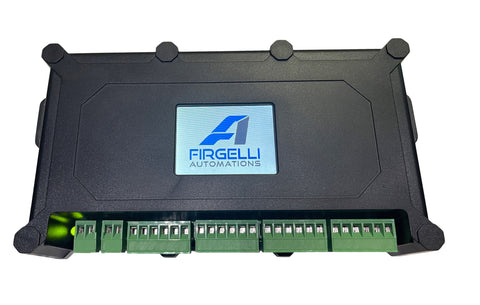
The adjustable speed control allows operators to fine-tune actuator velocity for specific process requirements, while customizable limit positions enable precise positioning without physical limit switch adjustments. Timer control functions support automated operation sequences, critical for unattended or scheduled operations. The interval mode proves particularly valuable in agricultural applications where equipment operates on defined cycles.
For applications requiring integration with PLCs or other industrial control systems, the F-SD's feedback signals interface readily with standard industrial protocols. The Hall sensor outputs provide both position information and direction sensing, enabling closed-loop control implementations without additional sensors.
When designing control systems for F-SD actuators, proper electrical protection is essential. Appropriate power supply sizing must account for inrush current during startup and sustained current during operation at load. Motor protection circuitry guards against overcurrent conditions, while limit switch monitoring prevents mechanical overtravel. In multi-actuator systems, synchronized control algorithms should include position error checking to detect and respond to individual actuator faults.
Installation and Mounting Considerations
Successful F-SD installation requires attention to both mechanical mounting and environmental factors. The actuator's mounting points must transfer full operational loads into the supporting structure without flexing or misalignment. Standard mounting brackets provide clevis or trunnion connections that allow for the slight angular deflection inherent in linear actuator installations.
Mounting geometry significantly impacts actuator performance and longevity. Side loading—forces perpendicular to the actuator's stroke axis—should be minimized through proper alignment and robust mounting. Applications involving significant side loads benefit from guide systems that constrain the load while allowing the actuator to provide pure axial force. In some cases, slide rails or linear bearings can support the load independently while the actuator provides motion control.
Environmental considerations extend beyond the actuator itself to include cable routing and electrical connections. The F-SD's IP66 rating protects the actuator body, but wiring connections require appropriate protection. Cable glands, sealed connectors, and proper strain relief prevent moisture ingress and mechanical damage. In high-vibration applications, additional wire management and connector securing prevent fatigue failures.
Thermal management, while less critical than in hydraulic systems, still requires consideration in high-duty-cycle applications. The 25% duty cycle rating assumes normal convective cooling. Applications approaching this duty cycle should ensure adequate airflow around the actuator body and avoid enclosure designs that trap heat. In particularly demanding applications, temperature monitoring can prevent thermal overload conditions.
Maintenance and Reliability
One of the F-SD series' most significant advantages over hydraulic alternatives is dramatically reduced maintenance requirements. Electric actuators eliminate hydraulic fluid, hoses, pumps, and the associated maintenance burden. However, some basic maintenance practices maximize F-SD service life and reliability.
Periodic inspection should focus on mounting hardware torque, electrical connection integrity, and mechanical alignment. Loose mounting bolts introduce vibration and accelerate wear, while compromised electrical connections create resistance heating and potential failure points. Visual inspection for physical damage, particularly to the actuator rod and seals, identifies potential issues before they cause failures.
The F-SD's sealed construction generally requires no lubrication maintenance, as internal components include appropriate lubrication during manufacturing. However, external mounting points may benefit from periodic lubrication, particularly in high-cycle applications. Clevis pins and bushings should be inspected for wear and replaced according to application-specific wear patterns.
In dusty or contaminated environments, periodic cleaning of the actuator exterior prevents buildup that could compromise sealing or create abrasion damage. The IP66 rating provides substantial protection, but proactive cleaning extends service life. Avoid high-pressure washing directly at seal interfaces, and ensure electrical connections remain properly sealed after any cleaning operations.
For applications involving the feedback system, periodic calibration verification ensures position accuracy remains within specifications. The Hall sensor system provides excellent long-term stability, but mechanical wear in mounting points or load-bearing components can introduce position errors over time. Recalibration procedures vary depending on the control system but generally involve setting known reference positions and updating controller parameters.
Comparing the F-SD to Other Actuator Options
Understanding where the Super Duty series fits within FIRGELLI's broader product line helps ensure optimal actuator selection for specific applications. While the F-SD excels in heavy-duty industrial environments, other actuator families may be more appropriate for certain use cases.
For applications requiring even higher force capacity or longer stroke lengths, FIRGELLI's column lift systems provide lifting forces up to several thousand pounds with strokes exceeding what's practical in a rod-style actuator. These lifting columns suit applications like adjustable workstations, medical equipment, and industrial positioning systems where vertical motion predominates.
Conversely, applications with more modest force requirements and tighter space constraints might be better served by FIRGELLI's bullet actuators or standard linear actuator series. These compact designs sacrifice some force capacity and environmental protection for reduced size and cost, making them ideal for furniture automation, light-duty machinery, and consumer product applications.
For applications requiring lateral motion guidance, track actuators integrate the actuator with a supporting rail system, eliminating side loading concerns and providing smooth, quiet operation. These units work particularly well in TV lifts, sliding panels, and other applications where the load moves perpendicular to gravity.
Rotary applications benefit from FIRGELLI's rotary actuators, which convert electric motor rotation directly into rotational motion without requiring linkages or conversion mechanisms. These units suit valve control, damper positioning, and other applications where rotary motion provides the most direct solution.
Future Developments and Industry Trends
Electric actuation technology continues evolving rapidly, driven by advances in motor design, control electronics, and integration capabilities. The F-SD series represents current best practices in industrial electric actuation, but ongoing developments promise even greater capabilities.
Connectivity and Industry 4.0 integration increasingly influence actuator design. Future iterations may include onboard diagnostics, predictive maintenance capabilities, and direct networking to industrial control systems. These features enable proactive maintenance scheduling, performance optimization, and integration with broader factory automation systems.
Battery-powered equipment, particularly in agriculture and material handling, drives demand for more efficient actuators with lower power consumption. Advances in motor and drive system design continue improving efficiency, extending battery runtime in cordless applications.
Integration with Arduino and other open-source control platforms enables rapid prototyping and custom automation solutions. The combination of capable industrial actuators with accessible control technologies democratizes advanced motion control, bringing sophisticated automation within reach of smaller operations and individual makers.
Frequently Asked Questions
What does the 25% duty cycle rating mean for the F-SD actuator?
The 25% duty cycle rating indicates that the F-SD can operate at full load for 25% of any given time period, with the remaining 75% allowing for cooling. Practically, this means in a 10-minute period, the actuator can run under full load for 2.5 minutes before requiring 7.5 minutes of rest. This rating significantly exceeds typical consumer actuators (10-20% duty cycle) and makes the F-SD suitable for demanding industrial applications with frequent operation. For applications running below maximum load, the actuator can sustain higher duty cycles. In continuous positioning applications with varying loads, the effective duty cycle often proves much higher than the rated maximum.
Can the F-SD Super Duty actuator be used in outdoor applications?
Yes, the F-SD's IP66 rating makes it well-suited for outdoor use. This rating certifies complete protection against dust ingress and protection against powerful water jets from any direction, meaning the actuator can withstand rain, washdown operations, and dusty environments typical of agricultural and industrial outdoor settings. However, electrical connections require proper protection using sealed connectors and appropriate cable glands. While the actuator body is weather-resistant, direct submersion is not recommended. For marine or particularly corrosive environments, additional protective measures such as protective coatings or more frequent inspection intervals may be warranted.
How do I control multiple F-SD actuators simultaneously for synchronized motion?
Multiple F-SD actuators can be synchronized using several approaches. For basic synchronized control, actuators can be wired in parallel to a single power source, though this approach doesn't compensate for individual actuator variations or load differences. For precise synchronization, FIRGELLI's intelligent motion controller provides dedicated synchronous mode that actively monitors each actuator's position via Hall sensor feedback and adjusts individual actuator speeds to maintain coordination. This closed-loop approach ensures synchronized motion even with varying loads or actuator characteristics. For custom applications, PLC-based control systems can implement sophisticated synchronization algorithms using the feedback signals from each actuator.
What stroke length should I choose for my application?
Stroke length selection depends on the total distance your application needs to move. As a general rule, select a stroke length that provides your required travel distance plus approximately 10-20% margin for mounting tolerances and mechanical variations. The F-SD offers strokes from 2 to 24 inches in 2-inch increments, providing flexibility for most applications. Consider that longer strokes create a longer fully-extended actuator, which may impact space constraints. Also account for the mounting method—clevis mounts require additional space beyond the stroke length when fully retracted. For complex mechanisms involving linkages or angular mounting, calculate the required actuator stroke using geometric analysis of the mechanism's motion.
What's the difference between Hall sensor and potentiometer feedback?
Hall sensor feedback, standard on the F-SD, uses magnetic sensing to detect actuator position without physical contact, providing excellent reliability and longevity since there are no wearing components. Hall sensors provide digital pulses that controllers count to determine position, offering good resolution and accuracy. Potentiometer feedback uses a resistive element that varies resistance based on actuator position, providing an analog voltage signal proportional to position. Potentiometers offer simpler interfacing for some control systems but include a physical contact wiper that can wear over time. For industrial applications, Hall sensors generally provide superior reliability, though potentiometer feedback can be specified for F-SD actuators when required by specific control system architectures.
What power supply do I need for the F-SD actuator?
The F-SD operates on 12VDC power, but proper power supply sizing requires considering both voltage and current capacity. Under load, the actuator draws substantial current—specific amperage varies with load and speed, but planning for 8-15 amps per actuator provides adequate margin for most applications. The power supply should maintain stable voltage under load, as voltage sag reduces actuator force and speed. For multiple actuator installations, calculate total current requirements by summing individual actuator demands, accounting for simultaneous operation. FIRGELLI offers appropriate power supplies sized for actuator applications. In vehicle or equipment installations with existing 12VDC systems, verify that the electrical system can support the additional load without compromising other functions.
What maintenance does the F-SD actuator require?
The F-SD requires minimal maintenance compared to hydraulic alternatives. Regular inspection every 3-6 months should verify mounting hardware torque, check electrical connections for corrosion or looseness, and inspect the actuator rod for damage or contamination. In dusty environments, periodically clean the actuator exterior to prevent buildup near seals. The internal mechanisms are permanently lubricated during manufacturing and don't require regular lubrication service. However, external mounting points like clevis pins should be lubricated according to application demands. In high-cycle applications, monitor for unusual noise or reduced performance that might indicate wear. The Hall sensor feedback system requires no maintenance but should be recalibrated if position accuracy drifts outside acceptable tolerances, typically only after significant mechanical wear in the overall system.


