Anytime you’re specifying a laser line, designing an optical filter, or dealing with a semiconductor bandgap, you usually hit the same practical concern: you need to convert between photon energy, wavelength, and frequency—and you have to get it right. This calculator lets you work out wavelength, frequency, energy, and photon momentum based on whichever of those numbers you already have. Problems show up across spectroscopy, photonics design, semiconductors, and optical communications, and even a 1 nm error can throw things off. Below, you’ll find the needed equations, a worked example, engineering background, and a full FAQ.
What is energy-to-wavelength conversion?
Energy-to-wavelength conversion means you’re calculating wavelength from a known photon energy (or the reverse). In practice: higher energy means shorter wavelength. That’s why gamma rays are tiny and radio waves are huge.
Simple Explanation
If you picture light as a wave on a rope, shaking the rope faster puts the wave peaks closer together (shorter wavelength), but it also delivers more energy along the rope. That’s the heart of it: energy and wavelength are linked through constants (Planck’s constant and the speed of light). Planck’s equation, E = hc/λ, simply quantifies what you usually see—shorter wavelengths, higher energy.
📐 Browse all 1000+ Interactive Calculators
Electromagnetic Wave Diagram

How to Use This Calculator
- Select your calculation mode from the dropdown — choose whether you're starting from energy, wavelength, or frequency.
- Enter your known value in the input field that appears (energy, wavelength, or frequency).
- Select the appropriate unit from the unit dropdown next to your input.
- Click Calculate to see your result.
Energy-Wavelength Calculator
This calculator is intended for education, concept evaluation, and preliminary design. Results are based on the equations and assumptions described on this page, but cannot account for every real-world load case, tolerance, material property, environmental condition, installation detail, safety factor, code, or regulatory requirement. Verify all inputs, assumptions, units, and results independently before selecting components or using the result in a real application. Safety-critical, structural, medical, lifting, transportation, or regulated applications must be reviewed by a qualified engineer.
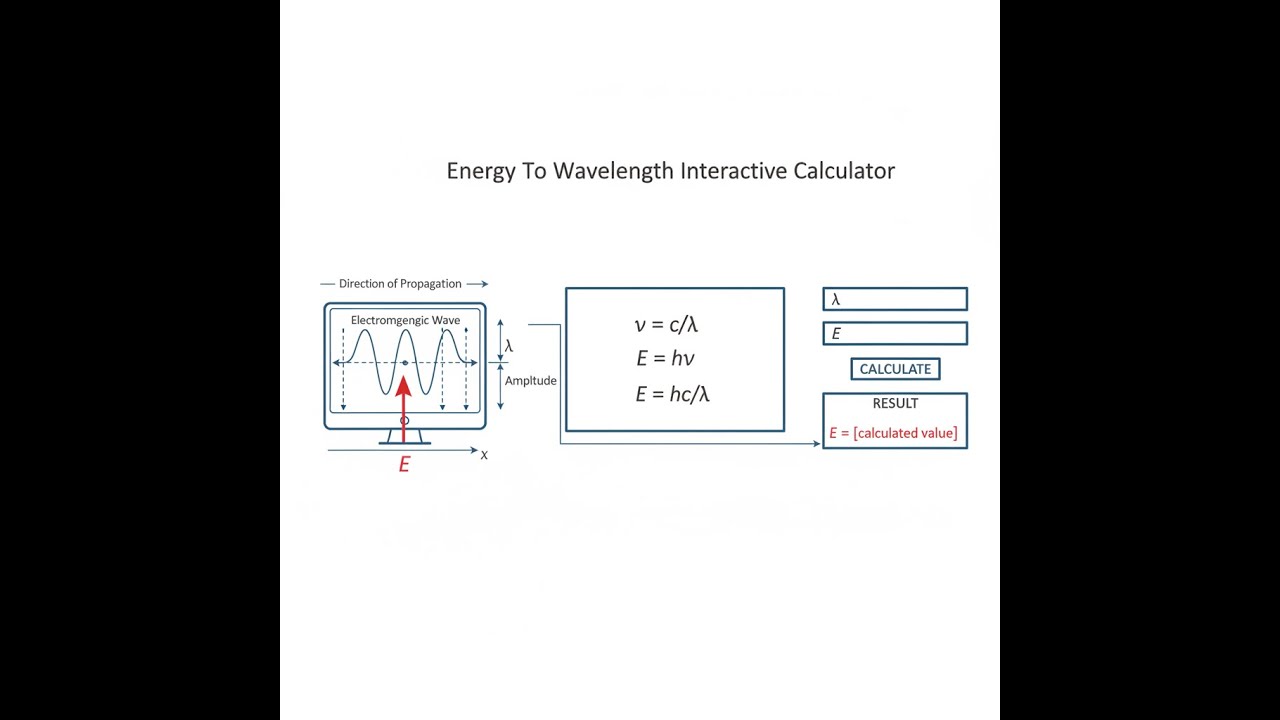
Energy to Wavelength Interactive Visualizer
You can see directly how higher photon energy always means a shorter wavelength, no matter where you are on the electromagnetic spectrum—from radio waves up to gamma rays.
WAVELENGTH
496 nm
FREQUENCY
605 THz
SPECTRUM
Visible
FIRGELLI Automations — Interactive Engineering Calculators
Fundamental Equations
To get photon energy from frequency, use this formula:
Planck-Einstein Relation (Energy-Frequency)
E = hν
E = photon energy (joules, J)
h = Planck's constant = 6.62607015 × 10⁻³⁴ J·s
ν (nu) = frequency (hertz, Hz)
Use this one for wavelength from energy:
Energy-Wavelength Relation
E = hc/λ
E = photon energy (joules, J)
h = Planck's constant = 6.62607015 × 10⁻³⁴ J·s
c = speed of light = 299,792,458 m/s
λ (lambda) = wavelength (meters, m)
And for frequency or wavelength via wave speed:
Wave Equation (Frequency-Wavelength)
c = λν
c = speed of light = 299,792,458 m/s
λ = wavelength (meters, m)
ν = frequency (hertz, Hz)
For photon momentum, start with either wavelength or energy:
Photon Momentum
p = h/λ = E/c
p = photon momentum (kg·m/s)
h = Planck's constant = 6.62607015 × 10⁻³⁴ J·s
λ = wavelength (meters, m)
E = photon energy (joules, J)
c = speed of light = 299,792,458 m/s
Simple Example
Say you have a photon energy of 2.5 eV (typical for visible light). With λ = hc/E:
λ = (6.626 × 10⁻³⁴ × 2.998 × 10⁸) / (2.5 × 1.602 × 10⁻¹⁹)
λ ≈ 496 nm — that’s blue-green light.
Frequency ≈ 605 THz. Spectrum region: Visible Light.
Theory & Practical Applications
Quantum Origins of the Energy-Wavelength Relationship
The classic E = hc/λ comes straight from Planck’s and Einstein’s work on blackbody radiation and the photoelectric effect. The point is practical: electromagnetic waves don’t just behave like waves—they also act like particles, with the energy of each “particle” inversely tied to wavelength. Planck’s constant, h, bridges the gap between the wave and particle story; it’s not just a historical footnote, it’s what you have to use every time you work out the energy–wavelength connection.
For engineering, this energy-wavelength link really matters. If you go shorter in wavelength, your photons are more energetic. For example, a 100 nm (ultraviolet) photon carries 12.4 eV, but a 1000 nm (infrared) photon is only 1.24 eV. This tells you immediately which photons can break chemical bonds, ionize atoms, or even punch through materials. If you’re doing anything from photochemistry to medical imaging, you’ll find these numbers line up with what works in the lab (or doesn’t).
Spectroscopic Applications and Selection Rules
The main job of this calculator in spectroscopy is to find out which photon wavelengths reach the right quantum transition. Electronic transitions (atoms): UV to visible, 100-700 nm, roughly 1.77-12.4 eV. Vibrational transitions (molecules): IR, 2.5-25 μm, or 0.05-0.5 eV. Rotational transitions: even further out, in the microwave. For classic atomic hydrogen, the Lyman-alpha line at 121.567 nm (10.20 eV) comes from the n=2→n=1 transition you see in textbooks—it checks out with the bandgap calculation.
But there’s a snag: not every theoretically allowed energy difference actually leads to a transition. Quantum selection rules mean many are forbidden in practice. For instance, for electric dipole transitions (strongest effect), Δℓ = ±1, so you can’t get s→s or d→d transitions directly. In vibrational spectroscopy, Δv = ±1 is the main path, though weak overtones exist. If you’re specifying a laser for a particular measurement, ignore selection rules at your peril—otherwise, you may end up with an expensive system that can’t probe your target feature.
Semiconductor Bandgap Engineering and Photovoltaics
If you’re specifying photodetectors or solar cells, these relationships tell you the real lower limit of what your device can detect. Photons must have energy greater than the bandgap to be absorbed. For silicon (Eg = 1.12 eV), anything longer than 1107 nm simply won’t be detected—it slips through. Pick gallium arsenide and the cutoff moves to 873 nm, so you’ll miss even more of the infrared. Engineers can blend alloys (like InxGa1-xAs) to tune this cutoff across the infrared for applications like telecom or sensing.
For solar applications, the optimum bandgap is a compromise between too much lost heat (from absorbing high-energy photons) and too many photons passing right through (if your bandgap is too high). The theory yields a sweet spot near 1.34 eV (925 nm), reflected in choices for high-end solar cells. If you pick a material like GaAs, you’re sacrificing some absorption, but gaining on thermalization losses—this is why these materials outperform silicon in lab-scale single-junction cells.
Optical Communication System Design
In optical fiber communications, you’re constantly picking wavelengths to match fiber transmission windows. The O-band (1260-1360 nm) hits zero-dispersion in silica fiber. The C-band (1530-1565 nm) is best for long transmission, lining up with EDFA amplifier gain. When you’re multiplexing many channels (WDM), lasers need to sit in precise “slots”—e.g., 100 GHz spacing (about 0.8 nm near 1550 nm), demanding laser stability and measurement within ±0.1 nm or better.
The energy-wavelength relationship also flags up where unwanted nonlinear effects can hit you in fiber—such as four-wave mixing (which depends on wavelength separation) or stimulated Raman scattering (which always shifts power from short to long wavelengths by a fixed amount). Both of these can limit how much power and how many channels you can fit in a link. So, use the formulas to predict those interaction wavelengths, not just spec laser part numbers.
Medical Phototherapy and Dosimetry
Choosing wavelengths for medical phototherapy isn’t guesswork. If you’re doing photodynamic therapy, you need your laser to match the drug’s absorption band. For example, Photofrin peaks at 630 nm, and protoporphyrin IX at 635 nm—these wavelengths penetrate a lot deeper into tissue than blue light, simply due to less scattering and absorption at longer wavelengths. If you need a target fluence, convert your laser power and wavelength to photon counts—it’s not just about watts, but how many “hits” you get in J/cm².
UV-based therapies show the wavelength dependence in biological effects: narrowband UVB (311 nm) is much less likely to burn than shorter UV, while DNA damage is most dangerous at 260 nm. If you’re planning treatments or writing protocols, always check how absorption changes by wavelength—nature evolved molecules like melanin for a reason in high-UV environments.
Worked Multi-Part Example: Laser System Specification
Problem: An optical engineer designs a Raman spectroscopy system to analyze pharmaceutical samples. The system uses a 532 nm excitation laser and must detect Raman-scattered light from C-H stretching vibrations at 2900 cm-1. Calculate: (a) the excitation photon energy in eV, (b) the energy shift of the Raman-scattered photons in eV, (c) the wavelength of the Stokes-shifted scattered light, (d) the wavelength separation required in the spectrometer, and (e) the number of photons emitted per second for 100 mW excitation power.
Solution:
(a) Excitation photon energy:
Given λexcitation = 532 nm = 532 × 10-9 m
Using E = hc/λ:
Eexcitation = (6.62607015 × 10⁻³⁴ J·s)(299,792,458 m/s) / (532 × 10-9 m)
Eexcitation = 3.7344 × 10⁻¹⁹ J
Converting to eV: Eexcitation = 3.7344 × 10⁻¹⁹ J / (1.602176634 × 10⁻¹⁹ J/eV)
Eexcitation = 2.331 eV
(b) Raman shift energy:
The Raman shift of 2900 cm-1 represents a vibrational energy difference.
Converting wavenumbers to energy: E(eV) = (wavenumber in cm-1) × (hc) / (eV)
Eshift = 2900 cm-1 × (1.23984 × 10-4 eV·m) / (10-2 m/cm)
Eshift = 0.3595 eV
(c) Stokes-shifted wavelength:
The Stokes-scattered photon has lower energy: EStokes = Eexcitation - Eshift
EStokes = 2.331 eV - 0.3595 eV = 1.9715 eV
Converting to joules: EStokes = 1.9715 eV × 1.602176634 × 10-19 J/eV = 3.1588 × 10⁻¹⁹ J
Using λ = hc/E:
λStokes = (6.62607015 × 10⁻³⁴ J·s)(299,792,458 m/s) / (3.1588 × 10⁻¹⁹ J)
λStokes = 6.2913 × 10⁻⁷ m
λStokes = 629.1 nm
(d) Wavelength separation:
Δλ = λStokes - λexcitation = 629.1 nm - 532.0 nm
Δλ = 97.1 nm
This substantial separation allows straightforward spectral filtering with notch filters or holographic gratings.
(e) Photon emission rate:
Power = 100 mW = 0.1 W = 0.1 J/s
Each photon carries Eexcitation = 3.7344 × 10⁻¹⁹ J
Photon rate = Power / Energy per photon
Photon rate = (0.1 J/s) / (3.7344 × 10⁻¹⁹ J/photon)
Photon rate = 2.68 × 10¹⁷ photons/second
Engineering significance: You can see from this that the 97.1 nm distance between excitation and Stokes light isn’t hard to resolve with decent spectrometers (down to 0.5 nm or less in many systems). And, even with poor collection, the photon rate is high enough to get solid Raman signals rapidly. Details like these are what you have to check, not just the raw energy or wavelength numbers. For more optical calculations, check the complete engineering calculator library.
Relativistic Corrections and High-Energy Photons
At high energies—mainly X-ray and gamma-ray—E = hc/λ still holds, but what happens to the photon after emission or collision changes. In this region, if you’re managing detectors or designing shielding, look up Compton scattering. Here, photons lose energy by scattering off electrons, actually shifting wavelength depending on the angle by Δλ = λC(1 - cos θ), with λC the electron Compton wavelength. For 511 keV photons, the Compton effect can’t be ignored; it will affect both detector response and proper shielding calculations.
Frequently Asked Questions
Free Engineering Calculators
Explore our complete library of free engineering and physics calculators.
Browse All Calculators →🔗 Explore More Free Engineering Calculators
About the Author
Robbie Dickson — Chief Engineer & Founder, FIRGELLI Automations
Robbie Dickson brings over two decades of engineering expertise to FIRGELLI Automations. With a distinguished career at Rolls-Royce, BMW, and Ford, he has deep expertise in mechanical systems, actuator technology, and precision engineering.
Need to implement these calculations?
Explore the precision-engineered motion control solutions used by top engineers.


