Acoustic engineers, room designers, and NDT technicians all run into the same core problem: sound doesn't behave the same way in every medium, and wavelength shifts with both frequency and the material the wave travels through. Use this Sound Wavelength Interactive Calculator to calculate wavelength, frequency, wave speed, or period using any combination of those inputs across 6 calculation modes. Getting wavelength right matters in room acoustics, ultrasonic flaw detection, speaker system design, and HVAC duct resonance—get it wrong and you're chasing problems that don't show up until commissioning. This page includes the fundamental wave equations, a worked concert hall example, variable definitions, and a full FAQ covering temperature effects, medium transitions, and ultrasonic resolution limits.
What is Sound Wavelength?
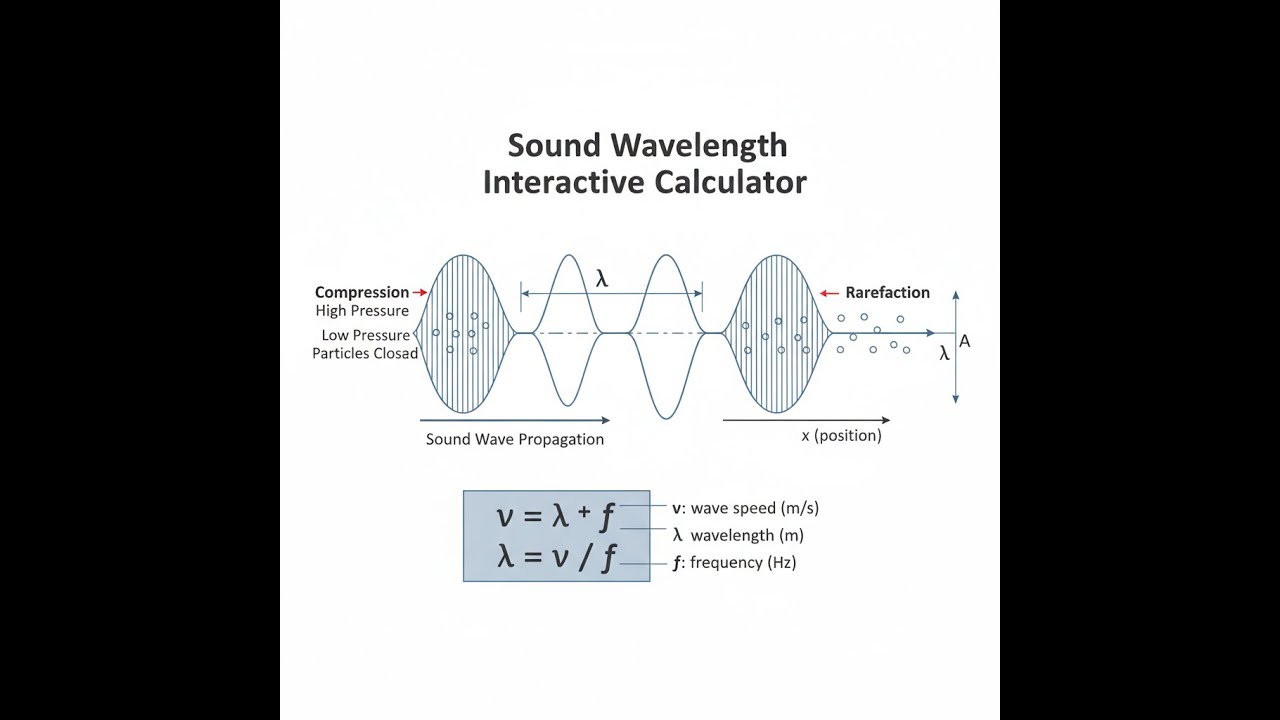
Sound wavelength is the physical distance between 2 successive pressure peaks (compressions) in a travelling sound wave. It depends on how fast the wave moves through a material and how many times per second the source oscillates — faster speed or lower frequency means a longer wavelength.
Simple Explanation
Think of dropping a stone in still water — the rings that spread out are like sound waves, and the gap between 2 rings is the wavelength. A low rumble (like a bass drum) has wide-spaced rings; a high-pitched whistle has rings packed tightly together. The same idea applies to sound moving through air, water, or steel — the medium just changes how fast those rings travel, which stretches or compresses the distance between them.
📐 Browse all 1000+ Interactive Calculators
Sound Wave Diagram

Interactive Calculator
How to Use This Calculator
- Select your Calculation Mode from the dropdown — choose what you want to solve for (wavelength, frequency, wave speed, or period).
- Enter the known values into the visible input fields — frequency (Hz), wave speed (m/s), wavelength (m), or period (s) depending on the mode selected.
- Check your units — wave speed defaults to 343 m/s (air at 20°C); update it if you're working in water, steel, or another medium.
- Click Calculate to see your result.
Sound Wavelength Interactive Visualizer
Watch how frequency and wave speed control wavelength in real-time. Adjust the controls to see sound waves stretch and compress as they travel through different media.
WAVELENGTH
0.78 m
PERIOD
2.27 ms
MEDIUM
Air
FIRGELLI Automations — Interactive Engineering Calculators
Fundamental Equations
Use the formula below to calculate sound wavelength, frequency, wave speed, or period.
v = λ × f
Wave speed (m/s) = Wavelength (m) × Frequency (Hz)
λ = v / f
Wavelength (m) = Wave speed (m/s) / Frequency (Hz)
f = v / λ
Frequency (Hz) = Wave speed (m/s) / Wavelength (m)
T = 1 / f
Period (s) = 1 / Frequency (Hz)
λ = v × T
Wavelength (m) = Wave speed (m/s) × Period (s)
Variable Definitions:
- v — Wave speed through the medium (m/s)
- λ (lambda) — Wavelength, the spatial period of the wave (m)
- f — Frequency, number of oscillations per second (Hz)
- T — Period, time for one complete oscillation (s)
Simple Example
A concert A note plays at 440 Hz through air at room temperature (343 m/s).
- Mode: Calculate Wavelength
- Frequency: 440 Hz
- Wave Speed: 343 m/s
- Result: λ = 343 / 440 = 0.780 m
Theory & Practical Applications
Sound wavelength represents the spatial distance between successive compressions or rarefactions in a propagating pressure wave. Unlike electromagnetic waves which can travel through vacuum, sound requires a material medium for propagation. The wavelength-frequency relationship v = λf is fundamental but deceptively simple—the wave speed v is not a universal constant but depends critically on the medium's elastic properties and density through the relationship v = √(K/ρ) for longitudinal waves, where K is the bulk modulus and ρ is density.
Wave Propagation Mechanisms in Different Media
In gases, sound propagates through collisional momentum transfer between molecules. The speed in an ideal gas follows v = √(γRT/M), where γ is the heat capacity ratio (1.4 for air), R is the gas constant, T is absolute temperature, and M is molar mass. This temperature dependence creates the non-obvious effect that wavelength for a fixed frequency changes with temperature—a 1000 Hz tone has wavelength 0.343 m at 20°C but only 0.331 m at 0°C, a 3.5% decrease that affects resonance calculations in HVAC systems and concert halls across seasonal temperature variations.
In liquids and solids, intermolecular forces dominate propagation. Water's bulk modulus of 2.2 GPa combined with density 1000 kg/m³ yields a sound speed of 1480 m/s—over four times faster than air. This dramatic increase causes wavelength to increase proportionally: a 1 kHz signal has wavelength 1.48 m in water versus 0.343 m in air. Steel's longitudinal wave speed of 5960 m/s creates wavelengths 17 times longer than in air at identical frequencies, which fundamentally changes how structures respond to acoustic excitation and why ultrasonic testing frequencies must be carefully selected based on material properties and defect sizes.
Acoustic Resonance and Standing Waves
Resonance occurs when wave reflections constructively interfere with incident waves, creating standing wave patterns. For a pipe closed at one end, resonant frequencies satisfy f_n = nv/(4L) where n is odd (1, 3, 5...) and L is pipe length. The fundamental resonance wavelength is λ₁ = 4L. For a 0.5 m closed pipe in air, the fundamental frequency is 343/(4×0.5) = 171.5 Hz with wavelength 2.0 m. The practical implication: changing pipe length by 1 cm shifts resonance by approximately 3.4 Hz, which matters critically in organ pipe tuning where temperature-induced speed changes of 0.6 m/s per °C combine with thermal expansion to detune instruments.
Room acoustics depend on wavelength-dimension relationships. Wavelengths comparable to room dimensions create modal resonances. A 5 m × 4 m × 3 m room has first axial modes at f = v/(2L) yielding 34.3 Hz, 42.9 Hz, and 57.2 Hz for the length, width, and height dimensions respectively. These low-frequency modes cause the "boomy" bass response in small rooms where λ exceeds room dimensions. Professional acoustic treatment targets wavelengths above 0.3 m (frequencies below 1143 Hz) because standard 50 mm acoustic foam only absorbs effectively when material thickness exceeds λ/10.
Ultrasonic Applications and Near-Field Effects
Ultrasonic frequencies above 20 kHz create wavelengths below 17 mm in air, enabling directional sound projection and high-resolution sensing. At 40 kHz (a common ultrasonic sensor frequency), wavelength in air is 8.6 mm. This enables obstacle detection with spatial resolution approaching λ/2 ≈ 4 mm, explaining why ultrasonic rangefinders typically specify ±3 mm accuracy. However, wavelength-dependent attenuation increases with f², causing 40 kHz signals to attenuate 100 times faster than 1 kHz signals over distance, limiting practical range to 3-8 m in air.
In ultrasonic testing of metals, wavelength must be carefully matched to flaw size. To detect a 1 mm crack in steel, wavelength must be comparable or smaller. Using v = 5960 m/s for steel, this requires f = v/λ = 5960/0.001 = 5.96 MHz. Industry standards typically specify using frequencies where λ = 2-3 times the minimum detectable flaw size to balance resolution against penetration depth, as shorter wavelengths attenuate more rapidly through grain boundaries and material interfaces.
Near-field effects become significant within the Fresnel distance N = D²f/(4v), where D is transducer diameter. For a 25 mm diameter transducer at 2.25 MHz in steel (λ = 2.6 mm), N = (0.025)²(2.25×10⁶)/(4×5960) = 59 mm. Within this distance, beam patterns are irregular and amplitude fluctuates unpredictably, requiring ultrasonic inspection protocols to position transducers beyond N to ensure reliable measurements. This geometric constraint directly determines minimum inspection standoff distances in aerospace and nuclear applications.
Doppler Effect and Moving Sources
When sources or observers move, observed wavelength and frequency shift according to the Doppler equations. For a source moving at velocity v_s toward a stationary observer, observed frequency is f' = f(v/(v - v_s)). A 1 kHz siren on a vehicle approaching at 30 m/s appears at f' = 1000(343/(343-30)) = 1096 Hz, but the wavelength measured ahead of the source is compressed to λ' = v/f' = 343/1096 = 0.313 m versus 0.343 m for the stationary wavelength. Behind the source, wavelength stretches to 0.373 m. This asymmetry is exploited in police radar, medical ultrasound blood flow measurement, and astrophysical velocity determination.
Worked Example: Concert Hall Acoustic Design
Problem: A concert hall measures 42 m long, 28 m wide, and 16 m high with average temperature 22°C. The design requires controlling the first three axial modes along each dimension and sizing acoustic absorbers. Calculate: (a) the first three resonant frequencies and wavelengths for the length dimension, (b) the minimum absorber thickness for 80% absorption of the fundamental mode, (c) the wavelength of a 440 Hz A4 note, and (d) the expected frequency shift of this note due to temperature rise to 26°C during a full concert.
Solution:
(a) Axial mode analysis:
First, determine sound speed at 22°C. Using v ≈ 331.3 + 0.606T with T in Celsius:
v = 331.3 + 0.606(22) = 331.3 + 13.33 = 344.6 m/s
For a rectangular room, axial modes occur at frequencies f_n = nv/(2L) where n = 1, 2, 3... along the length L = 42 m:
f₁ = 1(344.6)/(2×42) = 344.6/84 = 4.10 Hz, λ₁ = v/f₁ = 344.6/4.10 = 84.0 m
f₂ = 2(344.6)/(2×42) = 688/84 = 8.20 Hz, λ₂ = v/f₂ = 344.6/8.20 = 42.0 m
f₃ = 3(344.6)/(2×42) = 1033.8/84 = 12.30 Hz, λ₃ = v/f₃ = 344.6/12.30 = 28.0 m
These infrasonic modes are felt as pressure variations rather than heard. The fundamental mode has wavelength exactly twice the room length, creating maximum pressure variation between end walls.
(b) Absorber thickness requirement:
For 80% absorption, porous absorber thickness must exceed λ/4 of the target frequency. For the 4.10 Hz fundamental:
Minimum thickness = λ₁/4 = 84.0/4 = 21.0 m
This is completely impractical, illustrating why controlling low-frequency room modes requires architectural solutions (non-parallel walls, room dimension ratios) rather than absorptive materials. Typical practice: design room dimensions with ratio 1:1.6:2.5 to spread modal frequencies more evenly, avoiding coincident modes that cause severe resonances.
(c) Musical note wavelength:
For A4 at 440 Hz in air at 22°C:
λ = v/f = 344.6/440 = 0.783 m = 78.3 cm
This wavelength is comparable to human torso dimensions, causing significant diffraction around audience members. This creates acoustic shadow zones and explains why high frequencies (shorter wavelengths) appear more directional than bass frequencies in concert venues.
(d) Temperature-induced frequency shift:
At 26°C, new sound speed:
v' = 331.3 + 0.606(26) = 331.3 + 15.76 = 347.1 m/s
For a fixed-length organ pipe (closed tube), frequency shifts proportionally with speed since f = v/(4L) for fundamental mode. The relative frequency change equals relative speed change:
Δf/f = Δv/v = (347.1 - 344.6)/344.6 = 2.5/344.6 = 0.00725 = 0.725%
For 440 Hz: Δf = 440(0.00725) = 3.19 Hz
The note shifts to 443.19 Hz, nearly a third of a semitone sharp. This explains why orchestras tune to the oboe at performance temperature and why organ tuning requires stable thermal conditions. String instruments compensate by adjusting tension; wind instruments cannot, making temperature control critical in professional venues.
For additional physics calculators including wave interference and Doppler effect analysis, visit the FIRGELLI Engineering Calculator Hub.
Frequently Asked Questions
Free Engineering Calculators
Explore our complete library of free engineering and physics calculators.
Browse All Calculators →🔗 Explore More Free Engineering Calculators
About the Author
Robbie Dickson — Chief Engineer & Founder, FIRGELLI Automations
Robbie Dickson brings over two decades of engineering expertise to FIRGELLI Automations. With a distinguished career at Rolls-Royce, BMW, and Ford, he has deep expertise in mechanical systems, actuator technology, and precision engineering.
Need to implement these calculations?
Explore the precision-engineered motion control solutions used by top engineers.


