Drawer slides are one of those ubiquitous mechanical components that most people use dozens of times per day without a second thought. From kitchen cabinets to office desks, toolboxes to medical carts, these elegant telescoping mechanisms enable smooth, controlled linear motion in countless applications. Yet despite their simplicity, selecting the right drawer slide for your project requires understanding key mechanical principles, load characteristics, and design trade-offs.
Whether you're a DIY enthusiast building custom cabinetry, an engineer designing industrial equipment, or simply looking to upgrade your existing drawers, this comprehensive guide will walk you through everything you need to know about drawer slides. We'll explore how they work, compare different types, explain critical selection criteria, and provide practical insights to ensure your next project performs reliably under real-world conditions.
Understanding drawer slides becomes especially important when integrating them with automated systems. Many modern applications combine drawer slides with linear actuators to create motorized slide-out shelving, automated storage systems, and precision positioning mechanisms that blend mechanical stability with electric control.
Guide the load properly — the actuator should not become the guide.
Engineering principle: a drawer slide carries weight only when it stays aligned. Parallel rails, level mounting, and a rigid cabinet structure do the real work. The moment the slide is forced to act as the guide for a misaligned drawer, wear and binding follow.
"The load rating on the slide is only the start. The fasteners, the cabinet wall, and the drawer box all sit in the same load path, and the weakest one decides what the system can actually carry." — Robbie Dickson, Founder and Chief Engineer of FIRGELLI Automations
What is a Drawer Slide?
A drawer slide—sometimes called a drawer roller or drawer runner—is a mechanical device that enables telescopic linear motion along a single axis. At its core, it's an elegant solution to a common engineering challenge: how to support a moving component while maintaining stability, alignment, and load capacity throughout the entire range of motion.
The fundamental principle behind drawer slides involves one grooved component sliding over a rolling element (either rollers or ball bearings), which allows the entire mechanism to extend smoothly outward and retract inward. This telescopic design means the mechanism collapses into itself when closed, maximizing space efficiency—a critical advantage in applications from kitchen cabinets to industrial tool carts.
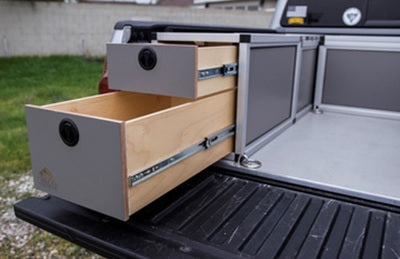
While drawer slides are inherently non-motorized mechanisms, they can be effectively coupled with linear actuators to create automated motion systems. This combination provides the structural stability and load-bearing capacity of drawer slides with the controlled, programmable movement of electric actuators—ideal for applications like automated kitchen shelving, medical equipment, or industrial slide-out platforms.
Common applications for drawer slides include:
- Kitchen cabinets and pantry pull-outs
- Desk drawers and office furniture
- Tool chests and workshop storage
- Medical carts and equipment
- Vehicle storage systems (trucks, RVs, emergency vehicles)
- Server racks and IT equipment
- Industrial machinery access panels
- Pull-out cutting boards and appliance garages
In virtually all installations, drawer slides are used in pairs mounted on opposite sides of the moving component. This paired configuration ensures balanced load distribution, prevents binding or twisting during operation, and maintains proper alignment throughout the stroke length.
What are the main types of drawer slides?
Understanding the different types of drawer slides is essential for selecting the right mechanism for your application. The two primary categories—roller slides and ball-bearing slides—each offer distinct advantages in terms of cost, load capacity, smoothness of operation, and durability.
Roller Slides
Roller slides represent the simpler and more economical option in drawer slide design. They consist of two main components: the cabinet member (which mounts to the stationary frame) and the drawer member (which attaches to the moving component). Each member incorporates a roller, typically manufactured from durable plastic compounds, which interfaces with a corresponding groove in the opposite member.

The operational mechanics of roller slides are straightforward but effective. When fully retracted, the two rollers sit at opposite ends of the mechanism, with the cabinet member's roller positioned at the front. As you extend the slide, the cabinet member's roller allows the drawer member to move outward while the drawer member's roller follows along the groove in the cabinet member. At full extension, the two rollers meet, which typically defines the maximum stroke length.
This two-roller design provides horizontal stability and ensures level extension throughout the travel range. The rollers bear the load while minimizing friction, allowing for smooth operation even under moderate loads. However, roller slides generally have lower load ratings compared to ball-bearing designs and may not provide the same level of smoothness in operation, particularly under heavier loads or after extended use.
Roller slides are ideal for:
- Light to medium-duty applications
- Cost-sensitive projects
- Residential furniture and cabinetry
- Applications where occasional use is expected
- Situations where the slightly audible rolling action is acceptable
Ball-Bearing Slides
Ball-bearing slides represent a more sophisticated approach to drawer slide design, incorporating precision ball bearings instead of plastic rollers to facilitate motion. These slides feature a three-component design: the cabinet member, an intermediate member, and the drawer member. Two sets of ball bearings interface between these components, creating exceptionally smooth operation.

The first set of ball bearings runs between the cabinet member and the intermediate member, while the second set operates between the intermediate member and the drawer member. During extension, the drawer member moves first, sliding along the ball bearings between itself and the intermediate member. Once the drawer member reaches the end of its travel on these bearings, the intermediate member begins to slide along the bearings between itself and the cabinet member until the mechanism reaches full extension.
This sequential extension pattern allows for longer stroke lengths relative to the closed length of the mechanism. Many ball-bearing slides offer full-extension capability, meaning the drawer can extend completely beyond the cabinet face—a significant advantage for accessing items stored at the back of deep cabinets or drawers.
Ball-bearing slides provide several performance advantages:
- Significantly higher load ratings than comparable roller slides
- Smoother, quieter operation
- Greater durability and cycle life
- More consistent performance under heavy loads
- Full or over-extension capabilities in many models
- Some models feature quick-disconnect mechanisms for easier installation

Heavy-Duty Ball-Bearing Slides: For industrial applications, vehicle storage systems, or any situation requiring exceptional load capacity, heavy-duty ball-bearing slides are available. These robust mechanisms may incorporate hardened steel ball bearings, reinforced members, and specialized sealing to protect against contaminants. Load ratings can exceed several hundred pounds per pair, making them suitable for demanding environments like workshop storage, industrial equipment, and commercial vehicle applications.
An important installation consideration: some ball-bearing slides allow the drawer member to be disconnected from the rest of the mechanism by pressing a release lever. This feature simplifies installation and removal but isn't universal across all models. Always consult the manufacturer's specifications to understand the disconnection capabilities of your specific slides.
Comparison: Roller slides vs Ball-bearing slides
| Attribute | Roller slides | Ball-bearing slides |
|---|---|---|
| Members | 2 (cabinet + drawer) | 3 (cabinet + intermediate + drawer) |
| Rolling element | Plastic rollers | Precision steel ball bearings |
| Typical load per pair | 50–75 lb | 100–150 lb standard; 200–500 lb+ heavy-duty |
| Extension | Usually partial (~75%) | Full extension common; over-extension available |
| Smoothness | Moderate; audible | Smooth and quieter |
| Cycle life | Lower | Higher |
| Cost | Lower | Higher |
| Best use | Light residential cabinetry, occasional use | Heavy-duty, frequent use, vehicle/industrial storage |
How are drawer slides different from slide rails?
While both drawer slides and slide rails (also called linear guides or linear bearings) enable linear motion, they serve distinctly different purposes and offer different capabilities. Understanding these differences is crucial for selecting the right mechanism for your application.

Slide Rail Fundamentals
Slide rails consist of two basic components: a carriage (or bearing block) and a rail. The carriage contains precision bearings—either ball bearings or roller bearings—that fit into precisely machined grooves in the rail. This design allows the carriage to travel smoothly along the rail with minimal friction and exceptional precision.
Slide rails are predominantly used in industrial and robotic applications where precise linear positioning is critical. Common applications include CNC machines, 3D printers, robotic arms, precision measurement equipment, and automated manufacturing systems. The engineering focus is on rigidity, precision, repeatability, and resistance to deflection under load.
Key Differences Between Drawer Slides and Slide Rails
The most fundamental difference is that drawer slides are telescopic while slide rails are not. Drawer slides collapse into themselves, with a closed length roughly equal to their extension length. Slide rails maintain a fixed length equal to the rail itself, with the carriage traveling along this fixed-length rail. This means a slide rail system will always be as long as its maximum travel distance, plus the length of the carriage.
Other critical differences include:
- Precision: Slide rails typically offer higher precision and tighter tolerances, making them preferred for applications requiring exact positioning.
- Rigidity: Slide rails generally provide superior rigidity and resistance to deflection, especially important in machining applications where cutting forces are present.
- Space efficiency: Drawer slides win decisively in space-constrained applications due to their telescopic design.
- Load orientation: Drawer slides are optimized for loads perpendicular to the direction of travel, while slide rails can be configured for various load orientations.
- Cost: Drawer slides are typically more economical for applications not requiring extreme precision.
- Installation: Drawer slides generally offer simpler installation for furniture and cabinet applications.
When integrating either mechanism with linear actuators for automated motion, drawer slides provide excellent stability for applications like automated storage retrieval, while slide rails might be preferred for precision positioning in industrial automation or CNC applications.
What should you consider when selecting drawer slides?
Selecting the appropriate drawer slide for your application requires evaluating several key factors that will determine whether your design performs reliably under real-world conditions. These considerations become even more important when integrating slides into custom furniture, automated systems, or industrial equipment.
Load Rating and Capacity
Load rating—sometimes called load capacity or weight rating—represents the maximum allowable load the drawer slide can handle before failure. This specification is typically provided per pair of slides, not per individual slide, so pay close attention to manufacturer documentation.
However, understanding load ratings requires more nuanced thinking than simply ensuring your load is below the rated capacity. Your drawer slide might be rated for 300 pounds, but that doesn't automatically mean your complete system will support 300 pounds. The load creates shear stress on mounting fasteners and generates corresponding forces on the cabinet structure. If these components cannot handle the load, your system will fail regardless of the slide's rating.
To properly evaluate load capacity, consider:
- Fastener shear strength: The screws or bolts mounting your slides experience shear forces. Calculate the shear stress based on fastener diameter, quantity, and material properties.
- Cabinet structure: The cabinet or frame supporting the slides must withstand the reaction forces without deflecting or failing.
- Material thickness: Thin cabinet walls may not provide adequate support even if fasteners are strong enough.
- Dynamic vs. static loads: Some manufacturers distinguish between static load (stationary drawer) and dynamic load (drawer in motion). Dynamic ratings are typically lower.
- Safety factor: Engineering practice suggests designing for loads significantly below the rated maximum to account for unexpected forces, wear over time, and safety margins.
For applications requiring substantial load capacity, heavy-duty ball-bearing slides or even industrial actuators with integrated slide mechanisms may be necessary.
Extension Length and Stroke
Maximum extension determines how far your drawer or platform can travel from the fully retracted position. This dimension directly impacts the total length and closed length of your drawer slide mechanism.
For most standard drawer slides, a useful rule of thumb applies: the maximum extension length approximately equals the fully retracted (closed) length, and both equal roughly half the total length of the slide. For example, a slide with 20 inches of travel will typically be about 20 inches long when closed and 40 inches total when fully extended.
Key considerations for extension length:
- Full-extension vs. partial-extension: Full-extension slides allow the drawer to extend completely beyond the cabinet face, providing access to the entire drawer depth. Partial-extension slides typically extend 75-80% of their length.
- Over-extension: Some specialized slides offer over-extension capability, extending beyond 100% of the closed length, useful for specific access requirements.
- Cabinet and drawer depth: Both your cabinet structure and drawer component must be at least as long as the fully retracted slide length to ensure proper mounting and support.
- Clearance for extension: Ensure adequate space exists in front of the cabinet for the drawer to extend fully without obstruction.
When incorporating linear actuators to motorize drawer slides, the actuator stroke must match or exceed the slide extension to achieve full travel.
Thickness and Clearance Requirements
The thickness of the drawer slide mechanism—measured from the mounting surface on the cabinet side to the mounting surface on the drawer side—determines the minimum clearance required between your stationary and moving components.
Typical drawer slide thickness ranges from approximately 0.5 inches for compact slides to over 1 inch for heavy-duty industrial mechanisms. This dimension becomes critical in space-constrained designs where every fraction of an inch matters.
Consider thickness in relation to:
- Available clearance: The gap between your cabinet interior and drawer exterior must accommodate the slide thickness plus a small clearance margin.
- Drawer width: In narrow drawer applications, slide thickness can consume significant proportions of available width.
- Specialty configurations: Under-mount slides, which attach to the drawer bottom rather than sides, offer different clearance requirements and may be preferable in certain designs.
Mounting Configuration and Installation
Proper mounting is essential for reliable drawer slide operation. The most common configuration uses a pair of slides mounted vertically on opposite sides of the drawer, but other arrangements exist for specialized applications.
Side-Mount Configuration: The standard approach, with slides mounted to the left and right sides of the drawer and cabinet. This configuration provides excellent stability and is suitable for most applications.
Bottom-Mount Configuration: Some slides can be mounted horizontally beneath the drawer bottom. Always verify that your specific slide model supports bottom mounting, as this configuration may affect load ratings and require different mounting hardware. Bottom-mount slides are often preferred in frameless cabinetry or when maximizing drawer interior space.
Single-Slide Applications: While rare, some specialized heavy-duty slides can support loads independently. However, paired installation remains the standard for stability and balanced load distribution.
Critical mounting considerations include:
- Hole patterns: Drawer slides feature specific mounting hole patterns. If you're fabricating custom components, ensure mounting holes align precisely with slide specifications and are level.
- Fastener type and size: Use fasteners appropriate for the material (wood screws for wood, machine screws for metal) and ensure adequate thread engagement.
- Alignment: Slides must be perfectly parallel and level to prevent binding. Even slight misalignment can cause premature wear or operational issues.
- Material compatibility: Ensure mounting surfaces are thick and rigid enough to support fasteners without splitting or deflecting.
When integrating slides with mounting brackets for actuators or other automation components, careful attention to alignment and fastener selection ensures reliable long-term operation.
What advanced factors matter for specialized drawer slide applications?
Beyond the fundamental selection criteria, certain applications demand attention to additional factors that affect performance, longevity, and suitability for specific environments.
Soft-Close and Self-Close Features
Many modern drawer slides incorporate dampening mechanisms that provide soft-close functionality, gently decelerating the drawer as it approaches the closed position. This feature prevents slamming, reduces noise, and extends the life of both the slides and the furniture. Some models also offer self-close capability, where the drawer automatically pulls itself closed once it reaches a certain point.
Environmental Factors
Operating environment significantly impacts drawer slide selection:
- Corrosion resistance: Standard steel slides may rust in humid or outdoor environments. Stainless steel or zinc-plated options provide better corrosion resistance.
- Temperature extremes: Some applications (automotive, outdoor equipment) experience wide temperature ranges that can affect lubricants and material properties.
- Contamination: Dusty, dirty, or wet environments may require sealed bearing designs to prevent premature failure.
- Food service and medical: Applications requiring frequent cleaning may need slides with antimicrobial coatings or designs that facilitate sanitation.
Integration with Motion Control Systems
For automated applications, drawer slides often work in conjunction with linear actuators to create programmable motion systems. This integration enables applications like:
- Automated kitchen storage with motorized pull-out shelves
- Industrial pick-and-place systems
- Medical equipment with controlled drawer extension
- Retail display systems with synchronized motion
- Accessibility solutions for individuals with limited mobility
When designing actuated drawer slide systems, ensure the actuator force rating, stroke length, and speed are compatible with the slide specifications. Track actuators can be particularly effective for this application, as they provide built-in guidance while generating linear motion.
Control systems typically require a control box and appropriate power supply to operate actuators reliably. For positioning applications, feedback actuators provide precise position control through integrated sensors.
How do you select drawer slides for your project?
Armed with understanding of drawer slide types, mechanical principles, and selection criteria, you can now approach your project with confidence. The selection process should follow these steps:
- Define your requirements: Determine load capacity, extension length, available clearance, and mounting configuration.
- Evaluate operating conditions: Consider environment, duty cycle, and any special requirements like corrosion resistance or soft-close features.
- Calculate system capacity: Verify that not just the slides, but your entire system—fasteners, cabinet structure, and drawer components—can handle the intended loads with appropriate safety margins.
- Consider future needs: If you might add automation later, select slides compatible with linear actuators and ensure adequate space for mounting actuators and control systems.
- Review manufacturer specifications: Always consult detailed specifications rather than relying on general categories or assumptions.
- Plan installation carefully: Precise alignment and appropriate fasteners are critical for reliable operation.
For projects requiring motorized operation, FIRGELLI Automations offers a complete range of drawer slides, compatible actuators, control systems, and accessories to create reliable automated motion solutions. Whether you're building custom furniture, industrial equipment, or specialized automation systems, selecting the right drawer slide foundation ensures your project performs reliably for years to come.
What usually goes wrong with drawer slides?
Most drawer slide failures aren't really slide failures. They're load-path failures, alignment failures, or environment failures that show up at the slide. The common ones:
- Misalignment binding. Rails not parallel or not level. The slide drags, wears unevenly, and starts to feel rough long before it actually fails.
- Fastener or cabinet-wall failure. The slide is rated for the load, but the screws pull out of a thin cabinet wall. The slide is fine; the structure underneath isn't.
- Overload of roller slides. A roller-type slide used in a heavy-duty role flattens the plastic rollers, and the drawer starts to sag and stick.
- Contamination of bearings. Sawdust, grit, or moisture get into unsealed ball-bearing tracks. Operation gets gritty and bearings spall.
- Wrong extension type. Partial-extension slides used where full access is needed — the back of the drawer never reaches the user, and items get trapped.
- Single-slide use on an asymmetric load. Skipping the pair and using one slide on heavy loads — twisting forces destroy the mechanism quickly.
How should you test a drawer slide installation before trusting it?
Repeated cycles with real load prove the design, and the hard part of travel is the last inch of extension — not the easy middle. A short test sequence catches most problems before they become callbacks:
- Check parallel and level with the drawer removed. Run a straightedge across the front edges of both slides; any twist will show before you ever load it.
- Cycle the empty drawer end-to-end at least 20 times. Listen for grit, watch for binding at the last inch of extension — that's where geometry errors hide.
- Load to the intended working weight (not the rated maximum) and cycle again. Watch the front of the drawer at full extension — sag or droop means the load path is wrong, not the slide.
- Push down hard on the fully extended drawer at its outer edge. If the cabinet wall flexes or the fasteners creak, the structure — not the slide — will be the failure point.
- For automated systems, run the full duty cycle with the actuator before committing wiring and finished panels.
Frequently Asked Questions
What's the difference between roller slides and ball-bearing slides?
Roller slides use plastic rollers and a two-member design (cabinet and drawer), making them more economical but with lower load ratings and less smooth operation. Ball-bearing slides use precision ball bearings and a three-member design (cabinet, intermediate, and drawer), providing higher load capacity, smoother operation, greater durability, and often full-extension capability. Ball-bearing slides are preferred for heavy-duty applications, frequent use, or situations requiring very smooth, quiet operation, while roller slides work well for light-duty residential applications where cost is a primary consideration.
How much weight can drawer slides hold?
Drawer slide load capacity varies dramatically based on type and quality. Light-duty roller slides might support 50-75 pounds per pair, while standard ball-bearing slides typically handle 100-150 pounds per pair. Heavy-duty ball-bearing slides can support 200-500 pounds or more per pair. However, the rated capacity assumes proper installation on adequate supporting structure with appropriate fasteners. Your actual system capacity depends on the weakest component—whether that's the slide, fasteners, cabinet structure, or drawer construction. Always design with a safety margin below the rated maximum capacity.
What does full-extension mean for drawer slides?
Full-extension drawer slides allow the drawer to extend completely beyond the cabinet face, providing access to the entire depth of the drawer. This means if your drawer is 20 inches deep, it can extend the full 20 inches outward. Partial-extension slides typically extend only 75-80% of their length, leaving the back portion of the drawer inside the cabinet. Full-extension is particularly valuable for deep drawers, file cabinets, or any application where you need complete access to items stored at the back. Some specialized slides even offer over-extension capability, extending beyond 100% of the closed length.
Can I mount drawer slides on the bottom instead of the sides?
Some drawer slide models are designed to support bottom-mount (under-mount) configuration, but not all slides are suitable for this application. Bottom mounting can affect load ratings, may require specific slide models designed for this purpose, and typically demands different mounting hardware than side-mount installation. Always verify with the manufacturer's specifications that your specific slide model supports bottom mounting before attempting this configuration. Bottom-mount slides are popular in frameless cabinetry and when you want to maximize interior drawer space by eliminating side-mounted hardware.
Can drawer slides be motorized with linear actuators?
Yes, drawer slides can be effectively motorized by coupling them with linear actuators. This combination provides the structural stability and load-bearing capacity of drawer slides with the controlled, programmable movement of electric actuators. The actuator attaches to the drawer component and cabinet structure, pushing or pulling the drawer along the slides. This approach is used in automated storage systems, accessibility solutions, industrial equipment, and smart furniture applications. When designing actuated systems, ensure the actuator stroke matches the slide extension length, the actuator force exceeds the required pushing/pulling force (accounting for friction and load), and you have adequate space for mounting the actuator and associated control systems.
How do I measure for drawer slides?
To measure for drawer slides, you need to determine three key dimensions: the depth of your cabinet opening (from front to back), the depth of your drawer box, and the available clearance between the cabinet interior and drawer exterior. The drawer slide's closed length must fit within your cabinet depth, and the extension length should provide adequate access—typically matching or slightly exceeding your drawer depth for full access. Measure the clearance on each side between the cabinet wall and drawer side to ensure the slide thickness (typically 0.5 to 1+ inches) will fit with a small margin for alignment. Also verify you have adequate vertical clearance for the slide height and sufficient space for mounting fasteners.
Do drawer slides require maintenance?
Quality drawer slides typically require minimal maintenance, but periodic attention extends their service life. For standard residential applications, occasionally cleaning debris from the slide tracks and lightly lubricating moving parts (using appropriate lubricant—avoid heavy oils that attract dust) maintains smooth operation. In industrial or high-use applications, more frequent inspection and lubrication may be necessary. Heavy-duty sealed bearing slides require less maintenance but should still be periodically inspected for wear, damage, or contamination. If slides become difficult to operate, make unusual noises, or show visible wear, they may need cleaning, lubrication, or replacement. Slides in harsh environments (dusty, wet, or corrosive conditions) require more frequent attention and may benefit from sealed bearing designs.
About the author: Robbie Dickson is the Founder and Chief Engineer of FIRGELLI Automations. He spent his earlier career as an engineer at Rolls-Royce, BMW, Isuzu, and Ford before founding FIRGELLI in 2002. Read more on Wikipedia.


