What is a TV lift and how does it work?
A TV lift is a motorized mechanism—typically driven by an electric linear actuator—that raises or lowers a television between a concealed storage position and a viewing position. TV lifts fall into two primary categories: drop-down lifts that descend from a ceiling cavity, and pop-up lifts that rise from furniture, cabinetry, or the floor.
Few home automation features command attention quite like a large-screen television descending smoothly from the ceiling or rising elegantly from within a fireplace mantel. These motorized tv lifts represent the intersection of engineering precision and interior design, transforming living spaces from refined entertainment areas to immersive home theaters at the press of a button. Whether you're an architect specifying systems for a luxury residence, a custom integrator designing a media room, or a DIY enthusiast planning a weekend project, understanding the different types of TV lift mechanisms is essential to selecting the right solution.
The technology behind TV lifts has evolved significantly from early hydraulic systems to today's precision electric linear actuators. Modern TV lifts operate quietly, reliably, and with the kind of smooth motion control that reflects advances in industrial automation technology. At their core, these systems use electric actuators to provide controlled vertical motion, with the primary distinction being the direction of travel and mounting orientation. This guide examines the two fundamental categories of TV lifts—pop-up and drop-down mechanisms—along with the critical specifications, mounting considerations, and selection criteria that determine which system best suits your application.
Motion design starts with geometry, not force alone. With a TV lift, the cavity dimensions, mounting orientation, and load path decide the design — the actuator force rating is the last number you choose, not the first.
"The lift type is really decided by the load path and the cavity you have available. Drop-down systems carry the full weight as a suspended overhead load, so the ceiling structure has to be designed for it. Pop-up systems transfer load straight down into a cabinet base, which is structurally simpler and far more forgiving in a retrofit. Pick the orientation that matches your structure first, then size the stroke around the TV — not the other way round." — Robbie Dickson, Founder and Chief Engineer of FIRGELLI Automations
What is a drop-down TV lift and where is it used?
Drop-down TV lifts are engineered specifically for ceiling installation, allowing televisions to descend vertically from overhead storage positions. These systems mount the television in a vertical orientation within the ceiling cavity, with the screen facing downward when retracted and rotating to face viewers as it extends. The primary application for drop-down lifts is creating concealed entertainment systems in rooms where ceiling height permits installation and where floor or furniture space is at a premium.
The mechanical advantage of drop-down systems lies in their ability to completely hide the television within the architectural envelope of the room. When properly installed with drywall integration, the only visible element is a ceiling panel that matches the surrounding finish. The UTVL-200 series exemplifies this approach, incorporating an adjustable drywall bracket that accepts a section of ceiling material, creating a flush, virtually invisible installation when the TV is retracted.
Installation Requirements and Ceiling Considerations
Implementing a drop-down TV lift system requires careful planning of the ceiling cavity space. The retracted mechanism must accommodate not only the television dimensions but also the lift mechanism itself, which includes the actuator assembly, mounting framework, and any integrated cable management. Typical ceiling cavity requirements range from 18 to 30 inches depending on the TV size and stroke length needed. Structural support is critical—the ceiling joists or added reinforcement must safely handle the combined weight of the television and lift mechanism, typically ranging from 50 to 150 pounds total.
Electrical and signal cable routing presents unique challenges in drop-down installations. Because the TV descends from the ceiling, all power, HDMI, and control cables must be routed through the lift mechanism with sufficient service loop to accommodate the full stroke length. Professional installations often incorporate cable management channels within the lift assembly to prevent binding or damage during operation. The control box and power supply are typically housed in the ceiling cavity near the lift mechanism, requiring accessible placement for maintenance.
Ideal Applications for Drop-Down Systems
Drop-down TV lifts excel in specific architectural scenarios. Home theaters with adequate ceiling height benefit from the dramatic reveal and the ability to maintain a clean, distraction-free ceiling when the system isn't in use. Conference rooms and presentation spaces use drop-down lifts to maintain professional aesthetics while providing display capability when needed. Bedrooms in luxury residences often feature drop-down systems to eliminate the visual dominance of a wall-mounted TV, with the display descending only for viewing then retracting to restore the room's design integrity.
What is a pop-up TV lift and what configurations are available?
Pop-up TV lift mechanisms represent the most versatile category of motorized TV mounting systems. These lifts raise the television from a concealed position below the viewing plane, making them ideal for integration into furniture, cabinetry, and architectural features like fireplace mantels or foot-of-bed installations. The fundamental principle is straightforward: when retracted, the TV is completely hidden within the mounting structure; when activated, the linear actuator extends to raise the screen to the optimal viewing height.
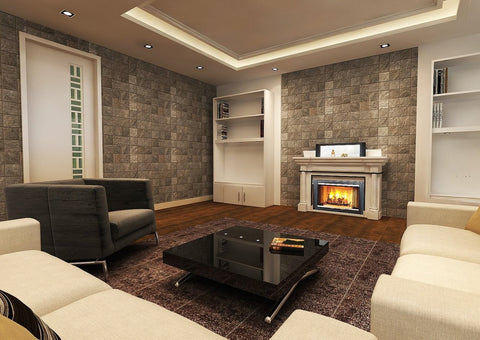
The engineering elegance of pop-up systems lies in their adaptability to different mounting configurations. Unlike drop-down lifts which have a single mounting orientation, pop-up lifts can be installed in two distinct ways: bottom-mounted or rear-mounted configurations. This flexibility allows designers and installers to work within the constraints of existing furniture or architectural features while still achieving reliable, smooth motion control.
Bottom-Mounted Pop-Up Configuration
Bottom-mounted pop-up TV lifts attach to a horizontal surface perpendicular to the direction of travel—typically the floor, a cabinet base, or a platform within furniture. This mounting style positions the linear actuator vertically with the TV mounting plate at the top of the actuator stroke. When retracted, the entire assembly sits within the concealment structure with only the top of the TV carriage visible at the base of the storage cavity.
This configuration is ideal for traditional cabinet installations where the TV rises from a base unit. Cabinet makers favor bottom-mounted systems because they simplify structural design—the weight loads transfer directly downward through the cabinet floor to the building structure. The mounting footprint is relatively compact, typically requiring only a rectangular opening sized for the TV width plus 4-6 inches on each side for the lift mechanism and cable clearance. Stroke lengths typically range from 18 to 48 inches, with longer strokes necessary for larger televisions or higher viewing positions.
Rear-Mounted Pop-Up Configuration
Rear-mounted pop-up TV lifts attach to a vertical surface parallel to the direction of travel—such as the back wall of a cabinet, the rear panel of furniture, or a structural wall. In this orientation, the actuator mechanism is mounted horizontally or at an angle along the back surface, with the TV carriage sliding along guides as it rises. This mounting approach offers distinct advantages in shallow furniture applications where bottom-mounting would compromise storage space or where structural considerations make floor-mounting impractical.
Rear-mounted systems are particularly valuable in retrofit installations where existing furniture is being converted to accommodate a lift mechanism. The mounting hardware attaches to the vertical back panel without requiring modifications to the base or floor of the unit. This configuration also simplifies cable management in some installations, as power and signal cables can be routed along the back wall rather than through the base of the furniture.
Common Pop-Up TV Lift Applications
Pop-up TV lift systems serve diverse installation scenarios across residential and commercial settings. Fireplace installations remain among the most popular applications, allowing homeowners to position a television above or within a mantel structure without the visual impact of a permanently visible screen. When not in use, the TV retracts into the mantel or a cabinet below, restoring the fireplace as the room's focal point.
Bedroom furniture installations frequently incorporate pop-up lifts at the foot of the bed, concealing the television within a dresser, cabinet, or custom millwork. This application addresses the common design challenge of television placement in sleeping areas—providing convenient viewing from the bed while maintaining a restful, uncluttered aesthetic when the TV isn't in use. Outdoor entertainment spaces increasingly feature pop-up TV lifts housed in weather-resistant cabinets, protecting expensive displays from the elements while enabling patio and deck viewing on demand.
Commercial applications range from boardroom conference tables with integrated rising displays to retail environments where screens emerge from counters or display fixtures for product demonstrations. The same tv lift technology that serves residential installations scales effectively to commercial requirements, with industrial-grade actuators available for heavy-duty cycle applications.
How do you choose between a drop-down and pop-up TV lift?
The decision between drop-down and pop-up TV lift systems fundamentally depends on architectural constraints and the desired visual effect. If you envision your television descending from the ceiling, perhaps in a home theater where ceiling height exceeds 9 feet and where the dramatic overhead reveal enhances the entertainment experience, a drop-down system is the logical choice. Conversely, if you want to integrate a television into existing furniture, emerge it from a fireplace surround, or raise it from a cabinet at the foot of a bed, a pop-up configuration is required.
Space availability often makes the decision for you. Drop-down systems require substantial ceiling cavity depth and typically aren't viable in standard 8-foot ceiling applications without significant structural modification. Pop-up systems work within a wider range of spatial constraints, requiring only that the concealment furniture or structure accommodate the retracted height of the TV plus the lift mechanism—typically adding 6-10 inches to the television's height dimension.
Budget considerations also play a role. While pricing varies based on stroke length, load capacity, and features, drop-down installations generally involve higher total project costs due to ceiling modification, additional structural support, and more complex installation labor. Pop-up systems, particularly those integrated into existing or purpose-built furniture, often present a more economical overall solution while still delivering the concealment and reveal functionality that makes TV lifts appealing.
Drop-Down vs Pop-Up TV Lifts: Comparison Table
| Attribute | Drop-Down | Pop-Up |
|---|---|---|
| Mounting orientation | Ceiling cavity, TV descends | Furniture/floor, TV rises |
| Minimum ceiling height | ~9 ft typical | Not constrained by ceiling |
| Cavity depth required | 18–30 inches | 6–10 inches above TV height |
| Load path | Suspended from ceiling structure | Transferred down through cabinet base |
| Retrofit suitability | Difficult (structural modifications often required) | High (works with existing furniture) |
| Typical install cost | Higher (ceiling work, structural support) | Lower (especially in purpose-built cabinets) |
| Best applications | Home theaters, luxury bedrooms, conference rooms | Fireplaces, foot-of-bed, outdoor cabinets, retail |
| Cable routing complexity | High (through ceiling cavity, full service loop) | Moderate (back panel or base routing) |
What specifications matter most when selecting a TV lift?
Once you've determined the appropriate lift type for your application, several key specifications determine whether a particular TV lift model will work for your installation. Understanding these parameters ensures proper fit, safe operation, and satisfactory performance.
Television Size and Weight Capacity
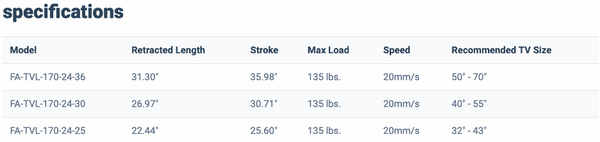
TV lifts specify compatible screen sizes as a range, typically expressed in diagonal inches—for example, 32" to 55" or 50" to 70". This range reflects the physical dimensions of the mounting interface and the weight capacity of the actuator system. Larger televisions require lifts with higher force ratings and more robust mounting plates. Weight capacity is equally critical, with specifications typically ranging from 50 to 175 pounds depending on the model. Modern large-screen LED and OLED TVs are lighter than older plasma models, but confirming that your television's weight falls within the lift's rated capacity is essential for safe operation and mechanism longevity.
The relationship between TV size and stroke length also impacts compatibility. A 65-inch TV installed in a pop-up configuration requires sufficient stroke length to raise the entire screen above the cabinet or furniture opening, plus additional travel to position the display at the optimal viewing height. Insufficient stroke length results in the bottom portion of the screen remaining below the sight line or the top of the screen not reaching a comfortable viewing angle.
Stroke Length Requirements
Stroke length—the total distance the lift mechanism travels between fully retracted and fully extended positions—is perhaps the most critical specification to evaluate. In drop-down applications, stroke length determines how far the TV descends from the ceiling. In pop-up applications, it governs how high the screen rises from its concealed position. Typical stroke lengths range from 18 inches to 48 inches, with some specialty models offering even greater travel.
Calculating the required stroke length involves considering multiple factors: the height of the TV itself, the clearance needed to fully conceal the screen when retracted, and the viewing height required when extended. For pop-up installations, a useful rule of thumb is that stroke length should equal or exceed the TV height plus 6-8 inches to ensure complete concealment and adequate extension. Ergonomic viewing angles suggest that the center of the TV screen should align approximately with viewer eye level when seated, which influences the extended height requirement.
Retracted Length and Concealment
The fully retracted length of a TV lift determines the minimum depth or height of the concealment space required. This dimension typically includes the TV thickness, the mounting plate, the actuator mechanism in its collapsed state, and the base mounting hardware. For pop-up systems, retracted length might range from 24 to 40 inches depending on TV size and lift model. Drop-down systems have similar retracted length requirements that dictate the ceiling cavity depth needed.
When planning concealment furniture or ceiling cavities, always add at least 4 inches to the specified retracted length to allow for cable routing, ventilation, and installation clearances. Tight-fitting installations that don't account for these practical considerations can lead to installation difficulties, inadequate ventilation causing TV overheating, or cable strain that damages connections.
Operating Speed and Noise Level
Modern TV lifts typically operate at speeds ranging from 0.5 to 1.5 inches per second. Faster operation might seem desirable, but moderate speeds actually provide smoother motion and quieter operation. The quality of the linear actuator significantly impacts noise levels, with premium units featuring internal gear reduction and precision components operating nearly silently. Budget models may produce noticeable motor noise or mechanical sounds during operation.
For bedroom and home theater applications where ambient noise levels are low, selecting a lift system known for quiet operation enhances the user experience. Specifications rarely provide objective noise measurements, so reviewing user feedback and manufacturer reputation becomes important when noise is a concern.
How do swivel mounts extend TV lift functionality?
TV lifts need not operate in purely vertical planes. Many applications benefit from the ability to adjust the screen's horizontal angle after the lift has positioned it vertically. Swivel mounting accessories, compatible with both pop-up and drop-down lift systems, add rotational adjustment ranging from 90 to 360 degrees depending on the mount design. This capability is particularly valuable in open-plan living spaces where seating areas span wide angles, in corner installations, or in multipurpose rooms where the TV must serve different viewing zones.
Manual swivel mounts attach between the lift mechanism's mounting plate and the TV's VESA mounting interface, adding minimal height to the overall assembly. These provide simple mechanical rotation that users adjust by hand once the TV has reached its extended position. Motorized swivel mounts integrate an additional actuator—typically a rotary actuator—controlled through the same remote control that operates the lift function, enabling remote adjustment of both vertical position and horizontal angle.
The combination of vertical lift and horizontal swivel creates a fully articulated display positioning system. In large rooms with multiple seating arrangements, this flexibility allows one TV installation to serve varied viewing locations. The added complexity requires additional planning for cable management, as signal cables must accommodate both vertical travel and rotational movement without binding or excessive strain on connectors.
What are the alternatives to a motorized TV lift?
While motorized TV lifts provide dramatic concealment and reveal functionality, they aren't always necessary or appropriate for every installation. Understanding the full spectrum of TV mounting options helps you select the solution that best balances functionality, budget, and aesthetic goals.
Fixed and Tilting Wall Mounts
Traditional fixed wall mounts offer the simplest, most economical approach to TV installation, positioning the screen at a predetermined height and angle with no adjustment capability. These work well when room geometry, furniture placement, and viewing positions are fixed and where the permanence of a visible TV isn't objectionable. Tilting wall mounts add a single degree of freedom, allowing vertical angle adjustment to reduce glare or optimize viewing from seating positions above or below the TV level.
Manual Articulating and Swivel Mounts
For rooms requiring multiple viewing angles without motorized operation, manual articulating arms and swivel mounts provide mechanical adjustment. These mounting brackets incorporate pivoting joints and extension arms that allow users to pull the TV away from the wall and rotate it to face different seating areas. While less elegant than motorized systems, they deliver functional flexibility at a fraction of the cost and without the need for electrical power or control systems.
Motorized Flip-Down Ceiling Mounts
Motorized flip-down mounts represent a middle ground between simple ceiling mounts and full drop-down TV lifts. These systems hinge at the ceiling, allowing the TV to fold down to viewing position then retract flush against the ceiling when not in use. Flip-down mounts work in applications where ceiling height is limited but overhead mounting is desired—such as RVs, boats, or rooms with 8-foot ceilings where drop-down lifts won't fit. The TV remains visible when retracted, but the fold-up storage position is less intrusive than a permanently downward-facing screen.
Electric Swivel Mounts for Fixed-Height Installation
Electric swivel mounts provide motorized rotation without vertical travel, suitable for installations where height is predetermined but horizontal angle adjustment enhances usability. These systems use a rotary actuator or motor-driven turntable to rotate the TV through 90 to 180 degrees, controlled via remote. They work well on walls or atop furniture in rooms with wide seating layouts where manual adjustment would be inconvenient.
How are TV lifts controlled and integrated with smart home systems?
Modern TV lift systems offer control options ranging from simple wired switches to full smart home integration. The basic control interface consists of a wired up/down rocker switch, typically mounted in a convenient wall location or on the furniture housing the lift. This provides reliable, straightforward operation without dependence on batteries or wireless connectivity.
Wireless remote control systems have become standard on most TV lift installations, offering the convenience of operation from anywhere in the room. RF (radio frequency) remotes provide reliable operation without line-of-sight requirements, unlike infrared remotes that need clear path to the receiver. Premium systems include programmable remotes with multiple channel capability, allowing control of the TV lift, the television itself, and other home theater components from a single device.
Smart home integration represents the leading edge of TV lift control, with systems incorporating relay interfaces that accept trigger signals from home automation platforms like Control4, Crestron, or open-source systems like Home Assistant. This enables sophisticated automation scenarios: the TV lift could automatically extend when the home theater mode is activated, or retract when the room's motion sensors detect no occupancy for a specified period. Integration with voice control platforms allows operation via spoken commands through Alexa, Google Assistant, or Siri-enabled devices.
What does proper TV lift installation planning require?
Successful TV lift installation requires careful planning that begins long before mounting hardware is installed. Whether you're working on new construction or retrofitting an existing space, several considerations ensure smooth installation and reliable operation.
Structural Support and Load Distribution
The combined weight of the television and lift mechanism must be properly supported by building structure. For drop-down ceiling installations, this typically means ensuring that ceiling joists or added blocking can handle 150-200 pounds of suspended load, accounting for a safety factor. Pop-up installations in furniture require that the cabinet or structure is adequately braced and that floor loading is within limits, particularly in upper-story installations or areas with raised flooring systems.
Electrical and Cable Planning
Electrical service for TV lifts typically requires a standard 120V AC outlet located near the lift mechanism but hidden from view when the system is retracted. The power supply converts AC to the DC voltage required by the actuator motor—usually 12V or 24V depending on the system. Signal cable routing from source equipment to the TV must accommodate the full range of lift travel with adequate service loop to prevent cable strain. Structured wiring conduit or cable management raceways should be incorporated into concealment spaces to maintain organization and allow future cable modifications.
Clearances and Ventilation
Concealed TVs still generate heat and require ventilation when operating. Cabinet or ceiling cavity designs should incorporate ventilation openings or passive air circulation paths to prevent heat buildup. Manufacturer specifications typically call for several inches of clearance around the TV on all sides when retracted. Failing to provide adequate ventilation can lead to TV overheating, shortened component life, or triggering of thermal shutdown protection in the display.
What usually goes wrong with TV lift installations?
Most TV lift failures trace back to a small number of design and installation mistakes rather than actuator defects. Catching these during planning is far easier than fixing them after the cabinet or ceiling is closed up.
- Undersized stroke length. The TV either doesn't fully conceal when retracted or doesn't reach a proper viewing height when extended. Always size stroke to TV height + 6–8 inches for pop-up installations.
- Inadequate ventilation in the cavity. Concealed TVs build heat and can hit thermal shutdown or shorten panel life. Maintain several inches of clearance around the TV and add passive vents to the cabinet or ceiling cavity.
- Cable strain and binding. Power, HDMI, and control cables routed without a proper service loop get pulled, kinked, or pinched at full stroke. Route cables with slack roughly equal to the stroke length.
- Side loading on the actuator. If the TV carriage is not properly guided and the actuator is forced to act as both lifter and guide, side loads accelerate wear and cause binding. The structure should guide the TV; the actuator should only lift it.
- Undersized structural support. Ceiling joists or cabinet bases not rated for 150–200 lb suspended or static load will sag, flex, or fail over cycles. Verify structure before specifying the lift.
- Cavity sized to the spec sheet exactly. Tight-fit installs without the recommended 4-inch clearance for cabling and ventilation cause installation problems and long-term reliability issues.
How should you test a TV lift installation before trusting it?
A TV lift that runs smoothly empty can still bind or overheat under real load. A short, deliberate commissioning routine catches the problems that only show up over time.
- Run full-stroke cycles with the actual TV mounted, not an empty carriage. Real load reveals binding the empty carriage hides.
- Cycle at least 10–20 full extensions and retractions consecutively. Watch for any change in speed, sound, or smoothness as the motor warms.
- Test the end-of-travel positions specifically. The hard part of travel is start-up under load and the final inch of retraction where alignment matters most.
- Check the cable service loop at full extension. Cables should have visible slack — not be stretched taut — at the longest travel position.
- Verify ventilation under operating conditions: run the TV at normal brightness for 30+ minutes in the retracted position and confirm cabinet or cavity surfaces don't get hot.
- Confirm the self-locking gear holds position with power removed mid-stroke. The TV should not drift or drop when power is cut.
How do you engineer the right hidden TV solution?
The choice between drop-down and pop-up TV lift systems ultimately depends on your architectural constraints, aesthetic vision, and functional requirements. Drop-down lifts deliver dramatic overhead reveals ideal for home theaters and spaces with adequate ceiling height, while pop-up systems offer greater versatility for furniture integration and retrofit applications. Both leverage the same core technology—precision electric linear actuators providing smooth, reliable motion control—adapted to different mounting orientations and installation scenarios.
Success in TV lift implementation comes from careful specification of stroke length, load capacity, and retracted dimensions matched to your specific TV and installation space. Enhanced functionality through swivel mounts, smart control integration, and thoughtful cable management elevates these systems from simple concealment mechanisms to sophisticated, integrated components of modern living spaces. Whether you're planning a new installation or exploring options for an existing space, understanding the engineering principles and practical considerations outlined in this guide positions you to make informed decisions and achieve results that combine technical reliability with visual elegance.
Frequently Asked Questions
What stroke length do I need for my TV lift?
The required stroke length depends on your TV size and viewing height requirements. For pop-up installations, the stroke length should equal or exceed your TV's height plus 6-8 inches to ensure complete concealment when retracted and proper viewing height when extended. For example, a 55-inch TV (approximately 27 inches tall) would require a minimum stroke length of 33-35 inches. Drop-down installations need stroke length sufficient to bring the screen from the ceiling to comfortable viewing height, typically 48-60 inches from the ceiling in standard rooms. Always verify the manufacturer's compatibility chart for your specific TV size and lift model.
How much weight can a TV lift support?
TV lift weight capacity varies by model and actuator strength, typically ranging from 50 to 175 pounds. Entry-level lifts designed for smaller screens (32-50 inches) generally handle 50-100 pounds, while heavy-duty systems for large-format displays (65-85 inches) support 125-175 pounds or more. Modern LED and OLED TVs are significantly lighter than older plasma models—a 65-inch LED TV typically weighs 40-60 pounds versus 80-100 pounds for an equivalent plasma screen. Always verify your TV's actual weight against the lift's rated capacity, and consider that the mounting plate and hardware add several additional pounds to the total load.
Can I install a TV lift myself or do I need professional help?
DIY installation of pop-up TV lifts in furniture is feasible for those with moderate carpentry and electrical skills, particularly when working with purpose-built TV lift cabinets that include pre-cut openings and mounting provisions. The mechanical installation involves securing the lift mechanism, mounting the TV to the lift plate using VESA-standard bolt patterns, and connecting power and control wiring. Drop-down ceiling installations are significantly more complex, requiring structural modifications, electrical work in ceiling cavities, and often professional assistance to ensure proper support and integration with ceiling finishes. If you're uncertain about structural load capacity, electrical connections, or ceiling modifications, consulting with a professional installer is advisable to ensure safe, reliable operation.
How loud are TV lifts during operation?
Quality TV lifts operate quietly, producing noise levels comparable to a modern refrigerator compressor or quieter—typically 40-50 decibels at a few feet distance. The sound consists primarily of the electric motor and gear reduction mechanism, with well-engineered systems featuring sound-dampening materials and precision components that minimize mechanical noise. Operating speed affects noise perception; lifts running at moderate speeds (0.5-1.0 inches per second) tend to be quieter than faster models. In home theater and bedroom applications where ambient noise is minimal, the brief operational sound (typically 15-30 seconds for full extension or retraction) is noticeable but not intrusive. Budget TV lifts with lower-quality actuators may produce more mechanical noise or vibration, making manufacturer reputation and user reviews important when quiet operation is a priority.
Can TV lifts integrate with smart home systems?
Yes, most modern TV lifts can integrate with smart home automation systems either through native compatibility or with the addition of relay interfaces. The integration typically works through dry contact relay triggers that the home automation system activates to extend or retract the lift. This allows for sophisticated automation scenarios such as having the TV automatically extend when you activate a "movie mode" scene, or retract when the security system is armed for the night. Popular home automation platforms like Control4, Crestron, Savant, and open-source systems like Home Assistant can interface with TV lifts. Some manufacturers offer WiFi-enabled control modules that provide direct integration with voice assistants like Alexa or Google Assistant, enabling voice command operation without additional home automation infrastructure.
What happens if there's a power outage while the TV is extended?
TV lifts equipped with quality linear actuators include internal mechanical locking that prevents the lift from dropping or drifting when power is lost. The actuator's gear reduction mechanism is self-locking, meaning the TV will remain safely in whatever position it occupied when power was interrupted. When power is restored, normal operation resumes—you can retract or extend the lift as usual. Some premium TV lift systems include battery backup options that allow several cycles of operation during power outages, though this is less common in residential installations. The mechanical safety of self-locking actuators ensures that even during extended power failures, your TV remains securely positioned without risk of sudden drops or movement.
About the Author
Robbie Dickson is the Founder and Chief Engineer of FIRGELLI Automations. He spent his early career as an engineer at Rolls-Royce, BMW, Isuzu, and Ford before founding FIRGELLI Automations in 2002. Learn more on Wikipedia.


