
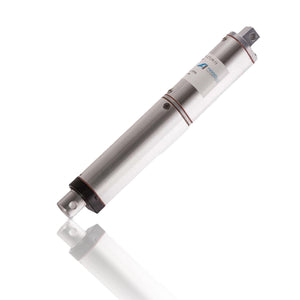
| Variable |
|---|
| Min Force |
| Max Force |
| Max Speed |
| Stroke Options |
| Voltage |
| IP Rating |
| Feedback |
| Price |


Compare electric linear actuators by the specifications that matter
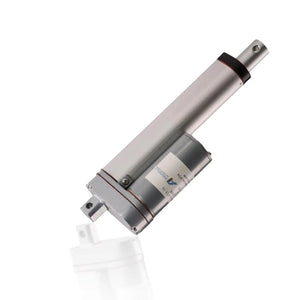
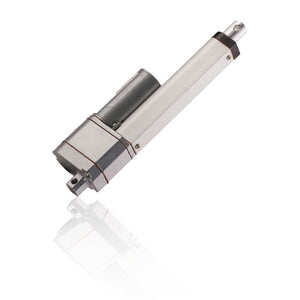
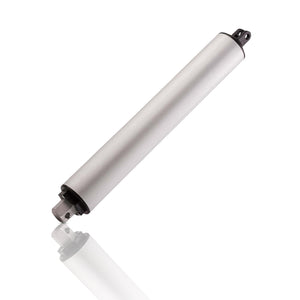
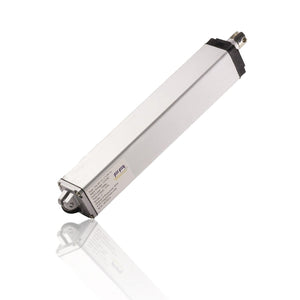
FIRGELLI electric linear actuators convert motor rotation into controlled push-pull travel. Use the product filters and specification tables above to compare models by stroke, dynamic force, loaded speed, duty cycle, feedback, IP rating, and physical size. The correct choice depends on the complete mechanism, not force or stroke alone.
Start with the motion you need, then confirm the worst-case load and mounting geometry. Product-level drawings, data sheets, and load-speed information take precedence over the general guidance on this page.

How to choose a linear actuator
- Stroke and installed length: measure the required travel, retracted length, extended length, and available bracket space.
- Dynamic force: calculate the load at the hardest point in the motion, including linkage geometry, friction, and acceleration where relevant.
- Speed under load: compare the required travel time with the model's loaded speed, not only its no-load speed.
- Duty cycle and power: check the expected run-rest pattern, current draw, wire size, switching device, and power supply.
- Environment: match the product's stated IP rating, temperature range, and materials to dust, water, and other site conditions.
- Feedback and control: choose a compatible feedback option when the system needs measured position, closed-loop control, or synchronization.
- Mounting: keep rod-style actuators axially loaded and use guides or rails to carry side loads.
Engineering note: hinged lids, levers, and linkages can require their highest actuator force near one end of travel. Check the full motion range before selecting a product.
Compare linear actuator families
- Micro linear actuators for compact mechanisms where package size is a primary constraint.
- Feedback linear actuators for measured position, closed-loop control, or synchronized systems.
- Track linear actuators for guided carriage motion without an extending rod.
- Industrial linear actuators for applications that require higher force or more rugged construction.
- Column lifts for vertically guided lifting and height-adjustment systems.
No single actuator family is best for every mechanism. A compact model may trade force or duty cycle for package size, while a higher-force model may move more slowly or require more installation space and current. Compare the complete operating point rather than selecting by one headline specification.
How electric linear actuators work
A typical electric linear actuator uses a DC motor, gearbox, lead screw, and traveling nut. The gearbox changes the motor's speed and torque. The screw and nut then convert rotation into linear travel, extending or retracting the output tube or carriage. Model-specific construction determines loaded speed, force, current, duty cycle, backlash, backdriving behavior, and service life.
Limit switches or other end-of-travel controls stop compatible models at their travel endpoints. Position feedback, where fitted, can provide a signal for measurement or closed-loop control. Always confirm the control and feedback features on the exact product page.
For a broader comparison of electric, hydraulic, pneumatic, linear, and rotary devices, read What Is an Actuator?

Animated cutaway: linear actuator motion
Common linear actuator applications
Linear actuators are used when a mechanism needs controlled straight-line movement for lifting, tilting, sliding, opening, closing, or positioning. Application examples are a starting point only: the actuator must still be selected for the real load, geometry, cycle rate, environment, and control method.


Home automation and furniture
Typical projects include TV lifts, appliance lifts, adjustable furniture, hidden compartments, cabinet doors, and access panels. Quiet operation, compact installed length, limit-switch behavior, and safe guarding often matter as much as force. A guided lift or rail should carry side loads rather than asking the actuator rod to act as the structural guide.
Industrial, mobile, and outdoor mechanisms
Actuators can position dampers, chutes, fixtures, machine guards, hatches, solar-panel mechanisms, and equipment attachments. These applications may introduce shock loads, vibration, contamination, water exposure, temperature changes, or long cable runs. Confirm the selected model's documented enclosure rating, wiring requirements, duty cycle, and load-speed point instead of assuming universal suitability for outdoor or industrial service.
Robotics and controlled positioning
Robotic and positioning systems may require feedback, repeatability, synchronization, and a controller that can stop at intermediate positions. Potentiometer, Hall-sensor, or encoder feedback options are not interchangeable without compatible electronics and control logic. Use the feedback documentation for the exact actuator and controller combination.
Installation and control considerations
- Mounting geometry: use pivoting brackets where the mechanism changes angle, and verify that the actuator does not bind through the full stroke.
- Load direction: support cantilevered or side-loaded mechanisms with rails, bearings, hinges, or other guides.
- Power: size the supply, fuse, switching device, connectors, and wire for the product's stated current and cable length.
- Reversing direction: many two-wire DC actuators reverse by changing polarity, but feedback and controller wiring vary by product.
- End-of-travel control: confirm whether the selected model includes internal limit switches or requires external sensing.
- Thermal operation: treat duty cycle as a model-specific operating limit under stated conditions, not as a universal run-time rule.
For wiring and control planning, use the Wiring Diagram Generator. For hinged mechanisms and changing lever geometry, use the Linear Actuator Calculator before finalizing the mounting points.
Selection tools and engineering resources
- Linear Actuator Selector Tools to narrow products by known stroke, force, and configuration requirements.
- Linear Actuator Calculator for mechanism and mounting calculations.
- Linear Actuator Selection Guide for a detailed engineering workflow.
- Wiring Diagram Generator for switches, relays, controls, and feedback wiring.
- Engineering Library for related calculators, mechanisms, and technical articles.
Checks before ordering
Confirm the exact product data sheet, stroke, retracted and extended dimensions, mounting hardware, cable requirements, controller compatibility, expected load-speed point, and power-supply capacity before purchase. IP ratings classify enclosure protection under defined tests; they do not by themselves establish corrosion, chemical, continuous-submersion, or safety-critical suitability.
If the mechanism can injure a person or damage equipment, include suitable guarding, mechanical stops, load support, emergency stopping, and an engineering safety review appropriate to the application.
Technical Resources & Tutorials
The Engineering Guide
Our most comprehensive resource. Learn the physics of motion, how to calculate torque curves, and the 7 critical selection criteria for industrial applications.
Read the Engineering Guide »Advanced Control & Wiring
Moving two actuators at once? Learn about Synchronized Motion and how to wire our FCB-1 Controller for precise feedback control.
See Synchronization Guide »Frequently Asked Questions
How does a linear actuator work?
Linear actuators convert rotary motion (from a DC motor) into linear motion using a lead screw and gearbox assembly. The motor spins a gear, which turns the lead screw. A nut on the screw is fixed to the extension rod; as the screw turns, the nut travels up or down, extending or retracting the rod. Limit switches at both ends cut power automatically to prevent damage.
How do I choose the right actuator (Force & Speed)?
Force and Speed trade-off against each other. High force = lower speed.
1. Determine Force: Estimate the weight you are lifting. Add a 50% safety margin.
2. Determine Stroke: How far does it need to travel?
3. Select Voltage: 12v is standard for automotive/home; 24v is efficient for industrial use.
Use our Calculator to find the perfect match.
Can I control the speed?
Yes. You can use a PWM (Pulse Width Modulation) Speed Controller to reduce speed, or an Actuator controller that allows up to 4 Actuators to be connected and controlled with the Built-In Timers or Remotes or switches.
Can a FIRGELLI actuator replace my old unit?
Yes. Check the Retracted Length, Stroke Length, and Pin Hole Size. If these match, our actuator will likely fit. We offer brackets to adapt to almost any mounting requirement.
Do you offer volume discounts?
Yes. Discounts start at quantities of 11+ units. Contact our sales team for OEM and bulk pricing.
What can I build with a linear actuator? (Project Ideas)
Actuators are used to automate thousands of DIY and industrial projects. The most common applications include:
- Home Automation: Hidden TV Lifts, spice racks, and appliance garages.
- Outdoor & Farm: Solar Panel Trackers and Automatic Chicken Coop Doors.
- Marine & Automotive: Motorized Boat Hatches, Truck Tonneau Covers, and Engine Hood Lifts.
- Robotics: Robotic Arms and Halloween Animatronics.
Want to see how to build these? Check out our Guide to 15 Common Actuator Projects for step-by-step instructions.
How to request or submit warranty claim
To submit a warranty claim, please email support@firgelliauto.com with the following information:
- Your Firgelli order number
- Application details, including duty cycle and operating environment
- A clear description of the issue, including:
- Observed behavior of the actuator
- Whether the actuator is making unusual noise
- Any changes in performance
Providing complete details will help us assess your claim as quickly as possible.
General Warranty Terms and Conditions
The warranty is valid only if the equipment has been used within the applicable operating specifications.
- The equipment must not have been exposed to abusive treatment, excessive shock or vibration, fluids other than fresh water, water in excess of given specified IP ratings, dust or particulates in excess of specific IP rating, or hazardous conditions.
- Firgelli Automations shall not be liable for the cost of removal, installation, for loss or damage to, or loss of use of facilities, loss of revenue or other damages or costs of any kind whether direct, indirect, incidental or consequential arising from the failure of Firgelli Automations products.
- This warranty shall be voided as to any products which have been repaired, worked upon, or altered by persons not authorized by Firgelli Automations, or which have been subject to misuse, negligence, accident, or overload. In no event shall Firgelli Automations be liable for any incidental or consequential damages.
- Periodically inspect mounting points, wires, electrical connections, observe unit in operation for any irregularities or changes in behavior.
How do I calculate the right specifications for my project?
Determining the correct force, speed, stroke length, or other design parameters can be challenging—especially when multiple variables are involved. To simplify the process, we’ve built a comprehensive Engineering Library with hundreds of interactive calculators, formulas, and design tools covering a wide range of engineering topics. Whether you're working on an actuator system or a completely different project, these tools can help you make accurate, informed decisions.
Top Blog Posts for Linear Actuators
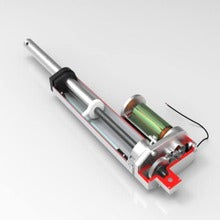
This article will give you a basic understanding of how actuators work and the terminology used to describe them. When you understand the basics it...
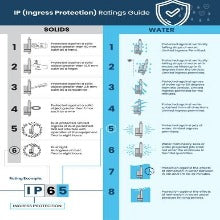
IP Ratings are given to any product that requires electricity or has moving parts or both. The IP rating contains a range of information within...
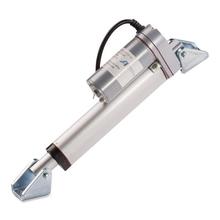
The most common method to mount your linear actuator is to use what is called clevis end mounting brackets. These common mounting methods consist of mounting the brackets at each end of the linear actuator...
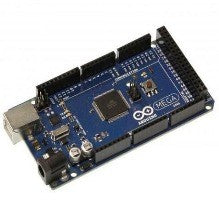
Arduinos are an open source electronics prototyping platform based on flexible, easy-to-use hardware and software. It's intended for DIY projects, artists, designers, hobbyists, and anyone interested in creating interactive projects. Arduinos are microcontroller boards that contain everything you need to easily interface with the microcontroller.
Arduinos are an open source electronics prototyping platform based on flexible, easy-to-use hardware and software. It's intended for DIY projects, artists, designers,...
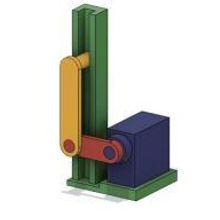
From automotive to machinery to home improvement, actuators are becoming more commonplace worldwide. This is most true in developing countries going through their industrial revolution....