Bringing Mechanical Flowers to the Desert: Blumen Lumen at Burning Man 2014
Every year, thousands of artists, engineers, and creative enthusiasts converge on Nevada's Black Rock Desert for Burning Man, an event built on the principle of radical self-expression. Among the countless art installations that grace the festival's sprawling landscape—affectionately known as the "Playa"—few have captured the intersection of engineering and artistry quite like Blumen Lumen. This remarkable installation featured massive mechanical flowers that responded to their environment, opening and closing their petals while emitting brilliant displays of colored light.
🎥 Video — Blumen Lumen - High Tech Art Featured at Burning Man 2014
The 2014 installation demonstrated what becomes possible when precision motion control technology meets visionary design. Created by FoldHaus, a collective of engineers and designers, Blumen Lumen stood as testament to the power of linear actuators in extreme environmental conditions. As George Student from FoldHaus explained, "It occurred to us that bringing flowers out there would bring a little bit of life, beauty, and love to the desert, which is a big part of what people are looking for at Burning Man."
What made this project particularly impressive wasn't just its aesthetic appeal—it was the engineering challenge of creating large-scale kinetic sculpture that could withstand the harsh desert environment while maintaining smooth, reliable motion throughout the week-long festival.
The Engineering Vision: FoldHaus's Folded Design Approach
FoldHaus brought considerable experience in kinetic art to the Blumen Lumen project, drawing inspiration from their previous installations that incorporated origami-inspired folding mechanisms. This design philosophy proved ideal for creating structures that needed to be simultaneously lightweight, strong, and capable of dramatic transformation.
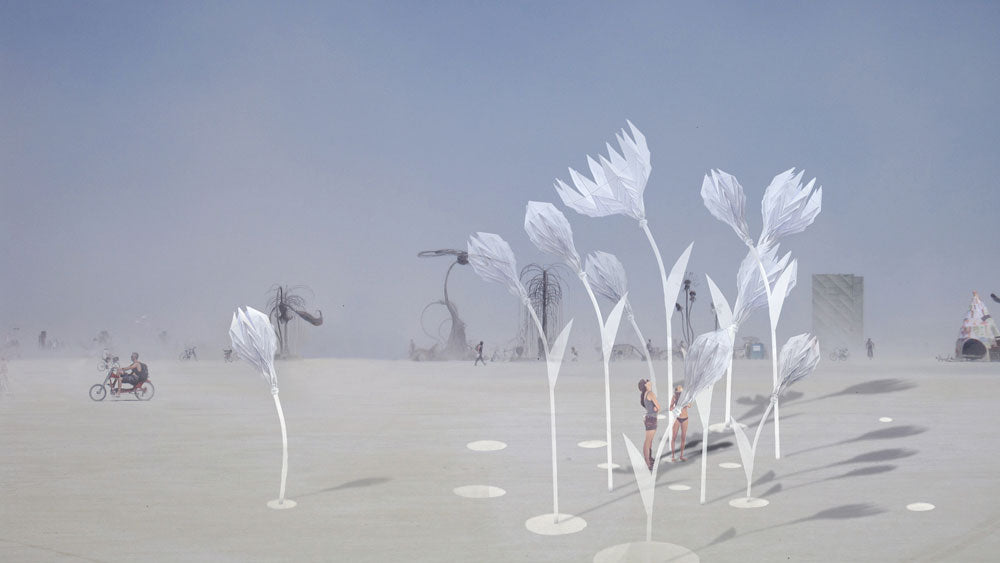
The team constructed each flower from sheets of corrugated polypropylene, a material choice driven by multiple practical considerations. Corrugated polypropylene offers an exceptional strength-to-weight ratio, critical when designing structures that stand nearly 20 feet tall. The material's flexibility allowed for the complex folding patterns required to create realistic petal shapes, while its durability ensured the structure could withstand repeated opening and closing cycles throughout the festival.
Previous experiments had validated the material's performance in similar applications, giving the team confidence that their design would hold up under the demanding conditions of Black Rock Desert. The folded structure itself provided inherent strength, distributing forces across multiple facets rather than concentrating stress in single points—a principle borrowed from architectural engineering and origami mathematics.
The Motion Control Solution: Linear Actuators in Extreme Conditions
At the heart of each mechanical flower's movement system were linear actuators specifically selected for their reliability in challenging environments. The Sleek Rod-Style Actuator from FIRGELLI Automations proved ideal for this application, offering several key advantages that aligned perfectly with the project's requirements.
The actuators needed to deliver smooth, controlled motion to create the graceful opening and closing sequences that gave the flowers their lifelike quality. Unlike hydraulic systems that might leak fluid or pneumatic systems requiring constant air pressure, electric linear actuators provided precise position control without the maintenance concerns that would have been problematic in a temporary desert installation.
One critical feature was the actuators' ability to hold position without continuous power draw. Once extended to open the flower petals, the actuators could maintain that position mechanically, conserving energy and reducing heat generation—important considerations when operating on battery or generator power in extreme heat. This self-locking capability also meant the flowers could hold their open or closed positions even during power cycling or system resets.
Weathering Desert Extremes
The Black Rock Desert presents one of the most challenging environments for mechanical and electrical systems. Daytime temperatures can exceed 100°F (38°C), while nights can drop dramatically. Wind is perhaps the most formidable challenge—gusts regularly reach 40-60 mph, carrying with them fine alkaline dust that infiltrates every unsealed gap.
The FIRGELLI actuators performed without compromise despite these conditions. The sealed housing protected internal components from dust intrusion, while the robust motor design operated reliably across the wide temperature range. When winds buffeted the towering structures at speeds up to 60 mph, the folded design of the flower petals and the secure mounting of the actuators allowed the installation to flex and absorb forces rather than resist them rigidly—a key principle in designing structures for high-wind environments.
The installation's success demonstrated an important principle for designers and engineers: selecting components rated for the actual conditions they'll encounter, with appropriate safety margins, prevents field failures that could compromise an entire project.
Installation and Mechanical Design Considerations
Implementing motion control in large-scale kinetic art requires careful attention to mechanical design beyond just selecting the right actuator. The FoldHaus team had to solve several engineering challenges to translate linear actuator motion into the smooth petal movements they envisioned.
The mounting strategy was critical. Each actuator required secure attachment points that could handle both the static loads of the structure and the dynamic forces generated during movement and wind buffeting. Custom mounting brackets likely played a role in achieving the necessary rigidity while accommodating the angular motion as petals opened and closed.
The geometry of the linkage system determined how actuator stroke translated to petal movement. A relatively short actuator stroke could be amplified through clever lever arrangements to produce the dramatic opening motion visible in the final installation. This mechanical advantage also reduced the force requirements on the actuators themselves, allowing for more compact units while still moving large petal structures.
Power distribution represented another engineering consideration. With multiple actuators per flower and multiple flowers in the installation, the electrical system needed robust power supplies capable of delivering sufficient current for simultaneous actuator movements. The system likely incorporated some form of control box to coordinate actuator timing and create the choreographed opening sequences.
Responsive Behavior and Illumination
What elevated Blumen Lumen from static sculpture to interactive art was its environmental responsiveness. The flowers didn't simply open and close on a timer—they reacted to their surroundings, creating an dynamic relationship between the installation and festival participants.
The control system integrated sensors that detected various environmental conditions—possibly including motion detection for approaching visitors, ambient light levels to trigger different behaviors between day and night, or even sound levels to create responses to music and crowd noise. This sensor data fed into the control logic that commanded the actuators to extend or retract, opening petals to welcome visitors or closing them in quieter moments.
As darkness fell across the Playa, the installation transformed. Integrated LED lighting systems within each flower burst to life, casting brilliant arrays of color that could be seen from considerable distances across the desert. The combination of movement and illumination created mesmerizing displays that attracted hundreds of participants, who gathered around the mechanical blooms to experience their beauty.
The lighting design complemented the mechanical motion, with colors and patterns that emphasized the opening and closing sequences. This integration of multiple technical systems—motion control, sensing, power management, and lighting—demonstrated the sophisticated engineering underlying what appeared to casual observers as pure artistic magic.
Lessons for Kinetic Art and Automation Projects
The success of Blumen Lumen offers valuable insights for engineers and artists planning similar kinetic installations, whether for festivals, public art, or commercial applications.
Material selection matters immensely. The corrugated polypropylene choice proved ideal because it balanced multiple requirements: weight, strength, formability, and weather resistance. Designers should evaluate materials holistically rather than optimizing for a single property.
Environmental protection is non-negotiable. In harsh conditions like those at Burning Man, unsealed components will fail. The sealed design of the industrial actuators prevented dust and moisture intrusion that would have degraded performance or caused complete failure.
Design for the worst-case scenario. The 60 mph wind gusts represented extreme conditions, yet the installation remained functional. Building appropriate safety margins into structural calculations and component specifications prevents catastrophic failures during peak stress events.
Power management requires planning. In remote installations without grid power, energy budgets become critical. The self-locking feature of the actuators conserved power by eliminating the need for continuous current to maintain position—a design choice that extended operating time between charges or reduced generator fuel consumption.
Test extensively before deployment. FoldHaus's previous experience with folded structures gave them confidence in their design approach. For novel applications, prototype testing under simulated conditions can identify problems while they're still easily correctable.
Applications Beyond Art: Motion Control in Challenging Environments
While Blumen Lumen was created as artistic expression, the engineering principles and component choices have broader applications. Electric linear actuators excel in numerous scenarios where reliable motion control is needed despite environmental challenges.
Agricultural automation often faces similar conditions—outdoor installations with dust, temperature extremes, and limited maintenance access. Automated greenhouse ventilation, shade systems, and irrigation controls benefit from the same sealed, self-locking actuator designs proven at Burning Man.
Marine applications present corrosive environments where hydraulic fluid leaks are particularly problematic. Electric actuators for hatch covers, adjustable seating, or equipment positioning offer clean, reliable alternatives that don't contaminate waterways.
Entertainment and stage productions require dramatic, reliable motion on demanding schedules. From automated stage elements to architectural installations in hotels and casinos, the lessons learned in temporary festival installations translate directly to permanent venues requiring similar kinetic effects.
Architectural applications increasingly incorporate kinetic elements—responsive facades, adjustable shading systems, or transformable spaces. These installations need actuator systems that operate reliably for years with minimal maintenance while meeting aesthetic requirements that don't compromise visual design.
The Intersection of Engineering and Art
Blumen Lumen represented more than just an impressive art installation—it demonstrated how thoughtful engineering enables artistic vision to flourish in even the most challenging environments. The project succeeded because the FoldHaus team understood that great kinetic art requires more than creative design; it demands rigorous technical execution.
By selecting appropriate materials, choosing reliable motion control components, and designing systems that could withstand extreme conditions, the team created an installation that functioned flawlessly throughout Burning Man 2014. The FIRGELLI Automations actuators played a crucial role in this success, providing the precise, reliable motion control that brought the mechanical flowers to life.
For engineers and designers planning kinetic installations—whether temporary festival art or permanent architectural features—Blumen Lumen offers a masterclass in integrated system design. When motion control, structural engineering, environmental protection, and artistic vision work together, the results can be truly spectacular.
Frequently Asked Questions
What type of linear actuators were used in the Blumen Lumen installation?
The installation utilized FIRGELLI Automations Sleek Rod-Style Actuators, chosen specifically for their smooth motion control, self-locking capability, and sealed design that could withstand the harsh desert environment. These actuators provided the precise extension and retraction needed to open and close the flower petals while maintaining position without continuous power draw.
How tall were the Blumen Lumen flowers?
The mechanical flowers stood nearly 20 feet tall, making them substantial structures that needed to be both strong enough to resist high winds and light enough to be practical for installation in a temporary desert environment. The height made them visible landmarks across the Playa and created an impressive sense of scale when visitors approached.
How did the installation withstand 60 mph winds?
The flowers' wind resistance came from multiple design factors: the folded structure of the petals distributed forces across many surfaces rather than concentrating stress, the corrugated polypropylene material provided flexibility to absorb gusts rather than resist them rigidly, and the actuators maintained secure positioning even under dynamic loads. The overall design philosophy emphasized resilience through flexibility rather than pure rigidity.
What were the power requirements for operating multiple mechanical flowers?
While specific power consumption figures weren't published, the self-locking feature of the actuators significantly reduced energy requirements by eliminating the need for continuous current to hold positions. This design choice was crucial for operating in a remote desert location where power came from batteries or generators rather than grid connections. The system likely incorporated power supplies sized to handle peak current during simultaneous actuator movement.
Can similar kinetic art projects be built for other environments?
Absolutely. The engineering principles proven at Burning Man—appropriate component selection, environmental protection, robust structural design, and integrated control systems—apply to kinetic installations in various settings. Whether for outdoor public art, architectural features, theatrical productions, or commercial installations, electric linear actuators provide reliable motion control that can be adapted to specific environmental conditions and aesthetic requirements.
How were the flowers' movements controlled and coordinated?
The installation featured environmental sensors that detected conditions like visitor proximity, ambient light levels, and possibly sound, feeding data to a control system that commanded the actuators. This created responsive behavior where flowers reacted to their surroundings rather than following simple pre-programmed patterns. The coordinated movement of multiple flowers likely involved a central control box or networked controllers that could synchronize timing across the entire installation.


