If you want to know how the color of a glowing object shifts as it heats up, you need to understand blackbody radiation—otherwise, you risk mismatched light sources, drifting calibration, or pushing sensors beyond their limits. This Color Temperature Blackbody Calculator gives you peak wavelength, spectral radiance, total radiant exitance, and CIE chromaticity coordinates based on temperature or peak wavelength. The numbers matter for lighting design, IR thermography, semiconductor process control, and astronomy. Below, you'll find working formulas (Planck, Wien, Stefan-Boltzmann), a 3200K worked example, the underlying theory, and a FAQ.
What is color temperature blackbody radiation?
Color temperature refers to the shift in color you see when an object is heated—think red to yellow to white as a metal glows hotter. A blackbody is an ideal case: it absorbs all incoming energy and re-emits light based solely on temperature, with no selective absorption or reflection.
Simple Explanation
If you've ever seen metal in a forge, you know the glow changes from dull red to orange to white. That color change is consistent and predictable for any object radiating due to heat. A blackbody is the physical ideal: it shows what wavelength and intensity come off a surface at any given temperature, without the quirks of real-world materials.
📐 Browse all 1000+ Interactive Calculators
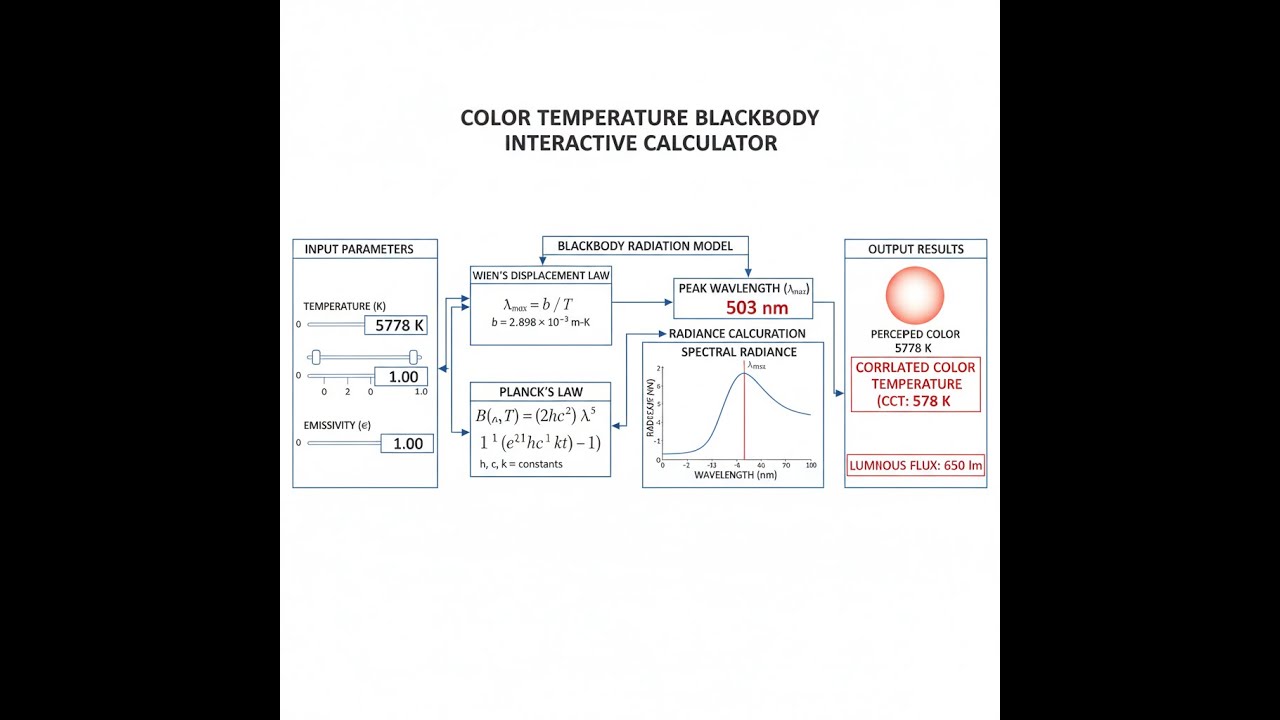
Visual Diagram

Color Temperature Blackbody Calculator
How to Use This Calculator
This calculator is intended for education, concept evaluation, and preliminary design. Results are based on the equations and assumptions described on this page, but cannot account for every real-world load case, tolerance, material property, environmental condition, installation detail, safety factor, code, or regulatory requirement. Verify all inputs, assumptions, units, and results independently before selecting components or using the result in a real application. Safety-critical, structural, medical, lifting, transportation, or regulated applications must be reviewed by a qualified engineer.
- Select a Calculation Mode from the dropdown — choose Full Spectrum Analysis, Peak Wavelength, Total Radiant Exitance, Spectral Radiance, CIE Chromaticity, or Color Rendering Index.
- Enter the required input value — either a temperature in Kelvin, a peak wavelength in nanometers, or both (for Spectral Radiance mode).
- Use the Try Example button to load a pre-set input if you want to see a typical result first.
- Click Calculate to see your result.
Color Temperature Blackbody Interactive Visualizer
If you want to see how blackbody color and radiance move as temperature rises, this tool uses Wien's and Planck's equations under the hood. Watch as the main emission peak marches from the infrared well into the visible as you crank up the heat.
PEAK WAVELENGTH
966 nm
TOTAL EXITANCE
4.59 MW/m²
COLOR REGION
Infrared
CIE CHROMATICITY
0.437, 0.404
FIRGELLI Automations — Interactive Engineering Calculators
Equations & Formulas
Simple Example
Take a blackbody at 3000K — roughly the temperature of a tungsten incandescent bulb.
- Peak wavelength (Wien's Law): 2.898 × 10⁻³ / 3000 = 966 nm — near-infrared, which is why most energy from an incandescent is heat, not light.
- Total radiant exitance (Stefan-Boltzmann): 5.670 × 10⁻⁸ × 3000⁴ = 4.59 × 10⁶ W/m²
- CIE chromaticity: approximately x = 0.437, y = 0.404 — warm orange-white on the Planckian locus.
Wien's Displacement Law
Use the formula below to calculate peak emission wavelength from temperature.
λmax = b / T
Where:
λmax = Peak wavelength of emission (meters)
b = Wien's displacement constant = 2.897771955 × 10⁻³ m·K
T = Absolute temperature (Kelvin)
Planck's Radiation Law (Spectral Radiance)
Use the formula below to calculate spectral radiance at a specific wavelength and temperature.
Bλ(λ, T) = (2hc²) / (λ⁵(ehc/λkT - 1))
Where:
Bλ = Spectral radiance (W·m-2·sr-1·m-1)
h = Planck constant = 6.62607015 × 10⁻³⁴ J·s
c = Speed of light = 2.99792458 × 10⁸ m/s
λ = Wavelength (meters)
k = Boltzmann constant = 1.380649 × 10⁻²³ J/K
T = Absolute temperature (Kelvin)
Stefan-Boltzmann Law (Total Radiant Exitance)
Use the formula below to calculate total radiated power per unit area from a blackbody surface.
M = σT4
Where:
M = Total radiant exitance (W/m²)
σ = Stefan-Boltzmann constant = 5.670374419 × 10⁻⁸ W·m-2·K-4
T = Absolute temperature (Kelvin)
CIE Chromaticity Approximation (McCamy's Formula)
Use the formula below to calculate CIE 1931 chromaticity coordinates from correlated color temperature.
x = -0.2661239(10⁹/T³) - 0.2343589(10⁶/T²) + 0.8776956(10³/T) + 0.179910
y = -1.1063814x³ - 1.34811020x² + 2.18555832x - 0.20219683 (for T ≥ 2222K)
Where:
x, y = CIE 1931 chromaticity coordinates (dimensionless)
T = Correlated color temperature (Kelvin)
Theory & Engineering Applications
Blackbody Radiation Physics
In blackbody radiation, the theoretical object absorbs all incident energy and re-emits it according to temperature—simple in principle, but rarely matched by real-world surfaces. Planck’s solution to blackbody emission was a turning point in physics; it describes emission from stars, heated metal, industrial furnaces, and lightbulb filaments directly. In practice, no object is a perfect blackbody. Every real material has an emissivity ε (from 0 to 1), expressing how efficiently it emits compared to the ideal. For example, graphite in the IR comes close (ε ≈ 0.98), while polished metals are poor emitters (ε ≈ 0.02–0.15)—instead, they mostly reflect. If you’re using IR thermography, failing to account for these emissivity shifts can easily lead to readout errors of 50°C or more.
Practical engineering means knowing the difference between theory and reality. A surface’s emissivity can be affected by finish, oxidation, and even angle of view. You can’t assume blackbody output unless you control for these factors, especially with metals or thin films.
Wien's Displacement Law and Peak Emission
Wien’s law states that as the temperature increases, the main emission wavelength moves to shorter values—inverse proportionality. At room temperature (293K), peak emission is around 9.9 microns (deep IR)—invisible to the eye but not to a thermal camera. The Sun, at around 5778K, peaks in the visible green (~501 nm), yet appears white because its spectrum fills the entire visible range. In practice, this law underpins temperature estimation from observed spectra, and is fundamental in pyrometry, astrophysics, and plasma diagnostics.
It’s worth noting: Doubling the temperature halves the peak wavelength. In steel, a jump from 1000K to 2000K moves the emission peak from about 2900nm to 1450nm, pushing radiation into the visible and making it look orange instead of dull red. At 4000K, the peak is at 724nm—deep red—but now significant blue is present, so the glow appears white hot, much like arc welding or certain discharge lamps. Actual perception is complicated by the eye’s nonlinear response, so visual temperature estimates are always rough.
Stefan-Boltzmann Law and Total Power Emission
The Stefan-Boltzmann law links total radiated power to temperature to the fourth power. The change is dramatic: a blackbody at 1000K emits 56.7 kW/m², but at 2000K it dumps 907.3 kW/m²—6teen times more for double the temperature. This rapid increase can lead to uncontrolled temperature rise if cooling isn’t adequate, which is a common problem in both ovens and high power electronics. Even spacecraft radiators become limited by area (and mass) as radiative cooling becomes the only way to dump heat in vacuum.
In lighting design, for example LEDs, junction temperatures near 400K can significantly increase radiative losses—over 2.5 times greater than at 300K. This affects both efficiency and color rendering if not considered in thermal design. Above 450K, radiative losses become more prominent, especially in high-power diodes where efficient cooling is hard to achieve.
Chromaticity and Color Perception
The CIE 1931 chromaticity diagram takes the complexities of human vision and compresses them into two numbers, x and y, mapped from cone cell responses. Blackbodies follow a distinct path on this diagram (the Planckian locus), and this is where standard color temperature definitions come from. Light sources that don’t match the locus (like most LEDs or fluorescents) are usually referenced by their closest blackbody point (CCT) plus a Duv value (offset). You need to check both for color critical work.
What catches many designers off-guard is this: Two lights at the same specified CCT can render colors very differently if their spectra are spiky or incomplete, as is common with LEDs. A 3000K incandescent lamp is close to an ideal blackbody and CRI near 100, while a phosphor-converted LED at the same CCT may have gaps and spikes that lower CRI to anywhere from 70–95. You’ll notice these differences immediately in art galleries, surgical suites, or manufacturing lines where real color fidelity matters.
Practical Applications in Infrared Thermometry
Non-contact temperature measurement relies on Planck’s law by sampling radiance at selected wavelengths. Two-color pyrometers (which measure at two wavelengths) can reduce errors from varying emissivity, as they work off radiance ratios, which are more sensitive to temperature than to absolute emission at each point. High-temp pyrometry (700°C and up) often uses near-IR bands (0.9–1.1μm), while lower temps use the 3–5μm and 8–14μm windows for best atmospheric transmission.
Below 500K, practical limitations increase: peak emission slides beyond 5.8μm (detector response drops), and overall power is much lower—total exitance is just 3.5 kW/m². Atmospheric absorption and detector noise also become problems. Advanced multi-spectral pyrometers can help, but need careful calibration. For most work, single-point readings are best above 400K. For deeper thermal system evaluations, use other dedicated thermal/optical calculators as needed.
Worked Example: LED Lighting Design Analysis
Problem: A lighting engineer needs to match a display’s illumination to 3200K (late afternoon sunlight) with CRI > 95. Find the chromaticity, peak wavelength, total radiant exitance, and radiance at 550nm. Compare a simple incandescent with a high-CRI LED for suitability.
Given: T = 3200K (target color temperature)
Solution Part 1 - Peak Wavelength (Wien's Law):
λmax = b / T
λmax = (2.897771955 × 10⁻³ m·K) / (3200 K)
λmax = 9.0555 × 10⁻⁷ m
λmax = 905.55 nm
This is in the near-infrared, confirming that most of the output from an incandescent is heat, not visible light. That’s why old bulbs run hot and emit little useful illumination for the watts consumed—efficacy is only about 5%.
Solution Part 2 - Total Radiant Exitance (Stefan-Boltzmann Law):
M = σT4
M = (5.670374419 × 10⁻⁸ W·m-2·K-4) × (3200 K)4
M = (5.670374419 × 10-8) × (1.04858 × 1014)
M = 5.945 × 10⁶ W/m²
M = 5.945 MW/m²
With such a high power density, a filament must be small or it will quickly overheat and fail—hence why lightbulb filaments are tiny coils. If your filament area is ~5 mm², you’ll see MW/m²-range heat fluxes in operation, matching theory to real lamp design constraints.
Solution Part 3 - CIE Chromaticity Coordinates:
Using McCamy's formula for T = 3200K:
x = -0.2661239(10⁹/T³) - 0.2343589(10⁶/T²) + 0.8776956(10³/T) + 0.179910
x = -0.2661239(0.030518) - 0.2343589(0.097656) + 0.8776956(0.3125) + 0.179910
x = -0.008124 - 0.022882 + 0.274279 + 0.179910
x = 0.4232
For the y coordinate with T ≥ 2222K:
y = -1.1063814x³ - 1.34811020x² + 2.18555832x - 0.20219683
y = -1.1063814(0.075747) - 1.34811020(0.179098) + 0.924770 - 0.20219683
y = -0.083813 - 0.241469 + 0.924770 - 0.202197
y = 0.3973
Solution Part 4 - Spectral Radiance at 550nm:
Using Planck's law at λ = 550nm = 5.5 × 10⁻⁷m:
Bλ = (2hc²) / [λ⁵(ehc/λkT - 1)]
First calculate the exponent term:
hc/λkT = (6.62607015 × 10⁻³⁴ J·s)(2.99792458 × 10⁸ m/s) / [(5.5 × 10⁻⁷ m)(1.380649 × 10⁻²³ J/K)(3200 K)]
hc/λkT = (1.98645 × 10⁻²⁵) / (2.4340 × 10⁻²³)
hc/λkT = 8.1587
Now calculate e8.1587 - 1 = 3484.2 - 1 = 3483.2
Calculate λ5 = (5.5 × 10⁻⁷)⁵ = 5.0315 × 10⁻³³ m⁵
Bλ = 2(6.62607015 × 10⁻³⁴)(2.99792458 × 10⁸)² / [(5.0315 × 10⁻³³)(3483.2)]
Bλ = 2(6.62607015 × 10⁻³⁴)(8.9875 × 10¹⁶) / (1.7524 × 10⁻²⁹)
Bλ = (1.1909 × 10⁻¹⁶) / (1.7524 × 10⁻²⁹)
Bλ = 6.794 × 10¹² W/(m²·sr·m)
Bλ = 6.794 × 10³ W/(m²·sr·nm)
Solution Part 5 - Color Rendering Analysis:
A true blackbody or incandescent at 3200K gives a continuous spectrum, so CRI is near 100—well above the designer’s target. CRI stays high because the chromaticity lies exactly on the Planck locus, with no visible offset.
High-CRI LEDs at 3200K often feature gaps or uneven peaks, especially in the deep red/blue, so while CRI can hit 95+ with good phosphor chemistry, color rendering of specific hues (especially saturated reds or blues) can differ from halogen/filament sources. For museum lighting or strict color work, the typical incandescent (despite energy waste) still outperforms LEDs for pure color fidelity. If energy is the main concern (not perfect color), then high-CRI LEDs are often good enough, but know the limitations.
Conclusion: For a 3200K radiator: Expect peak emission at 905.55nm (NIR), ~5.95 MW/m² total exitance, chromaticity (0.4232, 0.3973), and 6.794 kW/(m²·sr·nm) at 550nm. For critical color work, traditional filament-based sources remain the benchmark where CRI matters more than energy efficiency.
Practical Applications
Scenario: Semiconductor Manufacturing Process Control
Dr. Chen oversees RTP chambers in a silicon fab, heating wafers to 1473K (1200°C). Since thermocouples would contaminate the wafer, she checks pyrometer calibration against blackbody calculations. A measured peak at 1967nm and spectral radiance at 950nm helps her catch a 35K drift—dirty optics in Chamber 3. Fast cleaning avoids hundreds of thousands in scrapped product and prevents a major downtime.
Scenario: Cinematography White Balance Matching
Marcus needs modern LEDs to match the color and feel of real candlelight (about 1850K) for a film scene. He uses the calculator to nail the chromaticity and peak wavelength. Even with CCT and Duv matched, he sees why LEDs can’t fully replicate candle warmth: the lack of infrared leaves skin and surfaces looking less rich. For best results, he lights close shots with actual candles and softens LED fills with special gels, getting better results than relying on CCT alone.
Scenario: Astronomical Observation Planning
Elena wants to image the color difference in Albireo’s binary stars. Working out the chromaticity for both components, she sees standard RGB imaging will clip blue on the hotter star and underexpose red from the cooler one. With calculated exitances, she tunes her exposure time and filter choice, balancing both stars for best color contrast. This method pulls out genuine color you’d otherwise miss with straight RGB gear.
Frequently Asked Questions
Why doesn't my 5000K LED look like sunlight even though the Sun's temperature is about 5778K? +
Can I use Wien's law to measure temperature by observing color, and what are the practical limitations? +
What's the physical meaning of negative Duv values in LED specifications, and why does it matter? +
How does atmospheric absorption affect blackbody radiation calculations for remote sensing applications? +
Why do metal surfaces appear to change color more slowly than blackbodies as temperature increases? +
How do I determine the optimal color temperature for different indoor environments and tasks? +
Free Engineering Calculators
Explore our complete library of free engineering and physics calculators.
Browse All Calculators →🔗 Explore More Free Engineering Calculators
About the Author
Robbie Dickson — Chief Engineer & Founder, FIRGELLI Automations
Robbie Dickson brings over two decades of engineering expertise to FIRGELLI Automations. With a distinguished career at Rolls-Royce, BMW, and Ford, he has deep expertise in mechanical systems, actuator technology, and precision engineering.
Video Walkthrough - How to Use This Calculator
Need to implement these calculations?
Explore the precision-engineered motion control solutions used by top engineers.


