If you move from spectacles to contact lenses, you can’t just copy the prescription—there’s a physical gap (the vertex distance) between your spectacles and your cornea, which changes how much optical power actually hits your eye. The calculator here spits out the contact lens power you should use, based on your original spectacle Rx and the vertex distance (usually measured in millimeters). If you get this wrong, you’ll end up under- or over-corrected, especially for stronger prescriptions and specialist uses like scleral lenses or VR optics. Below, you’ll find the correction formula, an example, the basic optical theory, and a practical FAQ.
What is contact lens vertex correction?
When converting a spectacle prescription to contact lenses, you have to account for the gap between the glasses and the eye—usually around 12–14mm. Since contact lenses rest right on the cornea, the same lens power gives a different result, and this effect grows the more powerful the lens gets. Anything above ±4.00 diopters, it really starts to matter.
Simple Explanation
If you’ve ever moved a magnifying glass closer or further from a page, you’ll notice the strength changes. It’s the same with your glasses—the farther away from the cornea, the more “work” the lens does to bend the light. Since contact lenses remove that air gap, you need to adjust the prescription to get your vision right. This calculator takes care of the conversion for you.
📐 Browse all 1000+ Interactive Calculators
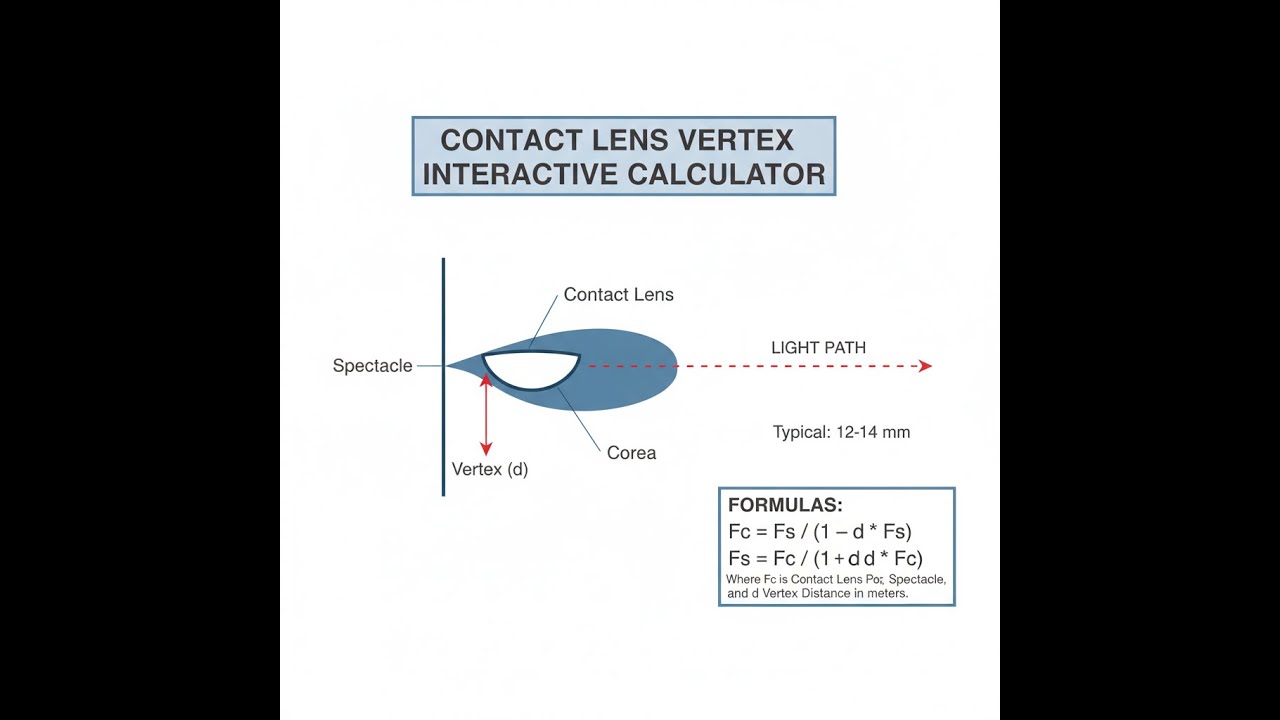
Optical System Diagram

Contact Lens Vertex Calculator
How to Use This Calculator
This calculator is intended for education, concept evaluation, and preliminary design. Results are based on the equations and assumptions described on this page, but cannot account for every real-world load case, tolerance, material property, environmental condition, installation detail, safety factor, code, or regulatory requirement. Verify all inputs, assumptions, units, and results independently before selecting components or using the result in a real application. Safety-critical, structural, medical, lifting, transportation, or regulated applications must be reviewed by a qualified engineer.
- Pick the calculation you’re doing—usually, you want Spectacle Rx → Contact Lens Rx.
- Type in the spectacle power (or contact lens power, if going the other way), in diopters.
- Enter the vertex distance in millimeters. If you haven’t measured it, 12mm is a common default.
- Click Calculate to get your answer.
Contact Lens Vertex Interactive Calculator
Calculate the precise contact lens power needed when converting from spectacle prescriptions. Watch how vertex distance affects optical power as the lens moves from 12mm away to directly on the cornea.
CONTACT LENS POWER
-5.60 D
POWER CHANGE
+0.40 D
PERCENT CHANGE
6.7%
FIRGELLI Automations — Interactive Engineering Calculators
Vertex Correction Equations
Here’s how you get the actual contact lens power from your spectacle prescription:
Spectacle to Contact Lens Conversion
Fc = Fs / (1 − d · Fs)
Where:
- Fc = Contact lens power (diopters, D)
- Fs = Spectacle lens power (diopters, D)
- d = Vertex distance (meters, m) — typically 0.012 to 0.014 m
Contact Lens to Spectacle Conversion
Fs = Fc / (1 + d · Fc)
Use this if you’re going the other way—contact lens back to spectacles. Handy when someone’s been wearing contacts and now needs new glasses.
Required Vertex Distance
d = (Fs − Fc) / (Fs · Fc)
This is for when you need to hit a specific contact lens power, but you want to figure out the vertex distance needed to get there. It’s mostly a design or fitting tool.
Power Difference (Absolute Change)
ΔF = Fc − Fs = Fs · [1/(1 − d · Fs) − 1]
Where:
- ΔF = Power difference (diopters, D)
The bigger the spectacle prescription, the more this number drifts. For minus lenses, you dial back the power for contacts; for plus lenses, you usually need to add more. The relationship isn’t linear.
Simple Example
Spectacle power: −6.00 D. Vertex distance: 12mm (0.012 m).
Fc = −6.00 / (1 − 0.012 × −6.00) = −6.00 / 1.072 = −5.60 D
That’s a +0.40 D change—so you’d order a −5.50 D or −5.75 D contact lens (go with what’s stocked).
Theory & Practical Applications of Vertex Correction
Fundamental Optical Principles Behind Vertex Distance
The main reason you need vertex correction is that light hitting a lens 12mm from your eye gets bent differently from light passing through a lens directly on your cornea. The lens power “moves” with the lens, and the effective correction changes with distance—especially at higher prescription strengths. It’s not a straight-line relationship. The bigger the prescription, the less interchangeable power becomes between glasses and contacts.
One point people often miss: the adjustment isn’t the same for plus and minus lenses of equal size. If you take a -8.00 D spectacle lens at 12mm, you get about -7.25 D for the contact equivalent. Flip it to +8.00 D, and the contact jumps to +8.82 D instead. That’s because of how the denominator in the correction formula shifts; it’s not just a sign change. With strong prescriptions, this gap affects what powers need stocking for contacts.
Clinical Decision Thresholds for Vertex Correction
The reason ±4.00 D is often quoted as the threshold is practical: most people can’t spot visual errors smaller than 0.25 D. If you’re under ±4.00 D, power differences due to vertex correction tend to fall below 0.20 D, so it’s usually not noticeable. Above ±6.00 D, you’re looking at vision changes big enough to drop you a line or two on a Snellen chart.
Still, you should correct below ±4.00 D if the user needs high-precision vision (pilots, shooters), has marked power differences between eyes (anisometropia), or can’t accommodate small prescription errors (e.g., low focusing ability). For those cases, the correction does make a difference, even if you can’t see it on the chart. Fitting specialists working with demanding tasks often apply vertex correction at ±3.00 D just to rule out any preventable defocus.
Vertex Distance Variation and Measurement Precision
The go-to number for vertex is 12mm, but it swings from 8mm on deep-set eyes or tight frames to 16mm on people with more prominent features or loose-fitting frames. A swing of 4mm at -8.00 D translates to about 0.30 D of power change—enough to give you a worse outcome than you might expect. Digital devices give you ±0.5mm accuracy, but plenty of opticians still measure with manual rulers, which might be off by ±2mm.
Some advanced clinics document the actual measured vertex with each prescription, knowing that even a 2-3mm change (say, from swapping frame styles) can change the lens needed for high-power scripts. Not every EHR system tracks this—some do, some don’t—but the ones dealing with a lot of strong prescriptions usually note the measured vertex so the contact lens math is easier later.
Contact Lens Design Considerations
Contact lenses—unlike glasses—are assumed to sit at zero vertex distance. But, thick lenses (think big powers or specialty scleral lenses) add a bit of distance inside the lens itself. For example, a -12.00 D soft lens can be almost 0.08mm thick in the center, while a high plus design can hit 0.50mm. In those rare, extreme prescriptions, you may need to tweak the numbers further, but most users never notice this small effect except with custom, high-power, or thick lenses.
Scleral lenses are a special case: they vault fully over the cornea and rest on the eye’s white, with a layer of fluid (maybe 150-400 microns thick) trapped underneath. That’s another effective “vertex distance” but inside the eye! Scleral lens fitters account for this by making custom adjustments. On the other hand, RGP (rigid) lenses usually avoid this problem because they’re thinner and less variable, so the vertex math stays predictable.
Multi-Focal and Astigmatic Corrections
When you’re adjusting for astigmatism, both the spherical and the cylindrical part need their own correction—but since their magnitudes differ, they don’t change by the same amount. For example, -6.00 -2.00 × 180 at 13mm vertex gives about -5.55 D sphere and -1.95 D cylinder. The axis (the angle) doesn’t get corrected—just the powers.
Progressive and bifocal lenses complicate things more. Patients often hold their reading material closer, reducing the real-world vertex distance for reading power compared to distance vision. Some fitting software offers separate corrections for each zone, but most practitioners just use a single number. The error introduced is usually minor unless the add is above +3.00 D or the patient is unusually sensitive.
Worked Example: High Myope Contact Lens Fitting
Scenario: Someone comes in with a prescription of -11.50 D sphere in both eyes. After careful measurement with a digital pupillometer, their vertex distance is 13.5mm. They want disposable contacts for sports.
Step 1: Convert vertex distance to meters
d = 13.5 mm = 0.0135 m
Step 2: Apply spectacle-to-contact formula
Fc = Fs / (1 − d · Fs)
Fc = -11.50 / (1 − 0.0135 × -11.50)
Fc = -11.50 / (1 − (-0.155))
Fc = -11.50 / 1.155
Fc = -9.96 D
Step 3: Round to nearest available contact lens power
Contact lens manufacturers use 0.25 D steps, so round -9.96 D to -10.00 D for fitting.
Step 4: Calculate power difference and percentage change
ΔF = -9.96 − (-11.50) = +1.54 D
Percentage change = (1.54 / 11.50) × 100 = 13.4%
Step 5: Clinical verification
Testing with a -10.00 D diagnostic lens confirms that no extra correction is needed—this matches the actual vision check. If the wrong (unadjusted) power had been used, the patient would be over-corrected by a significant margin and notice the blur right away.
Critical observation: When the prescription gets this strong, even small measurement errors matter. Skipping the correction leads to wasted time and extra lens trials.
Applications Across Optical Industries
You see vertex correction well beyond everyday optometry. For example, VR headsets hold screens much further from the eye—35-50mm instead of 12mm—so optical designers must account for big vertex shifts when building diopter adjustments into their headsets. The same challenges show up in military helmet optics and premium sports eyewear, where designers often recalculate prescription powers from regular frames due to differences in lens-to-eye distance. In manufacturing, vertex distance is used during quality checks to simulate how the lens will actually work once it’s worn—not just on the production bench.
Frequently Asked Questions
Free Engineering Calculators
Explore our complete library of free engineering and physics calculators.
Browse All Calculators →🔗 Explore More Free Engineering Calculators
About the Author
Robbie Dickson — Chief Engineer & Founder, FIRGELLI Automations
Robbie Dickson brings over two decades of engineering expertise to FIRGELLI Automations. With a distinguished career at Rolls-Royce, BMW, and Ford, he has deep expertise in mechanical systems, actuator technology, and precision engineering.
Video Walkthrough - How to Use This Calculator
Need to implement these calculations?
Explore the precision-engineered motion control solutions used by top engineers.


