World's First Active Aero System for Lamborghini: Engineering High-Speed Control
Picture this: You're pushing a Lamborghini to 220 MPH down a 3.5-kilometer runway when you suddenly realize you're running out of tarmac. The immediate answer isn't just "slow down"—it's "how do you slow down without losing control?" This exact scenario at a high-speed racing event became the catalyst for developing the world's first aftermarket active aerodynamic brake wing system for Lamborghini vehicles, engineered by Attivo Designs.
🎥 Video — First Ever Lamborghini Air Brake Wing Allows You to Drive Faster, Brake Harder, and Look Good Doing It!
Active aerodynamics have long been the domain of hypercar manufacturers like Bugatti, McLaren, and Koenigsegg, with systems that cost hundreds of thousands of dollars and require factory integration. But Attivo Designs set out to create something different: a retrofit solution that could be installed on existing Lamborghini models, providing genuine high-speed stability and emergency braking force when it matters most. At the heart of this system are precision linear actuators from FIRGELLI Automations, proving that electric actuation technology has evolved to meet even the most demanding automotive performance applications.
This project represents a significant milestone in aftermarket automotive engineering—demonstrating how advanced motion control technology can be adapted for extreme performance applications without compromising reliability or response time.
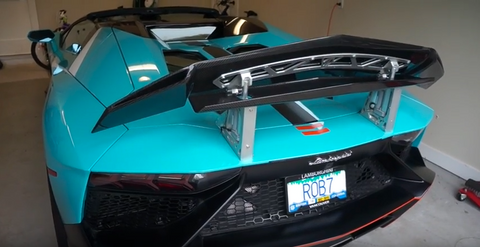
The Engineering Challenge: Active Aero at 200+ MPH
Developing an active aerodynamic system for a Lamborghini isn't simply about mounting a wing and making it move. The engineering challenges are substantial and multifaceted. At speeds exceeding 180 MPH, aerodynamic forces become extreme—any component failure could be catastrophic. The system needed to meet several critical requirements simultaneously:
- Response time: Deploy from horizontal to near-vertical position in under one second
- Structural integrity: Withstand aerodynamic loads exceeding 840 lbs at high speed
- Reliability: Function flawlessly under repeated cycling and varying environmental conditions
- Synchronization: Multiple actuators must move in perfect unison to prevent asymmetric loading
- Weight optimization: Add minimal mass while maintaining strength
- Integration: Connect to the vehicle's electrical system without compromising other functions
Attivo Designs chose carbon fiber for the wing structure—offering an optimal strength-to-weight ratio critical for performance vehicles. However, the actuation mechanism required even more careful consideration. Hydraulic systems, while powerful, add complexity, potential leak points, and maintenance requirements. Pneumatic systems require compressed air sources. Electric linear actuators emerged as the ideal solution: compact, powerful, precise, and requiring only electrical power from the vehicle's existing system.
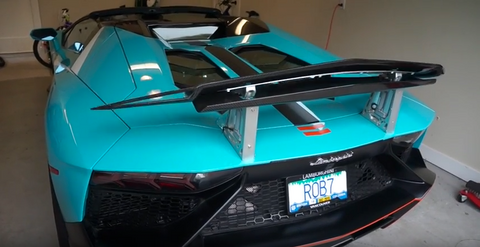
How the Active Air Brake System Works
The Attivo Designs air brake wing system uses a dual-strut configuration, with each strut containing two synchronized linear actuators. This four-actuator arrangement provides several key advantages over single-actuator designs:
Dual Actuator Architecture
Each strut incorporates two linear actuators wired into the same control system, ensuring they extend and retract simultaneously. This redundancy serves multiple purposes. First, it doubles the available force output, allowing the system to overcome the substantial aerodynamic loads encountered at high speeds. Second, it provides a safety factor—if one actuator were to fail, the remaining three could still operate the wing, though at reduced capacity. Third, the paired configuration helps distribute loads more evenly through the mounting structure.
The actuators are connected to a centralized control box that manages deployment timing and position. This control system can be triggered manually by the driver or programmed to deploy automatically based on vehicle speed, brake pressure, or other parameters depending on the installation configuration.
Deployment Sequence and Aerodynamic Effect
In normal driving conditions, the carbon fiber wing sits in a horizontal position, functioning similarly to a conventional fixed rear wing—providing downforce to improve high-speed stability and cornering grip. When maximum braking force is required, the system deploys the wing to a near-vertical position in approximately one second.
In this vertical configuration, the wing functions as an air brake, creating substantial aerodynamic drag. At 180 KPH (approximately 112 MPH), the system generates 840 lbs of braking force—equivalent to the output of a significant mechanical brake upgrade, but without the heat buildup, fade, or wear associated with friction braking systems. This aerodynamic braking force increases exponentially with speed, meaning it's most effective exactly when you need it most: during emergency high-speed deceleration.

Remote Control for Demonstration
Beyond its functional performance benefits, the system includes remote control capability for demonstration purposes when the vehicle is stationary. This feature proves invaluable at car shows, media events, and customer demonstrations, allowing the wing to be cycled through its full range of motion without running the engine or moving the vehicle. The remote control functionality showcases the precision and speed of the actuation system while highlighting the engineering sophistication of the installation.
Why Electric Linear Actuators for Automotive Applications
The choice of electric linear actuators for this application represents a broader trend in automotive engineering: the transition from hydraulic and pneumatic systems to electric actuation. This shift offers numerous advantages that proved critical for the Lamborghini air brake project.
Precision and Control
Electric linear actuators provide exceptional position control and repeatability. Unlike hydraulic systems that can vary based on fluid temperature and pressure, or pneumatic systems affected by air compressibility, electric actuators deliver consistent performance across varying conditions. For a safety-critical system like an air brake, this predictability is essential. The wing must deploy to exactly the same position every time, regardless of ambient temperature, altitude, or how many times it's been cycled.
Compact Packaging
Space constraints in a Lamborghini are severe. Every millimeter matters when integrating aftermarket components into a vehicle designed with minimal tolerances. Electric actuators eliminate the need for hydraulic pumps, reservoirs, hoses, and valves, or pneumatic compressors and air tanks. The entire actuation system consists of the actuators themselves, wiring, and the control module—all of which can be routed through existing spaces without major modifications to the vehicle structure.
Maintenance and Reliability
Hydraulic systems require regular fluid changes, seal replacements, and leak monitoring. Pneumatic systems need moisture management and pressure regulation. Electric actuators, by contrast, are largely maintenance-free. There are no fluids to leak, no seals to deteriorate, and no filters to change. This reliability proved crucial for Attivo Designs—as they note, the FIRGELLI components have "performed flawlessly time and again under varying loads."
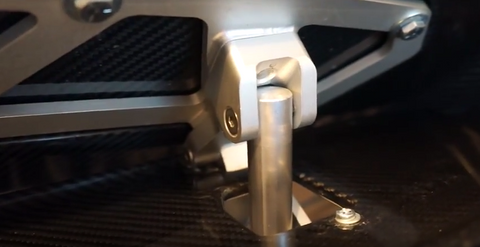
Force and Speed Specifications
For applications requiring rapid deployment and substantial force output, selecting actuators with appropriate specifications is critical. The system must overcome not only the weight of the carbon fiber wing but also the aerodynamic forces acting on it as it transitions from horizontal to vertical—forces that increase dramatically with vehicle speed. The dual-actuator-per-strut configuration allows the use of moderately sized actuators that together provide sufficient force while maintaining the speed necessary for one-second deployment.

Performance Benefits: More Than Just Braking
While the air brake functionality provides the most dramatic benefit—840 lbs of aerodynamic braking force at 180 KPH—the system delivers additional performance advantages that enhance the vehicle's overall dynamics.
Enhanced High-Speed Stability
Even in its horizontal position, the adjustable wing provides tunable downforce. Unlike a fixed wing that represents a compromise between maximum downforce and minimal drag, an active system can optimize for current conditions. On a straight runway run, the wing can be positioned to minimize drag and maximize top speed. When approaching a corner or needing to scrub speed, the wing can deploy to increase downforce and improve stability during deceleration.
Mechanical Brake System Preservation
High-performance driving puts enormous stress on brake systems. Track sessions often require cooling breaks to allow brake temperatures to drop and prevent fluid boiling or pad glazing. By supplementing mechanical braking with aerodynamic drag, the air brake system reduces thermal load on brake components. This extends brake life, reduces fade during repeated hard stops, and can allow the use of slightly less aggressive (and more streetable) brake pad compounds without sacrificing ultimate stopping power.
Increased Driver Confidence
Perhaps the most significant but hardest to quantify benefit is driver confidence. Knowing you have an additional braking tool available—especially one that becomes more effective at higher speeds—allows drivers to push harder on track. The air brake provides a psychological safety net for high-speed runs, particularly on venues with limited runoff areas where overshooting a braking zone could have serious consequences.

Technical Considerations for Similar Projects
For engineers and fabricators considering similar active aerodynamic projects, several key technical considerations emerge from the Attivo Designs Lamborghini installation:
Actuator Selection Criteria
Choosing appropriate actuators requires careful analysis of force requirements, stroke length, speed, and duty cycle. The force calculation must account for the maximum expected aerodynamic load plus a safety factor—not just the static weight of the component being moved. Stroke length must provide sufficient travel to achieve the desired range of motion while considering mounting geometry. Speed specifications determine deployment time, and duty cycle ratings ensure the actuators can handle repeated operations without overheating.
For applications requiring precise position control or feedback, feedback actuators with built-in potentiometers or hall effect sensors provide real-time position data to the control system, enabling closed-loop control and position verification.
Synchronization and Control
When multiple actuators must move in unison—as in this dual-strut, four-actuator configuration—proper synchronization is essential. Running actuators in parallel from the same control signal ensures they receive identical input. However, manufacturing tolerances, load variations, and friction differences can cause actuators to move at slightly different rates. For applications where perfect synchronization is critical, individual control with position feedback and active compensation may be necessary.
Mounting and Structural Integration
The mounting points for both the actuators and the moving wing structure must be engineered to handle the full range of expected loads. Mounting brackets must be rigid enough to prevent flexing under load, which could bind the actuators or create uneven force distribution. In automotive applications, vibration isolation may also be necessary to prevent road vibrations from being transmitted to the actuators and causing premature wear.
Electrical System Integration
Integrating aftermarket electrical systems into modern vehicles requires consideration of voltage compatibility, current draw, and electrical noise. Most linear actuators operate on 12V DC, matching standard automotive electrical systems. However, calculating total current draw during simultaneous deployment of multiple actuators is essential for proper wire sizing and fuse selection. Additionally, inductive loads from motor-driven actuators can create electrical noise that may require suppression to prevent interference with vehicle electronics.
Applications Beyond Automotive Performance
While the Lamborghini air brake project represents a high-profile automotive application, the same principles and technologies enable countless other motion control solutions. Electric linear actuators have become the go-to solution for applications ranging from home automation to industrial machinery, marine systems to medical devices.
In automotive contexts specifically, linear actuators enable everything from retractable spoilers and adjustable suspension systems to trunk lifts and convertible top mechanisms. The technology's versatility, reliability, and increasingly affordable pricing have made electric actuation accessible for custom fabricators, restoration specialists, and performance enthusiasts—not just OEM manufacturers with unlimited budgets.
Conclusion: Engineering Excellence Meets Real-World Performance
The Attivo Designs Lamborghini air brake wing project demonstrates how advanced motion control technology can be successfully applied to demanding high-performance applications. By combining precision-engineered carbon fiber structures with reliable electric linear actuators, the system delivers measurable performance benefits—840 lbs of braking force, sub-second deployment, and enhanced vehicle stability—while maintaining the reliability necessary for track use.
The success of this project highlights several important trends in modern engineering: the transition from hydraulic to electric actuation systems, the increasing accessibility of advanced motion control for custom applications, and the performance potential of well-engineered aftermarket solutions. For FIRGELLI Automations, projects like this showcase the real-world capability of our actuator technology under extreme conditions—when proper engineering meets quality components, the results speak for themselves.
Frequently Asked Questions
How much braking force does an active air brake actually provide?
The Attivo Designs Lamborghini air brake system generates 840 lbs of aerodynamic braking force at 180 KPH (approximately 112 MPH). This braking force increases exponentially with speed—at 220 MPH, the force would be substantially higher. To put this in perspective, 840 lbs represents roughly 15-20% of the total braking force available from a high-performance vehicle's mechanical brake system at that speed. While it's not a replacement for conventional brakes, it provides meaningful supplemental deceleration exactly when it's most needed: during high-speed emergency braking situations. The aerodynamic braking also doesn't generate heat or cause wear, unlike friction brakes.
How fast can the air brake wing deploy?
The system transitions from horizontal to near-vertical position in approximately one second. This rapid deployment is critical for high-speed applications where reaction time matters. The speed is achieved through careful selection of linear actuators with appropriate force and speed ratings, combined with optimized stroke length and mounting geometry. Faster deployment would require higher-speed actuators, but there are practical limits—deploying too quickly could create sudden aerodynamic loads that might destabilize the vehicle rather than assist with controlled deceleration.
Can this system be installed on other vehicles besides Lamborghinis?
While the Attivo Designs system was specifically engineered for Lamborghini models, the underlying technology—electric linear actuators controlling active aerodynamic elements—can be adapted to virtually any vehicle. The key considerations are mounting points with sufficient structural strength, electrical system compatibility, and appropriate sizing of the wing and actuators for the specific vehicle's speed range and weight. Similar active aero systems have been developed for everything from dedicated race cars to street performance vehicles. The modularity of electric linear actuator systems makes them well-suited for custom fabrication projects where hydraulic systems would be prohibitively complex.
What maintenance does an active air brake system require?
Electric linear actuator-based systems require minimal maintenance compared to hydraulic or pneumatic alternatives. There are no fluids to change, no seals to replace, and no leaks to monitor. Recommended maintenance includes periodic inspection of mounting points for tightness and signs of stress, verification of electrical connections, and occasional testing of the full deployment cycle to ensure all actuators are functioning synchronously. The actuators themselves are sealed units that require no lubrication or internal maintenance. This low-maintenance characteristic was a significant factor in choosing electric actuation for a high-performance application where reliability is paramount.
What are the power requirements for running multiple linear actuators?
Power requirements depend on the specific actuators used, but most automotive-grade linear actuators operate on 12V DC, drawing between 3-10 amps per actuator during movement depending on load and speed. A four-actuator system like the Lamborghini installation might draw 20-40 amps total during simultaneous deployment—well within the capacity of automotive electrical systems when properly wired and fused. The key is ensuring adequate wire gauge to handle the current without voltage drop, and protecting the circuit with appropriately rated fuses or circuit breakers. The actuators only draw current while moving; once positioned, they hold position mechanically without consuming power, making them efficient for applications with intermittent duty cycles.
Are feedback actuators necessary for synchronized multi-actuator systems?
For many applications, including the Lamborghini air brake system, standard linear actuators without position feedback can achieve satisfactory synchronization when wired in parallel and operated from the same control signal. Manufacturing quality and proper installation ensure actuators move at closely matched speeds. However, for applications requiring absolute precision—such as platforms that must remain perfectly level, or systems where even slight misalignment could cause binding—feedback actuators with position sensors enable closed-loop control. The control system can monitor each actuator's position independently and make real-time adjustments to maintain perfect synchronization. The trade-off is increased system complexity and cost versus the level of precision actually required for the application.


