The Ambitious Challenge of Humanoid Robotics
The human body is an engineering marvel that has evolved over millions of years to achieve remarkable flexibility, dexterity, and adaptability. With approximately 600 skeletal muscles working in concert to produce fluid, complex movements, the human musculoskeletal system sets an extraordinarily high bar for robotics engineers. When Elon Musk unveiled plans for the Tesla Bot (now known as Optimus), a fundamental question emerged: Can a humanoid robot with just 28 actuators match even a fraction of human capability?
🎥 Video — Tesla Bot vs. Human Flexibility: Can Cutting-Edge Robotics Overcome Actuator Limitations and Redefine Dexterity
This isn't merely an academic exercise. The answer has profound implications for manufacturing automation, healthcare assistance, hazardous environment operations, and countless other applications where robots might augment or replace human workers. Unlike industrial actuators used in fixed automation systems, humanoid robotics demands versatile, compact actuation solutions that can replicate the nuanced movements humans perform instinctively.
The disparity is stark: 600 muscles versus 28 actuators. Yet through innovative mechanical design, differential mechanisms, advanced control algorithms, and strategic use of passive compliance, modern robotics is attempting to bridge this seemingly impossible gap. Understanding how engineers approach this challenge reveals both the current limitations of robotic dexterity and the ingenious solutions being deployed to overcome them.

Understanding Human Degrees of Freedom
Before evaluating robotic capabilities, we must first understand what makes human movement so complex. The concept of degrees of freedom (DOF) provides a framework for quantifying movement capability. Each DOF represents an independent direction of movement—essentially, a way a joint can move without affecting other movements.
Major Joint Degrees of Freedom
A comprehensive breakdown of human DOF reveals the complexity robotics engineers face:
- Neck: 3 DOF (pitch, yaw, and roll movements)
- Shoulders: 3 DOF per shoulder (6 total), enabling the arm's remarkable range of motion
- Elbows: 1 DOF per elbow (2 total), primarily flexion and extension
- Wrists: 2 DOF per wrist (4 total), allowing rotation and bending
- Hands: 14 DOF per hand (28 total), with the thumb having 4 DOF and each finger having 3 DOF
- Spine: Between 12 and 24 DOF depending on measurement granularity
- Hips: 3 DOF per hip (6 total), providing the leg's base mobility
- Knees: 1 DOF per knee (2 total), primarily flexion and extension
- Ankles: 2 DOF per ankle (4 total), enabling balance and terrain adaptation
- Feet: 9 DOF per foot (18 total), crucial for stability and gait
This simplified analysis yields approximately 83 to 95 degrees of freedom for major joints alone. The actual number could be higher when considering smaller joints, subtle movements between vertebrae, and the complex mechanics of the hand and foot. Each of these DOF typically requires muscular actuation, though not always one-to-one mapping.
Muscles Versus Degrees of Freedom
Interestingly, the human body has many more muscles (approximately 600) than degrees of freedom (83-95). This redundancy serves multiple purposes: it provides backup capability if muscles are damaged, allows for variable force application, enables fine motor control through antagonistic muscle pairs, and permits sustained activity as different muscle groups alternate bearing loads. This biological redundancy is a luxury that cost-conscious robotic designs cannot easily replicate.
Actuator Requirements for Humanoid Robots
Creating a robot with human-like flexibility theoretically requires actuators corresponding to each degree of freedom—roughly 83 to 95 actuators for a complete humanoid system. However, practical robotic design involves numerous trade-offs between capability, complexity, cost, and reliability.
The One-to-One Approach
The most straightforward design philosophy would place one actuator at each joint requiring movement. This approach offers maximum flexibility and independent control but comes with significant drawbacks. The weight of 80-95 linear actuators or rotary motors, along with their power supplies and control systems, would be substantial. The cost would be prohibitive for commercial applications. Heat dissipation from dozens of simultaneously operating actuators would present thermal management challenges. The control system complexity would increase exponentially with each additional actuator requiring real-time coordination.
Strategic Reduction Through Design
Modern humanoid robotics takes a more pragmatic approach: identify which degrees of freedom are absolutely essential for target applications and implement creative mechanical solutions to achieve multiple motions from fewer actuators. The Tesla Bot's 28 actuators represent this philosophy taken to an extreme, relying heavily on differential mechanisms, coupled joints, and intelligent control systems to multiply the effective capability of each actuator.
This approach isn't unique to Tesla. Boston Dynamics, for example, has achieved remarkable agility in their robots while maintaining relatively modest actuator counts through sophisticated mechanical design and control algorithms. The key is understanding that not all tasks require full human-equivalent dexterity—a robot designed for warehouse work has different requirements than one intended for surgical assistance.
Differential Mechanisms: Multiplying Actuator Effectiveness
Differential mechanisms represent one of the most powerful techniques for reducing actuator count while maintaining functionality. These mechanical systems distribute motion or force from a single actuator across multiple degrees of freedom, effectively allowing one motor to control multiple joints under certain conditions.
How Differential Mechanisms Work
The fundamental principle behind differential mechanisms is motion coupling. Through gears, linkages, belts, or cables, the output of one actuator can be distributed to multiple joints. The classic automotive differential is a familiar example: one input (the driveshaft) drives two outputs (the wheels) while allowing them to rotate at different speeds during turns.
In robotics, differential mechanisms can be implemented several ways:
- Shared actuation: Connecting multiple joints to a single actuator via transmission elements allows synchronized or proportional movement patterns
- Tendon-driven systems: Using cables or tendons (similar to biological systems) to transmit force from centrally located actuators to distant joints
- Underactuated mechanisms: Designing passive joints that move in response to actuated joints, reducing active actuator requirements
- Mechanical intelligence: Incorporating springs, dampers, and compliant elements that provide passive adaptation to external forces
Advantages of Differential Actuation
Beyond the obvious benefit of reducing actuator count, differential mechanisms offer several advantages. Weight reduction is significant—fewer motors means lighter overall system mass, improving mobility and energy efficiency. Cost savings can be substantial, as actuators typically represent a major portion of robot system cost. Simplified power distribution requires fewer motor drivers and less complex wiring. Some differential designs can even enhance robustness, as the mechanical coupling can distribute loads across multiple joints, reducing stress concentrations.
Trade-offs and Limitations
Differential mechanisms aren't a universal solution. The most significant limitation is reduced independent control—coupled joints cannot move completely independently, restricting the robot's configuration space. Mechanical complexity increases, with additional gears, bearings, and linkages introducing potential failure points and maintenance requirements. Backlash and friction in the transmission components can reduce precision and responsiveness. Control algorithms become more complex, as the relationship between actuator inputs and joint outputs becomes non-linear and interdependent.
Perhaps most critically, differential mechanisms can compromise redundancy. In a fully actuated system, if one motor fails, other joints continue functioning. With coupled systems, a single actuator failure can disable multiple degrees of freedom simultaneously.
Harmonic Drives: Precision Gearing for Robotics
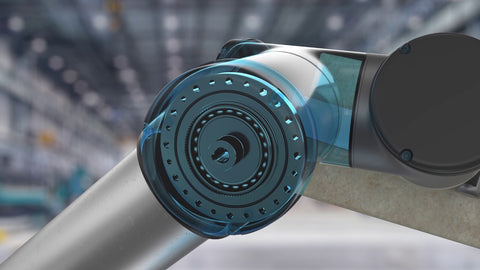
Among the various mechanical solutions employed in advanced robotics, the Harmonic Drive stands out as a particularly elegant approach to achieving high torque multiplication with exceptional precision—qualities essential for robots attempting human-like dexterity with limited actuators.
Harmonic Drive Principles
A Harmonic Drive consists of three primary components working in concert. The wave generator, connected to the input motor shaft, is an elliptical component that creates a wave-like deformation. The flex spline is a thin-walled, flexible steel cup with external teeth that deforms as the wave generator rotates inside it. The circular spline is a rigid ring with internal teeth that the flex spline meshes with at two points opposite the ellipse's major axis.
As the wave generator rotates, it forces the flex spline into an elliptical shape. The flex spline's teeth engage the circular spline's teeth at two points. Because the flex spline has slightly fewer teeth than the circular spline (typically two fewer), each full rotation of the wave generator causes the flex spline to rotate backwards by a small amount relative to the circular spline. This creates extremely high gear reduction ratios—typically 50:1 to 100:1, with some designs achieving 160:1 or higher.
Advantages in Robotic Applications
Harmonic Drives offer several characteristics that make them ideal for humanoid robotics. Zero backlash is achieved through the unique tooth engagement pattern, providing precise position control essential for coordinated multi-joint movements. High torque density allows compact motors to generate substantial output torque, critical when space is limited. Coaxial design keeps input and output shafts aligned, simplifying mechanical layouts. High efficiency (typically 70-90%) reduces waste heat and extends battery life in mobile robots.
For a robot like Tesla's Optimus with only 28 actuators, Harmonic Drives or similar precision reducers are likely essential. They enable relatively small motors to generate the torque needed for human-scale manipulation tasks while maintaining the positional accuracy required for delicate operations.
Limitations and Considerations
Despite their advantages, Harmonic Drives have limitations. Cost is significant—precision Harmonic Drives are expensive components. Torsional compliance due to the flex spline's flexibility can introduce unwanted oscillations in high-speed or dynamic applications. Limited speed capability means they excel at precision positioning but aren't ideal for high-velocity movements. Service life, while typically measured in millions of cycles, is finite, and failure often requires complete replacement of the unit.
Tesla Bot Capabilities with 28 Actuators
With only 28 actuators compared to the human body's 600 muscles and 83-95 degrees of freedom, what can the Tesla Bot realistically accomplish? The answer depends heavily on which 28 degrees of freedom are actuated and how cleverly the mechanical design multiplies their effectiveness.
Likely Actuator Distribution
While Tesla hasn't published detailed specifications, a logical distribution of 28 actuators for a humanoid robot might include: 6 for the legs (3 per leg for hip, knee, and ankle), 8 for the arms (4 per arm for shoulder, elbow, and wrist movements), 8-10 for the hands (allowing some grasping capability while sacrificing individual finger control), 2 for the torso (waist rotation and bending), and 2-4 for the head/neck. This distribution prioritizes mobility and basic manipulation while accepting significant limitations in hand dexterity compared to humans.
Realistic Application Scenarios
Given these constraints, the Tesla Bot is likely well-suited for specific categories of tasks. Manufacturing and warehouse operations represent an ideal use case—repetitive pick-and-place operations, moving boxes and materials, basic assembly tasks with pre-positioned components, and quality inspection using mounted cameras and sensors. These tasks don't require fine manipulation of complex objects or simultaneous control of many degrees of freedom.
Household assistance is another promising domain, including loading and unloading dishwashers and laundry, basic cleaning tasks like vacuuming, carrying items between locations, and simple food preparation tasks. However, tasks requiring fine motor control, like buttoning shirts or handling delicate glassware, would likely exceed its capabilities.
Basic healthcare support might include delivering supplies and medications, assisting with patient mobility (under supervision), routine sanitization tasks, and inventory management in medical facilities. However, any direct patient care requiring delicate touch would necessitate human oversight.
The construction industry could benefit from material handling and transport, tool fetching and organization, site cleanup, and basic repetitive tasks in controlled environments. Skilled work requiring precise manipulation would remain in human hands.
Limitations Compared to Humans
The actuator deficit creates clear limitations. The Tesla Bot will lack the hand dexterity for fine manipulation tasks—imagine trying to tie shoelaces, thread a needle, or perform intricate assembly work. Adaptive grasping of irregular objects will be challenging without the sensory feedback and compliance of human hands. Full-body coordination for dynamic tasks like climbing stairs while carrying awkward loads or maintaining balance on uneven terrain will be limited. The ability to perform novel tasks without reprogramming will be far below human capability, as the reduced DOF limits improvisation.
The Future of Humanoid Actuation Systems
The challenge facing Tesla and other humanoid robotics companies extends beyond mere actuator count. The future of practical humanoid robots likely lies in several converging technology trends and design philosophies.
Emerging Actuator Technologies
New actuation technologies promise to change the performance-versus-size equation. Artificial muscles using electroactive polymers or shape-memory alloys could provide more human-like compliance and power density. Micro linear actuators continue improving in force-to-size ratio, enabling more actuators in compact spaces. Pneumatic artificial muscles offer high power-to-weight ratios and inherent compliance, though they require air supply systems. Magnetorheological and electrorheological dampers provide variable stiffness without additional actuators, enabling adaptation to different tasks.
Advanced Control Approaches
Software and control strategy innovations may prove as important as hardware advances. Machine learning for motor control can optimize movement patterns to work within actuator limitations. Whole-body coordination algorithms can maximize the effectiveness of limited DOF through intelligent motion planning. Adaptive impedance control allows robots to adjust their stiffness and compliance based on task requirements. Force-feedback control systems, similar to feedback actuators used in industrial applications, enable delicate manipulation even with limited actuator count.
Hybrid Biological-Mechanical Systems
Looking further ahead, some researchers are exploring truly hybrid systems that combine biological and mechanical actuation. Bio-hybrid robots incorporating actual muscle tissue have demonstrated proof-of-concept in laboratory settings. While practical implementation faces enormous challenges, such systems could theoretically achieve human-like performance with more human-like mechanisms.
Lessons from Industrial Automation
The humanoid robotics challenge shares principles with decades of industrial automation experience. Companies like FIRGELLI Automations have spent over 20 years engineering linear actuators and motion control systems for applications ranging from simple TV lifts to complex industrial actuators in demanding environments.
Several lessons from industrial applications translate directly to humanoid robotics. First, right-sizing the actuator is critical—using more capability than needed wastes money and energy, while under-specification leads to failure. Second, environmental factors matter enormously—duty cycle, load characteristics, speed requirements, and operating environment all influence actuator selection and longevity. Third, control system integration often determines success or failure, as even excellent actuators perform poorly with inadequate control systems.
For hobbyists and engineers exploring robotic projects, starting with proven actuator technologies and understanding their limitations is essential. A micro actuator suitable for a small gripper mechanism differs fundamentally from a industrial actuator needed for heavy lifting. The appropriate control box and power supply are equally critical for reliable operation.
Conclusion
The Tesla Bot's ambitious goal of matching human utility with just 28 actuators represents both the promise and the challenge of modern humanoid robotics. While 28 actuators cannot replicate the nuanced dexterity of 600 human muscles controlling 83-95 degrees of freedom, clever mechanical design, differential mechanisms, precision components like Harmonic Drives, and sophisticated control algorithms can bridge much of this gap for specific applications.
The robot won't be folding fitted sheets or performing surgery anytime soon. But for structured environments with well-defined tasks—warehouses, factories, basic household chores—a well-designed humanoid robot with limited actuation can provide genuine utility. The key lies in matching robot capabilities to task requirements rather than pursuing human equivalence for its own sake.
As actuator technology advances, control algorithms improve, and our understanding of optimal mechanical design deepens, the gap between human and robot dexterity will continue to narrow. The question isn't whether humanoid robots will eventually achieve human-like flexibility, but rather how soon they'll achieve sufficient capability for widespread practical deployment. The Tesla Bot and similar platforms represent important steps on that journey, even if they're not yet the destination.
Frequently Asked Questions
How many actuators would a robot need to match human flexibility?
To fully replicate human flexibility and dexterity, a robot would theoretically need actuators corresponding to each human degree of freedom—approximately 83 to 95 for major joints. However, perfect replication of the human musculoskeletal system with its 600 muscles isn't practical or necessary for most applications. Modern robotic designs use 30-50 actuators combined with differential mechanisms, coupled joints, and intelligent control systems to achieve task-specific capability without matching full human flexibility. The exact number depends on the robot's intended purpose: a warehouse robot needs different capabilities than a surgical assistant robot.
What are differential mechanisms and how do they reduce actuator requirements?
Differential mechanisms are mechanical systems that distribute motion or force from a single actuator across multiple joints or degrees of freedom. They work through gears, linkages, cables, or belts that couple multiple output movements to one input. For example, a tendon-driven hand might use one actuator to close all fingers simultaneously for power grasping, with another actuator providing selective finger control for precision grips. This approach reduces actuator count, weight, and cost, though it sacrifices independent control of each joint. The trade-off between actuator reduction and control flexibility is a central consideration in humanoid robot design.
What makes Harmonic Drives suitable for humanoid robots?
Harmonic Drives are specialized gear systems offering extremely high gear reduction ratios (typically 50:1 to 160:1) with zero backlash and high precision. They consist of a wave generator, flex spline, and circular spline working together to convert high-speed, low-torque motor output into low-speed, high-torque joint movement. This combination is ideal for humanoid robotics because it allows compact motors to generate substantial force for human-scale tasks while maintaining the positional accuracy needed for coordinated movement. Their coaxial design simplifies mechanical layouts, and their high efficiency (70-90%) reduces waste heat—critical for battery-powered mobile robots. However, they're expensive and have limited service life compared to simple gear reducers.
Can the Tesla Bot perform household tasks with only 28 actuators?
The Tesla Bot can likely handle basic household tasks that don't require fine motor control or complex manipulation. Suitable tasks include loading and unloading dishwashers and washing machines, vacuuming and basic floor cleaning, carrying items between rooms, and simple repetitive activities. However, tasks requiring delicate touch or complex hand movements—like folding laundry, washing dishes by hand, buttoning clothing, or handling fragile objects—would exceed its capabilities. The limited actuator count means compromises in hand dexterity, so the robot will excel at tasks involving whole-arm movements and simple grasping rather than intricate finger manipulations. Over time, as control algorithms improve through machine learning, the range of manageable tasks may expand even without hardware changes.
What are the main limitations of using fewer actuators in humanoid robots?
Reducing actuator count below human-equivalent levels creates several fundamental limitations. First, independent joint control is compromised when differential mechanisms couple multiple joints to one actuator—the robot cannot achieve arbitrary joint configurations. Second, fine motor control suffers dramatically, particularly in the hands where humans have 27 bones and numerous muscles per hand. Third, adaptability to unexpected situations decreases because the reduced degrees of freedom limit the robot's ability to reach positions or grasp objects in novel ways. Fourth, force control becomes more challenging without antagonistic actuator pairs to modulate joint stiffness. Finally, redundancy is eliminated—if one actuator fails in an underactuated system, multiple capabilities may be lost simultaneously. Despite these limitations, well-designed robots can still perform useful work in structured environments with predictable tasks.
How do robotic actuators differ from human muscles?
Robotic actuators and human muscles operate on fundamentally different principles. Human muscles are biological tissues that contract when stimulated by nerves, can only pull (not push), work in antagonistic pairs for bidirectional control, have inherent compliance and shock absorption, and can modulate force output continuously across a wide range. In contrast, most robotic actuators (electric motors driving linear actuators or rotary joints) provide bidirectional motion from a single unit, typically have higher power density but less energy efficiency, operate with more rigid mechanical connections, and require external control systems to modulate force. Human muscles also heal when damaged, adapt to training stress by growing stronger, and operate using readily available biological fuel (glucose and oxygen). Robotic actuators require electrical power and mechanical maintenance. These fundamental differences mean robotic designs cannot simply copy biological approaches—they must develop solutions optimized for artificial actuation technologies.


