In geotechnical work, estimating how long clay takes to settle under load is a job you want to get right the first time. Miss the mark and you run into real-world problems—cracked slabs, failed embankments, or long delays. The Coefficient of Consolidation Calculator here gives you Cv, settlement time, degree of consolidation, and permeability. You'll need to input drainage path, time, and compressibility data. These calculations show up in foundation sizing, embankment scheduling, and checking clay liners. The page lays out the standard equations, a step-by-step example, technical background, and some Q&A on why lab and field results often diverge.
What is the Coefficient of Consolidation?
Coefficient of consolidation (Cv) tells you how fast a saturated clay lets water escape and compresses under a given load. Bigger Cv, quicker settlement. It directly controls how fast the soil tightens up beneath your structure.
Simple Explanation
If you picture wet clay as a soaked sponge under a weight, the squeeze is gradual—water oozes out and the sponge flattens. Cv tells you how fast this happens. If the sponge is loose and porous, water drains faster (high Cv); if it's tight and dense, much slower (low Cv). And don’t forget drainage path—if water has twice as far to go, it’ll take four times longer to finish consolidating.
📐 Browse all 1000+ Interactive Calculators
Table of Contents
Consolidation Process Diagram

How to Use This Calculator
- Pick your calculation type—Cv from t50, Cv from t90, settlement time, degree of consolidation, or permeability.
- Enter the time value (t50 or t90), and drainage path H. Use mm for lab samples, m for the field.
- For permeability or degree of consolidation, add Cv, volume compressibility (mv), and unit weight of water (γw) if needed.
- Click Calculate.
Interactive Coefficient of Consolidation Calculator
This calculator is intended for education, concept evaluation, and preliminary design. Results are based on the equations and assumptions described on this page, but cannot account for every real-world load case, tolerance, material property, environmental condition, installation detail, safety factor, code, or regulatory requirement. Verify all inputs, assumptions, units, and results independently before selecting components or using the result in a real application. Safety-critical, structural, medical, lifting, transportation, or regulated applications must be reviewed by a qualified engineer.
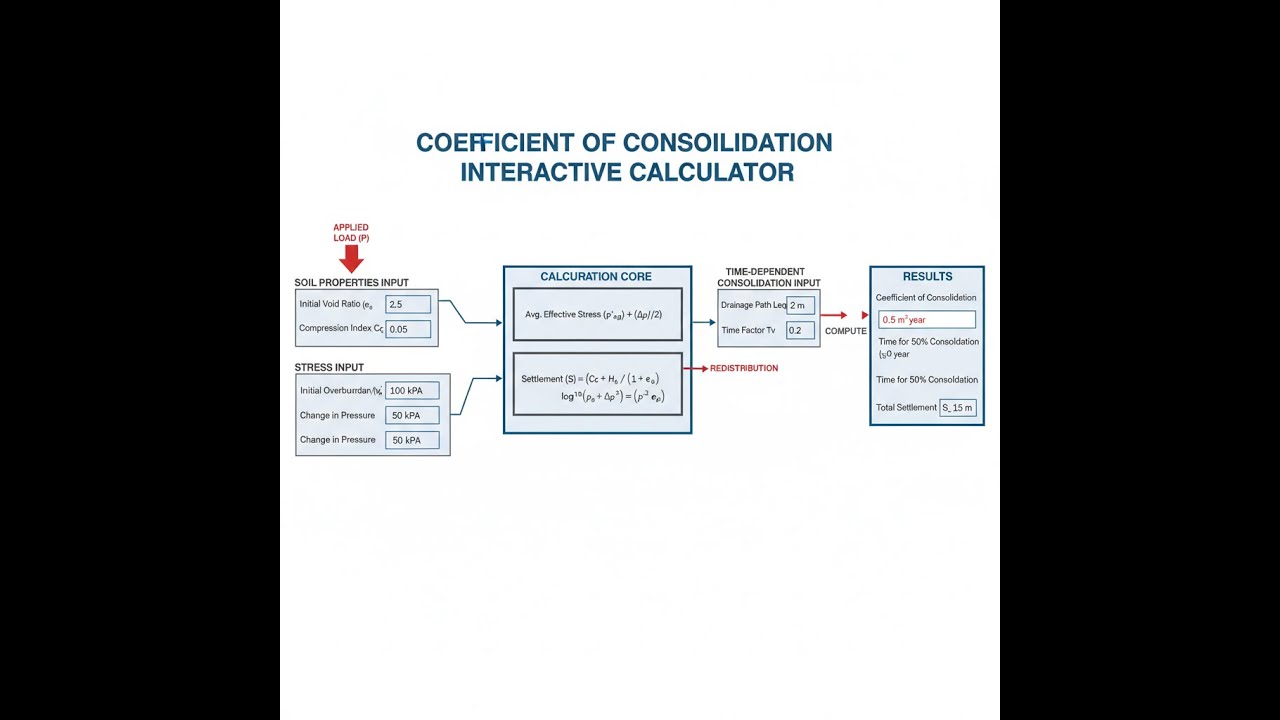
Coefficient of Consolidation Interactive Visualizer
Move the sliders to see how saturated clay soil compresses and sheds water as you adjust drainage distance and soil properties. You’ll notice how much the drainage length and permeability influence the speed of consolidation and Cv.
COEFFICIENT CV
0.15 mm²/s
TIME FACTOR
0.39
SETTLEMENT
50%
FIRGELLI Automations — Interactive Engineering Calculators
Governing Equations
The formula here gives you Cv based on lab test readings.
Coefficient of Consolidation from Laboratory Test
Cv = (Tv × H2) / t
Where:
- Cv = coefficient of consolidation (m²/year, cm²/s, or other area/time units)
- Tv = time factor (dimensionless): 0.197 for 50% consolidation, 0.848 for 90% consolidation
- H = drainage path length (m, cm): half the specimen height for double drainage, full height for single drainage
- t = time to reach specific degree of consolidation (years, seconds, etc.)
Time Factor
For time factor Tv use this formula:
Tv = (Cv × t) / H2
Where:
- Tv = time factor relating time, drainage distance, and consolidation rate
- All other variables as defined above
Degree of Consolidation
The degree of consolidation U at a given time can be found as:
For Tv < 0.217: U = √((4 × Tv) / π) × 100%
For Tv ≥ 0.217: U = (1 - e(-π²Tv/4)) × 100%
Where:
- U = degree (or percent) of consolidation at time t
- π = 3.14159...
Permeability from Consolidation Parameters
To estimate lab permeability (hydraulic conductivity) from consolidation results:
k = Cv × mv × γw
Where:
- k = hydraulic conductivity or permeability (m/s, cm/s)
- mv = coefficient of volume compressibility (m²/kN or 1/kPa)
- γw = unit weight of water (typically 9.81 kN/m³)
Simple Example
Suppose you run a lab consolidation test and get t50 = 245 s, with drainage path H = 12.5 mm (half thickness, double drainage). Compute Cv:
Cv = (0.197 × 12.5²) / 245 = (0.197 × 156.25) / 245 = 30.78 / 245 = 0.1256 mm²/s
This value is typical for silty clays—consolidation proceeds at a moderate rate. Always check if the drainage setup in the field matches lab assumptions before scaling up the times.
Theory & Engineering Applications
Coefficient of consolidation (Cv) sets the pace for how fast excess pore pressure dissipates when a saturated clay is loaded. Cv blends the soil's permeability and compressibility—so it isn't just about how easily water drains, but also how the structure of the clay responds as it sheds water. These relationships all come from Terzaghi's one-dimensional theory, which handles vertical water flow and vertical compression only.
Physical Meaning and Controlling Factors
Load up saturated clay and the first thing that happens is a jump in pore water pressure (since water can't move instantly through tight pores). With time, water drains toward the nearest escape, pore pressure drops, and the soil tightens. Cv is the rate at which this transition happens. It's mainly controlled by:
Permeability (k): Clays with more open or connected pores let water out faster, bumping up Cv. But mineralogy counts—smectite-heavy clays, even if loose, behave very differently from kaolinites of the same density. So you can get big variations just based on clay type.
Compressibility (mv or av): More compressible soils change volume easily with pressure, which means less water needs to move for a given settlement. Sometimes clays with low permeability but very high compressibility actually consolidate quicker because the total water needing to shift is lower per millimeter of settlement.
Stress History: Overconsolidated clays (those previously loaded and released) tend to have higher Cv than normally consolidated (never overloaded) ones at the same void ratio. The overconsolidation ratio (OCR) can make Cv swing up and down by factors, especially as the soil leaves the preconsolidation range and enters virgin compression.
Laboratory Determination Methods
Most labs use an oedometer (consolidometer) test with a confined specimen, usually 50-75 mm diameter, 19-25 mm thick. Incremental loads are applied, and the vertical displacement is tracked over time.
You can pull Cv from results two common ways:
Taylor Square Root of Time (t50): Charting vertical strain versus square root of time, you find where 50% consolidation occurs and apply Cv = 0.197H²/t50. This approach is clearest when the start of consolidation is easy to see and secondary effects are small—thin samples, short drainage, or stiff clays.
Casagrande Log of Time (t90): For clays with significant secondary compression, or where the start of consolidation is messy, the log time curve can be easier to read. Find the intersection point for 90% consolidation (t90), then use Cv = 0.848H²/t90. For very soft or organic clays, this approach handles less-than-ideal curves better.
Modern auto-testing rigs sometimes give you continuous Cv estimates, but it's still good to double-check against both t50 and t90 by hand. Results can be thrown off by sampling disturbance (especially with sensitive clays), incomplete saturation, or temperature swings. It's not unusual for lab Cv values in soft clays to be double field values, or even higher, mainly due to disturbance.
Field Applications and Settlement Prediction
Field prediction depends heavily on drainage—vertical, lateral, single, or double. If you have sand above and below, both sides can drain, and H is only half the clay thickness. If you have an impermeable base, water can escape only upward, so H is the full layer, and consolidation takes four times longer.
The link between degree of consolidation (U) and time factor (Tv) lets you predict how much of the total settlement will have occurred after a certain time. For U less than 60%, you can use U ≈ 2√(Tv/π). For higher degrees, the exponential formula is more accurate. In the field, anything over 90% U is usually considered "done" for construction, even though minor settlement (secondary compression) may continue.
Design Considerations for Large Projects
For highway embankments or any major fill project, Cv can dictate years versus months of waiting. Say you have a 6 m clay layer, Cv = 2.8 m²/year, and both top and bottom are permeable (double drainage: H = 3 m). For 90% consolidation, t90 = 0.848 × H² / Cv = 0.848 × 9 / 2.8 ≈ 2.73 years. If the project's timeline is 18 months, you need something like vertical drains or surcharging to get consolidation done faster.
Vertical (wick) drains can dramatically cut consolidation time. Stick them in the clay at say 1.5 m spacing; suddenly, the longest escape distance drops from meters to centimeters. Square-cornered math sometimes doesn't hold in the field (real soils have layering, anisotropy, etc.), but vertical drains can cut times by factors of 10-50 when designed and installed well. And the radial coefficient (Ch) is typically higher than vertical (Cv), which helps too.
Worked Example: Multi-Stage Settlement Analysis
Suppose a site gets 85 kPa extra load, with 1.8 m sand on 7.3 m normally consolidated clay (Cv = 3.2 m²/year), underlain by dense, undrained till. Lab expects 340 mm total settlement. What happens at 6 months, 1 year, 2 years, and what's the 90% settlement time?
Step 1: Drainage path. Sand above, till below = single drainage. H = 7.3 m.
Step 2: Calculate time factor for each target time.
t = 0.5 yr: Tv = (3.2 × 0.5)/7.3² = 1.6/53.29 = 0.0300
t = 1 yr: Tv = (3.2)/53.29 = 0.0600
t = 2 yr: Tv = (6.4)/53.29 = 0.1201
Step 3: Degree of consolidation (all Tv < 0.217, use square root formula).
t = 0.5 yr: U = √((4 × 0.03)/π) × 100 ≈ 19.5%
t = 1 yr: U = √((4 × 0.06)/π) × 100 ≈ 27.6%
t = 2 yr: U = √((4 × 0.1201)/π) × 100 ≈ 39.1%
Step 4: Settlement at each stage. Multiply U × 340 mm:
0.195 × 340 = 66.3 mm
0.276 × 340 = 93.8 mm
0.391 × 340 = 133.0 mm
Step 5: For 90% consolidation, use Tv = 0.848:
t90 = (0.848 × 53.29)/3.2 ≈ 14.1 years
Interpretation: With these parameters, consolidation is slow. Only about 28% finished after 1 year (94 mm of 340 mm). True 90% settlement takes over 14 years. Without improvement, this isn't practical for most building projects. Techniques like surcharge loading and wick drains are the standard fix to keep schedules reasonable and settlement under control.
Advanced Considerations and Limitations
Don't expect Cv to be constant—in practice, soil properties shift as pore space closes up. Both permeability and compressibility change as consolidation proceeds, so Cv will often drop by a factor of two or more from initial lab readings. Average values are usually close enough for early-stage design.
Field conditions often diverge from one-dimensional lab cases. Real soil layers aren't perfectly horizontal, side drains may exist, and edge effects may let some water escape sideways—sometimes speeding up settlement beyond what simple formulas predict. For complex jobs, numerical models can help, or just build in conservative contingencies for variations.
Secondary compression (after pore pressure is gone) is separate from Cv—organic soils and some clays continue to settle for decades. If this kind of creep matters for your application, you'll have to analyze it separately (usually with Cα).
For more geotechnical calculation tools, see the calculator library.
Practical Applications
Scenario: Highway Embankment Construction Schedule
On a highway job across soft clay (Cv = 1.9 m²/year, 8.2 m thick, single drainage), straight consolidation predicts 8+ years to hit 90% settlement, but the schedule calls for 14 months. With vertical drains at 1.2 m spacing, effective drainage path drops to 0.6 m and Ch is 2.85 m²/year. The calculator shows just 39 days for 90% radial consolidation. Adding surcharge preloads brings the construction window into line, with a manageable cost boost compared to delays.
Scenario: Foundation Settlement Monitoring for High-Rise
During post-construction monitoring of a tall building on 12 m of clay (Cv = 4.1 m²/year, double drainage so H = 6 m), 87 mm of settlement is observed after two years, while the ultimate prediction was 145 mm. The degree of consolidation computes as 51% (U), or roughly 74 mm expected at this stage—actual is a bit higher, likely due to faster consolidation in the upper clay (sand lenses) confirmed by vertical extensometers. Design tolerances are still met after updating calculations.
Scenario: Landfill Liner Quality Control
Permeability checks on clay liners are slow using direct tests (months per sample). Instead, consolidation tests (days per sample) give Cv and mv, letting you back-calculate k. Most samples hit 10⁻¹³ m/s—well below specs—except for one spot, where higher Cv flags a compaction issue. Re-compacting this zone keeps the project moving and avoids installation delays.
Frequently Asked Questions
Why does coefficient of consolidation vary with stress level? +
How do I account for multi-layer soil profiles in consolidation analysis? +
What causes laboratory and field Cv values to differ? +
Can vertical drains really reduce consolidation time by factors of 10-50? +
How should I interpret different Cv values from t50 versus t90 methods? +
What Cv values should I expect for different soil types? +
Free Engineering Calculators
Explore our complete library of free engineering and physics calculators.
Browse All Calculators →🔗 Explore More Free Engineering Calculators
About the Author
Robbie Dickson — Chief Engineer & Founder, FIRGELLI Automations
Robbie Dickson brings over two decades of engineering expertise to FIRGELLI Automations. With a distinguished career at Rolls-Royce, BMW, and Ford, he has deep expertise in mechanical systems, actuator technology, and precision engineering.
Need to implement these calculations?
Explore the precision-engineered motion control solutions used by top engineers.


