If you try to size a conveyor drive motor without good tension data, you risk belt slip, early belt damage, or picking a motor that simply can’t do the job. Use this conveyor belt tension calculator to get effective tension (T₁), slack side tension (T₂), and required motor power. You’ll need belt length, load mass, belt mass per metre, friction coefficient, belt speed, and incline angle. These figures are critical in environments like mining, logistics, and food — anywhere a shutdown costs real money. On this page you’ll find the basic formulas, a worked mining example, direct theory, and a detailed FAQ.
What is conveyor belt tension?
Belt tension is the force pulling along the belt as it carries a load. There are two main numbers: the tight side (T₁), which moves the belt, and the slack side (T₂), which just keeps the belt from sagging off the pulley.
Simple Explanation
Picture a conveyor belt acting like a stretched rubber band between two wheels — one drives, one idles. The drive side is tight; the return is slack. What actually moves your material is the difference in tension between these two sides. Heavier loads or more incline mean you’ll need higher tension on the tight side.
📐 Browse all 384 free engineering calculators
Conveyor Belt System Diagram

Conveyor Belt Tension Calculator
How to Use This Calculator
This calculator is intended for education, concept evaluation, and preliminary design. Results are based on the equations and assumptions described on this page, but cannot account for every real-world load case, tolerance, material property, environmental condition, installation detail, safety factor, code, or regulatory requirement. Verify all inputs, assumptions, units, and results independently before selecting components or using the result in a real application. Safety-critical, structural, medical, lifting, transportation, or regulated applications must be reviewed by a qualified engineer.
- Pick metric (m, kg) or imperial (ft, lb) units with the buttons.
- Enter your real system values for belt length, load mass, belt mass per length, friction coefficient, belt speed, and incline angle.
- If you want to check the process, use Try Example to autofill sample data.
- Click Calculate to get your results.
📹 Video Walkthrough — How to Use This Calculator
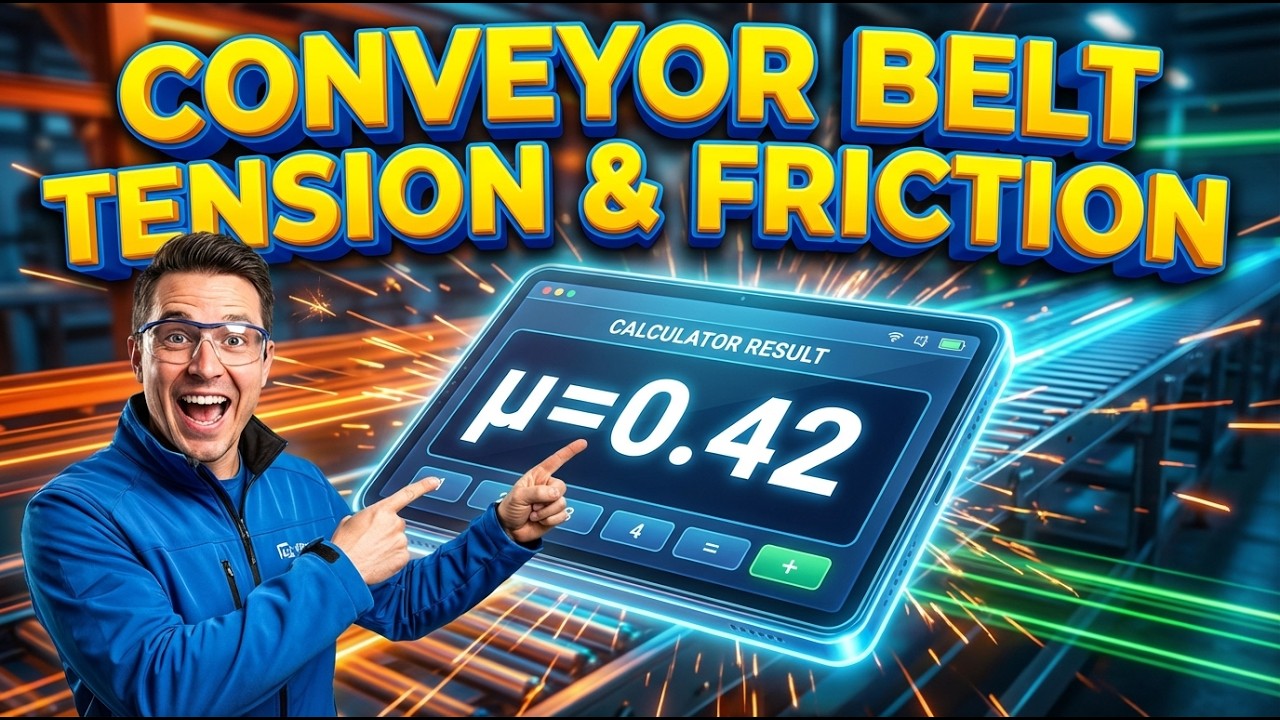
Conveyor Belt Tension & Friction Interactive Visualizer
Adjust load mass, incline, friction coefficient, and belt speed to see in real time how T₁, T₂, and motor power change. This helps you visualize how different setups affect what the system is really doing.
TIGHT TENSION T₁
1,234 N
SLACK TENSION T₂
123 N
MOTOR POWER
1.85 kW
TOTAL TENSION
1,357 N
FIRGELLI Automations — Interactive Engineering Calculators
Mathematical Equations
Primary Equations for Conveyor Belt Tension
Use the formula below to calculate conveyor belt tension.
Effective Tension (Tight Side):
T₁ = W sin θ + μ W cos θ
Where: W = (mload + mbelt) × g
Slack Side Tension:
T₂ = T₁ / eμβ
For simplified calculations: T₂ ≥ 0.1 × mbelt × g
Required Motor Power:
P = T₁ × v
Belt Mass Calculation:
mbelt = ρbelt × Abelt × L
Simple Example
Belt length: 20 m | Load mass: 100 kg | Belt mass: 5 kg/m | Friction coefficient: 0.30 | Belt speed: 1.5 m/s | Incline: 10°
Total belt mass = 5 × 20 = 100 kg. Total system mass = 200 kg.
T₁ = (200 × 9.81 × sin 10°) + (0.30 × 200 × 9.81 × cos 10°) = 341 + 579 = 920 N
Required motor power = 920 × 1.5 = 1,380 W (1.38 kW)
Technical Analysis and Applications
If you want your conveyor to last and do its job, you need to know your belt tension. Proper tension gives reliable movement without slip, keeps wear reasonable, and helps ensure your throughput is what you expect.
Fundamental Principles of Belt Tension
Conveyor belts only work because of friction between the drive pulley and the belt. The difference between tight side (T₁) and slack side (T₂) makes movement possible. The Euler-Eytelwein equation ties those two together based on the angle the belt wraps the pulley and the friction at that interface.
The tension on the drive side has to cover a few basic forces:
- Gravity: Anything not perfectly horizontal, and you need to lift part of the load and belt weight.
- Friction: Idler rolls, material resistance, and basic rolling drag always take some force.
- Acceleration: Starting up and speeding up require extra force for a brief moment.
- Secondary losses: Things like belt flex, windage, and bearing drag add up, even if they’re small compared to the first two items.
Design Considerations for Industrial Applications
Belt tension isn’t the only thing that matters. Belt type, material choice, load, and environment are factors — think about temperature, chemical exposure, and especially the load you plan to run, not just the belt breaking strength. Your choice of drive system changes how you tackle tension and efficiency.
For safety, engineers often use a margin — usually 6:1 up to 10:1, depending on how serious a failure would be. For mine hoists and similar, go higher. For light-duty processes with little risk, lower factors may be justified, but it depends.
Integration with Linear Actuators
Some conveyors now add linear actuators for automatic tensioning or for loading/unloading devices. With an actuator, it’s possible to keep the belt tension tuned as conditions change — temperature, stretch, or when the belt beds-in over its life.
Worked Example: Mining Conveyor System
Breakdown for a mining system with these specs:
- Belt length: 500 meters
- Load mass: 2000 kg (distributed)
- Belt mass: 15 kg/m
- Friction coefficient: 0.35
- Belt speed: 2.5 m/s
- Incline angle: 12 degrees
Step 1: Calculate total mass
Total belt mass = 15 kg/m × 500 m = 7,500 kg
Total system mass = 2,000 + 7,500 = 9,500 kg
Step 2: Calculate force components
Weight parallel to incline = 9,500 × 9.81 × sin(12°) = 19,436 N
Normal force = 9,500 × 9.81 × cos(12°) = 91,280 N
Friction = 0.35 × 91,280 = 31,948 N
Step 3: Calculate effective tension
T₁ = 19,436 + 31,948 = 51,384 N
Step 4: Calculate motor power
Power = 51,384 × 2.5 = 128,460 W = 128.5 kW
This example shows just how much power even a “normal” mining conveyor requires. Getting tension wrong can lead to oversized motors, energy waste, or worse — a conveyor that burns belts or can’t even move its load.
Advanced Considerations
In real setups, things often get more complex. Loads change, environmental factors come into play, and no calculation accounts for every misalignment or buildup of dust. For critical or high-capacity systems, finite element models or thorough simulation are often used to see how tension really distributes along the belt or when loading is uneven.
Belt tracking and geometry matter, too. If the pulleys aren’t crowned or idlers are misaligned, tension can shift toward one edge, which leads to early failure. Proper setup of the take-up and idlers is essential to maintaining even tension and good tracking over time.
Balancing tension and energy use is key. More tension can cut slip and keep tracking good, but every bit more means higher forces at the bearings and more motor power drawn. Variable speed drives can help you tune for lighter or heavier loads — not just one-size-fits-all settings.
Maintenance and Monitoring
Keeping an eye on belt tension saves money by catching problems early. Load cells, strain gauges, or simple displacement sensors can show when something drifts away from spec. Automatic tensioner actuators can keep the system close to ideal, even as belts stretch or conditions change.
Reviewing tension data over time can highlight small drift: maybe a pulley bearings is going, or a scrap of belt is getting weaker. If tension trends up or down unexpectedly, it’s usually a sign to stop and check before real trouble starts.
Frequently Asked Questions
What is the difference between effective tension and slack side tension?
How do I determine the friction coefficient for my conveyor belt?
Why is my calculated motor power higher than expected?
How does incline angle affect belt tension requirements?
What safety factors should I apply to conveyor belt tension calculations?
How can linear actuators improve conveyor belt tension control?
📐 Explore our full library of 384 free engineering calculators →
About the Author
Robbie Dickson
Chief Engineer & Founder, FIRGELLI Automations
Robbie Dickson brings over two decades of engineering expertise to FIRGELLI Automations. With a distinguished career at Rolls-Royce, BMW, and Ford, he has deep expertise in mechanical systems, actuator technology, and precision engineering.
🔗 Explore More Free Engineering Calculators
Need to implement these calculations?
Explore the precision-engineered motion control solutions used by top engineers.


