If you’re working with radioactive isotopes, it’s common to run into chain decays—one isotope (the parent) decays into another isotope (the daughter), which may still be radioactive. The activity of the daughter isn’t just a simple function of start and end points; it depends on both half-lives, how much parent you started with, and how much time has passed. If you want to know real-world values—like how much technetium you’ll get from a molybdenum generator, or what dose rates to expect after shutting down a reactor—you need to run the math, not guess. This Decay Chain Calculator lets you plug in half-lives, starting activities, and elapsed time to get daughter activity, equilibrium timing, and activity ratios. It works for typical nuclear medicine workflows (like generator scheduling), reactor shutdown scenarios, and monitoring decay products in environmental samples. You'll find practical examples using the Bateman equation, a Mo-99/Tc-99m decay, background on equilibrium, and detailed FAQ below.
What is a radioactive decay chain?
A radioactive decay chain is when one unstable atom (the parent) decays and produces another unstable atom (the daughter), which then decays on its own schedule. The daughter's activity builds up over time and eventually reaches a stable balance — called equilibrium — with the parent.
Simple Explanation
Think of it like a dripping tap filling a leaky bucket. The tap (parent) drips water in at a steady rate, and the bucket (daughter) leaks out at its own rate. At first the bucket fills up, then it stabilizes when water drips in as fast as it leaks out — that's equilibrium. The only difference in nuclear physics is that the tap itself slows down over time as the parent isotope decays away.
📐 Browse all 1000+ Interactive Calculators
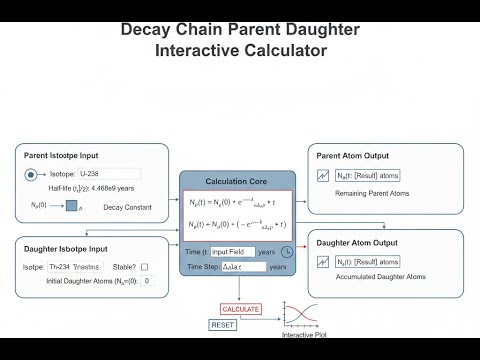
System Diagram

Decay Chain Parent-Daughter Calculator
This calculator is intended for education, concept evaluation, and preliminary design. Results are based on the equations and assumptions described on this page, but cannot account for every real-world load case, tolerance, material property, environmental condition, installation detail, safety factor, code, or regulatory requirement. Verify all inputs, assumptions, units, and results independently before selecting components or using the result in a real application. Safety-critical, structural, medical, lifting, transportation, or regulated applications must be reviewed by a qualified engineer.
Decay Chain Parent Daughter Interactive Calculator
Visualize how radioactive parent isotopes decay into daughter products, showing activity buildup, equilibrium formation, and the complex interplay between competing decay rates. Watch daughter activity rise and fall while parent activity decreases exponentially.
DAUGHTER ACTIVITY
862 MBq
ACTIVITY RATIO
1.11
EQUILIBRIUM TYPE
Transient
PEAK TIME
18.2 hrs
FIRGELLI Automations — Interactive Engineering Calculators
Decay Chain Equations
Use the formula below to calculate parent activity at any point in time.
Parent Decay
AP(t) = AP,0 e-λPt
Use the formula below to calculate daughter activity over time using the Bateman equation.
Daughter Activity (Bateman Equation)
AD(t) = AD,0 e-λDt + (λD/(λD - λP)) AP,0 (e-λPt - e-λDt)
Use the formula below to calculate the activity ratio at equilibrium.
Activity Ratio at Equilibrium
AD/AP = λD/(λD - λP)
(Valid for transient and secular equilibrium)
Use the formula below to calculate decay constants from half-life values.
Decay Constants
λ = ln(2)/t1/2 = 0.693147/t1/2
Use the formula below to calculate the rate-sum half-life of the combined parent-daughter system.
Effective Half-Life
t1/2,eff = ln(2)/(λP + λD)
(For combined parent-daughter decay)
Variable Definitions:
- AP,0 — Initial parent activity at time t = 0 (Bq, Ci, or submultiples)
- AD,0 — Initial daughter activity at time t = 0 (Bq, Ci, or submultiples)
- AP(t) — Parent activity at time t (Bq, Ci)
- AD(t) — Daughter activity at time t (Bq, Ci)
- λP — Parent decay constant (s-1)
- λD — Daughter decay constant (s-1)
- t1/2,P — Parent half-life (time units)
- t1/2,D — Daughter half-life (time units)
- t — Elapsed time (seconds, minutes, hours, days, years)
How to Use This Calculator
- Select a calculation mode from the dropdown — choose from daughter activity, equilibrium time, activity ratio, rate-sum half-life, parent activity, or equilibrium type.
- Enter the parent half-life and daughter half-life values, selecting the correct time units for each.
- Fill in any additional inputs shown for your selected mode — initial parent activity, elapsed time, equilibrium fraction, or initial daughter activity as required.
- Click Calculate to see your result.
Simple Example
Parent half-life: 66 hours (Mo-99). Daughter half-life: 6 hours (Tc-99m). Initial parent activity: 1000 MBq. Initial daughter activity: 0 MBq. Elapsed time: 24 hours.
Result: Daughter activity ≈ 862 MBq. Parent activity ≈ 776 MBq. Activity ratio (daughter/parent) ≈ 1.11 — confirming transient equilibrium where daughter activity briefly exceeds parent activity.
Theory & Engineering Applications
Decay chain calculations form the theoretical foundation for understanding sequential radioactive transformations where one unstable nucleus decays into another unstable nucleus, creating a parent-daughter relationship. The Bateman equation, first derived by Ernest Rutherford's colleague Harry Bateman in 1910, provides the analytical solution for radioactive decay chains and remains the standard method for calculating daughter product activities in nuclear engineering, medical physics, and environmental science applications.
Fundamental Decay Chain Physics
When a radioactive parent isotope decays, it may produce a radioactive daughter isotope rather than a stable product. The daughter's activity depends on three competing processes: production from parent decay (source term proportional to parent activity), removal by daughter decay (sink term proportional to daughter activity), and any initial daughter activity present at t = 0. The differential equation governing this system is dND/dt = λPNP - λDND, where N represents the number of atoms. Converting to activities (A = λN) yields the Bateman equation solution.
The critical insight often overlooked in textbook treatments is that the Bateman equation contains a singularity when λP = λD. In this special case (parent and daughter have identical half-lives), the solution reduces to AD(t) = AD,0 e-λt + AP,0 λt e-λt, containing a term linear in time. This situation occurs with certain isomeric transitions and requires distinct computational handling to avoid numerical instabilities in software implementations.
Equilibrium Classification and Criteria
Secular Equilibrium develops when the parent half-life exceeds the daughter half-life by at least an order of magnitude (t1/2,P >> t1/2,D). In this regime, λD >> λP, and the exponential term e-λDt decays much faster than e-λPt. After approximately 7 daughter half-lives, the daughter activity reaches equilibrium where AD ≈ AP (activities become equal). The daughter activity then decreases at the same rate as the parent. Classic examples include 226Ra/222Rn (radium-radon, used in early radiation therapy), 238U/234Th (uranium series), and 99Mo/99mTc (molybdenum-technetium generator systems for nuclear medicine).
Transient Equilibrium occurs when the parent half-life is longer than the daughter half-life but by less than a factor of ten (t1/2,P > t1/2,D). Here, daughter activity builds up until reaching a maximum, then decreases at a rate determined by the parent decay. At equilibrium, the activity ratio AD/AP = λD/(λD - λP) exceeds unity, meaning daughter activity surpasses parent activity. This ratio approaches 1 as the half-life difference increases. The 132Te/132I system (tellurium-iodine, t1/2 of 3.2 days and 2.3 hours respectively) demonstrates transient equilibrium, as does 90Sr/90Y (strontium-yttrium, a major fission product with 28.8 year and 64.1 hour half-lives).
No Equilibrium exists when the daughter half-life equals or exceeds the parent half-life. In this case, parent activity decreases faster than daughter activity can decay, preventing equilibrium establishment. The daughter activity continuously increases if starting from zero initial activity. This situation requires careful tracking in reactor operations where short-lived fission products decay into longer-lived daughters, creating increasing radiation fields over time despite reactor shutdown.
Time to Equilibrium Calculations
The time required to reach equilibrium (typically defined as 99% or 99.9% of maximum activity ratio) depends solely on the daughter decay constant. For transient or secular equilibrium to reach 99% completion requires teq ≈ 6.64/λD (approximately 6.64 daughter half-lives). Nuclear medicine generator systems exploit this relationship: 99Mo/99mTc generators (where 99Mo has t1/2 = 66 hours and 99mTc has t1/2 = 6.01 hours) reach equilibrium in about 24 hours, allowing daily "milking" of technetium-99m for medical imaging procedures. The equilibrium rebuilds overnight, providing fresh 99mTc each morning for hospital nuclear medicine departments.
Nuclear Medicine Applications and Generator Systems
Radioisotope generator systems represent the most important practical application of decay chain calculations. These systems use a long-lived parent to continuously produce a short-lived daughter suitable for diagnostic or therapeutic applications. The 99Mo/99mTc generator supplies over 80% of nuclear medicine procedures worldwide, with technetium-99m being ideal for gamma imaging due to its 140 keV photon energy, lack of beta emission, and 6-hour half-life allowing same-day procedures with minimal patient dose.
Generator elution must be timed precisely based on decay chain calculations. Immediately after elution, daughter activity is near zero. Activity rebuilds according to AD(t) = AP(λD/(λD - λP))(1 - e-(λD-λP)t), reaching maximum at tmax = ln(λD/λP)/(λD - λP). For 99Mo/99mTc, maximum 99mTc activity occurs at approximately 23 hours post-elution, yielding 87% of the theoretical equilibrium value. Waiting longer provides minimal additional activity while reducing the parent activity available for subsequent elutions.
Environmental Monitoring and Uranium Series
Natural uranium decay chains present complex multi-generation decay sequences requiring iterative Bateman equation applications. The 238U series contains 14 radioactive isotopes before reaching stable 206Pb. Environmental scientists measuring radon-222 concentrations in buildings must account for its secular equilibrium with radium-226 in soil and building materials. The 1,600-year half-life of 226Ra ensures constant 222Rn production, while radon's 3.82-day half-life allows it to migrate into buildings before decaying. Radon progeny (218Po, 214Pb, 214Bi, 214Po) rapidly reach equilibrium with radon, creating the primary inhalation hazard in residential radon exposure.
Reactor Physics and Fission Product Buildup
Nuclear reactor operations involve hundreds of decay chains from fission products. Iodine-131 (t1/2 = 8.02 days) decays to xenon-131 (stable), but tellurium-131 (t1/2 = 25 minutes) also produces 131I, creating a short-lived parent producing a longer-lived daughter. Post-shutdown dose rates initially decrease rapidly as short-lived isotopes decay, but then decrease more slowly as secular equilibrium establishes between medium-lived parents and their daughters. The "7-10 rule" (dose rate decreases by factor of 10 for every 7-fold increase in time) approximates this complex multi-chain behavior but requires detailed Bateman calculations for accurate safety assessments.
Worked Example: Mo-99/Tc-99m Generator Elution Scheduling
A hospital nuclear medicine department receives a 99Mo/99mTc generator calibrated to 37 GBq (1 Ci) of 99Mo activity at 6:00 AM Monday. Determine: (a) the optimal elution time after the initial elution, (b) the maximum 99mTc activity obtainable, and (c) the activity ratio at equilibrium.
Given Data:
- Initial 99Mo activity: AP,0 = 37 GBq = 37,000 MBq
- 99Mo half-life: t1/2,P = 66.0 hours
- 99mTc half-life: t1/2,D = 6.01 hours
- Initial 99mTc activity: AD,0 = 0 (immediately after first elution)
- Time unit for calculation: hours
Solution Step 1: Calculate Decay Constants
λP = ln(2)/t1/2,P = 0.693147/66.0 = 0.010502 hr-1
λD = ln(2)/t1/2,D = 0.693147/6.01 = 0.115332 hr-1
Solution Step 2: Time to Maximum Daughter Activity
For a parent-daughter system with AD,0 = 0, maximum daughter activity occurs at:
tmax = ln(λD/λP)/(λD - λP)
tmax = ln(0.115332/0.010502)/(0.115332 - 0.010502)
tmax = ln(10.986)/(0.104830) = 2.3971/0.104830 = 22.87 hours
Solution Step 3: Parent Activity at tmax
AP(22.87 hr) = 37,000 × e-0.010502 × 22.87 = 37,000 × e-0.2402
AP(22.87 hr) = 37,000 × 0.7861 = 29,086 MBq
Solution Step 4: Maximum Daughter Activity
Using the Bateman equation with AD,0 = 0:
AD(t) = (λD/(λD - λP)) × AP,0 × (e-λPt - e-λDt)
AD(22.87) = (0.115332/(0.115332 - 0.010502)) × 37,000 × (e-0.010502 × 22.87 - e-0.115332 × 22.87)
AD(22.87) = 1.1005 × 37,000 × (0.7861 - 0.07152)
AD(22.87) = 40,719 × 0.7146 = 29,097 MBq
This represents 78.6% of the initial parent activity, delivering substantial 99mTc for clinical use.
Solution Step 5: Activity Ratio at Transient Equilibrium
After sufficient time (typically 4-5 daughter half-lives), the activity ratio stabilizes to:
AD/AP = λD/(λD - λP) = 0.115332/(0.115332 - 0.010502) = 0.115332/0.104830 = 1.1005
Practical Interpretation: The hospital should elute the generator approximately 23 hours after the previous elution (6:00 AM Tuesday following Monday's 6:00 AM calibration). This timing yields the maximum 99mTc activity of approximately 29 GBq, sufficient for multiple patient procedures. At equilibrium, the daughter activity exceeds parent activity by 10%, characteristic of transient equilibrium. The generator can be eluted daily for approximately one week (about three 99Mo half-lives) before parent decay reduces daughter yield below clinically useful levels, requiring generator replacement.
For more advanced nuclear engineering calculations, visit our complete calculator library.
Practical Applications
Scenario: Hospital Radiopharmacy Daily Operations
Elena, a nuclear medicine radiopharmacist at a 400-bed teaching hospital, manages daily 99Mo/99mTc generator elutions for cardiac stress tests, bone scans, and thyroid imaging procedures. Her generator was calibrated Monday morning at 6:00 AM with 50 GBq of 99Mo activity. To optimize patient scheduling and minimize radioactive waste, Elena must calculate the optimal elution time to maximize 99mTc yield. Using the decay chain calculator with t1/2,P = 66 hours and t1/2,D = 6.01 hours, she determines that maximum 99mTc activity (approximately 44 GBq) occurs at 22.9 hours post-elution, corresponding to 5:00 AM Tuesday morning. This timing allows her to prepare radiopharmaceuticals for the day's first procedures starting at 7:00 AM, with each dose calibrated for administration 2-3 hours later when patients arrive. The transient equilibrium activity ratio of 1.10 confirms that daughter activity will briefly exceed parent activity, validating her elution schedule. This precise timing optimization reduces wasted radioisotope by 15% compared to arbitrary 24-hour elution cycles, saving the hospital approximately $12,000 annually in generator costs while ensuring adequate activity for all scheduled procedures.
Scenario: Environmental Radon Assessment in Home Inspection
Marcus, a certified home inspector specializing in radon testing, conducts a 5-day alpha track detector measurement in a basement of a 1970s split-level home scheduled for sale. His detector measures 7.8 pCi/L (288 Bq/m³) of radon-222, exceeding the EPA action level of 4 pCi/L. To advise the homebuyer on mitigation costs and health risks, Marcus needs to calculate the equilibrium factor between radon gas and its short-lived progeny (218Po, 214Pb, 214Bi, 214Po), which deliver the actual lung dose. Using the decay chain calculator with 226Ra parent half-life (1,600 years) and 222Rn daughter half-life (3.82 days), he confirms secular equilibrium exists, meaning radon concentration remains essentially constant over the measurement period. For the progeny, he calculates time to 99% equilibrium using the shortest half-life (218Po at 3.1 minutes): teq = 6.64 × 3.1 min = 20.6 minutes. This confirms that radon progeny reach full equilibrium within 30 minutes of radon entry, validating the standard assumption that progeny contribute the full equilibrium dose. Marcus's report recommends a sub-slab depressurization system (estimated cost $1,200-1,800) and explains that without mitigation, the homeowner faces a lifetime lung cancer risk increase of approximately 2.7% based on EPA dose-response models, justifying the mitigation investment for the concerned buyers.
Scenario: Nuclear Reactor Post-Shutdown Dose Rate Prediction
Dr. Yuki Tanaka, a reactor physicist at a research reactor facility, prepares a detailed maintenance schedule requiring personnel entry into the reactor pool area 72 hours after shutdown from 4 MW steady-state operation. To ensure worker doses remain below 2 mSv per maintenance session, she must calculate the gamma dose rate from fission product decay chains, particularly 140Ba/140La (barium-lanthanum, with half-lives of 12.75 days and 1.678 days respectively). At shutdown, her ORIGEN-S burnup calculation predicts 3.2 × 10¹⁵ Bq of 140Ba activity. Using the decay chain calculator in transient equilibrium mode with initial daughter activity of zero, Dr. Tanaka calculates that 140La activity reaches 95% of its equilibrium value (activity ratio = 1.15 times parent activity) within 11.3 hours post-shutdown. At t = 72 hours, parent 140Ba activity has decayed to 2.48 × 10¹⁵ Bq, while daughter 140La has reached transient equilibrium at 2.85 × 10¹⁵ Bq. Combined with shielding calculations accounting for the 1.596 MeV gamma from 140La, she determines the dose rate at the planned work location will be 1.7 mSv/hr, requiring work restrictions to 70-minute maximum shifts to remain within dose limits. This calculation leads her to recommend delaying maintenance until 120 hours post-shutdown, when dose rates drop to 0.85 mSv/hr, allowing standard 2-hour work periods and completing the maintenance campaign more efficiently with lower worker doses.
Frequently Asked Questions
What is the difference between secular and transient equilibrium in decay chains? +
How do I handle decay chains where the parent and daughter have very similar half-lives? +
Why does my Mo-99/Tc-99m generator produce less activity after several elutions? +
How long must I wait for radon progeny to reach equilibrium when measuring indoor radon? +
Can I use decay chain calculations for three-generation decay series? +
What units should I use for half-lives when parent and daughter have vastly different timescales? +
Free Engineering Calculators
Explore our complete library of free engineering and physics calculators.
Browse All Calculators →🔗 Explore More Free Engineering Calculators
About the Author
Robbie Dickson — Chief Engineer & Founder, FIRGELLI Automations
Robbie Dickson brings over two decades of engineering expertise to FIRGELLI Automations. With a distinguished career at Rolls-Royce, BMW, and Ford, he has deep expertise in mechanical systems, actuator technology, and precision engineering.
Video Walkthrough - How to Use This Calculator
Need to implement these calculations?
Explore the precision-engineered motion control solutions used by top engineers.


